



Most reliability strategies die the same way. Someone builds a beautiful 40-slide deck, presents it to leadership, gets nods around the table, and then nothing moves. Six months later the same equipment is failing, the backlog is worse, and the strategy lives in a shared drive nobody opens.
The problem isn't the strategy itself. It's that strategy and funding operate on completely different timelines and speak completely different languages. Reliability people talk in failure modes and MTBF. Finance talks in payback periods and CAPEX cycles. Nobody builds the bridge between "we should do condition monitoring on the critical pumps" and "here is a funded initiative with a gate we can defend at the next budget review."
A three‑horizon asset reliability roadmap is that bridge. It sequences work into near-term, mid-term, and long-term horizons, attaches money to each phase, and installs governance gates so nothing scales until it's proven. It's less about picking the perfect technology and more about building a funding rhythm that survives leadership turnover and budget cuts.
Why reliability roadmaps stall — the coordination gap nobody owns
The failure is rarely technical. It's structural. Reliability improvements touch four different groups who almost never sit in the same room at the same time:
-
Maintenance owns the failure data and knows what's actually breaking
-
Operations owns the uptime targets and hates anything that risks production
-
Finance owns the CAPEX gate and wants a clean business case
-
IT/data owns the systems where any of this gets tracked and measured
When a reliability initiative moves forward, it needs all four to agree at roughly the same moment. In practice, one of them is always out of phase. Maintenance is ready to pilot vibration monitoring, but Finance already locked the annual budget. Or Finance approves the money, but operations won't give you a maintenance window to install sensors. Or everything's approved and nobody defined how success gets measured, so the pilot "works" but can't be defended for scale-up.
Across a wide range of asset-heavy operations, roadmaps stall not from lack of ideas but from a missing coordination layer. There's no shared artifact that says: this is horizon one, it costs this much, it proves this specific thing by this date, and if it hits these numbers we release the next tranche. Without that, every good idea competes in an unstructured fight for the same budget line every single year.
The three-horizon model fixes the timing problem by pre-committing the sequence. You're not asking for everything at once. You're asking for a small, gated first step with a clear line of sight to bigger investment — but only if the first step earns it.
The three horizons, and what actually belongs in each
The horizons aren't just "soon, later, much later." Each one has a distinct purpose, risk profile, and funding character. Mixing them up is the most common planning mistake.
Stop losing track of critical assets.
Ownitly helps you monitor, maintain, and manage every asset efficiently and reliably.
- Centralized asset tracking
- Automated maintenance alerts
- Compliance monitoring & reporting
No credit card required
| Horizon | Timeframe | Purpose | Funding character | Typical scope |
|---|---|---|---|---|
| Horizon 1 | 0–6 months | Prove value fast, fix obvious bleeding | Operating budget / small pilot funds | Data cleanup, quick-win PM changes, 1–2 pilots on critical assets |
| Horizon 2 | 6–18 months | Scale what worked, build the foundation | Blended OPEX + first CAPEX tranche | Condition monitoring rollout, EAM workflow rebuild, spares strategy |
| Horizon 3 | 18–36 months | Systemic reliability, predictive at scale | Multi-year CAPEX program | Enterprise predictive program, reliability-centered maintenance across fleet |
The mistake people make is trying to fund Horizon 3 outcomes with Horizon 1 evidence. You can't walk into a budget meeting asking for a $1.5M predictive program when you've never run a single successful pilot. The whole point of the sequence is that Horizon 1 generates the proof that makes Horizon 2 fundable, and Horizon 2 generates the track record that makes Horizon 3 defensible.
The opposite mistake is spending 18 months in Horizon 1 "getting the data clean" and never actually piloting anything. Data cleanup is necessary but it's not a horizon — it's a task inside Horizon 1. If you're still in cleanup at month nine with nothing in production, the roadmap has quietly turned into a data project and reliability outcomes have disappeared.
Horizon 1: earn the right to continue
Horizon 1 exists to produce credibility, not transformation. You pick one or two assets where failures are visibly hurting the business, run a tightly scoped pilot, and measure the daylights out of it. The output isn't just "fewer failures" — it's a defensible number Finance will accept.
-
One condition-monitoring pilot on a genuinely critical asset (not the easy one — the one people already worry about)
-
A focused PM optimization on a family of assets where you're clearly over- or under-maintaining
-
Enough data cleanup to make the pilot measurable, and no more
The discipline here is resisting scope creep. Everyone will want to add "just one more asset" to the pilot. Don't. A tight pilot that finishes in four months beats a sprawling one still limping along at month ten.
Horizon 2: turn one win into a repeatable pattern
Horizon 2 is where most roadmaps generate their actual ROI — and also where they most often break. You've proven the concept on two pumps; now you're rolling it out to forty. That's a completely different operational challenge. It's no longer about whether the approach works; it's about coordination, standardization, and not overwhelming the technicians who now have to respond to a flood of new alerts.
The sensor-specific thresholds that were hand-tuned during the pilot now need documented, repeatable rules so a rollout to forty assets doesn't drown the team in false positives. That work has to happen before you flip the switch, not after.
Horizon 3: systemic, and boring on purpose
By Horizon 3 the exciting part is over, which is exactly right. Horizon 3 is about embedding reliability into how the organization actually runs — RCM across the fleet, predictive as the default, and a continuous-improvement cadence that keeps the gains from decaying. If Horizon 3 feels dramatic, something went wrong earlier. It should feel like the natural continuation of two horizons of proof.
Governance gates: the part that makes funding survive
Gates are what separate a roadmap from a wish list. A gate is a pre-agreed decision point where the initiative either releases its next tranche of funding or gets paused, adjusted, or killed. The power of gates is that they're agreed before anyone is emotionally invested in the outcome.
A practical gate structure that holds up in real budget cycles:
-
Charter gate — Before any spend. Defines the asset scope, the specific metric that constitutes success, the baseline, and who owns the decision at the next gate. If you can't state the success metric here, you're not ready to fund it.
-
Pilot-complete gate — At the end of Horizon 1. Did the pilot hit its pre-defined criteria? This is a yes/no against numbers set at the charter gate, not a subjective "it felt good."
-
Scale gate — Before releasing the Horizon 2 CAPEX tranche. Is the operational capacity there to handle the rollout? Are the workflows standardized? Can the team actually respond to the new signals?
-
Sustain gate — Entering Horizon 3. Are the Horizon 2 gains holding six months after rollout, or did they decay once the project team moved on?
The gate that matters most is the scale gate, not the pilot gate. Plenty of pilots succeed. Far fewer scale cleanly, because scaling exposes coordination weaknesses the pilot never stressed. A pilot on two assets can be babysat by one engineer. Forty assets cannot. If your organization can't absorb the alert volume, the maintenance-planning load, and the parts demand at scale, the pilot's success is genuinely misleading.
This is also where data discipline pays off or bites you. Scaling on top of duplicate or inconsistent asset records means the rollout inherits every one of those errors — which is why solid EAM data governance has to be in place before, not during, the scale gate.
When a gate should stop the project
Gates only work if you're genuinely willing to fail one. A gate that never says no is theater. Real reasons to hold at a gate:
-
The pilot hit its metric but only because of unusual conditions that won't repeat
-
Success depended on heroics from one person, not a repeatable process
-
The rollout would require more skilled maintenance capacity than you can hire or train in time
-
The savings are real but smaller than the ongoing cost to sustain the system
Killing an initiative at a gate isn't failure. It's the roadmap working as designed — freeing budget for something with a better return.
Pilot success criteria that Finance will actually accept
The weakest link in most reliability roadmaps is the success criteria. Teams define success as "the sensor detected a fault" when they should define it as "we avoided an unplanned outage that would have cost roughly $X, at a monitoring cost of $Y, for a payback of Z months."
Good pilot criteria share a few traits. They're set before the pilot starts. They tie to a dollar figure, not just a technical event. And they include a baseline, because "we reduced failures" means nothing without knowing the previous rate.
-
Detection lead time — average warning before functional failure (target: enough time to plan a repair, not scramble)
-
Avoided downtime value — using a consistent per-asset downtime cost, not a made-up number
-
False positive rate — because a system that cries wolf will get ignored, killing the whole program
-
Response integration — did the alert actually convert into a planned work order, or did it die in someone's inbox
Pro-tip: Ground downtime figures in a reproducible costing method that Finance already signed off on.
That last one is quietly the most important. A pilot can detect faults perfectly and still fail if detection never turns into action. Grounding the downtime figure in a reproducible, pre-approved costing method is what makes the business case defensible — Finance can argue with your reliability opinions, but they can't easily argue with a costing method they already signed off on.
Example timeline and budget phasing
Here's how a mid-sized manufacturing operation with a mix of rotating and static assets might phase this out. Numbers are illustrative and depend heavily on asset criticality and current maturity, but the shape is what matters.
Months 0–6 (Horizon 1): Roughly $40k–$70k. Two condition-monitoring pilots on critical pumps and a compressor, plus focused PM optimization on a family of over-maintained assets. Most cost is sensors, a bit of integration work, and internal time. The charter gate happens at month zero; the pilot-complete gate at month five or six.
Months 6–18 (Horizon 2): A first CAPEX tranche in the low-to-mid six figures, released only at the scale gate. This funds rollout to the next 30–50 assets, EAM workflow rebuild so alerts convert to work orders automatically, and a spares strategy adjustment for newly monitored equipment. This is where annual savings start showing up on a real P&L — often enough to make Horizon 3 a much easier conversation.
Months 18–36 (Horizon 3): A multi-year program funded off demonstrated Horizon 2 returns. RCM across the broader fleet, predictive as default, embedded review cadence. Budget here is larger but far easier to defend, because you're funding an expansion of something already generating returns rather than a bet.
The phasing logic: front-load the learning, back-load the spending. Horizon 1 is cheap and fast on purpose. You're buying information, not equipment. The expensive commitments only happen after the information de-risks them.
A short real scenario
A regional food processing plant — around 200 production assets, chronic unplanned downtime on their refrigeration compressors — kept requesting a plant-wide predictive program and kept getting denied because Finance saw a big number with no proof behind it.
They restructured into a three-horizon roadmap. Horizon 1 was two compressors and one ammonia pump, about $50k, four months, with a single success metric: detect at least two developing faults with enough lead time to plan repairs during scheduled downtime instead of emergency stops.
The pilot caught three developing faults over those four months. Two of them would very likely have been unplanned outages — each roughly $18k–$25k in lost production plus emergency labor. At the pilot-complete gate the numbers were hard to argue with, and Finance released the Horizon 2 tranche without the usual fight.
The interesting part came at the scale gate a few months later. Rolling out to 30 more assets generated so many alerts that the maintenance planner couldn't keep up, and false positives started getting ignored. They held at the scale gate for six weeks, tuned thresholds, rebuilt the alert-to-work-order flow, then resumed. Without that gate, the whole program would have quietly collapsed under alert fatigue — a technically "successful" project that nobody actually trusted anymore.
When this roadmap approach makes sense — and when it doesn't
When it makes sense:
-
You have asset-heavy operations where downtime carries real cost
-
Reliability improvements keep getting denied for lack of proof
-
Leadership is willing to fund small, gated experiments
-
You have at least basic failure data to establish baselines
When it's a bad idea:
-
Your asset data is so broken that no baseline is trustworthy — fix the data foundation first, because gated funding built on garbage numbers just launders bad decisions
-
Leadership wants transformation now and won't tolerate a phased approach (rare, but it happens under regulatory pressure)
-
You lack the maintenance capacity to act on what monitoring finds — detecting faults you can't respond to just adds anxiety
Who should not do this: Very small operations with a handful of assets and simple failure patterns. The governance overhead of formal gates and horizons will cost more than it returns. A simpler prioritized fix list beats a full roadmap at that scale.
Where the systems have to connect
Three-horizon roadmaps succeed or fail based on whether the connected pieces actually talk to each other. A pilot detects a fault — that has to become a prioritized work order, which has to reflect in spares planning, which has to feed the cost data, which feeds the next gate decision. Break any link and the roadmap stalls even when every individual part works.
This is where operational software matters — not as a shiny predictive layer, but as the connective tissue. An AI-assisted EAM platform earns its place when it automatically converts a sensor anomaly into a triaged work order with the right priority, keeps asset records clean enough that scale-up doesn't inherit a mess, and pulls downtime and cost data together so each governance gate is decided on trustworthy numbers instead of arguments.
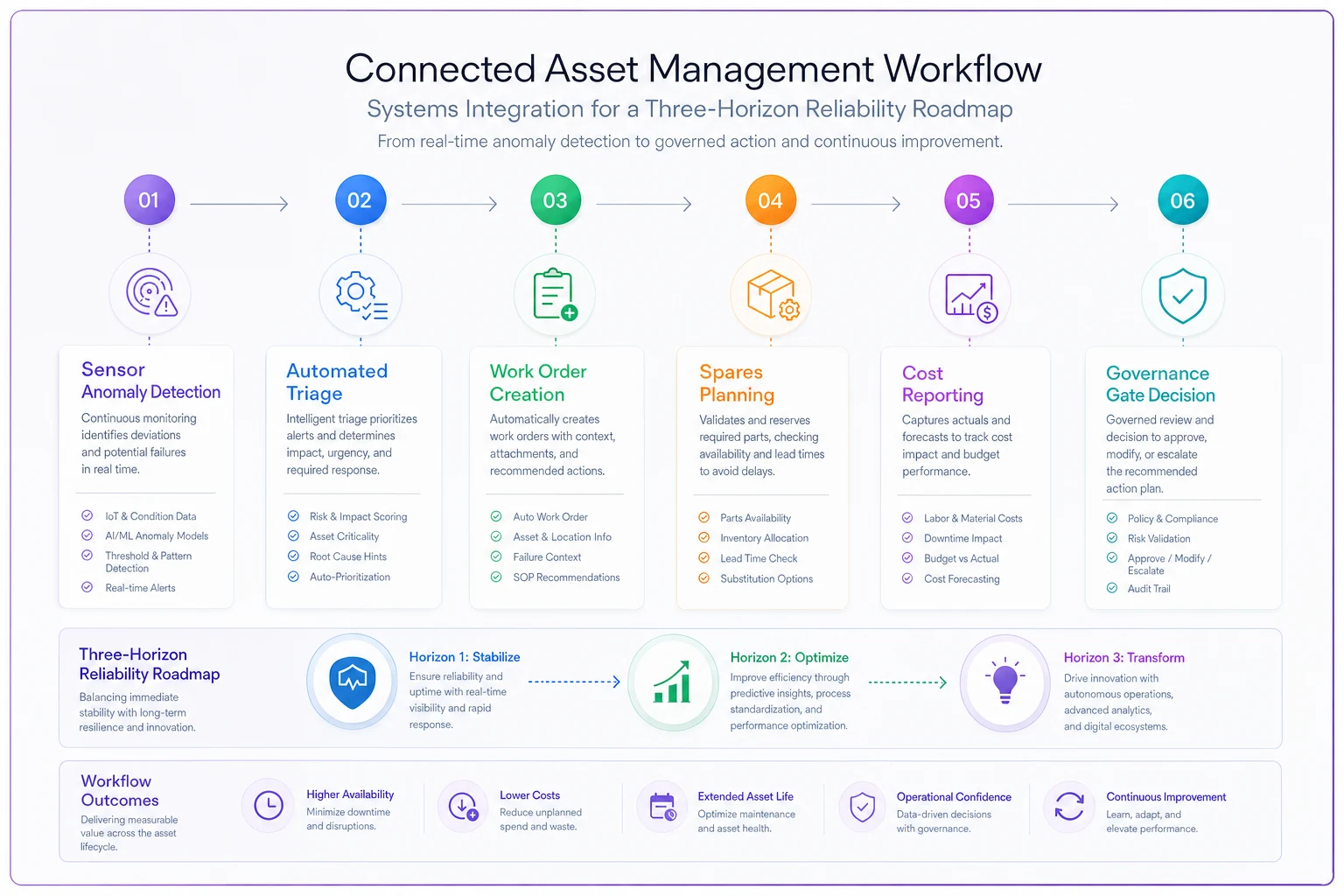
The automation reduces the manual coordination load — the exact thing that quietly kills most roadmaps between horizons — so the team spends time acting on reliability signals rather than shuffling data between disconnected systems.
The roadmap is the plan. The gates are the discipline. The connected system is what lets a two-pump pilot actually grow into a funded, fleet-wide reliability program without falling apart in the gaps between the groups who own each piece. Get the sequencing and the gates right, keep the underlying data honest, and reliability stops being a deck nobody opens and becomes a funded line of work the whole organization can defend.
Ready to elevate your asset operations?
Join 1,500+ businesses using Ownitly to optimize asset utilization, reduce downtime, and ensure compliance.