

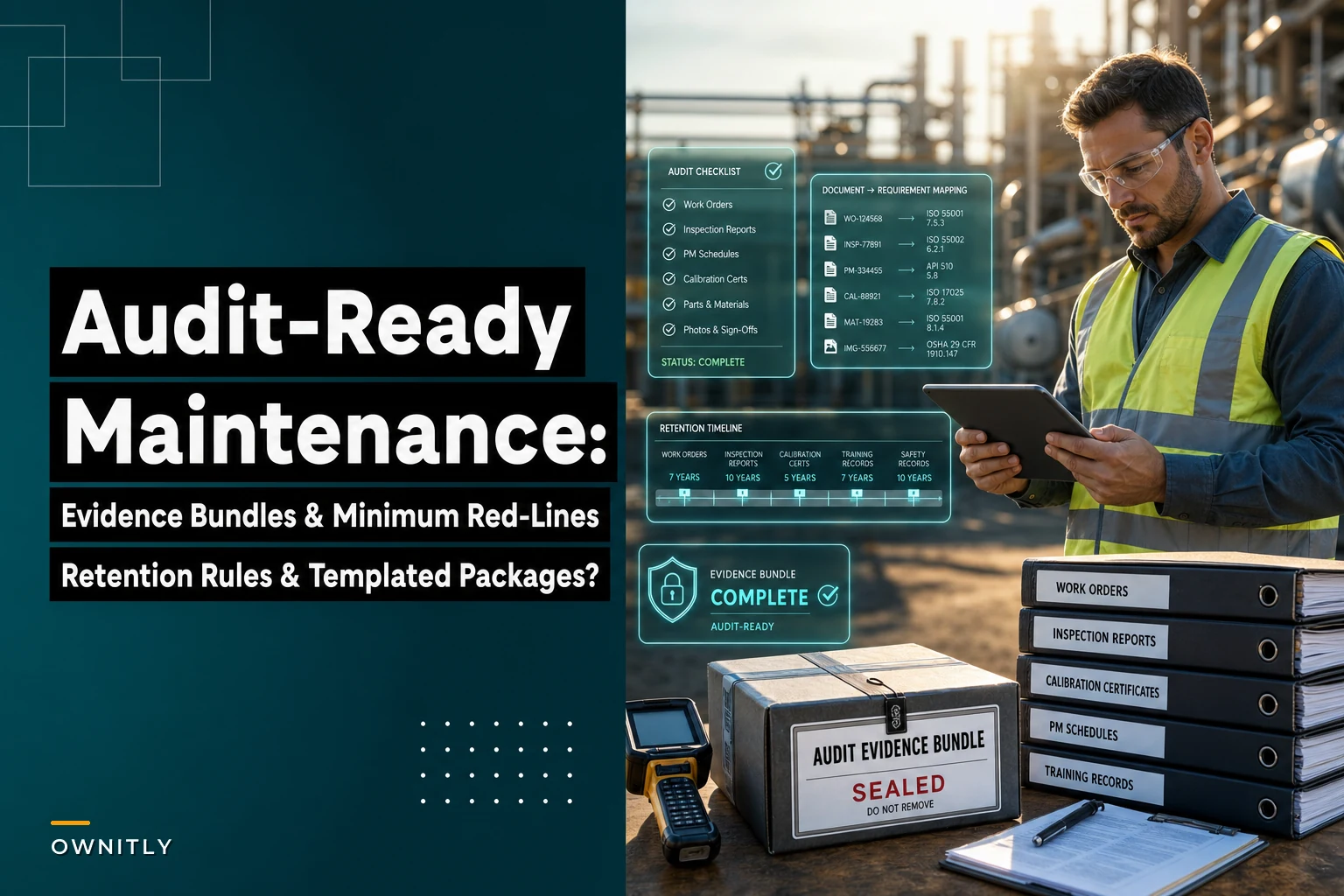

Three years of perfect maintenance execution means nothing if you can't prove it during an audit. Most asset managers discover this the hard way when an inspector rejects their carefully organized folders full of work orders, invoices, and inspection reports — not because the work wasn't done, but because the documentation doesn't tell the story auditors need to hear.
The gap between how maintenance teams organize records and how auditors evaluate evidence creates unnecessary risk for otherwise well-run operations. You complete every PM on schedule, track every failure, document every repair. Then audit day arrives and inspectors struggle to trace the compliance narrative through your system.
This disconnect happens because maintenance teams build filing systems while auditors need evidence packages. Your CMMS stores work orders by asset ID. Your document management system sorts by date. Your procurement records live in accounting. Meanwhile, the auditor needs to see how a specific regulatory requirement flows through your entire maintenance program — from planning through execution to continuous improvement.
The broken assumptions that create audit-vulnerable documentation
Most maintenance departments organize records based on operational logic that makes complete sense for daily work but creates audit nightmares. The technician needs to quickly find the last PM for a specific compressor. The planner needs to review failure history by equipment type. The procurement team needs to match invoices to work orders.
These operational needs drive documentation structures that scatter audit evidence across multiple systems, formats, and retention schedules. A single regulatory requirement might touch twelve different record types stored in five different systems with three different retention policies. No wonder auditors struggle to validate compliance even when the actual maintenance work exceeds requirements.
The traditional approach treats documentation as a byproduct of maintenance work rather than a deliberate compliance artifact. Work orders get filed because they exist, not because they serve specific evidentiary purposes. Inspection reports get stored individually rather than as part of compliance narratives. Training records sit in HR systems completely disconnected from the maintenance tasks they enable.
This scattered approach worked when audits happened once a year and focused on spot checks. Modern continuous compliance expectations and risk-based audit methodologies demand evidence packages that tell complete compliance stories. The auditor reviewing your pressure vessel maintenance program needs more than a stack of completed work orders — they need to see the entire lifecycle from risk assessment through inspection planning to failure analysis and program improvement.
Asset class dictates evidence architecture
Different asset types face fundamentally different regulatory frameworks, which means their evidence requirements diverge significantly. A rotating equipment maintenance program needs different documentation than a pressure system integrity program, even when both programs run from the same CMMS.
Stop losing track of critical assets.
Ownitly helps you monitor, maintain, and manage every asset efficiently and reliably.
- Centralized asset tracking
- Automated maintenance alerts
- Compliance monitoring & reporting
No credit card required
Critical rotating equipment requires evidence chains that connect vibration trends to maintenance decisions. Your evidence package needs to show:
-
Baseline vibration signatures from commissioning
-
Trend data showing degradation patterns
-
Maintenance interventions triggered by specific threshold breaches
-
Post-maintenance performance validation
-
Root cause documentation for any failures
Auditors examining rotating equipment programs specifically look for evidence that predictive maintenance actually drives maintenance decisions rather than just generating reports. They want to see clear connections between condition data and work execution.
Pressure vessels and piping demand completely different evidence structures focused on inspection intervals and thickness measurements. The evidence package must demonstrate:
-
Risk-based inspection calculations with all input parameters
-
Thickness measurement locations and trending
-
Corrosion rate calculations with methodology documentation
-
Inspection deferral justifications with engineering analysis
-
Repair documentation including material certifications
The regulatory framework around pressure equipment means auditors need to trace specific calculation methodologies through your entire inspection program. Missing one parameter in your RBI calculation can invalidate years of inspection deferrals.
Electrical distribution systems require evidence packages that prove both preventive maintenance completion and arc flash analysis currency. Your documentation needs:
-
Thermographic inspection images with temperature readings
-
Relay coordination study updates after system modifications
-
Arc flash label verification records
-
Breaker timing test results trending over time
-
Incident energy calculations with system modeling assumptions
Electrical system audits focus heavily on whether your documentation matches field conditions. Auditors will compare single-line diagrams against actual installations and verify that arc flash calculations reflect current system configurations.
The retention timeline trap that catches everyone
Every maintenance manager has some understanding that different records need different retention periods, but the actual requirements create complex matrices that most organizations oversimplify into dangerous practices.
Safety-critical asset records often require retention for the life of the equipment plus several years, which sounds straightforward until you realize "life of equipment" includes the entire time an asset remains on-site, even if decommissioned. That pump sitting idle in your boneyard still requires full record retention because it remains part of your facility's equipment population.
Environmental compliance records frequently demand five-year retention periods that restart with each violation or audit finding. A minor spill in year two of your retention period resets the entire clock, meaning records you thought could be disposed of must now be maintained for three additional years.
Financial audit requirements add another layer, often requiring seven-year retention for any record that touches capital maintenance or tax-relevant expenses. Your routine PM work order might seem like a simple operational record until it includes replacing a component that gets capitalized.
The real complexity emerges when single documents fall under multiple retention requirements. A pressure vessel inspection report might need:
-
Life of equipment retention for safety compliance
-
Seven years for insurance purposes
-
Five years for environmental permits if the vessel contains regulated substances
-
Ten years if it's part of a consent decree or legal proceeding
Most organizations default to keeping everything forever, which creates its own problems. Excessive record retention increases legal discovery risks, storage costs, and information management complexity. You need deliberate retention schedules that balance compliance requirements against practical limitations.
Building inspector-ready evidence bundles
Evidence bundles succeed when they tell complete compliance stories without requiring the auditor to hunt for supporting documentation. Each bundle should stand alone as proof that a specific regulatory requirement has been met.
Start with the regulation itself. If the requirement states "pressure vessels shall be inspected at intervals not exceeding five years or half the remaining life, whichever is less," your evidence bundle needs to prove both the inspection completion and the interval calculation.
The bundle for this requirement would include:
-
Current inspection report with all required elements
-
Previous inspection report showing interval compliance
-
Remaining life calculation with all inputs and assumptions
-
Risk assessment if intervals were modified
-
Inspector certifications showing qualification for the inspection type
-
Any repairs or modifications between inspections
-
Pressure test certificates if repairs affected pressure boundary
Here's a visual workflow for assembling an evidence bundle.
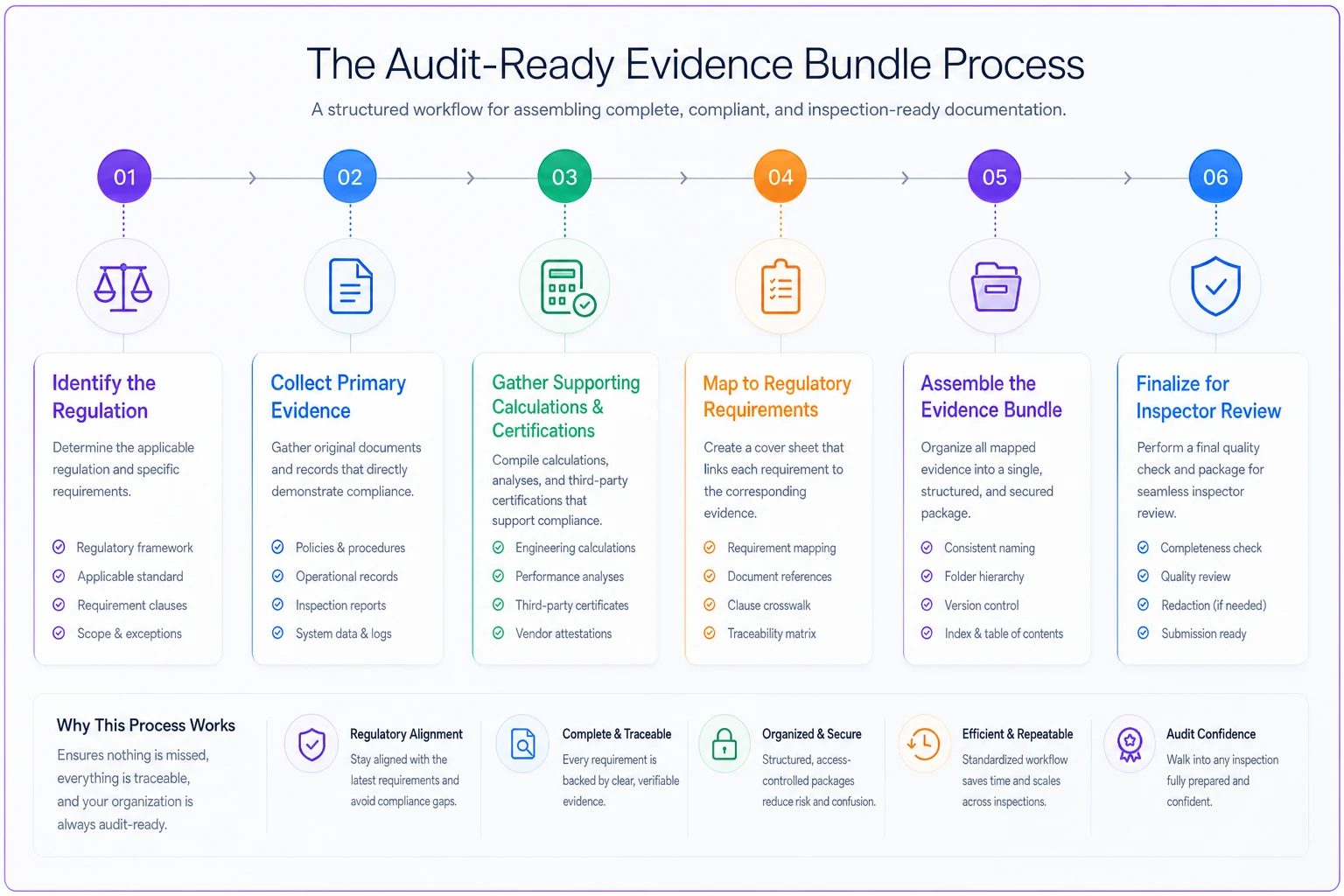
Notice how the bundle includes both primary evidence (inspection reports) and supporting documentation (calculations, certifications). Auditors need both to validate compliance. The primary evidence proves you did the work. The supporting documentation proves you did it correctly.
For predictive maintenance programs, bundles need to show the complete decision chain from data collection through action. A vibration-based maintenance bundle might contain:
-
Baseline vibration data from commissioning or last overhaul
-
Trend reports showing degradation
-
Alert notifications when thresholds were exceeded
-
Work orders generated from alerts
-
Post-maintenance vibration data confirming correction
-
Program effectiveness metrics showing prevented failures
Each bundle should include a cover sheet that maps specific regulatory requirements to the included documents. This roadmap helps auditors quickly locate the exact evidence they need without searching through hundreds of pages.
Red-line minimum requirements by asset class
Different asset classes have non-negotiable documentation minimums below which audit failure becomes likely. Understanding these red lines helps prioritize record-keeping efforts.
Boilers and pressure vessels absolutely require:
-
Thickness measurements at established monitoring locations
-
Calculations showing how inspection intervals were determined
-
Evidence that repairs followed code requirements including welder qualifications
-
Pressure test documentation after any pressure boundary repair
-
Management of change records for any modifications
Missing any of these elements typically results in immediate audit findings.
Rotating equipment cannot pass audit without:
-
Alignment reports for precision-aligned equipment
-
Balance reports for high-speed machinery
-
Lubrication analysis showing ISO cleanliness codes
-
Vibration trends demonstrating predictive maintenance effectiveness
-
Coupling integrity verification for critical equipment
Auditors particularly focus on whether predictive maintenance programs actually prevent failures versus just collecting data.
Electrical systems face audit failure without:
-
Arc flash calculations less than five years old
-
Thermographic inspection reports for critical distribution
-
Relay coordination studies after system changes
-
Ground resistance testing for sensitive equipment
-
Breaker maintenance showing timing and resistance tests
The five-year arc flash requirement catches many facilities that assume calculations remain valid indefinitely.
Control and safety systems require:
-
Proof testing documentation at required intervals
-
Bypass authorization and restoration records
-
Calibration certificates with as-found and as-left values
-
Logic solver diagnostic reports
-
Management of change for any program modifications
Safety system audits fail most often on incomplete proof testing documentation or unauthorized modifications.
Summary of red-line minimums by asset class:
| Asset Class | Key minimums |
|---|---|
| Boilers and pressure vessels | Thickness measurements at established monitoring locations; Calculations showing how inspection intervals were determined; Evidence that repairs followed code requirements including welder qualifications; Pressure test documentation after any pressure boundary repair; Management of change records for any modifications |
| Rotating equipment | Alignment reports for precision-aligned equipment; Balance reports for high-speed machinery; Lubrication analysis showing ISO cleanliness codes; Vibration trends demonstrating predictive maintenance effectiveness; Coupling integrity verification for critical equipment |
| Electrical systems | Arc flash calculations less than five years old; Thermographic inspection reports for critical distribution; Relay coordination studies after system changes; Ground resistance testing for sensitive equipment; Breaker maintenance showing timing and resistance tests |
| Control and safety systems | Proof testing documentation at required intervals; Bypass authorization and restoration records; Calibration certificates with as-found and as-left values; Logic solver diagnostic reports; Management of change for any program modifications |
Understanding these red lines helps focus auditing and record-keeping efforts where they matter most.
The hidden linkages that inspectors actually check
Experienced auditors don't just verify that required documents exist — they trace connections between different record types to validate that your maintenance program functions as designed.
They'll compare your PM schedule against actual completion records to verify compliance percentages match your reports. A 98% PM compliance claim falls apart when work orders show half were completed outside the required window.
Training records get cross-referenced against work order assignments. That technician performing boiler inspections better have current certification, and the certification better match the inspection types being performed.
Procurement records need to align with maintenance specifications. Using non-certified replacement parts on pressure equipment, even for non-pressure components, can trigger major findings if your procedures require certified materials.
Failure investigations must connect to program improvements. If three pumps failed from the same cause, auditors expect to see changes to your PM program or operating procedures. Repeat failures without corrective action suggest your maintenance management isn't closing the loop.
These linkage checks reveal whether documentation reflects real maintenance execution or just paperwork compliance. A well-structured evidence bundle makes these connections obvious, while scattered records force auditors to dig deeper and increase finding risk.
Where AI-powered systems prevent documentation disasters
Modern maintenance operations generate too much documentation for manual evidence management to stay practical. AI-powered operational platforms can automatically structure records into audit-ready packages while still maintaining the operational filing systems your teams need for daily work.
These platforms recognize which documents constitute evidence for specific requirements and automatically group them into compliance bundles. When an inspector asks for pressure vessel inspection records, the system produces complete evidence packages rather than just inspection reports.
Retention rules become system-managed rather than human-remembered. Each document gets tagged with all applicable retention requirements, and the longest requirement controls disposal timing. The system tracks when retention triggers reset and prevents premature disposal of critical records.
Tag each document with every applicable retention rule and let the longest retention period govern disposal to avoid accidental destruction of required records.
AI automation particularly helps with cross-reference validation — automatically verifying that technicians have current certifications for assigned work, that materials match specifications, and that inspection intervals comply with calculations. These checks happen continuously rather than just in the weeks before an audit.
For organizations managing hundreds of critical assets, automated evidence bundling transforms audit preparation from a months-long scramble into a routine report. The same records that support daily operations automatically organize into the evidence packages auditors need.
Making evidence packages operational tools, not audit artifacts
The most successful maintenance organizations treat evidence packages as operational tools that happen to support audits, not as audit-specific paperwork. When evidence bundles help technicians understand equipment history and help planners make better decisions, maintaining audit-ready documentation becomes automatic rather than extra work.
A well-structured pressure vessel evidence bundle helps engineers quickly understand current equipment condition, inspection history, and remaining life. The same organization that satisfies auditors also improves operational decision-making.
Predictive maintenance bundles that show complete degradation histories help technicians identify recurring problems and improve repair effectiveness. The evidence that proves program compliance also drives program improvement.
This operational focus transforms documentation from a compliance burden into a maintenance asset. Teams maintain better records because those records help them work more effectively, not just because audits require them.
Building audit-ready maintenance records requires thinking like an auditor while organizing like an operator. The evidence packages inspectors need tell complete compliance stories through linked documentation that proves not just task completion but program effectiveness.
Different asset classes demand different evidence architectures, retention schedules layer complex requirements onto every document, and inspectors increasingly verify connections between record types rather than just checking boxes. Manual approaches to evidence management don't scale with modern compliance requirements.
Success comes from structuring documentation as evidence packages from the start rather than scrambling to create them before audits. Whether through manual organization or AI-powered platforms, the key is maintaining clear connections between regulatory requirements and the records that prove compliance.
The maintenance departments that consistently pass audits aren't necessarily doing the best maintenance — they're the ones who can prove their maintenance effectiveness through well-structured evidence packages that tell clear compliance stories.
Ready to elevate your asset operations?
Join 1,500+ businesses using Ownitly to optimize asset utilization, reduce downtime, and ensure compliance.