

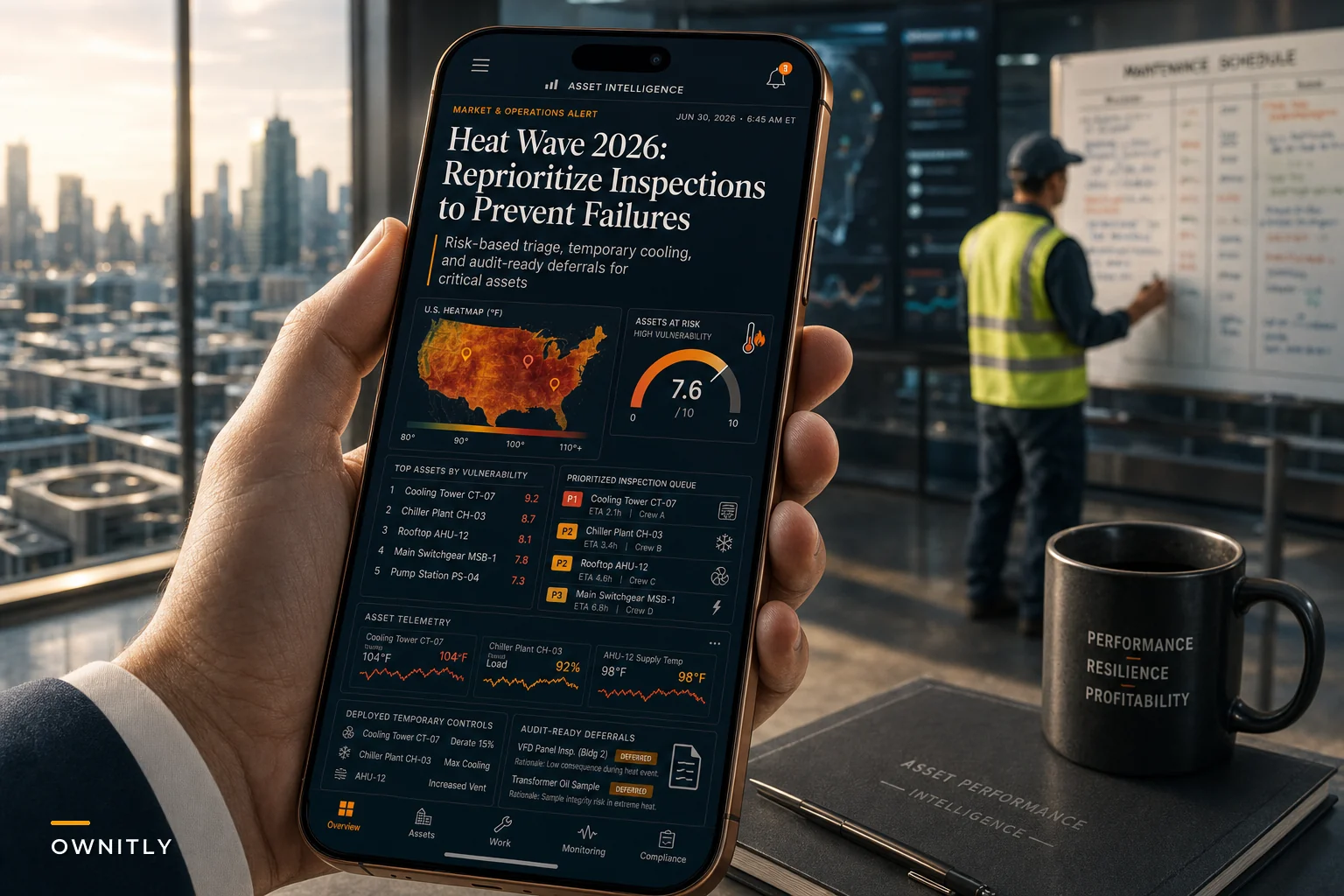

The heat dome settling over much of the U.S. right now is breaking temperature records from Ohio to North Carolina. NPR reported that dangerous heat indices could reach 115°F in some areas through the July 4th weekend, with overnight temperatures barely dropping below 80°F in major cities.
For asset managers running facilities across affected regions, this isn't just about cranking up the AC. It's forcing immediate decisions about which inspections to delay, which equipment needs closer attention, and how to keep operations running when both your assets and your maintenance teams are hitting thermal limits.
The real challenge isn't the heat itself—it's that most maintenance schedules weren't built for sustained extreme temperatures. Your quarterly transformer inspection scheduled for next week? That transformer is now running 20–30 degrees hotter than baseline. Your HVAC units that normally get serviced every 60 days? They're running continuously without their usual overnight recovery window.
The cascade effect during heat events
Most heat wave prioritization plans focus on the obvious stuff—cooling systems, electrical infrastructure, worker safety. The real operational chaos tends to come from secondary failures nobody planned for.
Take a manufacturing facility in Texas during the 2023 heat wave. Their maintenance team correctly prioritized the main production equipment cooling systems. What they missed was the compressed air system. The aftercoolers couldn't keep up with ambient temperatures hitting 105°F, moisture started condensing in the lines, and suddenly there was water in pneumatic controls across three production lines. Fourteen hours of downtime, roughly $280,000 in lost production.
The pattern repeats across industries. Data centers focus on server cooling and miss UPS battery rooms cooking. Food processing plants monitor refrigeration compressors and overlook conveyor motor ventilation. Chemical plants track reactor cooling while heat-stressed pump seals fail in secondary systems.
These aren't failures of planning—they're failures of triage methodology. When everything is running hot, you need more than a priority list. You need a scoring system that accounts for current operating temperature versus design limits, criticality to production continuity, redundancy availability, time to failure at current conditions, and inspection accessibility during extreme heat.
Building your heat event triage matrix
Here's a framework that actually holds up when temperatures spike:
Stop losing track of critical assets.
Ownitly helps you monitor, maintain, and manage every asset efficiently and reliably.
- Centralized asset tracking
- Automated maintenance alerts
- Compliance monitoring & reporting
No credit card required
Asset Heat Vulnerability Scoring
| Asset Category | Base Score | Heat Multiplier | Redundancy Factor | Final Priority |
|---|---|---|---|---|
| Transformers/Switchgear | 10 | 2.5x (oil-filled) / 1.5x (dry) | 0.5x if N+1 | 5–25 |
| HVAC/Cooling | 10 | 1.2x | 0.7x if backup exists | 7–12 |
| Motors (outdoor) | 8 | 2.0x | 0.8x if spares ready | 6.4–16 |
| Compressed Air | 6 | 1.8x | 0.5x if dual system | 3–10.8 |
| Control Systems | 7 | 1.5x | 0.3x if redundant | 2.1–10.5 |
| Pumps/Seals | 5 | 1.6x | 0.6x if parallel | 3–8 |
The math is straightforward, but the inputs require judgment. A transformer showing 165°F winding temperature when the design max is 180°F gets immediate attention. But if you have redundant units and can shift load, maybe the single-point-of-failure VFD panel creeping toward thermal shutdown takes priority instead.
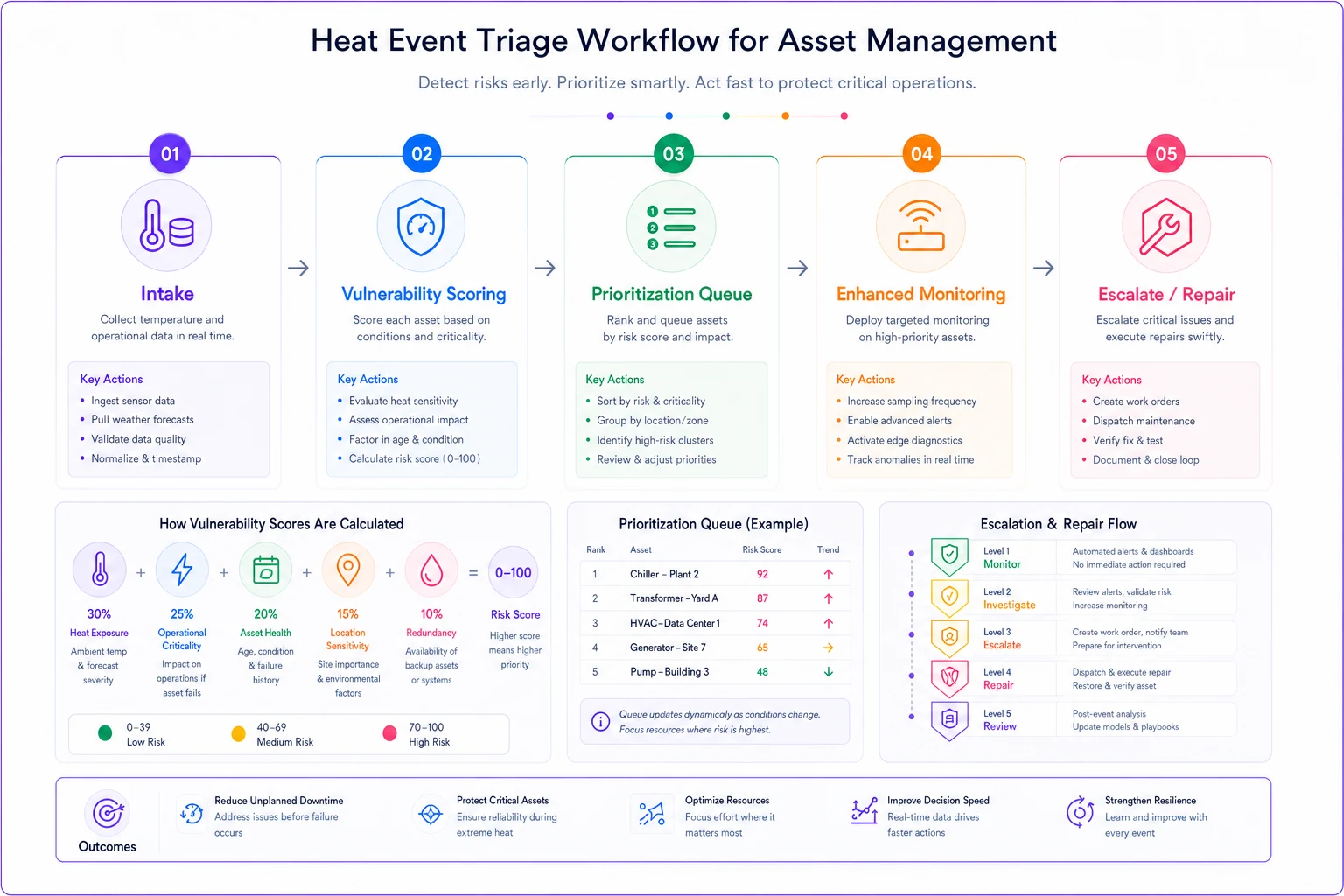
This illustrates the practical steps from data collection to prioritized actions during a heat event.
The 72-hour inspection pivot
First 24 hours: Pull thermal imaging on all critical electrical equipment. Not full inspections—just temperature checks. Document baseline readings for everything running above normal. Flag anything within 15% of design limits for enhanced monitoring.
24–48 hours: Shift inspection windows to early morning (4 AM–8 AM) where possible. Cancel non-critical PM tasks that require equipment shutdown—you need everything running for cooling and ventilation. Start logging runtime hours on equipment that normally cycles but is now running continuously.
48–72 hours: Deploy temporary monitoring where permanent sensors don't exist. Hourly rounds with infrared thermometers, temporary RTDs on critical motors, temperature strips on electrical panels. You're essentially building a real-time heat map of the facility.
A chemical plant in Louisiana ran this approach during their last heat event. They caught three motors trending toward failure, one transformer approaching critical temperature, and found two ventilation fixes that dropped equipment bay temps by 8–12°F. More importantly, they documented every decision—which mattered when their insurer questioned why certain scheduled inspections were delayed.
Equipment-specific red lines you can't ignore
Transformers: Oil temperature reaching 95°C or winding temperature within 10°C of nameplate rating. At this point you either shed load immediately or accept probable failure within hours.
VFDs and Control Panels: Internal temperature 5°C below shutdown threshold. Most units alarm at 40°C and shut down at 50°C, but heat damage accelerates sharply above 45°C.
Motors: Surface temperature exceeding 80°C for Class B insulation, 100°C for Class F. Once you cross these thresholds, insulation life drops by half for every 10°C increase.
Hydraulic Systems: Oil temperature above 140°F (60°C). Seal failure rates triple, and oil oxidation accelerates—leading to varnish formation that can take entire systems down weeks after the heat event ends.
Battery Rooms: Ambient temperature above 77°F (25°C) for VRLA batteries. Every 15°F above that baseline cuts battery life roughly in half and raises thermal runaway risk.
The enforcement challenge is getting operators to respect these limits when production pressure is high. One facility started posting real-time temperature displays next to equipment with automatic alarms at 80% of red line values. Hard to claim you didn't know how hot things were running when the number is right in front of you.
Documentation requirements that save you during audits
Heat events create a real compliance headache. You're deferring scheduled inspections, running equipment outside normal parameters, and making fast calls with incomplete information. Without solid documentation, you'll spend months explaining those decisions to auditors, insurers, and regulatory bodies.
Minimum Documentation for Heat Event Decisions
-
Deferral Authorization Record
-
Continuous Monitoring Logs
-
Post-Event Assessment
-
Deferral Authorization Record
Asset ID and normal inspection schedule
-
Deferral Authorization Record
Specific weather conditions driving deferral (temperature, duration)
-
Deferral Authorization Record
Risk assessment comparing inspection risk vs. operational risk
-
Deferral Authorization Record
Compensating measures implemented (enhanced monitoring, load reduction)
-
Deferral Authorization Record
Sign-off from operations and maintenance leadership
-
Continuous Monitoring Logs
Hourly temperature readings for critical assets
-
Continuous Monitoring Logs
Runtime hours for typically-cycling equipment
-
Continuous Monitoring Logs
Any parameter excursions beyond normal operating range
-
Continuous Monitoring Logs
Corrective actions taken with timestamps
-
Post-Event Assessment
List of all deferred inspections with new target dates
-
Post-Event Assessment
Equipment damage assessment (even minor issues)
-
Post-Event Assessment
Lessons learned and procedure updates
-
Post-Event Assessment
Cost impact summary (overtime, emergency repairs, production loss)
A paper manufacturer dealt with three consecutive heat waves last summer. They thought supervisor logbooks and verbal approvals were adequate documentation. When OSHA showed up following a transformer failure, those informal records didn't hold up. The facility paid around $45,000 in fines—not because they made wrong decisions, but because they couldn't demonstrate their decision-making process was sound. That's an expensive lesson for something a basic documentation template would have prevented.
The morning-after inspection surge
Once temperatures drop, you face a different problem: the backlog. Everything you deferred needs to get done, plus additional inspections for equipment that ran outside normal parameters. This surge typically lands when your maintenance team is already exhausted from working modified schedules during the event itself.
Week 1 post-event: Focus on equipment that exceeded 90% of design temperature limits. These assets likely sustained accelerated wear or minor damage. Infrared inspection for electrical systems, vibration analysis for rotating equipment, oil analysis for transformers and hydraulic systems.
Weeks 2–3: Work through deferred PM tasks, prioritized by how far past due the inspection is, whether the asset ran continuously during the heat event, any abnormal conditions noted during enhanced monitoring, and criticality scores from your standard assessment.
Week 4+: Extended inspection scope for hidden damage. Heat events cause problems that don't show up immediately—loosened electrical connections, degraded seals, contaminated lubricants. Budget for 20–30% additional inspection time compared to normal PM tasks.
The sequencing matters more than most teams realize. Skipping straight to deferred PMs while ignoring assets that actually ran hot is how you miss the failures that show up 3–4 weeks later.
Modern tools that actually help during heat events
The gap between what maintenance software promises and what actually helps during emergencies is wide. Most CMMS platforms can't handle the rapid re-prioritization and documentation demands that heat event response creates. Operational software with AI automation built in changes that considerably.
AI-powered platforms can continuously recalculate inspection priorities based on real-time temperature data, automatically generate deferral documentation with proper risk assessments, and flag assets approaching critical thresholds before manual rounds catch them.
One distribution center integrated their building management system with an AI-enhanced maintenance platform. During their last heat event, the system automatically identified inspection priority changes based on temperature trends, generated work orders for enhanced monitoring routes, compiled compliance documentation without manual data entry, and predicted which assets would exceed temperature limits based on incoming weather forecasts.
They ended up with significantly less scrambling during the event and complete audit-ready documentation afterward. More importantly, they caught two likely motor failures early by tracking temperature trends 8–10 hours before critical limits were reached.
These platforms also help with pattern recognition across multiple events. After pulling data from several heat waves, they surface which assets consistently struggle, which interventions actually work, and where it makes sense to invest in permanent monitoring or cooling upgrades.
Planning for next month's heat waves
Weather patterns suggest this won't be the last extreme heat event this summer. Based on how facilities that handle heat waves well actually operate, here's a practical 30-day preparation checklist.
Immediate actions (next 7 days):
-
Baseline temperature readings for all critical assets under normal conditions
-
Verify infrared thermometer and thermal camera calibration
-
Review and update temperature monitoring routes
-
Stock critical spare parts for heat-vulnerable equipment
-
Define clear red lines and response procedures
Short-term improvements (next 14 days):
-
Install temporary ventilation where needed
-
Clean air filters and cooling fins on all equipment
-
Verify control system temperature alarm setpoints
-
Train operators on heat event monitoring procedures
-
Create deferral documentation templates
Strategic preparation (next 30 days):
-
Analyze historical failure data during hot weather
-
Budget for permanent monitoring solutions
-
Develop a heat event inspection priority matrix
-
Negotiate expedited repair contracts for critical assets
-
Update compliance procedures for weather-driven deferrals
Most of these aren't complicated. The ones that don't get done are usually the ones that require coordination across departments—which is exactly why a heat event hits and nobody has a current spare parts list or an updated alarm setpoint.
When heat wave prioritization stops being emergency mode
Extreme heat events are becoming a regular part of operations for more facilities each year. The emergency procedures you're building out now may end up as your standard summer protocol within a few years.
That shift requires rethinking some basic assumptions. Inspection intervals designed for 85°F summer peaks don't hold up when you're regularly hitting 100°F. Equipment life projections based on 2,000 hours annual runtime fall apart when cooling systems log 3,500 hours. Those aren't edge cases anymore.
The facilities handling this well are treating heat vulnerability as a standard risk factor in maintenance planning, not a one-off emergency. They're investing in better cooling for critical assets, building redundancy where heat creates single points of failure, and accepting that some equipment will need replacement every 3–4 years instead of 7–10.
More than anything, they've converted heat event response from a scramble into a practiced process. The first extreme heat event is chaotic. By the third or fourth, if you've documented lessons learned and updated your procedures, it's methodical.
The current heat wave is an accelerated lesson in asset vulnerability. The facilities that document what they learn, update their procedures, and invest in appropriate monitoring will handle the next event with far less disruption. The ones that treat it purely as a crisis to survive won't be ready when it comes around again—and it will.
The current heat wave is an accelerated lesson in asset vulnerability. The facilities that document what they learn, update their procedures, and invest in appropriate monitoring will handle the next event with far less disruption. The ones that treat it purely as a crisis to survive won't be ready when it comes around again—and it will.
Ready to elevate your asset operations?
Join 1,500+ businesses using Ownitly to optimize asset utilization, reduce downtime, and ensure compliance.