

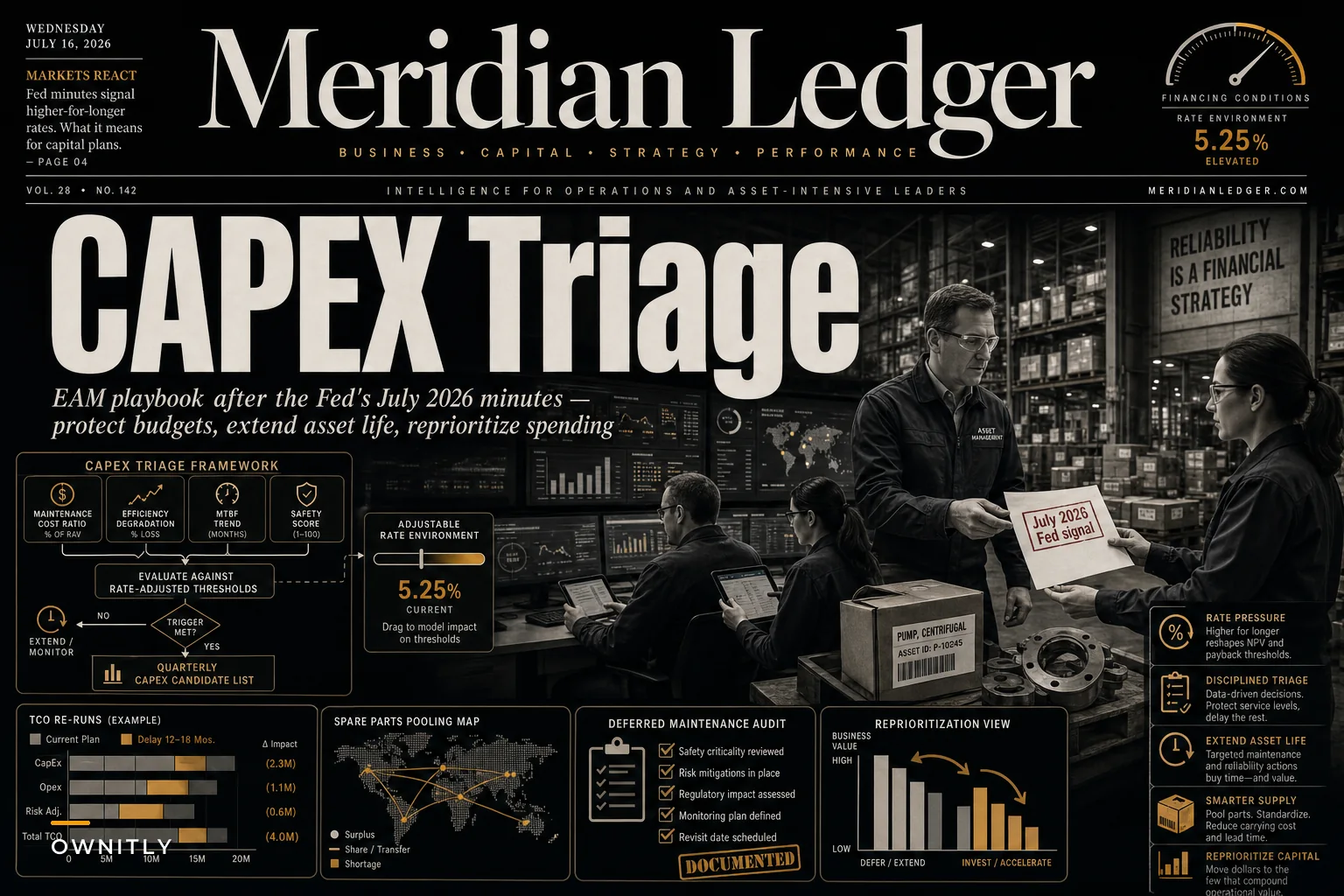

The Fed just threw asset managers another curveball.
Minutes from the June FOMC meeting show policymakers split on whether to resume rate hikes, with several officials worried that inflation could reaccelerate. Markets immediately priced in higher borrowing costs through at least mid-2027.
For anyone managing physical assets, this changes the math on CAPEX planning for the rest of 2026.
I watched this play out at three manufacturing clients last quarter when their credit lines repriced. One food processor saw their equipment financing rate jump from 7.2% to 9.4% basically overnight — suddenly their planned conveyor replacement made zero financial sense. They had to build a completely different approach just to keep those assets running another 18 months without a major failure.
Most organizations are sitting on CAPEX plans built when money was cheaper. Those plans are now fantasy. You've got roughly 90 days to restructure before Q4 budget locks hit.
Move 1: Emergency triage your CAPEX pipeline by payback period
Forget your original CAPEX prioritization. When financing costs jump 200+ basis points, projects that looked smart at 6% become money pits at 9%.
Pull every approved and pending CAPEX project. Recalculate payback periods using your new cost of capital — probably somewhere between 9% and 11% depending on your credit profile.
| Project Type | Old Payback (6% financing) | New Payback (9.5% financing) | Typical Decision |
|---|---|---|---|
| Regulatory/Safety | 8-10 years | 12-14 years | Must proceed anyway |
| Efficiency upgrades | 3-4 years | 4.5-6 years | Delay or phase |
| Capacity expansion | 5-6 years | 7-9 years | Cancel or redesign |
| Technology refresh | 2-3 years | 3-4 years | Selective proceed |
| Comfort/convenience | 4-5 years | 6-8 years | Cancel |
The shock usually comes from efficiency projects — the ones everyone assumed were no-brainers — suddenly showing 5+ year paybacks. A compressed air system upgrade saving $45k annually looked great at a $180k price tag and 6% financing. At 9.5%, the total cost climbs to around $217k and the payback stretches past what most CFOs will sign off on.
Create three buckets:
-
Proceed
Payback under 3 years OR regulatory requirement
-
Restructure
Payback 3-5 years, look for phasing options
-
Freeze
Everything else
Most organizations find that 40-60% of their CAPEX pipeline lands in the freeze bucket. That's just where things are right now.
Move 2: Convert major replacements into aggressive life extension programs
That chiller replacement scheduled for Q4 — the one already approved and budgeted — is worth reconsidering. Building an 18-month life extension plan instead might be the smarter call.
Stop losing track of critical assets.
Ownitly helps you monitor, maintain, and manage every asset efficiently and reliably.
- Centralized asset tracking
- Automated maintenance alerts
- Compliance monitoring & reporting
No credit card required
Life extension isn't just "run it until it breaks." You need structured intervention programs that buy you 12-24 months without catastrophic failure risk. The economics are hard to argue with: spending $40k on targeted refurbishment beats $400k on replacement when your financing costs are this high.
Start with your top 10 highest-value assets scheduled for replacement. For each one, build this matrix:
Replacement cost: Include equipment, installation, commissioning, and financing
Extension cost: Major component rebuilds, control upgrades, enhanced monitoring
Failure risk score: Based on current condition and criticality
Monthly degradation rate: How fast the asset is actually deteriorating
A packaging line reviewed last month broke down like this:
-
Full replacement
$850k financed at 9.2% = roughly $1.1M total cost
-
18-month extension
$67k in targeted repairs + $8k monthly maintenance
-
Failure risk
Moderate but manageable with weekly vibration checks
The extension program ran about $211k over 18 months versus $1.1M for replacement. Even accounting for slightly higher maintenance costs and some efficiency loss, deferring saved them over $600k.
The trick is figuring out which components actually need attention. Don't rebuild everything — focus on the subsystems driving failure risk. On rotating equipment, that's usually bearings, seals, and couplings. On HVAC, compressors, heat exchangers, and control boards. On production equipment, look at drives, gearboxes, and wear components.
This targeting is what separates a real life extension program from just delaying the inevitable.
Move 3: Weaponize your spare parts inventory as CAPEX deferral insurance
When you're pushing assets past design life, spare parts become your insurance policy against catastrophic failures. Most organizations mess this up in one of two directions — they hoard everything or run lean and hope for the best.
Neither works when you're aggressively deferring replacements.
For every asset on life extension, identify the "sudden death" components — parts whose failure means immediate shutdown with no workaround. Those get stocked, full stop. Everything else gets managed through vendor agreements or consortium sharing.
A chemical plant that restructured their spares strategy around CAPEX deferral had 47 critical components across 12 assets on life extension. Cost to stock everything: $340k. Cost of one unplanned failure on their reactor: $1.8M. The math isn't complicated.
But they didn't just buy parts and stick them on shelves. They negotiated smarter arrangements:
-
Consignment agreements
Vendor holds inventory, you pay when installed (saves 15-20% in carrying cost)
-
Regional pooling
Share expensive spares with nearby facilities (splits cost by 50-70%)
-
Buyback guarantees
Vendor repurchases if unused after 24 months (reduces risk on slow-movers)
The real insight was treating spare parts as CAPEX deferral insurance with calculable ROI. Spending $340k to protect $8M in deferred CAPEX is a 23:1 coverage ratio. Most CFOs will approve that without much debate.
Track these metrics monthly:
-
Coverage ratio (value of deferred CAPEX / cost of spare insurance)
-
Stockout events on life-extended assets
-
Emergency procurement premiums paid
-
Actual versus predicted failure rates
Most organizations find they're either massively over-insured or have dangerous gaps in critical areas. The sweet spot tends to land around 4-6% of deferred CAPEX value in targeted spares.
Move 4: Restructure maintenance contracts from fixed to performance-based
Your maintenance contracts are probably built for a different rate environment. Fixed-scope, fixed-price agreements made sense when capital was cheap and replacements were routine. Now you need contracts that align with life extension and CAPEX deferral.
Performance-based agreements tie contractor payment to asset availability and efficiency. Instead of paying $15k monthly for preventive maintenance regardless of outcomes, you pay based on uptime, efficiency metrics, and failure prevention. This shifts risk to contractors who actually know the equipment.
A distribution center restructured their conveyor maintenance contract this way:
Old contract: $22k/month fixed for PM and repairs
New structure:
-
Base fee
$8k/month
-
Uptime bonus
Up to $10k at 99%+ availability
-
Efficiency bonus
Up to $6k for maintaining throughput
-
Failure penalty
-$3k per critical breakdown
The contractor pushed back at first, then ran the numbers. With their expertise, hitting those targets was realistic. They ended up averaging around $23k/month — slightly more than before — while the DC saw uptime climb from 94% to 97.8%.
The critical part is defining measurement precisely. "Uptime" needs clear exclusions for planned maintenance and external events. "Efficiency" needs baseline metrics and adjustment factors. "Critical breakdown" needs specific duration and impact thresholds. Vague language in performance contracts causes disputes that eat up whatever savings you thought you'd captured.
Contract restructuring typically takes 60-90 days. Start with your highest-cost contracts on life-extended assets. These conversations get easier when contractors understand the alternative is bringing maintenance in-house or switching providers entirely.
Move 5: Build dynamic CAPEX triggers based on operating metrics, not calendar dates
Traditional CAPEX planning runs on fixed replacement schedules — replace all HVAC units at 15 years, refresh production equipment every decade. That approach falls apart in a volatile rate environment.
You need floating triggers based on actual operating economics. When repair costs cross specific thresholds or efficiency drops below certain points, that triggers a CAPEX evaluation using current financing rates — not rates from two years ago when the schedule was originally built.
Here's a visual workflow of the trigger framework.
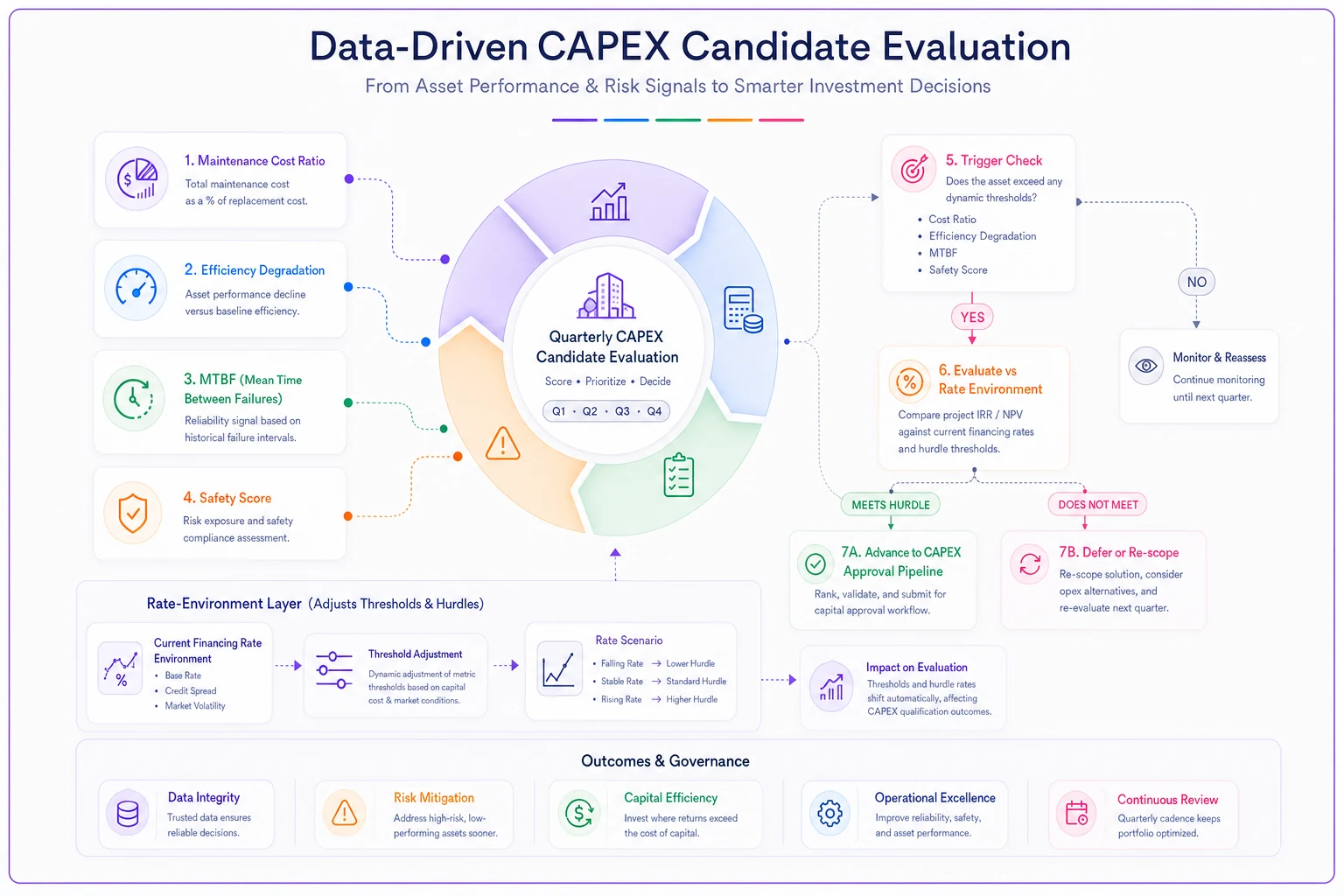
A trigger framework that holds up in practice:
-
Maintenance cost ratio
When trailing 12-month maintenance exceeds 35% of replacement cost
-
Efficiency degradation
When measured efficiency drops 20% below nameplate
-
Reliability threshold
When MTBF falls below 60% of design specification
-
Safety scores
When risk assessment exceeds predetermined thresholds
The power is in trajectory, not just totals. Don't just track maintenance cost — track how it's moving. A pump showing linear cost growth hits the trigger predictably. One showing exponential growth needs attention now.
A metals processor replaced their 10-year blanket replacement policy with this approach:
-
Triggers set at 40% maintenance cost ratio (their break-even point)
-
200+ assets monitored monthly through CMMS data
-
Quarterly CAPEX candidates generated from trigger hits
-
Each evaluated against current cost of capital
Result: CAPEX dropped around 30% while reliability stayed flat. They stopped replacing assets that were running fine and caught several degrading faster than the schedule would have flagged them.
Make the triggers dynamic based on rate environment. When financing is cheap, your maintenance threshold might sit at 30%. When rates are elevated like now, push it to 40% or 45%. Build this adjustment into your evaluation matrix so it doesn't require manual recalibration every quarter.
This approach also feeds directly into TCO modeling and depreciation controls when justifying any remaining CAPEX — you're working from data-driven triggers rather than arbitrary schedules, which makes the business case considerably cleaner.
Your 90-day implementation roadmap
According to Reuters' analysis of the Fed minutes, markets are pricing in elevated rates through at least mid-2027. That's a narrow window to restructure before budgets lock.
Days 1-30: Assessment and triage
-
Pull all CAPEX projects and recalculate paybacks at current rates
-
Identify top 20 assets for life extension evaluation
-
Calculate spare parts gaps for deferred replacements
-
List all maintenance contracts over $10k/month
Days 31-60: Program design
-
Build life extension plans for viable assets
-
Negotiate spare parts agreements (consignment/pooling)
-
Draft performance-based contract structures
-
Design trigger frameworks and thresholds
Days 61-90: Implementation launch
-
Cancel or defer 40-60% of CAPEX pipeline
-
Execute critical spare purchases
-
Begin contract renegotiations
-
Deploy trigger monitoring
Speed matters here. One month of delay on a $5M CAPEX portfolio runs roughly $40k in unnecessary interest. Three months is $120k that could have funded critical maintenance or spare coverage instead.
Beyond the rate spike
This scramble exposes a structural problem — most asset strategies are too rigid for volatile economic conditions.
Organizations with modular CAPEX approaches are handling this transition with far less chaos. They already had triggers, performance contracts, and life extension protocols in place. The ones struggling are locked into fixed replacement schedules and inflexible maintenance agreements with no easy off-ramps.
The lesson isn't just about surviving rate spikes. It's about building asset management systems that can actually adjust when economic conditions shift — floating CAPEX triggers tied to financial metrics, maintenance strategies you can dial up or down, spare parts programs that scale with risk, and contract structures that share risk appropriately.
AI-powered operational platforms are increasingly handling this kind of orchestration automatically — recalculating triggers as rate environments change, flagging intervention points before failures happen, and surfacing contract restructuring opportunities from performance data. The manual spreadsheet-based CAPEX planning most organizations rely on simply can't keep pace when conditions move this fast.
Whether you're running sophisticated software or working from Excel, the immediate priority is the same: protect your balance sheet by deferring CAPEX aggressively while managing operational risk through targeted interventions and smarter contracting. The Fed controls interest rates. You control how your assets respond. Start the CAPEX reprioritization now — don't wait for the next FOMC meeting to force the issue.
Ready to elevate your asset operations?
Join 1,500+ businesses using Ownitly to optimize asset utilization, reduce downtime, and ensure compliance.