



A maintenance supervisor at a chemical processing plant walked me through their audit nightmare a while back. They'd spent $180,000 replacing heat exchanger tubes and classified it as routine maintenance. The auditors disagreed. Without proper decision documentation, they ended up restating three quarters of financial reports and scrambling to justify every major repair from the past two years.
This isn't rare. Asset managers walk a minefield where one misclassified repair triggers audit findings, budget overruns, and chaotic year-end adjustments. The real problem isn't understanding CAPEX versus OPEX—most teams get that part. The harder problem is building repeatable decision frameworks that actually survive scrutiny while your maintenance team is still getting work done.
The classification problem nobody talks about
Most organizations hand their maintenance teams vague guidelines. "Repairs under $10,000 are OPEX." "Anything extending asset life is CAPEX." Then reality hits. A pump overhaul costs $8,500 but includes upgraded seals that improve efficiency. A building roof patch turns into partial replacement when structural damage surfaces. Emergency generator repairs require compliance upgrades that weren't in the original scope.
Technicians make these calls constantly, often without realizing they're making accounting decisions. By the time finance catches discrepancies during month-end close, the work's done, invoices are paid, and nobody remembers why specific choices were made.
The disconnect multiplies across systems. Your EAM tracks work orders one way. ERP handles cost allocation differently. The fixed asset register uses another classification scheme entirely. Each system tells a slightly different story about the same maintenance event, and reconciling them becomes someone's full-time job—usually the wrong someone.
Auditors expect clear decision trails. They want to see how you determined that replacing 40% of a conveyor system was maintenance while 60% would be capital. They need evidence that emergency repairs didn't inadvertently create asset improvements. They require documentation proving routine maintenance didn't accidentally hit capitalization thresholds.
Building decision rules that actually work
Functional asset capitalization maintenance playbooks rely on scenario-based decision trees, not percentage thresholds. A food manufacturer replaced their old "25% rule" with specific scenarios:
Stop losing track of critical assets.
Ownitly helps you monitor, maintain, and manage every asset efficiently and reliably.
- Centralized asset tracking
- Automated maintenance alerts
- Compliance monitoring & reporting
No credit card required
Scenario: Compressor failure requiring major component replacement
-
If replacing with identical specs
OPEX up to $15,000
-
If upgrading capacity/efficiency
CAPEX regardless of amount
-
If adding monitoring capabilities
Split based on primary purpose
-
Required evidence
Pre-failure performance data, replacement specifications, efficiency test results
Scenario: Building envelope repairs (roof, walls, windows)
-
Patching/sealing existing
OPEX
-
Section replacement under 500 sq ft
OPEX with photo documentation
-
Section replacement over 500 sq ft
CAPEX with structural assessment
-
Required evidence
Damage assessment, square footage calculations, before/after thermal imaging
Each scenario includes specific evidence requirements. Your maintenance team knows exactly what to capture before starting work—not after.
Capture the listed "Required evidence" items before starting work to avoid post-hoc reconstruction.
The framework also needs to handle borderline cases. A paper mill created what they call "threshold triggers"—specific conditions that automatically escalate classification decisions:
| Trigger Condition | Escalation Path | Required Documentation |
|---|---|---|
| Work order exceeds $25,000 | Finance review within 24 hours | Scope change form, component pricing |
| Efficiency improvement >10% | Engineering assessment | Baseline data, projected performance |
| Compliance-driven upgrades | Legal/Finance joint review | Regulatory citation, upgrade specifications |
| Multiple assets affected | Asset manager approval | Individual asset impact assessment |
| Emergency repair over $10,000 | Post-repair classification | Initial assessment, actual work performed |
These aren't suggestions—they're system-enforced gates.
The work order can't proceed without proper classification and documentation attached.
Evidence packages that survive audits
Generic maintenance records won't hold up. Auditors want evidence packages that tell the complete story of each capitalization decision, not a stack of invoices and a work order number.
A pharmaceutical company structures their evidence bundles around four components:
Decision Documentation
-
Initial assessment (photos, measurements, performance data)
-
Classification worksheet with specific criteria checked
-
Approval chain with timestamps
-
Any scope changes with re-classification triggers
Technical Evidence
-
Before/after specifications
-
Performance test results
-
Compliance certificates
-
Engineering assessments where applicable
Financial Trail
-
Purchase orders linked to work orders
-
Invoice reconciliation
-
Cost allocation breakdown
-
Any credits or warranty claims
Operational Context
-
Asset history showing pattern of repairs
-
Criticality assessment
-
Production impact analysis
-
Comparison to replacement cost
The critical piece is capturing this evidence as work happens, not reconstructing it months later when nobody remembers the details. Mobile forms force technicians to upload photos before closing work orders. Automated workflows require engineering sign-off on efficiency improvements. Purchase orders won't process without proper classification codes.
The EAM to ERP reconciliation maze
Even with solid classification, your systems probably don't talk to each other properly. The handoff between EAM and ERP systems creates endless reconciliation headaches that most teams just accept as normal.
Most organizations try to solve this with monthly manual reconciliation. Someone exports EAM work orders, pulls ERP transactions, builds elaborate spreadsheets trying to match them up. By the time discrepancies surface, the trail's cold and nobody remembers specifics.
Better operations use automated reconciliation with exception handling. A manufacturing company built these reconciliation checkpoints into their workflow:
Daily Automated Checks
-
Work orders over $5,000 auto-flag for finance review
-
CAPEX-tagged work orders create pending journal entries
-
Cost variances over 20% trigger investigation
-
Missing purchase orders block work order closure
Weekly Reconciliation Cycles
-
All CAPEX work orders reconciled to fixed asset registers
-
Labor hours validated against timesheets
-
Material costs matched to inventory transactions
-
Contract work verified against vendor invoices
Monthly Close Procedures
-
Full EAM-to-ERP transaction matching
-
Variance analysis with documented explanations
-
Capitalization threshold review
-
Audit trail verification
Here's a simple reconciliation workflow diagram.
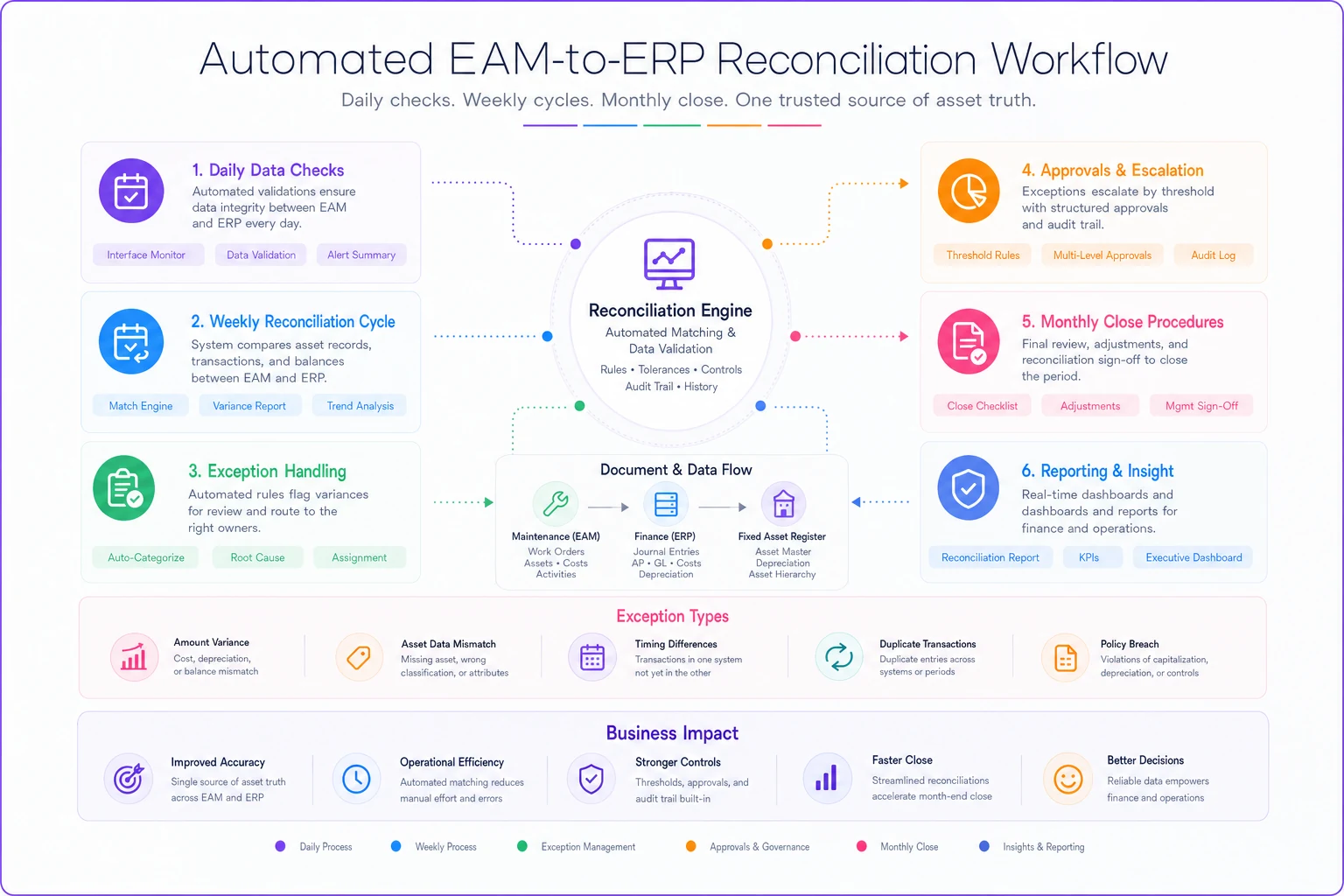
The automation eliminates most manual work while catching issues before they compound. When auditors arrive, you hand them exception reports showing exactly how edge cases were handled—not a mess of spreadsheets and unanswered questions.
When maintenance timing affects classification
Timing changes everything, and most playbooks miss this entirely. The same repair might be OPEX in January but CAPEX in November, depending on your capitalization policies and year-to-date spending patterns.
A utility company discovered this after capitalizing $2.8 million in "maintenance" during Q4. Individual repairs looked routine in isolation, but clustered together they constituted a major overhaul that required capitalization. Their auditors weren't satisfied with the explanation.
Now they track cumulative maintenance by asset:
-
Year-to-date maintenance spend by asset
-
Percentage of replacement value consumed
-
Clustered work order analysis
-
Projected Q4 maintenance that might trigger capitalization
When cumulative maintenance approaches 20% of replacement value, finance gets pulled in. They might defer non-critical work, accelerate full replacement, or formally document why continued maintenance makes sense despite the capitalization trigger.
The timing issue also applies to multi-phase projects. Replacing a boiler tube bundle might be maintenance. But if you're planning to replace the drums next quarter and the control system after that, you're executing a phased capital project. Classification depends on documented project intent—not just the individual work orders.
Approval gates that don't slow operations
Traditional approval chains kill maintenance velocity. By the time finance approves a classification, equipment's failed, production's down, and everyone's in emergency mode with no time for proper documentation.
Smart organizations build conditional approval paths based on decision complexity, not just dollar amounts. A steel mill implemented these decision speeds:
Instant Approval (Under 2 hours)
-
Routine maintenance under $5,000
-
Like-for-like replacements under $15,000
-
Safety-critical repairs regardless of amount
-
Pre-classified scenario matches
Rapid Review (Under 24 hours)
-
Efficiency improvements under $50,000
-
Multi-asset maintenance clusters
-
Borderline CAPEX/OPEX decisions
-
Vendor-proposed upgrades
Full Committee Review (Weekly)
-
Major overhauls over $100,000
-
Scope changes affecting capitalization
-
New asset creation from maintenance
-
Audit-flagged categories
A $3,000 control system upgrade might need full review while a $30,000 motor replacement gets instant approval because it's like-for-like. The routing logic is based on complexity and risk, not just the number on the invoice.
The hidden coordination tax
Every misclassification creates invisible work downstream. Maintenance planners resubmit paperwork. Accountants adjust entries. Asset managers update registers. Auditors dig through documentation. Budget controllers scramble to find coverage.
-
3 hours of maintenance planner time
-
2 hours of accounting effort
-
1 hour of asset management updates
-
Multiple review cycles and email chains
At around $150 per reclassification, they were burning close to $45,000 annually just fixing classification errors—before factoring in audit findings, budget impacts, or delayed maintenance from approval confusion.
Their fix was front-loading the classification effort. They invested in mobile decision tools for field supervisors, automated classification based on work patterns, pre-approved scenario templates, and monthly training refreshers for maintenance leads. The investment paid back within four months through reduced rework alone, not counting audit risk or faster execution.
Building your asset capitalization maintenance playbook
Start with your highest-risk scenarios—the ones that repeatedly cause debates or show up in audit findings. Map specific decision criteria for each, not generic thresholds that leave room for interpretation.
Document evidence requirements upfront. Your maintenance team should know exactly what photos, measurements, and reports to capture before starting work. Build these into mobile work order forms so evidence capture is automatic, not something that gets skipped when the job gets busy.
Create reconciliation rhythms that catch issues early. Daily exception reports beat monthly fire drills. Automated flags beat manual reviews. Clear escalation paths beat ad-hoc approval chains that nobody really follows.
Train your maintenance supervisors on the financial implications of their decisions. They're not just fixing equipment—they're making accounting judgments that affect financial statements, tax filings, and audit outcomes. Most of them have no idea.
The goal isn't perfect classification—that's not realistic with the complexity of modern maintenance operations. The goal is defensible decisions, clear documentation, and systems that catch issues before they cascade. When auditors challenge a classification, you want to show them a structured decision process, not scramble for explanations three months after the fact.
With the right operational framework, CAPEX/OPEX classification becomes another maintenance parameter to manage rather than a compliance problem that derails your team at the worst possible time.
Ready to elevate your asset operations?
Join 1,500+ businesses using Ownitly to optimize asset utilization, reduce downtime, and ensure compliance.