


Most EAM buying mistakes don't happen in the demo. They happen three months earlier, when someone decides what the platform is for without saying it out loud. One team is quietly shopping for a sensor-driven analytics engine that catches bearing failures early. Another team, often in the same company, is shopping for something that will survive a regulator pulling five years of calibration records. Those two mandates pull vendors in opposite directions, and a lot of cloud EAM platforms are built to lean hard one way.
If you're evaluating cloud EAM predictive vs compliance options and treating them as interchangeable because the feature grids overlap, you'll end up paying for strengths you don't use and patching gaps you didn't price in. This guide splits the two archetypes cleanly, shows where the tradeoffs actually bite, and gives you a way to decide based on what your organization really is — not what the sales deck says you could become.
The Two Archetypes, and Who Actually Buys Each
There's no official taxonomy here, but vendors cluster into two design philosophies in practice. The product's center of gravity tells you everything.
Predictive‑maintenance‑first platforms are built around data in motion. The core investment goes into telemetry ingestion, time-series storage, anomaly detection, model training and retraining, and the analytics surface that turns vibration, thermal, and current signatures into work orders. The architecture assumes high-frequency data and a constant feedback loop between what the models predict and what the field actually found.
Compliance‑first platforms are built around data at rest, and around proving what happened. The core investment goes into immutable records, versioned change history, electronic signatures, evidence capture, access controls that enforce separation of duties, and the ability to reconstruct the exact state of a record on any past date. The architecture assumes an auditor, an investigator, or a lawyer will eventually ask "show me."
The predictive camp optimizes for being early. The compliance camp optimizes for being defensible. Those aren't opposites in theory — but in product engineering they absolutely compete for roadmap, because immutability and rapid model iteration pull storage, schema, and workflow design in different directions.
The buyer personas sort out predictably:
| Characteristic | Predictive‑First Buyer | Compliance‑First Buyer |
|---|---|---|
| Title that drives it | Reliability engineer, maintenance manager, ops director | Quality lead, regulatory affairs, plant compliance officer |
| Primary pain | Unplanned downtime, reactive firefighting | Audit findings, failed inspections, legal exposure |
| Success looks like | Failures caught weeks early, lower MTBF variance | Clean audits, zero data-integrity findings |
| Typical industries | Rotating equipment, fleets, power gen, discrete manufacturing | Pharma, food/bev, utilities under NERC CIP, aerospace |
| Worst nightmare | A critical asset fails with no warning | A record can't be produced or has been altered |
The quiet trap: a lot of asset-intensive organizations have both buyers, and whoever runs the RFP wins the architecture. If the reliability team leads, you get a great analytics platform that makes your quality lead nervous during the Part 11 review. If quality leads, you get an airtight record system that reliability engineers route around because pulling model data out of it is painful.
Where the Feature Tradeoffs Actually Bite
Feature checklists hide the tradeoffs because almost every vendor claims almost everything. The difference shows up in depth, and in which features are first-class versus bolted on.
Stop losing track of critical assets.
Ownitly helps you monitor, maintain, and manage every asset efficiently and reliably.
- Centralized asset tracking
- Automated maintenance alerts
- Compliance monitoring & reporting
No credit card required
-
Model lifecycle management — can you version models, roll back a bad one, run champion/challenger comparisons, and see which model version generated a specific alert six months ago?
-
Real-time telemetry handling — ingestion rates, edge buffering when connectivity drops, and how gracefully the system handles sensor gaps instead of throwing false anomalies.
-
Alert-to-work-order feedback — whether confirmed/dismissed outcomes feed back into tuning, or whether that loop is manual and therefore mostly never happens.
On the compliance side, the real differentiators are equally easy to underweight:
-
True immutability vs. "we log changes" — write-once storage with cryptographic verification is very different from an audit table someone with DB access could quietly edit.
-
Point-in-time reconstruction — can you render a record exactly as it existed on a given date, including the SOP version, the signer, and the attached evidence?
-
Evidence capture at the point of work — photos, metadata, chain-of-custody, and acceptance criteria bound to the work order, not stored in some side folder.
The mistake that costs the most: buyers evaluate predictive analytics by watching a slick dashboard, and evaluate compliance by reading a feature list. It should be the reverse. Make the predictive vendor show you model rollback and alert lineage live. Make the compliance vendor show you a record changing and then prove the old version is still recoverable and tamper-evident.
One thing people miss on the predictive side: model management is a compliance concern once a model is deciding whether a critical asset gets inspected. If you're in a regulated environment, you'll eventually need to document why a model fired, on what data, under what version — which means even a predictive-first platform needs real governance around its models, not just good math.
Integration Patterns: Where Each Archetype Lives or Dies
Neither archetype survives as an island, but their priority integrations differ sharply, and that ordering tells you which platform was built for which world.
-
IoT / telemetry gateways — the lifeblood. OPC-UA, MQTT, historian connectors (PI and similar). If this is weak, nothing downstream works.
-
CMMS / work execution — alerts have to become scheduled, assigned, trackable work or they're just noise.
-
ERP — for parts, costs, and tying predicted failures to spend.
-
MES — production context that explains why a signature changed (load, product changeover, ramp).
Compliance-first priority integrations:
-
Identity / SSO with fine-grained roles — separation of duties is enforced here or it isn't enforced at all.
-
SIEM — access and change events need to flow into security monitoring for regulated OT/IT environments.
-
LIMS — in pharma, food, and labs, maintenance and calibration evidence has to reconcile with lab systems.
-
ERP / document management — for controlled procedures, retention, and financial reconciliation.
The integration pattern that quietly breaks programs: a predictive-first platform with a thin identity integration. It authenticates fine, but it can't enforce that the person who tuned the model isn't the same person who approved the resulting work — and in a regulated setting, that single gap turns a great analytics tool into an audit liability.
The reverse failure: a compliance-first platform with a batch-only telemetry connector. It'll happily store sensor summaries once an hour, which is useless for catching a fast-developing fault. If your reliability team needs real-time, confirm the ingestion path is streaming, not a scheduled pull dressed up in the demo.
Governance and Policy: The Checklist That Decides Audits
This is where the compliance archetype earns its price, and where predictive-first buyers get blindsided. Walk your shortlisted platforms through this concretely — not as a yes/no checkbox:
-
Retention — Can you set and enforce retention by record type, with legal hold that overrides deletion? Can retention differ by jurisdiction?
-
Data lineage — For any analytic output or KPI, can you trace back to source readings, transformations, and the model/version involved?
-
Role separation — Does the system prevent conflicting roles (maker/checker, author/approver), or merely log that one person did both?
-
QA / validation — Is there a documented validation path (IQ/OQ/PQ) the vendor supports, with environments that don't commingle test and production records?
-
Electronic signatures — Are signatures bound to the record state at signing, with identity, timestamp, and meaning (approved, reviewed, rejected)? This is the heart of 21 CFR Part 11.
-
Certification posture — For utilities, does the platform support NERC CIP requirements around access control, logging, and change management for critical assets? For life sciences, does it genuinely support Part 11, or just claim "Part 11 ready," which means nothing on its own?
-
Change history — Immutable, attributed, and reconstructable — including deletes and attempted deletes.
"Part 11 ready" and "NERC CIP compliant" are marketing phrases, not platform properties. Compliance is something you operate; the platform either makes it achievable or makes it a daily fight. Test the second condition.
A governance gap predictive-first buyers almost always underestimate: model changes are changes. If a retrained model alters inspection frequency on a regulated asset, that retraining event needs the same change-control rigor as editing a procedure. Platforms built for analytics rarely treat it that way out of the box.
A Decision Framework That Matches Reality
Forget the feature grid for a moment. The right archetype falls out of three variables: regulatory profile, risk tolerance, and operational maturity.
Step 1 — Classify your regulatory load.
-
Heavy (Part 11, NERC CIP, FDA-adjacent, formal audit cycles)
compliance archetype is the floor, non-negotiable.
-
Moderate (industry standards, insurance/legal exposure, occasional audits): either can work; governance depth matters more than analytics depth.
-
Light (internal standards only)
predictive archetype's strengths pay off faster.
Step 2 — Gauge your failure risk tolerance.
If a single unplanned failure means safety incidents or seven-figure downtime, predictive capability has real ROI regardless of regulation. If your failures are expensive but graceful (redundancy, warning time), predictive is a nice-to-have, not a must.
Step 3 — Be honest about maturity.
Low data maturity + predictive-first platform = an expensive dashboard nobody trusts, because the sensor coverage and data hygiene aren't there yet. High compliance discipline already in spreadsheets + compliance-first platform = fast, clean win.
| Regulatory Load | Risk Tolerance | Recommended Center of Gravity |
|---|---|---|
| Heavy | Any | Compliance-first, add predictive as a governed module later |
| Moderate | Low (failures hurt) | Predictive-first with a hard governance checklist applied |
| Moderate | High | Either — pick on integration fit and TCO |
| Light | Low | Predictive-first, clearly |
| Light | High | Basic CMMS may be enough; don't over-buy |
The pattern worth internalizing: you can add predictive analytics onto a strong compliance foundation more cleanly than you can retrofit true immutability and signature controls onto an analytics platform. When in doubt and regulated, buy the harder-to-retrofit capability first.
POC KPIs and Test Scenarios That Separate Real From Demo
Vendor POCs reward showmanship unless you script them. Give both archetypes a scenario they can't pre-stage.
For predictive-first, measure:
-
Lead time on a seeded fault — inject or replay a known degradation signature; how many days or hours before it alerts, and what's the false-positive rate on healthy assets over the same window?
-
Model rollback time — deploy a bad model, roll it back, and confirm you can attribute which alerts came from which version.
-
Telemetry resilience — cut connectivity for an hour; does edge buffering recover cleanly without a flood of false anomalies?
For compliance-first, measure:
-
Point-in-time reconstruction — ask them to produce a record exactly as it existed 18 months ago, with the then-current SOP version and signer. Time it.
-
Tamper evidence — attempt an out-of-band edit; confirm it's blocked or unmistakably flagged and the prior state is intact.
-
Separation-of-duties enforcement — have one test user try to author and approve the same critical record. It should fail.
-
Evidence package assembly — how long to compile a complete, defensible record bundle for one asset for an auditor?
A practical target worth borrowing: predictive POCs should hit meaningful fault lead time — days, not minutes-before-failure — with false positives low enough that technicians don't start ignoring alerts. Alert fatigue kicks in fast once dismissal rates climb past roughly a third in real deployments. Compliance POCs should produce an audit-ready evidence bundle for a single asset in minutes, not the days it takes when records are scattered across email threads, shared drives, and the CMMS.
Run the point-in-time reconstruction yourself, with your data — a vendor who won't let you do that is telling you something.
Run these scenarios yourself, with your data where possible. A vendor who won't let you drive the point-in-time reconstruction live is telling you something.
Migration and Hybrid Deployment — The Part That Gets Underplanned
Almost nobody greenfields this. You're migrating from a CMMS, spreadsheets, a historian, and three systems of record that disagree about asset IDs. Two migration realities decide whether this goes smoothly.
First, master data has to be clean before either archetype adds value. A predictive platform trained on mislabeled assets predicts failures for the wrong machine. A compliance platform with duplicate asset records produces audit bundles that contradict each other. Resolve identity and hierarchy first — everything downstream inherits those errors.
Second, hybrid is the common end state, and it's fine if the boundary is deliberate. A workable pattern: compliance-first platform as the system of record for controlled assets and evidence, with a predictive layer feeding governed alerts into it as work orders. The boundary rule that keeps this sane — analytics can recommend, but the record of what was decided and done lives in the controlled system, under change control. When model outputs start silently editing controlled records, you've lost the audit trail you paid for.
Here's a simple workflow that captures the key handoffs during migration and hybrid deployment.
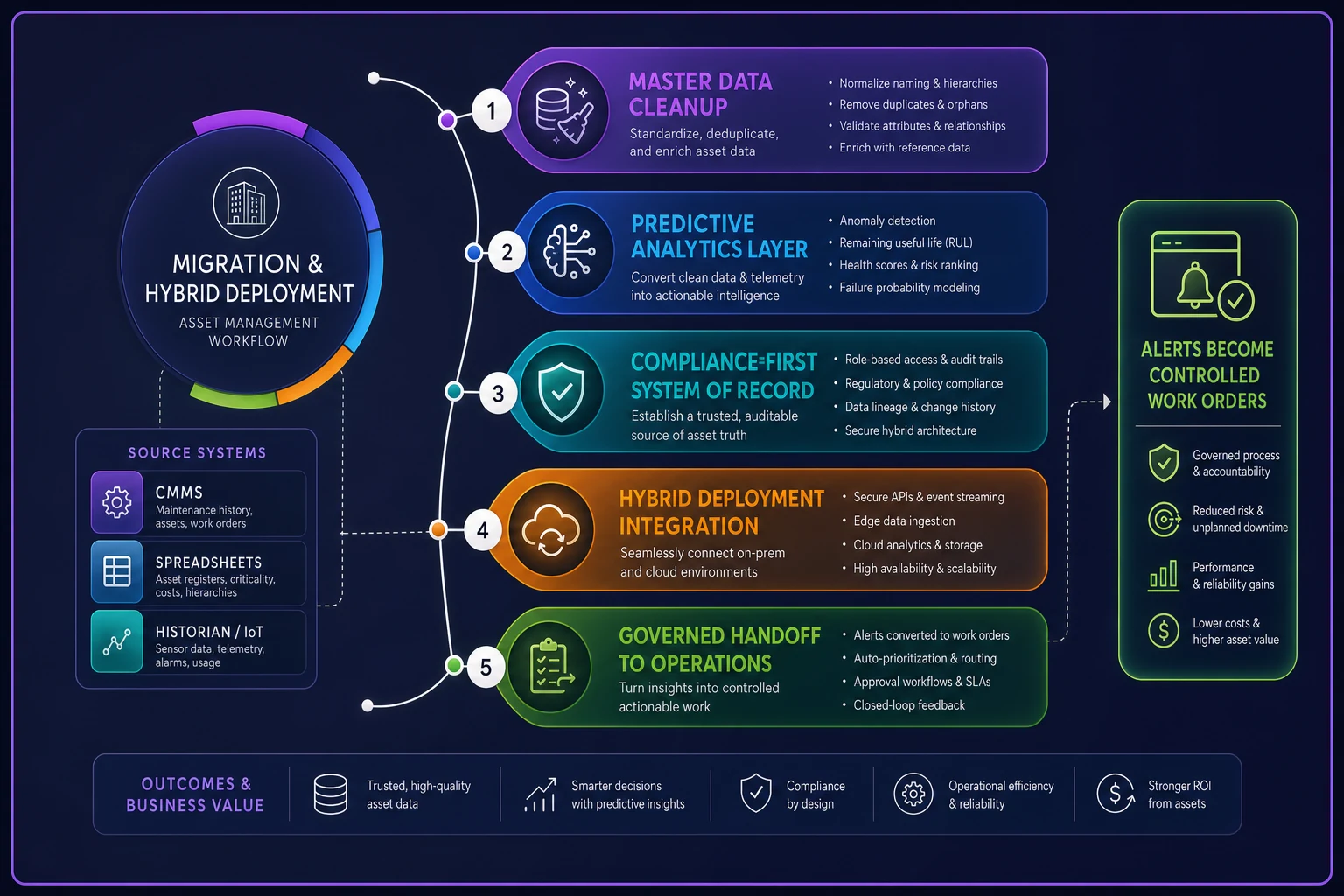
For regulated environments especially, keep model retraining events, data lineage, and signatures inside the controlled system's governance, even when the math happens elsewhere. The analytics can be best-of-breed. The decision record cannot be loose.
How This Affects Near‑Term EAM Plays
Budget timing shapes this decision more than vendors admit. When capital gets tight and CAPEX reprioritization is on the table, the instinct is to defer the "nice-to-have" predictive investment and keep the compliance spend because it's mandatory. That's often the right call — but only if you've correctly classified which failures are graceful and which aren't.
Deferring predictive coverage on an asset whose unplanned failure triggers a safety or production event isn't a saving; it's a deferred loss. If you're pressure-testing EAM spend against a shifting rate and budget environment right now, the moves in this breakdown of immediate EAM responses to the Fed's July 2026 minutes pair well with the archetype decision here — classify the asset risk first, then decide what's deferrable.
The One Thing to Get Right
Decide your platform's center of gravity before you look at a single demo, and base it on what your regulatory load and failure risk actually demand — not on which team happens to be running the RFP. The feature grids will blur together.
The architecture won't. A predictive-first platform retrofitted for compliance and a compliance-first platform retrofitted for analytics are both common, both expensive, and both avoidable when you name the mandate up front and test the hard capability, not the pretty one.
Decide your platform's center of gravity before you look at a single demo, and base it on what your regulatory load and failure risk actually demand — not on which team happens to be running the RFP.
Ready to elevate your asset operations?
Join 1,500+ businesses using Ownitly to optimize asset utilization, reduce downtime, and ensure compliance.