


There's a specific meeting that happens during almost every cloud EAM selection: the reliability lead brings a shortlist built around anomaly detection and failure prediction, the compliance lead brings a shortlist built around retention, e‑signatures, and immutable records, and procurement is stuck reconciling two philosophies that rarely agree.
The market has split into two camps. Some platforms are architected to squeeze more life out of assets through prediction; others are built to survive an FDA, FAA, or PHMSA audit without breaking a sweat. Vendors will claim they do both — but almost every platform leans one way at the architectural level.
This guide walks through the predictive maintenance vs compliance cloud EAM decision the way it actually plays out: where tradeoffs hide, what breaks during integration, what governance looks like under each model, and how to structure an RFP so vendors can't paper over the gaps.
Why the Two Architectures Diverge in the First Place
The split is not marketing noise; it emerges from opposite data‑layer design pressures. Predictive‑first platforms prioritize fast ingestion, time‑series storage, and retrainable models, tolerating imperfect records because pattern matters more than perfection.
Compliance‑first platforms are obsessed with proving what happened, when, and by whom. They favor write‑once storage, granular audit trails, controlled vocabularies, and validated workflows that resist automatic data mutation.
These opposing priorities show up in small everyday cases. For example: a predictive platform asks whether a fix worked and what it reveals about an asset; a compliance platform asks who edited the work order, why, and whether the original can be reconstructed.
Side‑by‑Side: Where the Tradeoffs Actually Live
Feature checklists are often useless because both vendors can check boxes. The meaningful differences appear one layer down; this table summarizes where the architectural lean matters.
Stop losing track of critical assets.
Ownitly helps you monitor, maintain, and manage every asset efficiently and reliably.
- Centralized asset tracking
- Automated maintenance alerts
- Compliance monitoring & reporting
No credit card required
| Dimension | Predictive‑Maintenance‑First | Compliance‑First |
|---|---|---|
| Sensor / IoT ingestion | Native, high‑frequency, built for time‑series | Often bolted on or via partner connectors |
| Failure prediction & anomaly models | Core capability, retrainable | Basic thresholds, limited or read‑only ML |
| Audit trail depth | Adequate, sometimes shallow on config changes | Deep, immutable, covers config and metadata |
| E‑signatures / 21 CFR Part 11 style controls | Add‑on or partial | Native and validated |
| Data lineage | Focused on sensor‑to‑alert path | Focused on record‑to‑evidence path |
| Master data discipline | Flexible, tolerant of gaps | Strict, controlled vocabularies enforced |
| Workflow rigidity | Configurable, encourages iteration | Locked, change‑controlled |
| Time to first value | Faster (weeks for a pilot) | Slower (months, validation gates) |
| ERP / financial integration | Decent, sometimes secondary | Strong on procurement and cost traceability |
| Handling of auto‑generated actions | Encouraged | Requires human approval gates |
The row that most teams trip over is data lineage: predictive platforms trace sensor→alert→work order, while compliance platforms trace record→approval→evidence. If you need both, you either buy a platform that does one well and the other adequately, or you integrate two systems and own the seam.
The Integration Seam Nobody Budgets For
Teams that pick a predictive‑first platform and later need airtight audit trails usually build a separate compliance layer for evidence. Teams that pick compliance‑first and later want prediction bolt on a sensor analytics platform that pushes alerts back in. Either approach creates a seam — and seams are where the real cost lives.

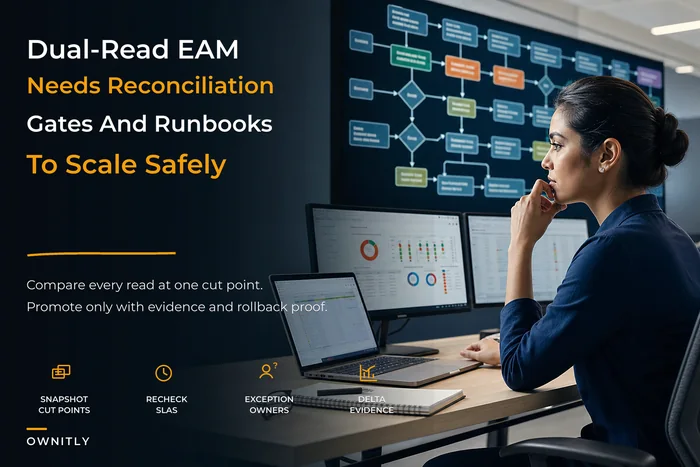
See the hybrid‑topology runbook for owning the predictive/compliance seam: Hybrid EAM architectures and dual‑read reconciliation runbooks.
A typical example: a specialty chemicals operation picked a strong predictive platform for rotating equipment. Eighteen months in, an auditor asked for change history on critical work orders, including who modified model‑recommended maintenance intervals. The EAM showed work orders but couldn't reconstruct model config changes cleanly.
That gap cost roughly three months of manual evidence reconstruction, a consulting bill in the low six figures, and a rushed retrofit. The lesson: predictive was the right choice for downtime, but nobody priced the compliance seam into the original decision.
Governance and Data‑Lineage Implications
Governance turns the architectural lean into an operating‑model decision. Predictive‑first platforms shift burden toward model governance; compliance‑first platforms shift burden toward change friction and strict workflows.
-
Capture human approval for any model‑driven interval change as a distinct, timestamped record.
-
Define and control who can edit controlled vocabularies to avoid duplicate or inconsistent asset records.
-
Map lineage end‑to‑end before go‑live and treat system boundaries as governance risks you own.
-
Decide the source of truth for cost and confirm ERP handoff preserves full cost lineage for capitalization.
Teams that get governance right treat it as buying criteria, not cleanup work. Some AI‑assisted EAMs can help — flagging duplicate assets, surfacing evidence gaps, and auto‑capturing approval metadata — but ask to see these capabilities working on real data, not a scripted demo.
Implementation Timelines: What to Actually Expect
Timelines diverge sharply and vendors under‑quote both directions. Predictive‑first delivers pilots faster but often has a long tail of tuning and adoption work; compliance‑first is slower to start but tends to be stable once validated.
Predictive‑first: pilot in weeks for sensor ingestion and alerts, but model tuning and reducing false positives can stretch six to twelve months before technicians trust alerts enough to act without second‑guessing.
Compliance‑first: validation, workflow lockdown, controlled vocabulary setup, and permission architecture can push initial go‑live to four to nine months, but the change‑control rigidity that slows setup also reduces surprises later.
-
Scope non‑negotiables first
identify which asset classes require evidence versus which are reliability plays.
-
Pilot the harder side early
test the compliance seam if you lean predictive, or test a predictive bolt‑on on a non‑critical asset if you lean compliance.
-
Validate data lineage before scaling
reconstruct one full record and one sensor‑to‑decision path end‑to‑end.
-
Lock governance roles before go‑live
assign model owners, vocabulary owners, and evidence owners with real names.
-
Scale by asset criticality, not by site
roll out to highest‑consequence assets first to battle‑test governance.
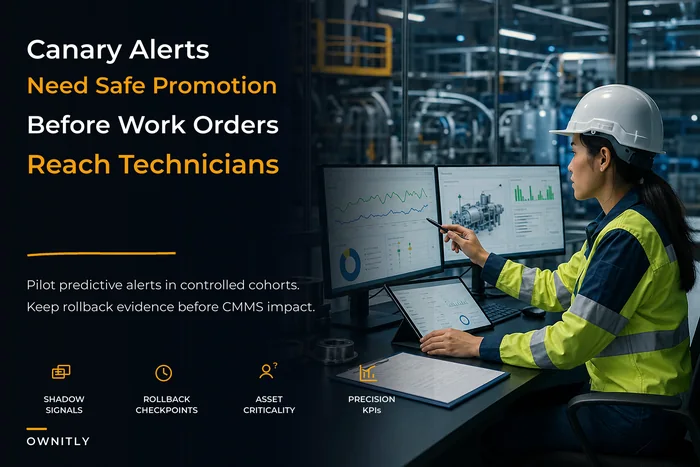
For staged pilots and canary recipes, see Canary deployment patterns for predictive alerts in EAM. For predictive maintenance design guidance, see https://www.cloudera.com/resources/faqs/predictive-maintenance-guide.html.
ROI Considerations That Get Overlooked
Predictive's headline ROI is avoided downtime; compliance's is avoided penalties. The long‑term value often hinges on overlooked recurring costs rather than the headline metric.
Predictive's hidden ROI killer is false positives: poorly tuned models can generate so much noise that technicians waste significant time validating phantoms, delaying net positive ROI until substantial tuning investment.
Compliance's underrated ROI is audit efficiency: a compliance‑first platform that produces audit‑ready bundles can cut audit prep from weeks to days, often producing recurring savings that exceed penalty avoidance over a few years.
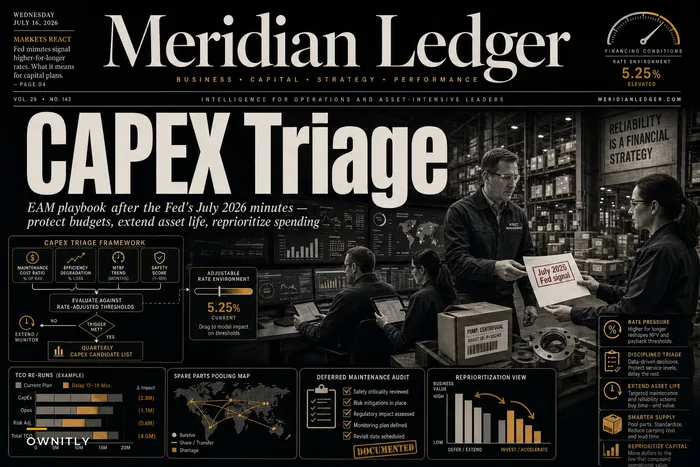
When budgets tighten, scrutinize both false‑positive labor and audit‑prep labor. Pair this decision with sequencing moves like immediate EAM actions to protect budgets and reprioritize CAPEX to fund the archetype that protects your biggest exposure first.
RFP Checklist and Sample Questions
Generic RFPs let vendors hide their architectural lean. Use targeted questions to pressure‑test the shortlist and force the architecture into the open.
-
Can the audit trail capture configuration and model changes, not just record edits?
-
Is write‑once/immutable storage available for regulated records or only as an add‑on?
-
What is native versus partner‑delivered for sensor ingestion and prediction?
-
How are auto‑generated maintenance actions approved and logged?
-
Can you reconstruct a full sensor‑to‑decision and a full record‑to‑evidence lineage for the same asset?
-
How are controlled vocabularies enforced, and who can change them?
-
What breaks when integrating the missing side (predictive add‑on to compliance or vice versa)?
-
What is realistic time‑to‑trusted‑alerts, not just time‑to‑first‑alert?
-
How does the ERP handoff preserve cost lineage for capitalization?
-
Show me a real audit prep workflow, timed.
Ask vendors to answer 'when it went wrong' questions honestly — those answers reveal architecture lean better than feature lists.
-
"Walk me through the last time a customer failed an audit despite using your platform. What was the gap?"
-
"If a model recommends changing an interval, what's the exact record trail, and can an auditor reconstruct the pre‑change state?"
-
"How many of your regulated customers use your native compliance features versus a third‑party document system alongside you?"
-
"What's your typical false‑positive rate at go‑live versus after tuning?"
Recommended Platform Archetypes by Industry
No archetype wins everywhere. Match the platform lean to regulatory exposure and downtime economics.
-
Pharma, medical devices, aerospace MRO
compliance‑first almost always.
-
Power generation, oil & gas, pipelines
split — often need both and should budget the seam.
-
Discrete manufacturing, automotive
predictive‑first usually leads.
-
Food & beverage
scope by line; compliance for safety/traceability, predictive for high‑throughput equipment.
-
Water utilities, municipal
compliance‑leaning with selective predictive on critical pumps.
-
Facilities, real estate, light commercial
predictive‑first or general‑purpose EAM; deep compliance is overkill.
When Each Choice Makes Sense — and When It Doesn't
Choose the archetype that protects your dominant risk. The wrong choice adds brittle cost or frustrates adoption.
-
Predictive‑first makes sense when downtime cost per hour dwarfs regulatory exposure and you can invest in sensors and tuning.
-
Predictive‑first is a bad idea when audit readiness is critical and will be treated as an afterthought.
-
Compliance‑first makes sense when a failed audit or data‑integrity finding could threaten the business.
-
Compliance‑first is a bad idea when chronic unplanned downtime is the dominant problem and rigidity will be worked around.
Who should not force a single platform to do both: highly regulated operations with severe downtime economics (power, oil & gas, pipelines). Trying to make one platform excel at both usually yields mediocrity; lead with dominant risk and budget the seam deliberately.
A Short Real Scenario
A regional food processor had three plants: one compliance‑critical line and two plants suffering unplanned downtime. Leadership considered one platform for everything but instead scoped by exposure.
They placed the compliance line on a compliance‑first platform and rolled predictive on the two downtime‑heavy plants. The split cost more upfront but avoided a retrofit; within a year the predictive plants saw materially less downtime and the compliance line reduced audit prep from weeks to days.
Bringing It Together
The decision isn't about feature checklists. It's about which architectural lean matches your dominant risk and whether you're prepared to own the integration seam for the other capability.
Scope by regulatory exposure and downtime economics before you talk to vendors. Force architecture into the open with incisive RFP questions, budget the seam upfront, and treat governance — model ownership, vocabulary control, and end‑to‑end lineage — as buying criteria, not cleanup work.
Pick the archetype that protects your biggest exposure first. Everything else can be layered on, but you can't cheaply retrofit the architecture you didn't choose deliberately.
Ready to elevate your asset operations?
Join 1,500+ businesses using Ownitly to optimize asset utilization, reduce downtime, and ensure compliance.