

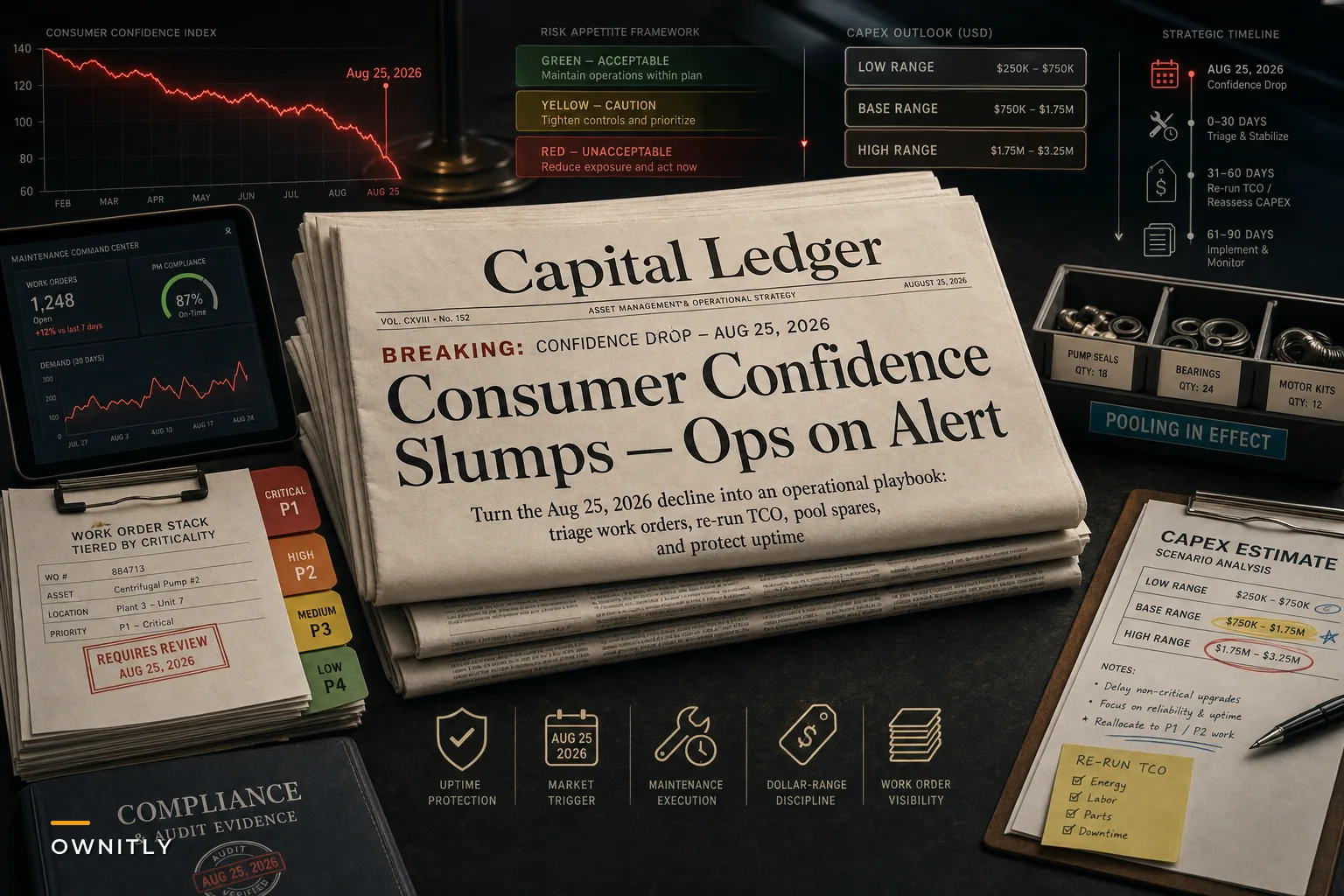

When the Conference Board reported on August 25 that consumer confidence slipped to 89.4, the number itself wasn't the story. The story is what happens in finance departments over the following six weeks. A confidence dip that low—driven by pessimism about jobs and inflation, as Reuters noted in its coverage—tends to trigger reflexive tightening across enterprises. And that reflex almost always lands on maintenance first, because maintenance looks discretionary on a spreadsheet even when it isn't.
If you run assets, you already know how this plays out. Someone in finance freezes CAPEX approvals "until we see Q4 demand." Someone else asks why spare-parts carrying costs are so high. A replacement you scheduled two years ago quietly becomes next fiscal year's problem. None of these decisions are made by people who understand what deferring a bearing replacement actually costs. That's the real challenge—not the budget cut itself, but the fact that the cut arrives before you've had a chance to defend the work that matters.
This isn't about surviving austerity. It's about walking into the budget conversation with a defensible, ranked list before anyone hands you a percentage to cut.
Why maintenance gets cut first (and why that logic is broken)
Maintenance spending has a peculiar quality: the cost of doing it is visible and immediate, while the cost of not doing it is invisible and delayed. When confidence drops and leadership wants to protect cash, that asymmetry makes maintenance an easy target. You can defer $180k of preventive work this quarter and nothing bad happens in the same quarter. The failure shows up in month five, and by then nobody connects it to the deferral.
Budget cuts almost never distinguish between maintenance that prevents catastrophic failure and maintenance that just keeps things tidy. A blanket 15% reduction hits a critical pump's vibration monitoring the same way it hits repainting a handrail. Both are "maintenance." Both get trimmed. One of them shuts down a production line.
The teams that come out of a downturn in reasonable shape aren't the ones who fought the cut hardest. They're the ones who reshaped where the cut landed. That's a completely different skill than defending a total budget number—and one most maintenance organizations have never had to develop because they've operated under stable funding for years.
Start with consequence, not with the asset list
The instinct during a squeeze is to open the EAM, pull every open work order, and start crossing things off by cost. Don't. Sorting by cost tells you what's expensive to do, not what's expensive to skip. Those are unrelated questions.
Stop losing track of critical assets.
Ownitly helps you monitor, maintain, and manage every asset efficiently and reliably.
- Centralized asset tracking
- Automated maintenance alerts
- Compliance monitoring & reporting
No credit card required
Instead, rank by consequence of deferral. For every category of planned work, you're answering one thing: if I push this three or six months, what breaks, and what does that breakage actually cost?
A simple deferral-risk grid works well here. It doesn't need to be sophisticated—it needs to be defensible in a room full of people who don't know your assets.
| Deferral risk tier | What it looks like | Handling under budget pressure |
|---|---|---|
| Tier 1 — Protect fully | Failure causes safety exposure, regulatory breach, or line-stopping downtime | Never cut. Fund even if it means trimming elsewhere |
| Tier 2 — Conditional defer | Failure raises risk over time but degradation is measurable and slow | Defer only with monitoring in place to catch drift early |
| Tier 3 — Defer with tracking | Cosmetic, comfort, or redundant-system work | Defer freely, log the decision, revisit next cycle |
| Tier 4 — Question the work entirely | Calendar-based PMs on assets that rarely fail | Downturn is the excuse to finally re-baseline the interval |
Tier 4 is the one people miss. A budget crunch is actually a decent forcing function to eliminate maintenance that was never justified in the first place. Plenty of PM schedules are inherited artifacts—someone set a monthly inspection on a low-criticality asset a decade ago and nobody questioned it since. When you're forced to defend every line, those surface quickly.
The tiering process itself doesn't have to be a massive project. At the category level it usually takes a few days with the right people in the room. Asset-by-asset detail only matters for the contested items—and there are usually fewer of those than you'd expect.
The real problem this exposes: nobody can price your risk
Most maintenance organizations get stuck at the same point. Finance asks, "What happens if we cut this?" and the honest answer is a shrug and "something bad, probably." That's not a fundable answer. It gets overruled every time.
The underlying issue is that maintenance risk and enterprise funding decisions live in two different languages. Maintenance thinks in failure modes, MTBF, and inspection intervals. Finance thinks in cash exposure, deferred CAPEX, and probability-weighted cost. When those two never translate into each other, the maintenance side loses the argument by default—not because the work is unimportant, but because the case was never made in dollars.
This is exactly why mapping your maintenance posture to funding logic matters before a crisis hits. If you've already connected risk tolerance to dollar allocations, the confidence-driven budget conversation becomes an adjustment instead of a fight. We went deeper on this framework in mapping maintenance risk appetite to enterprise funding allocations—the short version is that every deferral decision should carry an explicit, pre-agreed risk price, so you're not inventing justifications under pressure.
The organizations that translate well share one habit: they express deferral as a range, not a point. "Skipping this quarter's overhaul saves $140k now and carries roughly a 20–30% chance of an unplanned failure costing $400k–$600k within nine months." That sentence wins budget arguments. "We really shouldn't cut this" does not.
A rough sequence for how this translation should work:
-
Start with failure consequence—what actually stops if this asset goes down
-
Attach a cost range to that consequence (downtime, spoilage, emergency labor, whatever applies)
-
Estimate a probability window for failure if deferred
-
Express the whole thing as expected cost exposure, not as maintenance urgency
That's it. It's not sophisticated modeling—it's just getting the risk into a format finance already knows how to read.
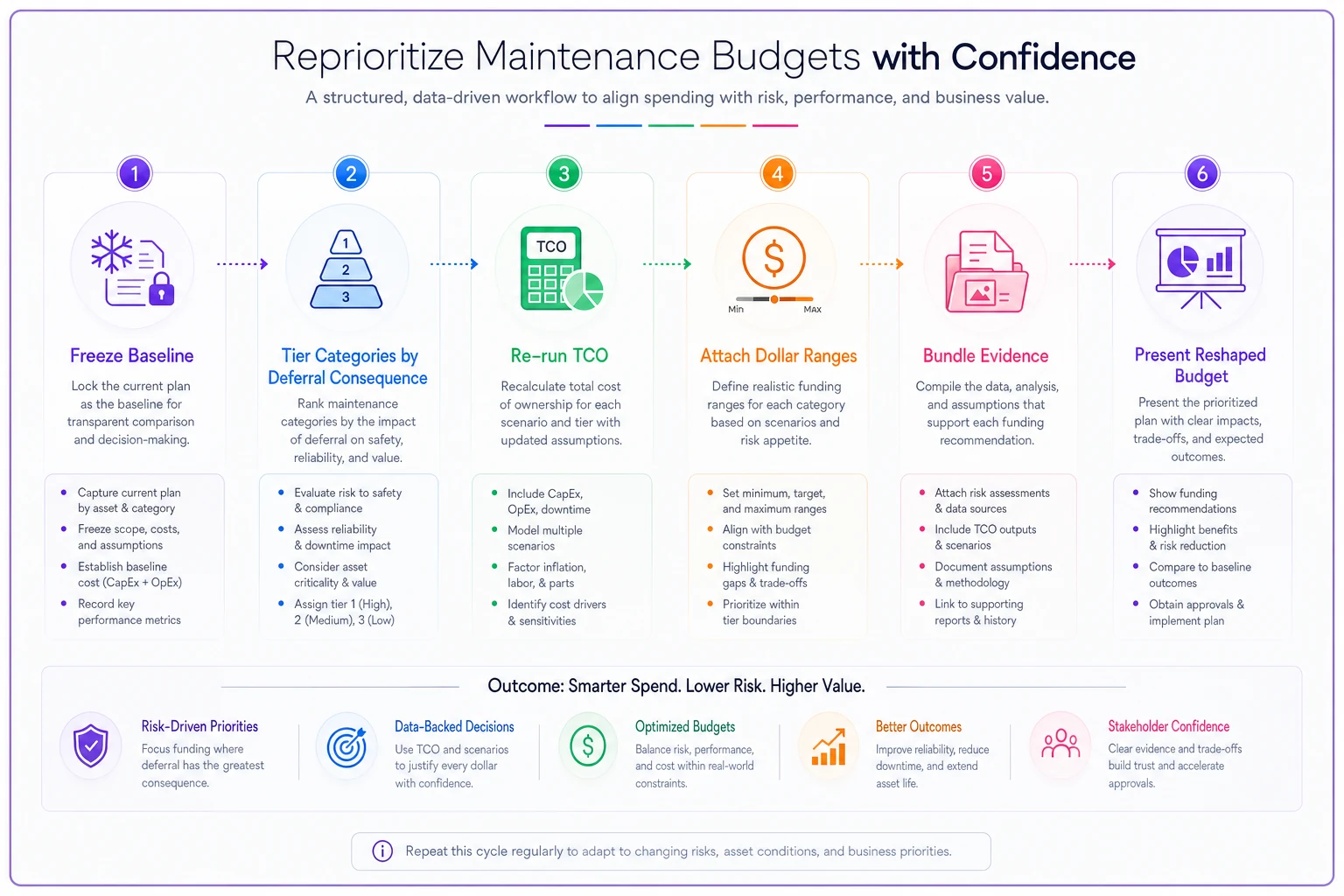
A workable reprioritization sequence
When the cut is coming, here's a sequence that produces a defensible plan in about a week rather than a month of meetings.
-
Freeze the baseline. Snapshot your current planned-work portfolio before anyone starts negotiating. You need a clean "before" to measure decisions against.
-
Tier every category by deferral consequence, using something like the grid above. Do this at the category level first—asset-by-asset comes later, only for the disputed items.
-
Re-run TCO on your top deferral candidates. A downturn changes the math on replace-vs-repair. Extending an asset's life another 18 months might now beat replacement even if replacement was the plan—but only if you can quantify the added maintenance and reliability risk of stretching it.
-
Attach a dollar range to each Tier 2 and Tier 3 deferral. This is the step everyone skips and the one that actually protects you.
-
Bundle the evidence. For anything you're protecting in Tier 1, have the failure history, consequence data, and cost basis ready in one packet. Finance rarely fights a well-documented Tier 1 item.
-
Present the reshaped budget, not the defended budget. Walk in with "here's how I'd absorb a 12% cut while protecting uptime," not "here's why you can't cut me."
Use this workflow to produce a defensible plan quickly.
That last point changes the dynamic completely. Showing up with a pre-built reprioritization signals that you've already done the hard thinking. It moves you from defendant to advisor.
Where spares and inventory get squeezed—handle it carefully
Spare-parts carrying costs are a favorite target when confidence drops, because inventory sitting on a shelf looks like frozen cash. Some of that scrutiny is fair. But there's a specific trap here: cutting spares for critical, long-lead-time components to save carrying cost, then eating weeks of downtime when one fails because the replacement is now a 14-week order.
The discipline during a squeeze is to separate spares by lead time and criticality, not by carrying cost. A cheap part with a 12-week lead time on a Tier 1 asset is far more dangerous to cut than an expensive part you can source in three days. Finance sees the expensive part and wants it gone. Your job is to reframe the conversation around downtime exposure, not shelf value.
A quick checklist for a defensible spares review under budget pressure:
-
Flag every spare tied to a Tier 1 asset—these come off the cut list first
-
Sort remaining spares by lead time; anything over 8 weeks gets scrutiny before anything under 2
-
Identify parts that could be pooled across sites rather than stocked redundantly
-
Check for slow-movers that have sat untouched for 24+ months—those are legitimate cuts
-
Document which reductions carry downtime risk, so the decision is on record if it bites later
The pooling option gets underused. If you're running multiple sites with overlapping equipment, shared spares at a central location beats redundant local stock on most high-value components. It doesn't solve every gap, but it can meaningfully reduce carrying costs without touching criticality.
Pool long-lead spares centrally where possible to avoid duplicative stocking without increasing downtime risk.
It doesn't solve every gap, but it can meaningfully reduce carrying costs without touching criticality.
A real scenario
A mid-sized regional food processor—three plants, mostly rotating equipment and packaging lines—hit exactly this situation heading into a soft Q4. Finance handed the maintenance lead a target: cut planned maintenance spend by about 14%, roughly $310k off an annual planned budget in the low $2M range.
The reflexive move would have been across-the-board. Instead, the team tiered the work first. They found close to $190k of the target in Tier 3 and Tier 4 alone—deferrable cosmetic work plus a cluster of calendar-based PMs on low-criticality conveyors that hadn't produced a single relevant finding in two years. Eliminating those wasn't a sacrifice; it was overdue.
The remaining gap got harder. They found around $80k more by extending two asset replacements by 18 months, backed by a fresh TCO run and tightened vibration monitoring to catch early drift. The last chunk came from pooling a set of long-lead spares across two of the three plants.
What mattered most: they protected every Tier 1 item, and they walked into the review with the reshaped plan already built and priced. Finance approved it in one meeting instead of the usual three rounds of back-and-forth. Over the following two quarters they had one unplanned failure on a deferred asset—caught early by the added monitoring, repaired during a planned window, no line stoppage. The 14% cut held without an uptime hit.
The lesson wasn't just that they cut smart. It was that having the tiering and the dollar-ranged risk ready turned a defensive scramble into a controlled decision.
When aggressive deferral actually makes sense—and when it doesn't
Not every deferral is a gamble. Pushing calendar-based work on assets with strong reliability history and low failure consequence is often just good hygiene, downturn or not. If an asset has run clean for years and its failure wouldn't stop anything critical, stretching its PM interval is a reasonable permanent change, not a temporary sacrifice.
Deferral becomes problematic in three specific situations:
-
When you can't monitor the thing you're deferring. Stretching an interval is only safe if you can detect early degradation. Deferring maintenance on an asset with no condition monitoring is flying blind.
-
When the asset is already late in its life curve. Assets past their reliable service window fail on an accelerating curve. Deferral there compounds risk faster than the savings justify.
-
When the failure mode is sudden rather than gradual. Some failures give warning; some don't. You can defer what degrades slowly. You should not defer what fails without notice.
The teams that get burned usually deferred something in one of these three categories because it happened to be the biggest cost line, not because it was actually safe to push.
It's worth saying plainly: the goal isn't to avoid all deferral. It's to make sure every deferral is a conscious choice with a known risk price attached, not a line item that got cut because it was large and nobody pushed back hard enough.
A drop in consumer confidence isn't really a maintenance event—it's a budgeting event that lands on maintenance. The organizations that handle it well aren't the ones with the best assets or the deepest reserves. They're the ones who can translate operational risk into the language finance uses to make decisions, and who show up to the budget conversation with a reshaped plan instead of a plea to be left alone.
The work of tiering by consequence, pricing deferral risk, and connecting all of it to funding logic is worth doing now, while Q4 budgets are still being drafted. Once the number lands on your desk as a mandate, you've lost the chance to shape where it falls. Do the ranking before you're asked to cut, and the cut becomes something you steer rather than something that happens to you.
Ready to elevate your asset operations?
Join 1,500+ businesses using Ownitly to optimize asset utilization, reduce downtime, and ensure compliance.