


Most maintenance budgets don't fail because someone did bad math. They fail because "risk appetite" lives in a slide deck as a vague sentence — "we accept moderate risk on non-critical assets" — and never gets translated into a number anyone can act on. A field supervisor can't spend a policy statement. A CFO can't fund an adjective.
The gap between the boardroom's stated tolerance and the mechanic's actual decision is where money quietly leaks. You'll see it when a plant approves a $400k capital replacement for a pump that could've run two more years, while three failing instruments sit in a backlog because nobody could justify the spend. Both decisions were made by reasonable people. The problem is there was no shared ruler.
This article is about building that ruler — turning maintenance risk appetite into explicit bands, mapping each band to operational thresholds, and then converting those thresholds into allocation rules that tell you where the next dollar goes: CAPEX vs OPEX, which funding bucket, and how much.
Why risk appetite stays abstract in most organizations
The honest reason risk appetite rarely becomes operational: nobody wants to be the person who writes down "we accept up to $250k in annual failure exposure on Class C assets" and then watches a $260k failure happen. It feels safer to stay vague. Vague statements can't be violated.
-
Category creep. Every asset owner argues their equipment is "critical," so the critical tier balloons until it's meaningless. When 70% of your assets are Tier 1, you have no prioritization at all.
-
Reactive funding. Money follows the last failure, not the biggest future risk. The squeaky wheel gets the CAPEX.
-
Disconnected buckets. Reliability engineers think in downtime hours. Finance thinks in depreciation schedules. Operations thinks in production units. Nobody's numbers reconcile, so the funding conversation restarts from scratch every quarter.
The fix isn't more meetings. It's a translation layer that takes one input — how much risk this asset class is allowed to carry — and produces consistent outputs everyone can defend.
The three translations you actually need
Risk appetite becomes useful only after it survives three conversions. Skip any one and the whole thing collapses back into opinion.
Stop losing track of critical assets.
Ownitly helps you monitor, maintain, and manage every asset efficiently and reliably.
- Centralized asset tracking
- Automated maintenance alerts
- Compliance monitoring & reporting
No credit card required
-
1. Appetite band → operational threshold. A qualitative band ("low tolerance," "moderate tolerance") has to become a hard limit: maximum allowed unplanned downtime per year, maximum single-event financial exposure, maximum acceptable probability of failure over the planning horizon.
-
2. Operational threshold → funding trigger. Once you have thresholds, a breach — or a forecast breach — becomes an automatic funding signal. If projected downtime exceeds the band, that asset moves into a prioritized bucket. No debate required; the rule already decided.
-
3. Funding trigger → CAPEX/OPEX split. The last conversion decides how it gets funded. Replacing the asset is CAPEX. Increasing inspection frequency or condition monitoring is OPEX. The risk band should carry a default rule for which lever you reach for first.
If you've already built downtime costs per asset, you're most of the way to the second translation. The method in Downtime costing per asset gives you the dollar-per-hour figure that turns an allowed-downtime threshold into a financial exposure number — and financial exposure is the language finance funds in.
Defining the risk-appetite bands
Keep the number of bands small. Four is enough for almost any portfolio. More than five and asset owners can't tell them apart, which pushes you right back into category creep.
Here's a workable band structure mapped to concrete thresholds. Treat the numbers as a starting template — you'll tune them to your asset base and production economics.
| Band | Risk appetite | Max unplanned downtime / yr | Max single-event exposure | Target probability of failure (planning horizon) | Default funding posture |
|---|---|---|---|---|---|
| A – Minimal | Near-zero tolerance | ≤ 4 hrs | ≤ $25k | < 2% | CAPEX-first, proactive replacement, redundancy |
| B – Low | Controlled | ≤ 24 hrs | ≤ $150k | < 8% | Balanced; condition monitoring + planned renewal |
| C – Moderate | Managed | ≤ 72 hrs | ≤ $400k | < 20% | OPEX-first; inspect and repair, replace on evidence |
| D – Tolerant | Run-to-fail acceptable | No hard cap | ≤ $75k (low consequence) | Not tracked | Minimal spend; corrective only |
Two things people consistently get wrong here.
First, they assume Band A always means the most expensive assets. Not true. Band placement is about consequence of failure, not replacement cost. A $12k instrument that trips an entire production line into a safety shutdown belongs in Band A. A $2M piece of standby equipment with full redundancy might sit comfortably in Band C.
Second, they forget that a single asset can carry different bands for different failure modes. A compressor might be Band B for a bearing failure — predictable, repairable — but Band A for a seal failure that releases process gas. When that happens, the asset inherits the strictest band that applies. Don't average bands. That's how you end up under-protecting the failure mode that actually hurts you.
Turning thresholds into allocation rules
This is the part most frameworks skip, and it's the part your CFO actually cares about. A threshold breach has to map to a funding action with a bucket, not just a flag.
Set up four funding buckets and route by band:
-
Reliability capital (CAPEX) replacements, redundancy, design-out projects. Primary destination for Band A breaches and Band B assets nearing end-of-life.
-
Condition-monitoring OPEX sensors, added inspection rounds, analytics coverage. Primary lever for Band B and the upper edge of Band C.
-
Corrective OPEX planned repairs, component swaps, refurbishment. The workhorse bucket for Band C.
-
Contingency reserve a ring-fenced amount sized to cover the aggregate accepted exposure across Bands C and D. This is the number that lets you sleep — it's what you've explicitly decided to self-insure.
The allocation logic follows a straightforward decision path:
-
If an asset's forecast unplanned downtime exceeds its band threshold, and the cheapest fix is design-out or replacement → Reliability capital.
-
If the threshold breach can be closed by detecting failures earlier, buying you planned instead of unplanned downtime → Condition-monitoring OPEX.
-
If the asset is inside its band but consuming corrective spend faster than expected → Corrective OPEX, with a review flag if spend trends toward the exposure cap.
-
If the asset is Band D and inside its low-consequence exposure limit → log it and move on. Contingency reserve already covers it.
The contingency reserve is where discipline actually shows up. Add up every Band C and D asset's accepted annual exposure. If that aggregate number exceeds your reserve, you don't actually have the risk appetite you claimed — you have an unfunded liability. Either fund the reserve or move assets up a band. This single reconciliation catches more budget problems than any other check in the process.
Worked examples per asset class
Abstract bands don't convince anyone. Here's how the same framework produces different, defensible answers across three asset classes.
Rotating equipment — a mid-size process pump
-
- Band A (feeds a critical line, weak redundancy).
-
- Threshold ≤ 4 hrs unplanned downtime/yr, ≤ $25k single-event exposure.
-
- Reality check the last two years averaged around 18 hrs unplanned downtime — well outside the band.
-
- Allocation decision the breach can't be closed through inspection alone; the standby is the real problem. Route to Reliability capital: refurbish the standby unit (~$60k–$80k) so the pair actually delivers the availability the band demands. Add vibration monitoring on both as Condition-monitoring OPEX to hold the gains.
The insight: the funding didn't go to the failing pump. It went to restoring redundancy, because that's what brought downtime back inside the band at the lowest cost. Risk-band thinking pointed the money at the system, not the loudest symptom.
Static equipment — a pressure vessel on a corrosion-prone service
-
- Band A for the loss-of-containment failure mode.
-
- Threshold probability of failure < 2% over the interval; single-event exposure is effectively uncapped, which forces proactive management.
-
- Allocation decision you don't replace a slow-degrading vessel preemptively — you inspect your way into the band. Route to Condition-monitoring OPEX: risk-based inspection at intervals tight enough to keep failure probability under threshold, with wall-thickness trending.
This is exactly where risk-based inspection scoring earns its keep. The interval logic in Tame inspection backlogs is what converts the "< 2% probability" threshold into an actual inspection cadence you can schedule and fund. Without that link, "Band A" on a static vessel is just anxiety.
Instrumentation — a non-critical flow transmitter
-
- Band D (run-to-fail acceptable), with a low-consequence exposure cap around $75k aggregate across the population.
-
- Threshold no hard downtime cap on any single unit; the constraint is the pooled exposure.
-
- Allocation decision minimal proactive spend. Fund from Corrective OPEX when they fail, hold spares, and log the aggregate against the Contingency reserve. The mistake here is over-managing — applying Band A rigor to Band D instruments burns inspection labor with no meaningful risk reduction. The band explicitly gives you permission not to spend.
That permission-not-to-spend is underrated. Half of good allocation is knowing where to deliberately not put money.
The workflow that keeps this alive
A one-time band assignment decays fast. Assets move between bands as consequence, redundancy, and condition change. The framework only works if the reassessment loop runs on a regular cadence.
The operating workflow in sequence: New or changed asset enters the register → assigned a preliminary band based on consequence-of-failure screening → downtime cost and exposure figures attached → band confirmed and locked with an owner → thresholds pushed into the maintenance system as monitored limits → actual downtime and corrective spend tracked against thresholds continuously → any breach or forecast breach auto-routes to the correct funding bucket → quarterly reconciliation checks aggregate accepted exposure against the contingency reserve → annual review re-scores bands as conditions change.
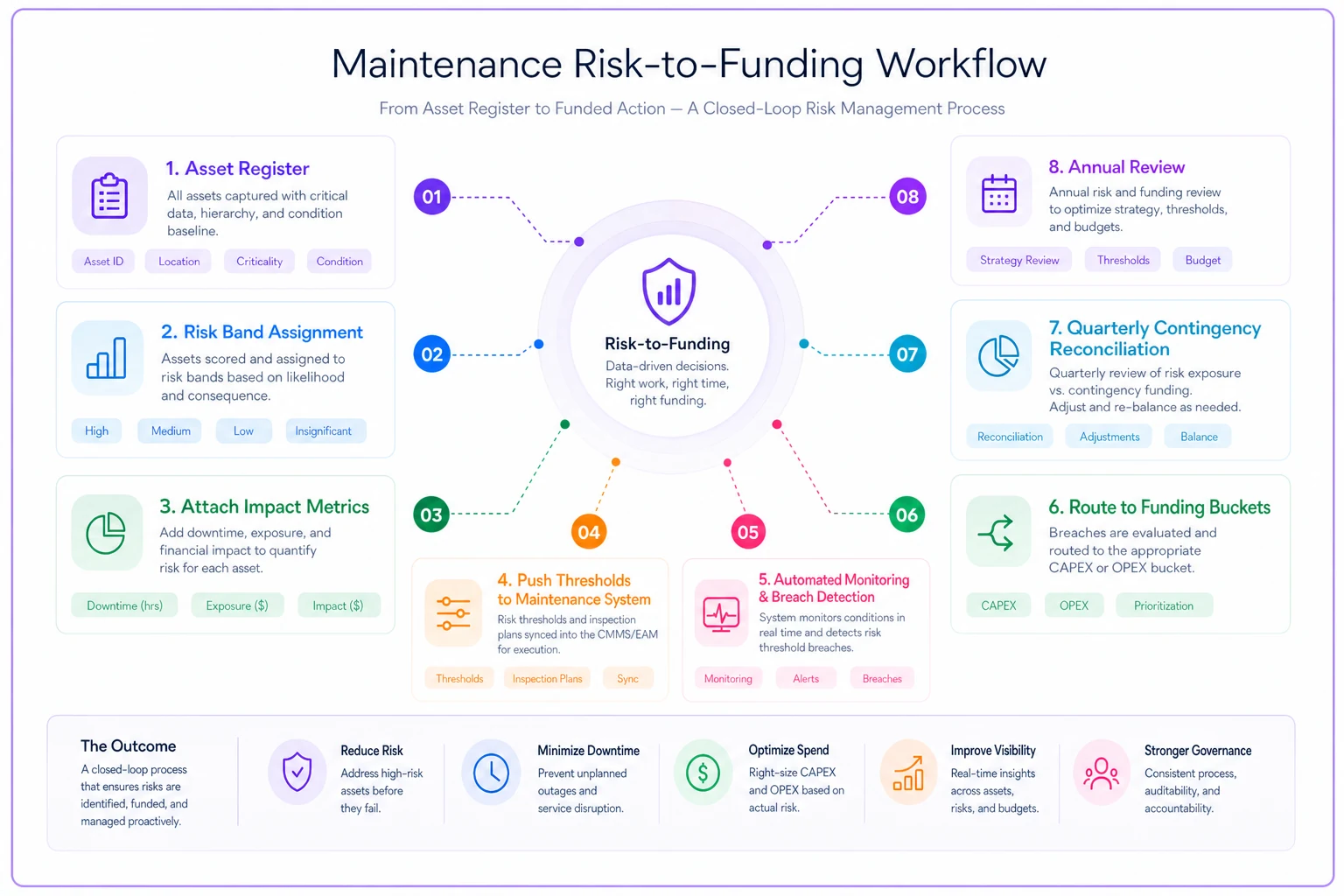
A simple diagram like this makes the automation points obvious and helps stakeholders see where the routing happens.
-
Band assignment with no owner. If nobody owns the band, nobody defends it, and it drifts. Every band needs a named accountable person.
-
Thresholds that live in a spreadsheet nobody watches. A threshold that isn't monitored against real data is a wish. The whole point is that breaches surface automatically and trigger routing — not that someone remembers to check a tab.
Assign a named owner to each band to prevent drift and ensure someone defends the threshold.
This is the practical reason to hold your asset register, thresholds, downtime data, and work history in one connected system rather than three disconnected tools. When band thresholds live next to actual downtime and spend, a breach routes itself to the right funding bucket instead of waiting for a human to notice, translate, and argue. Layering AI-assisted monitoring on top of that — flagging assets trending toward their exposure cap before they breach it — turns the framework from a quarterly review exercise into something that watches continuously. That's the difference between catching a Band B asset drifting toward failure in month three versus discovering it in the year-end budget post-mortem.
When this framework makes sense — and when it doesn't
When it works well:
-
You have a mixed portfolio where "everything is critical" has become the default and you need a way to break the tie.
-
Funding decisions are currently driven by the last failure or the most senior voice in the room.
-
Finance and reliability keep talking past each other because their numbers don't reconcile.
When it's overkill:
-
A single-asset operation or very small portfolio. If you have eleven assets, you don't need a four-band taxonomy — you need a spreadsheet and a conversation.
-
Extremely homogeneous fleets where every unit carries near-identical consequence. Banding adds ceremony without differentiation.
Who should probably wait:
If you can't produce a defensible downtime cost per asset, banding will just formalize your guesses. Build the exposure numbers first — otherwise the thresholds are decorative. And if your asset register itself is unreliable, fix the data before you fund based on it. Where you sit on that readiness curve is worth checking against the maintenance maturity model; banding pays off at the middle maturity stages, not the earliest ones.
A short real scenario
A regional food-processing operation ran about 240 tracked assets across two plants. Their budget process was pure recency — whatever broke last quarter got funded next quarter. Reliability capital was chronically over-requested and under-approved because every request looked equally urgent on paper.
They ran the banding exercise over roughly six weeks. The result surprised them: only around 30 assets landed in Band A, not the roughly 90 that owners had informally treated as critical. Reclassifying the rest freed up attention and budget that had been spread thin defending assets that didn't need Band A protection.
The concrete shift: two Band A packaging-line drives that had been stuck in a "maybe next year" CAPEX queue got funded immediately, because the framework showed their forecast downtime blew past the 4-hour threshold and no OPEX lever could close it. Meanwhile a batch of instrument replacements that had been auto-approved out of habit got downgraded to Band D corrective-only, trimming a chunk of unnecessary planned spend.
The net effect over the following year wasn't a dramatic headline number — it was quieter and more valuable. Unplanned downtime on the Band A assets dropped noticeably, the budget conversation went from three-hour arguments to a review of routed exposures, and the contingency reserve reconciliation caught roughly $200k of accepted exposure that had never been consciously funded. That last discovery was the moment leadership realized the old process wasn't managing risk — it was just hoping.
Closing thought
The value of mapping maintenance risk appetite to funding allocations isn't precision for its own sake. It's that it removes the argument. When a band, a threshold, and a routing rule have already decided where the money goes, the quarterly budget stops being a contest of conviction and starts being a review of whether reality still matches the bands you set.
The framework will be wrong sometimes — a Band C asset will fail in a way nobody expected, or a Band A threshold will turn out too tight. That's fine. A written, monitored, reconciled framework that's occasionally wrong beats a vague statement that's never testable at all. You can tune a number. You can't tune an adjective.
The value of mapping maintenance risk appetite to funding allocations isn't precision for its own sake. It's that it removes the argument. When a band, a threshold, and a routing rule have already decided where the money goes, the quarterly budget stops being a contest of conviction and starts being a review of whether reality still matches the bands you set.
The framework will be wrong sometimes — a Band C asset will fail in a way nobody expected, or a Band A threshold will turn out too tight. That's fine. A written, monitored, reconciled framework that's occasionally wrong beats a vague statement that's never testable at all. You can tune a number. You can't tune an adjective.
Ready to elevate your asset operations?
Join 1,500+ businesses using Ownitly to optimize asset utilization, reduce downtime, and ensure compliance.