

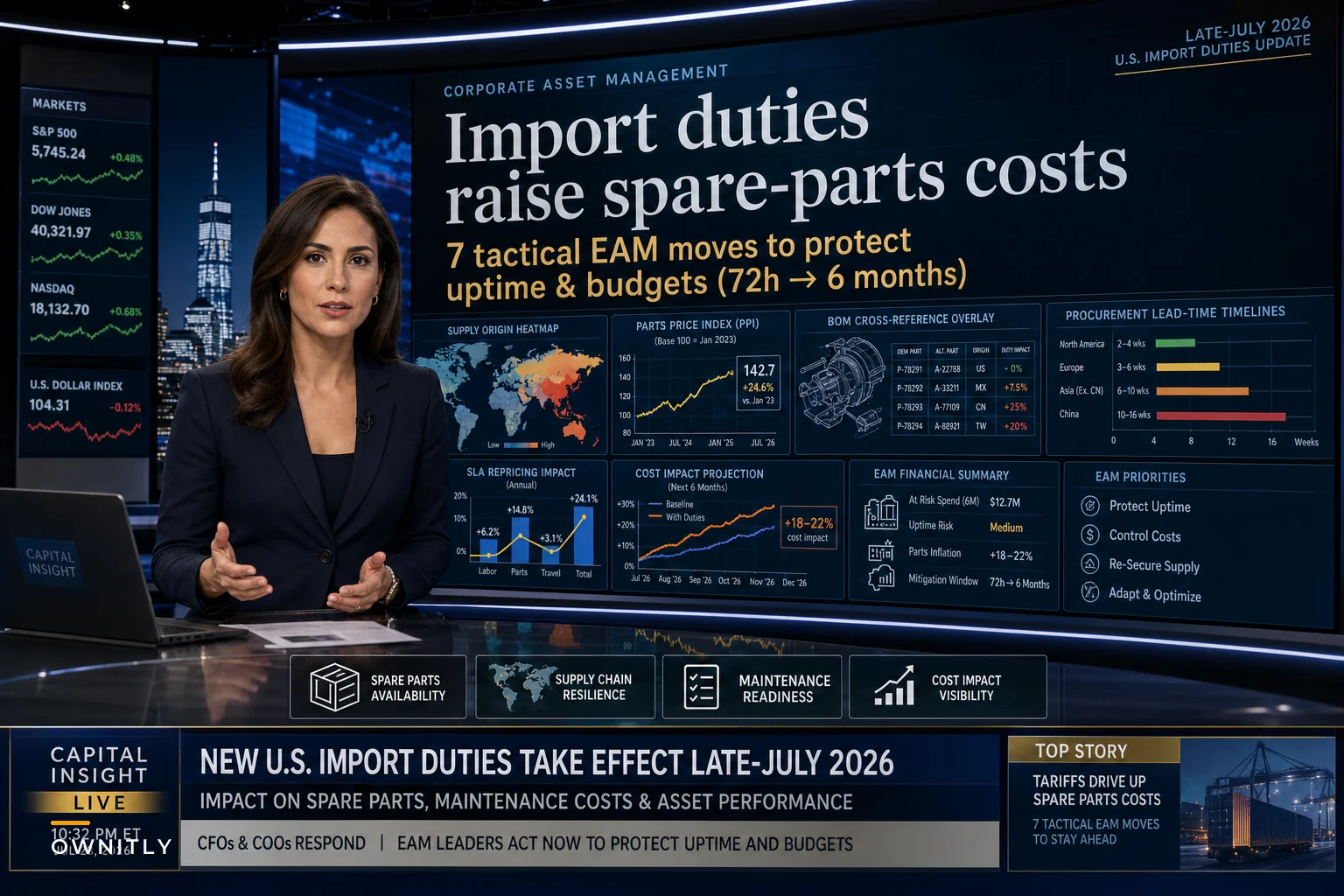

The forced-labor duties announced July 23rd hit maintenance operations like a wrench dropping into a gearbox. Reuters reported that these tariffs—running 10% to 12.5%—now cover imports from roughly 60 trading partners. For asset managers, that means the bearing you ordered last month at $840 just became a $940 bearing. Same part, same vendor, bigger invoice.
Why your parts budget is quietly breaking right now
The timing is rough. Most maintenance departments already burned through Q3 contingency funds dealing with summer heat failures and deferred work from Q2. Now procurement's calling about price adjustments on standing POs, and finance wants explanations for variance reports that suddenly look terrible.
What makes this different from a typical price increase is that these tariffs hit unevenly across your parts catalog. A motor from Germany faces different duty rates than one from Vietnam. Gaskets from Mexico get treated differently than those from India. Those carefully negotiated vendor agreements are now a mess of exceptions nobody planned for.
The real operational damage goes beyond sticker shock
Walk into any maintenance storeroom right now and you'll see supervisors doing frantic math on reorder points. That calculation used to be straightforward—usage rate times lead time plus safety stock. Now you're layering in tariff variability, potential supply switches, and the possibility that your primary vendor might pull out entirely.
Stop losing track of critical assets.
Ownitly helps you monitor, maintain, and manage every asset efficiently and reliably.
- Centralized asset tracking
- Automated maintenance alerts
- Compliance monitoring & reporting
No credit card required
A food processing plant dealt with exactly this a few weeks back. Their maintenance manager found that roughly 68% of critical spare parts came from affected countries. The immediate hit was around $180,000 unplanned against their Q4 maintenance budget. But the scarier number was the 14-day extension in average lead times as suppliers scrambled to find compliant sources.
What really breaks operations is the uncertainty. When a hydraulic pump fails at 2 AM, your technician needs to know there's a replacement in the storeroom. If procurement froze the PO because they're waiting on duty rate clarification, that pump isn't there. The line stays down, operators stand around, and production schedules start cascading.
The procurement-to-maintenance handoff, already fragile in most organizations, falls apart under this kind of pressure. Buyers hesitate to commit when prices might shift tomorrow. Planners can't schedule PM work without confidence in parts availability. The whole system slides into reactive mode, which ends up costing more than the tariffs themselves.
Seven moves that actually protect your operation
1. Run immediate exposure analysis on your parts catalog
Start with your CMMS parts master and cross-reference every SKU against country of origin. Most organizations find they don't actually know where 30–40% of their parts come from — the vendor might be domestic, but the manufacturer isn't.
Build a simple risk matrix:
| Parts Type | Origin | Action |
|---|---|---|
| Critical parts | Affected countries | Immediate action |
| Critical parts | Unaffected countries | Monitor |
| Non-critical parts | Affected countries | Plan alternatives |
| Non-critical parts | Unaffected countries | No action required |
Don't try to work through all 10,000 SKUs at once. Focus on parts with lead times over 30 days and annual spend over $5,000. That typically covers somewhere around 200–300 items representing roughly 70% of your actual risk exposure.
2. Establish tariff-adjusted reorder triggers
Your old min-max levels assumed stable pricing. That assumption is gone. For affected parts, you need reorder points that factor in both tariff volatility and extended lead times.
A practical approach: take your current reorder point and add 25% for any part facing tariffs. Then add another 10% for parts with single-source suppliers. Yes, carrying costs go up, but that's still cheaper than emergency expediting when tariffs spike unexpectedly.
If you normally reorder bearings at 20 units with a 45-day lead time, your tariff-adjusted trigger might be 28 units with a 60-day assumed lead. That builds in buffer for price negotiations and supply chain delays.
3. Create parallel sourcing paths without doubling inventory
The knee-jerk reaction is qualifying alternate suppliers for everything. That's expensive and usually overkill. A better approach is identifying your "bridge" parts — components that work across multiple equipment types.
A mid-sized chemical plant found 47 parts that could serve as temporary substitutes across different pump models. They only qualified alternates for those bridge parts, cutting qualification costs by roughly 70% while keeping operational flexibility intact. When their primary seal supplier got hit with tariffs, they switched to the alternate for three months while renegotiating pricing — and never touched emergency stock.
Setting up these parallel paths takes real cross-referencing work. Your spares pooling strategy becomes even more important when you're trying to minimize inventory investment while keeping flexibility. Document which parts can substitute, even if it means accepting slightly shorter service intervals.
Focus initial exposure analysis on parts with lead times over 30 days and annual spend over $5,000.
4. Renegotiate maintenance contracts with escalation caps
Your service providers are dealing with the same tariff pressures. Before they come to you with blanket 15% increases, get ahead of it with structured escalation agreements.
A tiered model tends to work well here:
-
Tariffs under 5%
Provider absorbs
-
Tariffs 5–10%
Split 50/50
-
Tariffs over 10%
Full pass-through with 30-day notice
Include documentation requirements — they need to prove the tariff impact with actual invoices, not just claim increases. One facility manager negotiated caps along these lines and saved around $67,000 over six months compared to accepting straight pass-through pricing. That number adds up fast across multiple service contracts.
5. Shift PM schedules to reduce parts consumption
This sounds counterintuitive, but extending certain PM intervals by 10–15% can meaningfully reduce parts consumption without significantly increasing failure risk. The key is picking the right equipment.
Start with over-maintained assets — equipment that never shows wear at current PM intervals. If you're replacing filters that still look clean or belts showing no wear, you're probably maintaining on schedule out of habit rather than need. Extending those intervals by 500–1,000 runtime hours can cut annual parts consumption by somewhere in the 8–12% range.
Don't touch intervals on critical equipment or anything with regulatory requirements. Focus on auxiliary systems, redundant equipment, and assets with solid condition monitoring already in place.
6. Build tariff impact into work order costing
Work order cost estimates are unreliable if they're pulling catalog prices from six months ago. Planners need visibility into actual landed costs during planning, not after the invoice arrives.
A simple multiplier table by commodity type helps:
| Commodity Type | Multiplier |
|---|---|
| Electronics / sensors | 1.12x |
| Steel components | 1.10x |
| Rubber / polymer parts | 1.08x |
| Domestic assemblies | 1.03x |
Apply these during work order planning in your CMMS. When technicians see the real cost of parts, decisions shift. That $200 seal kit starts looking worth rebuilding instead of replacing when it's actually $225 after duties.
7. Establish emergency procurement protocols
When equipment fails and you need parts now, tariff optimization isn't the priority. But you still need controls to keep emergency buying from wrecking your budget.
Pre-approved emergency procurement thresholds work well:
-
Under $5,000
Supervisor approval with any supplier
-
$5,000–$15,000
Manager approval with preferred supplier list
-
Over $15,000
Director approval with competitive quotes
Also worth setting up: a "tariff override" authorization specifically for critical repairs. This lets buyers source from higher-tariff suppliers when necessary but tracks those decisions for later review. A paper mill using this approach found they only needed overrides for about 3% of emergency purchases — much lower than the 15% they initially feared.
How this disruption maps to your decision flow
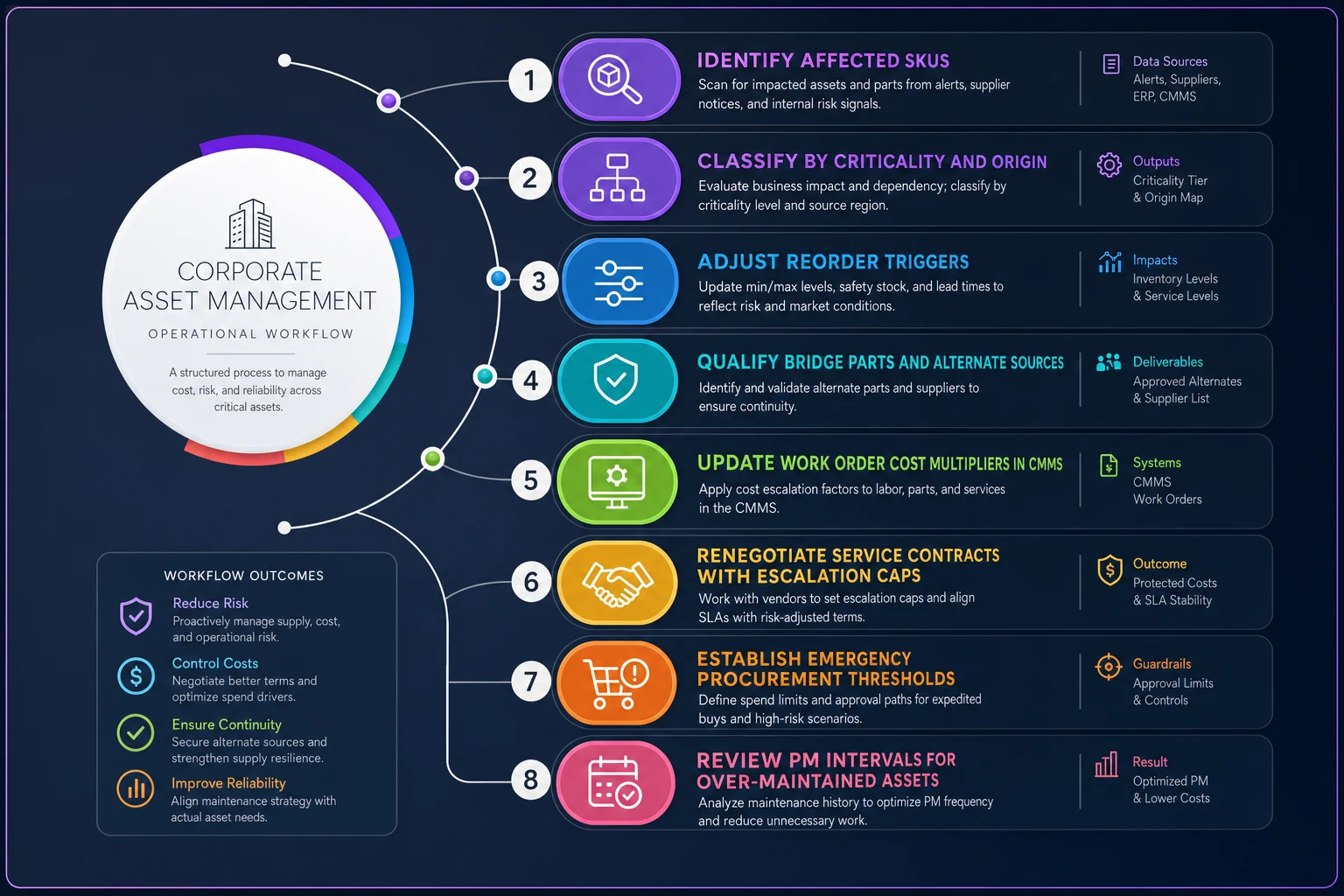
When tariff exposure hits your parts catalog, the decision path matters as much as the individual tactics. Here's how the response sequence connects:
Use the flow below as the recommended sequence.
-
Identify affected SKUs
-
Classify by criticality and origin
-
Adjust reorder triggers for affected parts
-
Qualify bridge parts and alternate sources
-
Update work order cost multipliers in CMMS
-
Renegotiate service contracts with escalation caps
-
Establish emergency procurement thresholds
-
Review PM intervals for over-maintained assets
Running these steps in order matters. Organizations that jump straight to alternate sourcing without first understanding their actual exposure tend to over-qualify parts they don't really need and miss the ones that matter.
The competitive advantage hidden in this chaos
While everyone scrambles to understand tariff codes and harmonized system classifications, disciplined operators are using this disruption to fix longstanding problems. That deferred CMMS cleanup project? Now it matters for tracking country of origin. The spare parts optimization study gathering dust? It just became urgent when carrying costs jumped 20%.
Operations with strong process discipline will come out of this period with better inventory management, cleaner data, and more flexible supply chains. Those running on spreadsheets and tribal knowledge will stay perpetually reactive, bleeding money through emergency purchases and preventable downtime.
A metals processor turned their tariff response into a full maintenance transformation. They used the pressure of rising costs to finally secure funding for predictive maintenance tools, arguing that cutting failures by 20% would offset most tariff impacts. Six months in, their maintenance costs were actually lower than pre-tariff levels while competitors dealt with both higher parts costs and more frequent failures.
The USTR has also signaled that Section 301 investigations are ongoing, which means duty structures may keep shifting. Building adaptable processes now is more valuable than optimizing for whatever the current rate happens to be.
Moving forward with tactical precision
The maintenance departments that get through this won't be the ones that find magical tariff-free suppliers or negotiate impossible discounts. They'll be the ones that adapt their operating model to work within new constraints.
That means accepting some costs will go up and building systems to minimize operational impact. It means having direct conversations with finance about carrying cost versus downtime risk. It means training technicians to think about parts consumption differently.
Most organizations want a simple solution — a new supplier, a bulk purchase, a clever workaround. But tariffs on spare parts aren't a problem you solve once. They're a new operating condition that requires adjustment across the whole maintenance operation. The sooner that sinks in and you start building resilient processes, the less these duties will actually cost you long-term.
Your equipment doesn't care about trade policy. It'll fail on the same schedule regardless of duty rates. But your response to those failures — how quickly you restore service, how efficiently you consume parts, how well you predict and prevent problems — that's where operational discipline either saves you or sinks you.
Ready to elevate your asset operations?
Join 1,500+ businesses using Ownitly to optimize asset utilization, reduce downtime, and ensure compliance.