

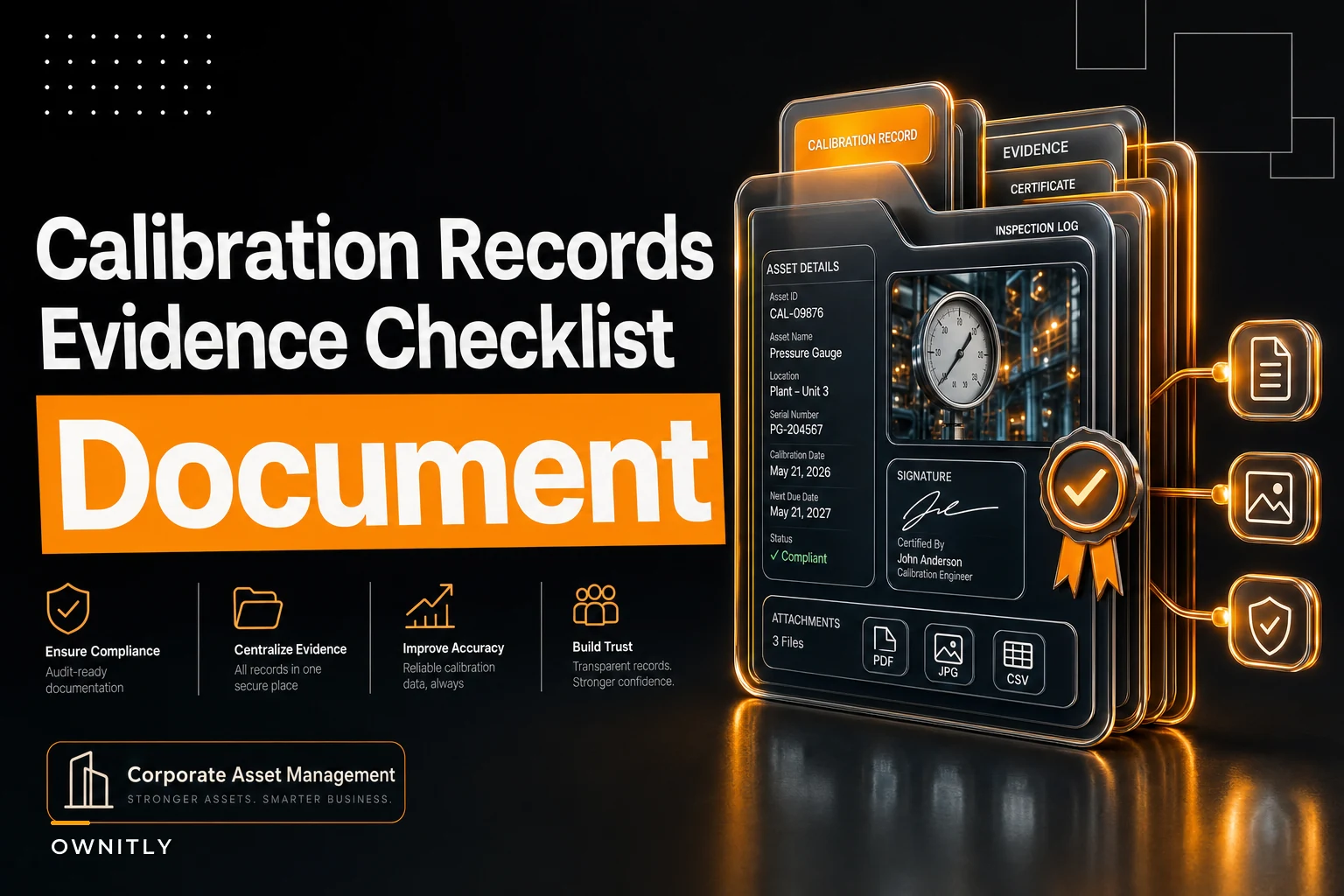

Pull any ten routine calibration records from a plant running a risk‑based program and you'll usually find the same problem: the scheduling logic is solid, but the evidence is a mess. The interval math is defensible, the drift history is tracked, but the actual record of what happened on the bench or in the field is thin, inconsistent, or scattered across three systems.
That's the gap this article closes. Not when to calibrate — that's covered separately in risk-based calibration scheduling. This is about what you capture every single time a routine calibration is performed, and how you package it so that two years later someone can reconstruct exactly what happened without calling the technician who did the work — who may have left the company by then.
Start with the record, not the schedule
Teams invest heavily in the scheduling engine and treat the record as an afterthought — a signed paper sheet, a PDF dumped into a shared folder, maybe a line in the CMMS saying "PASS."
The schedule tells you when. The evidence package tells you what, how, and whether you can trust it. During an audit, nobody questions your interval rules first. They pull a record and start asking: "Show me the as‑found reading. What standard did you use? Was that standard in cal at the time? Who performed this?"
If the answer to any of those is "let me check another system" or "the tech would remember," you've already lost the thread.
A routine calibration evidence package is the complete, self‑contained set of data and documents that proves one calibration event happened correctly. Self‑contained is the key phrase. If someone has to go hunting across systems to verify a single calibration, the package isn't finished.
The required metadata — the non‑negotiable core
These fields have to be present on every routine calibration, no exceptions. If any one is missing, the record is incomplete and, in a regulated context, potentially worthless.
Stop losing track of critical assets.
Ownitly helps you monitor, maintain, and manage every asset efficiently and reliably.
- Centralized asset tracking
- Automated maintenance alerts
- Compliance monitoring & reporting
No credit card required
-
Device ID — the unique asset/instrument tag, not the model number. "Pressure transmitter, Rosemount 3051" is useless. "PT‑4021‑A" is a record.
-
Calibration method / procedure reference — the specific SOP or procedure number and revision used. Procedures change; the revision matters.
-
Date and time — both, not just date. "Before or after the shift incident at 14:30" becomes answerable only if you have the time.
-
As‑found (pre) readings — what the instrument read before any adjustment. This is the most commonly fumbled field, and it's the one auditors care about most, because it tells you whether the instrument was in tolerance during the period it was actually in service.
-
As‑left (post) readings — what it read after adjustment. If no adjustment was made, as‑found equals as‑left, and you still record both.
-
Reference standard used — the ID of the standard/working master, and its own calibration due date or certificate reference. An in‑tolerance reading taken with an out‑of‑cal standard proves nothing.
-
Measurement uncertainty — the expanded uncertainty for the calibration, with coverage factor. Skipping this is one of the fastest ways to get an audit finding in an accredited lab.
-
Pass/fail determination — against a stated acceptance tolerance, not a vague "looks fine." The tolerance value itself goes in the record.
-
Technician identity — the named person who performed it. Initials alone don't scale across a 40‑person team with two "JMs."
-
Signature / authenticated approval — electronic or wet, with a reviewer sign‑off separate from the performer where your quality system requires it.
A quick field test: hand the record to someone who wasn't there and ask them to tell you whether the instrument passed, against what, measured how, by whom, and when. If they can answer all of that from the record alone, the core is complete.
Required vs. enriched: know the difference
Not everything belongs in every package. The core above is mandatory. Enriched items are the things that turn a compliant record into a defensible, reconstructable one. The trick is knowing which enrichments earn their keep for a given instrument class, because capturing everything on everything just buries the signal.
| Item | Required core | Enriched (add for higher‑risk instruments) |
|---|---|---|
| Device ID | ✔ | |
| Procedure ref + revision | ✔ | |
| Date & time | ✔ | |
| As‑found / as‑left readings | ✔ | |
| Reference standard + its cal status | ✔ | |
| Uncertainty | ✔ | |
| Pass/fail + stated tolerance | ✔ | |
| Technician + signatures | ✔ | |
| Raw data files (meter exports, CSV) | ✔ | |
| Linked calibration certificate (PDF) | ✔ | |
| Photos of setup / nameplate / seals | ✔ | |
| Drift reference (trend vs. prior events) | ✔ | |
| Environmental conditions (temp/humidity) | ✔ for sensitive measurements |
The pattern worth internalizing: the core is about compliance, the enrichments are about reconstruction and troubleshooting. When an instrument fails and you need to figure out how long it was drifting, the as‑found readings tell you the current state, but the drift reference and raw data files tell you the story. That story is what saves you during a deviation investigation.
Example: minimal vs. enriched package
A minimal package for a low‑risk, low‑consequence instrument — say, a non‑critical panel gauge on a utility line:
-
PT‑7730 | SOP‑CAL‑12 Rev C | 2026‑03‑14 09
40 | As‑found 0.02% high, as‑left 0.01% | Std MS‑04 (cal due 2026‑08) | U = 0.05% (k=2) | PASS (tol ±0.25%) | Tech R. Okafor | e‑signed, reviewed by L. Haddad
That's it. One compact record, fully self‑contained. For an instrument that wouldn't trigger a safety or quality event if it drifted, this is proportionate.
An enriched package for a critical instrument — say, a flow meter feeding a batch dosing step in a regulated process:
-
All of the above core fields, plus
-
Raw CSV export from the calibration flow rig (all five test points, three runs each)
-
Linked PDF certificate from the accredited lab, with its reference number embedded
-
Photos
instrument tag plate, test rig connection, tamper seal before and after
-
Drift reference
a short trend showing as‑found values across the last four calibration events, with the slope annotated
-
Environmental log
21.3°C, 44% RH during the procedure
The enriched version takes maybe ten extra minutes to assemble. For an instrument where a silent drift could scrap a batch worth more than a technician's monthly salary, that ten minutes is the cheapest insurance you'll buy all year.
File naming and folder conventions that survive five years
This is the boring part, and it's where almost everyone loses data. Records that can't be found are records that don't exist, as far as an auditor is concerned.
[DeviceID][YYYYMMDD][ProcedureRef][Result].ext PT-4021-A20260314SOP-CAL-12-CPASS.pdf PT-4021-A20260314SOP-CAL-12-C_rawdata.csv
Three principles that matter more than the exact format:
-
Device ID first. You will search by instrument far more often than by date or technician. Lead with what you search by.
-
ISO date format (YYYYMMDD). It sorts chronologically on its own. "3‑14‑26" does not, and mixed US/international date formats in the same folder are a genuine nightmare during an audit pull.
-
No spaces, no special characters. They break scripts, break links, and break when you migrate systems. Underscores and hyphens only.
Put the Device ID at the start of the filename so searches return instrument-specific results quickly.
For folders, organize by instrument first, then by year — not the reverse. You're almost always answering "show me every calibration for PT‑4021‑A" rather than "show me everything calibrated in March." Let the folder structure match how you'll actually retrieve things.
Retention and versioning — the part people get wrong
Two failure modes come up repeatedly here.
The first is under‑retention: records purged before the retention clock actually runs out. The retention period for a calibration record isn't tied to the calibration date — it's often tied to the service life of the product or batch the instrument touched. A record from 2021 might still be live because the batch it validated is still on a shelf somewhere. Set retention based on the downstream obligation, not the calendar date of the cal.
The second is silent overwriting. Someone finds a typo in an as‑left value, opens the file, fixes it, saves over the original. Now there's no record that the value was ever different — which in a regulated environment is worse than the original typo. Every change to a committed calibration record needs to be a new version with the original preserved and a reason logged. Append, never overwrite.
Practical versioning rules worth adopting:
-
Lock the record once reviewed and approved. After that, changes create a new revision, not an edit.
-
Keep a change reason on every revision — even "corrected transcription error" is enough, as long as it's there.
-
Preserve the full audit trail of who changed what, when, and why. If your system can't do this natively, you need a different system for these records.
If your system can't do this natively, you need a different system for these records.
Where the records should actually live
Spreadsheets and shared drives work right up until they don't — usually somewhere around a few hundred instruments or your first serious audit. The failure isn't dramatic; it's slow. A file gets saved to the wrong folder. A date format drifts between technicians. An as‑found value gets transcribed wrong off a paper sheet three days later from memory.
-
The metadata becomes mandatory at entry. You physically can't close the calibration work order without the required core fields. That alone eliminates the most common finding.
-
The record links to the asset master automatically, so the device ID is always valid and the calibration history for any instrument is one click away — which is exactly what feeds the drift analysis your scheduling program depends on.
-
Reference standard status gets validated in real time. If the standard you selected is out of cal, the system flags it before you've wasted the calibration, rather than an auditor catching it afterward.
-
Audit reports generate from structured data instead of being assembled by hand the week before the audit. "Show me all failed calibrations on critical instruments in Q1" becomes a query, not a two‑day scavenger hunt.
Here's a simple workflow visualization of how records should flow through systems.
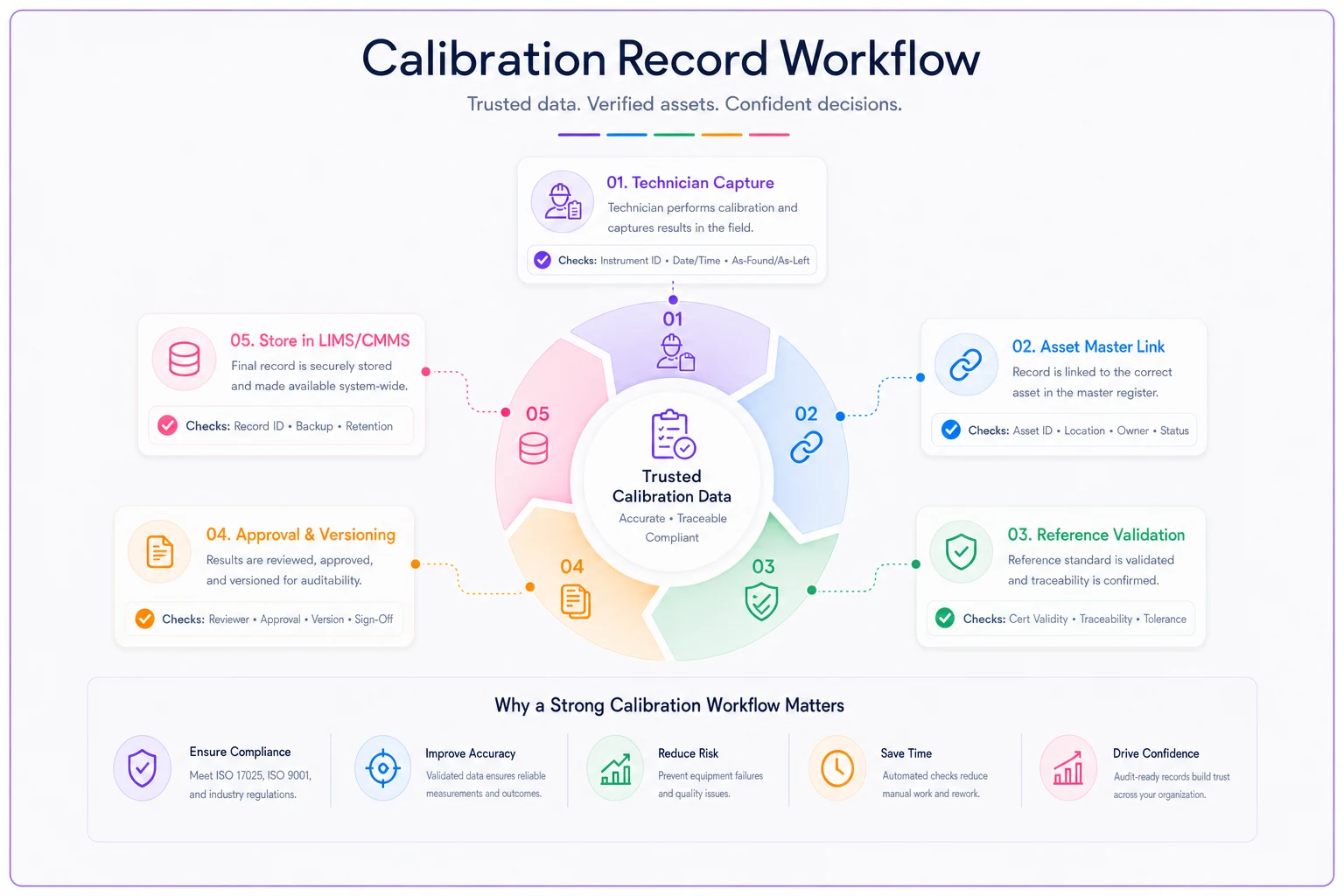
The honest caveat: a system only helps if the capture discipline is there. A CMMS full of "PASS" entries with blank as‑found fields is no better than a filing cabinet. The tool enforces structure; it doesn't replace the decision about what structure you need. Get the checklist right first, then let the system enforce it.
A short real scenario
A mid‑sized contract packaging operation ran roughly 280 instruments under a risk‑based program. The scheduling was genuinely good. The records were paper, scanned to PDF, named by whoever scanned them.
During a customer audit, the auditor asked for the calibration history of three specific flow meters over 18 months. It took the quality team close to two days to pull it together, and two of the records were missing as‑found values entirely — the technician had only logged as‑left. That turned into a finding, then a corrective action, then a follow‑up audit.
After moving the records into their CMMS with mandatory core fields and the naming convention above, the same request — pulled during the follow‑up — took under an hour and came out as a report. No missing fields, because the system wouldn't let the work order close without them. The scheduling never changed. Only the evidence discipline did. The difference between a finding and a clean pass was entirely in how the record was captured and stored.
When a minimal package is the right call — and when it isn't
Over‑documenting low‑risk instruments is a real cost. If a technician spends fifteen minutes assembling photos and raw exports for a non‑critical gauge that wouldn't affect quality or safety if it drifted, that time is being pulled away from the instruments that actually matter.
Minimal is appropriate when: the instrument is low‑consequence, has a stable drift history, and nothing downstream depends on its precision in a way that could affect a product, a person, or a compliance obligation.
Enriched is non‑negotiable when: the instrument feeds a critical process parameter, has shown drift in recent history, is subject to regulatory scrutiny, or its failure would trigger a batch investigation. For these, the raw data and drift reference aren't nice‑to‑haves — they're what you'll reach for first when something goes wrong.
The mistake isn't choosing one or the other. It's applying the same documentation depth to everything, which either buries your critical records in noise or leaves them dangerously thin. Match the package to the risk, the same way you match the interval to the risk.
The checklist to pin above the calibration bench
Work through this for every routine calibration before closing the record:
-
Device ID (asset tag, not model)
-
Procedure reference and revision
-
Date and time
-
As‑found readings recorded before any adjustment
-
As‑left readings
-
Reference standard ID and its own cal status
-
Measurement uncertainty with coverage factor
-
Pass/fail against a stated tolerance
-
Named technician
-
Signature / authenticated approval (plus independent review where required)
-
Enrichments added where the risk justifies them
raw data, certificate, photos, drift reference, environmental conditions
-
File named using the DeviceIDdateprocedure_result convention
-
Stored where it links to the asset master and cannot be silently overwritten
If every routine calibration leaves behind a package that checks these boxes, you've solved the problem most risk‑based programs quietly have: excellent scheduling, undermined by evidence nobody can trust two years later. The schedule decides when. The package decides whether any of it holds up.
If every routine calibration leaves behind a package that checks these boxes, you've solved the problem most risk‑based programs quietly have: excellent scheduling, undermined by evidence nobody can trust two years later. The schedule decides when. The package decides whether any of it holds up.
Ready to elevate your asset operations?
Join 1,500+ businesses using Ownitly to optimize asset utilization, reduce downtime, and ensure compliance.