


Most hybrid EAM problems don't show up as failures. They show up as quiet disagreement. Your cloud platform says a pump was replaced on the 14th. Your on-prem system of record still has it as active, under warranty, running on the old asset tag. Nobody notices until finance asks why depreciation doesn't match the field, or until a regulator asks for the maintenance history and you hand them two versions of the truth.
That's the real cost of running hybrid EAM at scale. Not the architecture diagrams — the day-to-day drift between systems that are each individually correct and collectively lying.
This piece is about the operational machinery that keeps a hybrid EAM dual-read reconciliation model trustworthy: how you decide to go hybrid in the first place, how you build reconciliation runbooks people actually run, how you gate promotions and rollbacks so bad data doesn't propagate, and how you detect drift before it reaches a report someone signs their name to.
First, the decision nobody wants to make honestly: hybrid or single-platform?
There's a reflex in asset-heavy organizations to treat hybrid as the "safe" choice — keep the legacy EAM, bolt on a modern cloud layer, migrate "when we're ready." In practice, "when we're ready" never arrives, and you've committed to running two systems of record indefinitely without admitting it.
Hybrid is a legitimate architecture. But it's expensive in a way that doesn't show up on the license invoice. Every hybrid setup means someone owns reconciliation forever. If you don't staff and tool that reality, you're not running hybrid — you're running two systems that happen to disagree.
Here's the decision matrix I'd actually use, stripped of vendor politics:
| Factor | Lean single-platform | Lean hybrid (dual-read) |
|---|---|---|
| Regulatory record-of-truth | One clear authoritative system is required | Different jurisdictions/plants legally need different retention or residency |
| Field + finance data velocity | Low-to-moderate change volume | High transaction volume with distinct latency needs (real-time field vs. batch finance) |
| Legacy system lock-in | Migration is feasible within ~18 months | Legacy system is irreplaceable (OT integration, custom controls) |
| Reconciliation capacity | No appetite to own ongoing reconciliation | You can fund a standing reconciliation function |
| Failure tolerance | Can accept short cutover risk | Cannot tolerate big-bang cutover |
| Cost profile | Lower run-cost, higher migration cost | Lower migration risk, higher run-cost |
The pattern worth noticing: hybrid rarely wins on the merits of a single factor. It wins when two or three non-negotiables collide — usually a legacy OT-coupled system you can't rip out, plus a regulatory residency requirement, plus a transaction volume that makes a clean cutover genuinely dangerous. If you only have one of those, you're probably rationalizing avoidance of a hard migration.
When hybrid actually makes sense
-
You have a plant-floor EAM welded to control systems, and the cloud platform serves finance, analytics, and multi-site reporting. Neither can be the sole record.
-
Data residency rules force certain asset records to physically stay in a jurisdiction while the rest consolidate centrally.
-
You're mid-migration and need both systems live during a phased cutover — this is temporary hybrid, and you should name it that way.
When hybrid is a bad idea
-
You chose it to avoid the discomfort of a cutover decision.
-
You can't name a single owner of reconciliation for each data domain.
-
Your "integration" is a nightly CSV dump nobody validates.
If you're still weighing the structural tradeoffs, the groundwork in EAM architecture and integration patterns for enterprise scale is worth reading before you commit. A lot of hybrid pain traces back to integration shortcuts taken early.
What "dual-read" actually means operationally
Dual-read is simple to say and easy to get wrong. The idea: for a given asset domain, you read from both systems and compare, rather than assuming the sync worked. One system is the authoritative writer for each field; the other is a mirror. Reconciliation is the act of continuously proving the mirror still matches the master.
Stop losing track of critical assets.
Ownitly helps you monitor, maintain, and manage every asset efficiently and reliably.
- Centralized asset tracking
- Automated maintenance alerts
- Compliance monitoring & reporting
No credit card required
The mistake teams make is treating sync as a one-way guarantee. "We pushed the record, so it's there." But pushes fail silently — a schema mismatch drops a field, a null overwrites a populated value, a timezone shift moves a completion date by a day. None of these throw errors. They just produce two records that are each plausible and quietly different.
Dual-read reconciliation isn't a pipe. It's a comparison discipline. For every reconciled field you need to answer three things:
-
Which system is the master for this field? Asset status, cost, and work order completion may each have different masters.
-
What's the acceptable tolerance? Exact match for asset tags; a few minutes' skew is usually fine for timestamps.
-
What happens when they disagree? Auto-correct, flag for review, or halt and escalate.
That third answer is where most programs are vague, and vagueness is what turns a 20-minute reconciliation into a 3-hour archaeology dig.
The reconciliation runbook: make it boring and repeatable
A reconciliation runbook is not a policy document. It's an operational script someone runs on a schedule, producing the same artifacts every time, so that a different person could run it next week and get identical results.
Here's the structure of a runbook that survives contact with reality:
The numbered reconciliation process
-
Snapshot both systems at a fixed cut point. Same moment, both sides. If you snapshot the cloud at 2:00 and on-prem at 2:40, you've built drift into the comparison itself.
-
Normalize before you compare. Strip timezone, trim whitespace, standardize units, resolve code lookups. Most "mismatches" are formatting, not substance — and if you don't normalize first, you'll chase ghosts.
-
Run field-level comparison by domain. Asset master, work orders, cost postings, status. Don't lump them; different domains have different masters and tolerances.
-
Classify each delta. Three buckets
expected (known lag, already in flight), tolerable (within defined threshold), exception (real disagreement requiring action).
-
Route exceptions to a named owner with a resolution SLA. An unassigned exception is an exception that will reappear next cycle, bigger.
-
Record the resolution and the evidence. What was wrong, which system was corrected, who approved it, timestamp. This is what you'll need when someone questions it in six months.
-
Re-run a targeted check on the corrected records to confirm the fix held.
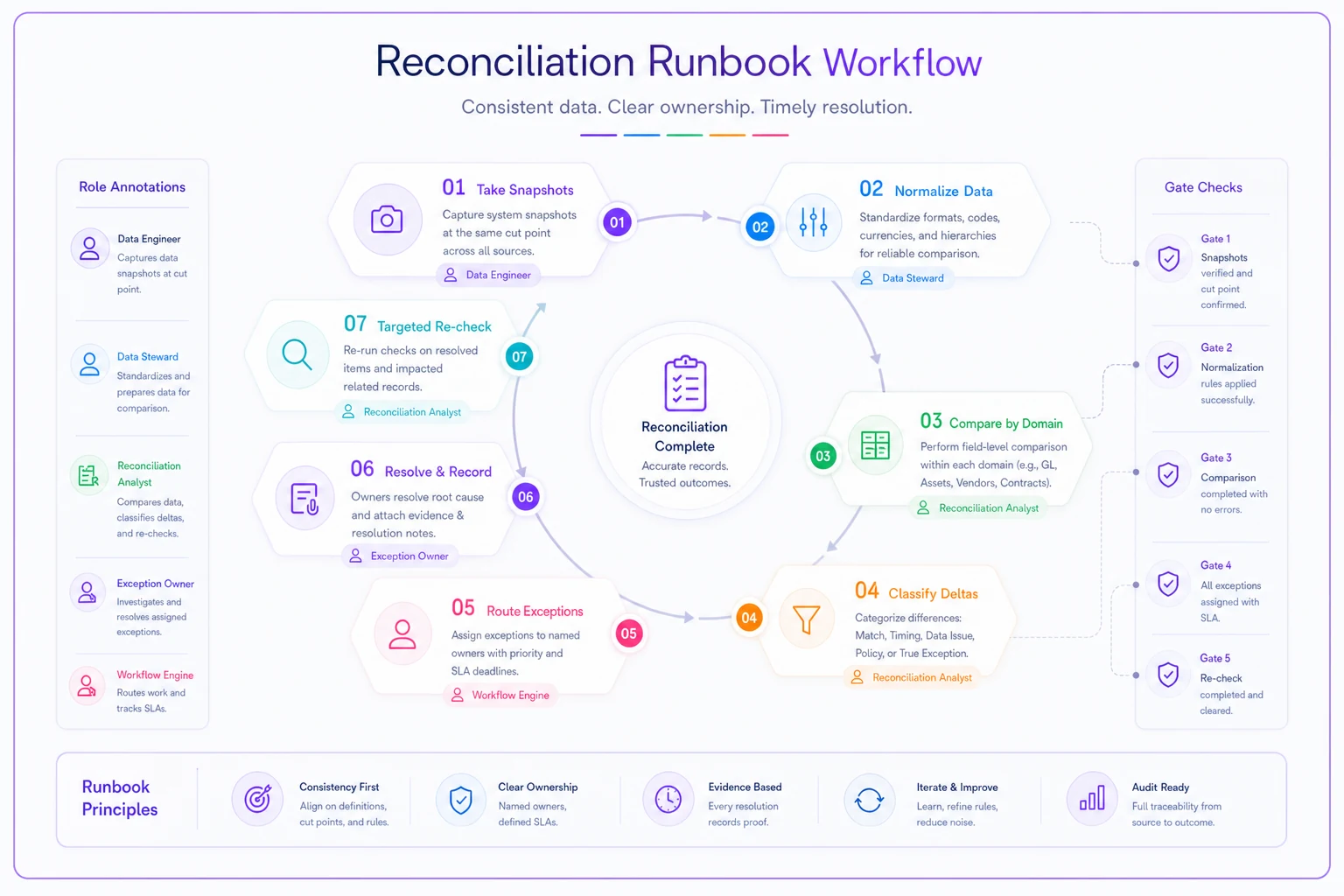
The diagram above outlines the runbook flow from snapshot to verification.
What separates a real runbook from a wishlist: steps 4 through 7 have named owners and time limits. "Someone looks into mismatches" is not a runbook. "Cost-posting exceptions route to the plant controller with a 48-hour resolution SLA" is.
A reconciliation checklist you can steal
-
- [ ] Both snapshots taken at the same cut point, documented
-
- [ ] Normalization rules applied and versioned
-
- [ ] Each reconciled field has a declared master system
-
- [ ] Tolerance thresholds defined per field, not global
-
- [ ] Deltas classified into expected / tolerable / exception
-
- [ ] Every exception has an owner and an SLA
-
- [ ] Resolution evidence captured (what, who, when, which system corrected)
-
- [ ] Targeted re-check confirms the fix
-
- [ ] Exception volume trended over time, not just resolved per cycle
That last bullet matters more than it looks. If you only resolve exceptions and never trend them, you'll fix the same five records every week and never notice the integration is slowly degrading.
Promotion and rollback gates: stop bad data from propagating
Reconciliation tells you two systems disagree. Gates decide what you're allowed to do about it — and, more importantly, what you're not allowed to do until the disagreement is resolved.
A promotion gate is a checkpoint between environments or between the staging of a data change and its acceptance as the record of truth. In a hybrid model, promotion gates usually sit at two places: when a change in the writer system is promoted to become the authoritative value, and when a batch is cleared to sync to the mirror.
The failure mode without gates: a bad bulk update — say, a mass asset reclassification — gets applied, syncs to the mirror, overwrites good data on both sides, and now there's no clean copy to roll back to. You've corrupted both your record and your backup of the record in the same motion.
A workable gate model:
-
Pre-promotion check. Before a change batch is accepted, run reconciliation against a baseline. If the delta exceeds a threshold — more than 2% of records in the batch changing status unexpectedly, for example — the gate holds and escalates.
-
Promotion approval. A named role signs off that the delta is intended. "We reclassified 400 assets on purpose" is a valid reason to pass the gate. An unexplained 400-record change is not.
-
Post-promotion verification. After promotion, re-reconcile to confirm both systems now agree. Only then is the change "landed."
-
Rollback trigger. Defined conditions that automatically revert
verification fails, exception volume spikes, a downstream system rejects the batch.
Rollback is the part everyone skips because it's annoying to build and they assume they won't need it. The teams that get burned are always the ones who could promote in one click but had no equivalent "undo." You need a pre-promotion snapshot preserved long enough to restore from, and a documented procedure for restoring it — rehearsed, not theoretical.
A quick real scenario
A multi-site utility running a legacy on-prem EAM for plant controls alongside a cloud platform for finance and analytics across around nine sites was reconciling roughly 40,000 active asset records nightly. Reconciliation "ran," but it was a nightly export compared by a spreadsheet macro one analyst maintained. When he was out, nobody reconciled.
The breaking point: a batch warranty-status update flipped around 1,100 assets to "out of warranty" incorrectly because of a code-mapping mismatch between systems. It synced. Finance picked it up for a capital review and nearly greenlit replacement spend on assets that were fine. The error got caught, but only because a plant engineer happened to question one line item.
They rebuilt it as a proper runbook with gates: same-cut-point snapshots, per-domain comparison, a 2% delta threshold that held the batch, and a named approver. Over the next couple of quarters, unexplained deltas per cycle dropped from somewhere in the 300–400 range to under 50. More telling — the ones that remained were real, explainable, and resolved inside the SLA instead of piling up. The spreadsheet analyst stopped being a single point of failure, which was arguably the bigger win.
Nothing about that fix was exotic. It was discipline, ownership, and gates where there used to be a nightly leap of faith.
Evidence bundling: reconciliation you can defend
A reconciliation that fixes data but leaves no trace is only half done. At scale — especially in regulated environments — you need to prove what disagreed, how you resolved it, and who decided. That's the evidence bundle.
-
The two source snapshots (or hashes of them, with the snapshots archived)
-
The normalization rule version applied
-
The full delta report, classified
-
The resolution log for each exception
action taken, master system, approver, timestamp
-
The post-fix verification result
-
The gate decisions (what passed, what held, what was overridden and by whom)
Bundle this per cycle rather than relying on scattered logs. When someone six months out asks why a particular asset's cost history has a correction on March 3rd, you want to hand them one coherent package — not reconstruct it from four systems. The same handoff discipline that keeps procurement and finance aligned applies here. The breakdowns described in avoiding common EAM–ERP handoff failures are, at root, the same category of problem: changes crossing a system boundary without a verified, evidenced landing.
Monitoring for drift, not just mismatches
There's a difference between a mismatch and drift. A mismatch is a single record disagreeing right now. Drift is the trend — the slow widening of disagreement that reconciliation keeps patching without anyone asking why the patch is needed more often.
Most teams monitor mismatches and ignore drift. Drift is the more dangerous signal because it means something structural is degrading: a schema changed, a sync job is silently truncating, a code table went stale, volume outgrew the batch window.
Useful drift signals to watch:
-
Exception rate over time, by domain. A rising baseline means the pipeline is degrading, not that today was unusual.
-
Recurring records. The same assets showing up cycle after cycle point to a mapping or ownership problem, not a transient glitch.
-
Time-to-resolution trend. If exceptions take longer to clear each month, your capacity is being outrun.
-
Silent-field drift. Fields that stopped changing when they should be changing — often the sign a sync quietly broke and nobody noticed because nothing errored.
That last one catches the worst failures. An erroring sync screams. A sync that succeeds but silently stopped carrying one field whispers, and you only hear it when the data's been wrong for weeks.
Who should NOT run a hybrid dual-read model
If you can't commit to a standing reconciliation function — tooling plus named owners plus a monitored drift signal — don't go hybrid. A hybrid architecture without disciplined reconciliation isn't resilience, it's two systems slowly diverging while everyone assumes they match. You'd be safer on a single platform you trust than two platforms you hope agree.
Hybrid rewards organizations that treat reconciliation as a permanent operational capability, the same way they treat backups or security monitoring. It punishes the ones who treat it as a migration afterthought.
Pulling it together
The honest version of hybrid EAM is this: you're not buying flexibility, you're buying an obligation. The obligation is to prove, continuously, that your two systems of record still tell the same story — and to catch it fast when they don't.
The organizations that run this well don't have fancier architecture. They have boring, repeatable runbooks; gates that refuse to promote unexplained changes; evidence bundles they can hand to an auditor without flinching; and drift monitoring that surfaces degradation before it reaches a report. Dual-read isn't a feature you turn on. It's a discipline you fund and keep funding — and when you do, the quiet disagreement between systems stops being a liability and becomes something you can actually see, measure, and trust.
Ready to elevate your asset operations?
Join 1,500+ businesses using Ownitly to optimize asset utilization, reduce downtime, and ensure compliance.