

Most EAM architecture arguments never actually get to architecture. They get stuck on vendor features, dashboards, and which mobile app the technicians hate least. Meanwhile the thing that actually decides whether your program survives at scale — how asset data, work-order events, condition signals, and financial postings flow between systems — gets designed accidentally. Somebody wires a nightly batch job, somebody else adds a webhook, a contractor bolts on a middleware layer, and three years later nobody can explain why an asset's cost history disagrees between the EAM and the ledger.
This piece is about that plumbing. Specifically: picking the right topology for your scale and audit profile, writing data contracts that survive team turnover, and building promotion and rollback gates so that when you push a new model or a schema change, you can prove exactly what happened and undo it cleanly. If you run assets across multiple sites and answer to auditors, this layer quietly determines your credibility.
Why integration shape matters more than feature lists
Two organizations can buy the exact same EAM platform and end up with completely different reliability outcomes based purely on how they connect it to everything else. Same features. Different integration topology. Very different results.
The pattern that shows up constantly: a program starts small, integration is simple, everything works. Then a second site comes online with slightly different asset naming. Finance wants near-real-time cost visibility instead of monthly reconciliation. A condition-monitoring vendor shows up with a streaming feed. Each addition is reasonable on its own. Together they turn a clean system into a tangle of point-to-point connections nobody fully understands.
What breaks isn't usually the EAM itself — it's the coordination between systems. A work order closes in the field, the parts consumption event fires, but the financial posting lags by a day. A snapshot pulled that afternoon shows an asset that consumed labor but no parts. Multiply that across thousands of transactions and your asset performance measurement system starts producing numbers that leadership quietly stops trusting. Once trust is gone, people go back to spreadsheets and the whole platform investment starts leaking value.
Before you argue about which topology is "best," get clear on the two constraints that actually decide it: auditability (can you reconstruct who changed what, when, and why) and scalability (does adding a site, a data source, or a downstream consumer create linear work or exponential chaos).
The three canonical topologies
Almost every EAM integration architecture at enterprise scale collapses into one of three shapes. These aren't brands or products — they're patterns for where the source of truth lives and how downstream systems read from it.
Stop losing track of critical assets.
Ownitly helps you monitor, maintain, and manage every asset efficiently and reliably.
- Centralized asset tracking
- Automated maintenance alerts
- Compliance monitoring & reporting
No credit card required
Single-platform (EAM as system of record for everything)
Everything lives in the EAM. Condition data, work management, cost postings, asset hierarchy. Other systems read directly from it, usually through its API or a reporting replica.
Clean when it works. One place to look, one audit trail, one security model. The problem is that EAM platforms are optimized for work and asset management, not high-frequency sensor ingestion or complex financial logic. Push those workloads into it and you either overload the platform or contort your data model into shapes it was never designed for.
Hybrid event-store + EAM
The EAM stays the system of record for asset and work data. But every meaningful state change — work order created, status changed, parts issued, reading recorded — gets published as an immutable event to an append-only event store. Downstream consumers (analytics, finance, condition models) subscribe to the event stream rather than hammering the EAM directly.
The event store becomes your audit backbone. Because events are immutable and time-ordered, you can replay history, rebuild any downstream view, and answer "what did the system know at 3pm on the 14th" without heroics. This is the topology I'd default to for regulated, multi-site operations, and it pairs naturally with the ideas in an EAM data platform operating model built for trustworthy analytics.
Dual-read stores (operational + analytical split)
Two purpose-built stores kept in sync: an operational store optimized for transactions (the EAM and its immediate neighbors) and an analytical store optimized for queries and model training. Writes go to operational; reads for reporting and ML go to analytical; a sync layer keeps them consistent.
Fast dashboards and heavy analytical workloads without touching production performance. The risk is the sync layer itself. If it drifts, your two stores disagree, and now you have two "truths" that both look authoritative. Reconciliation becomes a permanent operational chore rather than a one-time setup.
Topology decision matrix
Use this to narrow the choice.
| Dimension | Single-platform | Hybrid event-store + EAM | Dual-read stores |
|---|---|---|---|
| Best site count | 1–3 sites | 4+ sites, growing | Any, with heavy analytics |
| Audit reconstruction | Good (single trail) | Excellent (immutable replay) | Moderate (must reconcile two stores) |
| Sensor / high-frequency data | Poor fit | Strong | Strong |
| Real-time cost visibility | Limited | Strong | Strong |
| Operational complexity to run | Low | Medium–High | High |
| Failure mode | Platform overload | Event schema drift | Store divergence |
| Time to first value | Fast | Medium | Slow |
| Who it fits | Small ops, simple audit | Regulated, multi-site, scaling | Analytics-heavy, mature data team |
The right answer is almost always driven by scale and audit intensity, not by how modern the architecture sounds.
When single-platform actually makes sense
If you run one or two sites, your audit requirements are straightforward, and you don't have streaming condition data — don't over-engineer. A single-platform topology gets you audit-ready faster and costs far less to operate. Adding an event store and a sync layer to a small operation is a reliable way to burn your data budget on complexity you'll never use.
The moment you have more than a handful of sites with inconsistent naming, or finance wants continuous reconciliation instead of month-end, single-platform starts fighting you. And if you're ingesting high-frequency sensor data, forcing it through the EAM is asking for performance problems the vendor never designed around.
When it's a bad idea
If you run one or two sites, your audit requirements are straightforward, and you don't have streaming condition data — don't over-engineer. A single-platform topology gets you audit-ready faster and costs far less to operate. Adding an event store and a sync layer to a small operation is a reliable way to burn your data budget on complexity you'll never use.
The moment you have more than a handful of sites with inconsistent naming, or finance wants continuous reconciliation instead of month-end, single-platform starts fighting you. And if you're ingesting high-frequency sensor data, forcing it through the EAM is asking for performance problems the vendor never designed around.
Who should not build dual-read stores
If you don't have a team that can own the sync layer as a permanent responsibility, skip it. Dual-read is powerful, but a neglected sync process quietly corrupts trust. I've watched organizations spend more time explaining store divergence to auditors than they ever saved on query performance. If your data function is lean, the hybrid event-store approach gives you most of the analytical benefit with a cleaner audit story.
If you don't have a team that can own the sync layer as a permanent responsibility, skip it. Dual-read is powerful, but a neglected sync process quietly corrupts trust. I've watched organizations spend more time explaining store divergence to auditors than they ever saved on query performance. If your data function is lean, the hybrid event-store approach gives you most of the analytical benefit with a cleaner audit story.
Data contracts: the part everyone skips
Topology decides where data flows. Data contracts decide whether it stays meaningful as it flows. A data contract is a versioned, enforced agreement between a producer (say, the EAM) and its consumers (analytics, finance, condition models) about the shape, meaning, and guarantees of the data being shared.
The failure mode without contracts is familiar. A producer changes a field — renames wo_status values, tightens a units field, drops a column nobody thought was used. Nothing errs immediately. Weeks later a downstream KPI silently shifts and nobody notices until a number in an executive report looks wrong. By then the trail is cold.
A workable data contract specifies at minimum:
-
Schema — field names, types, required vs optional
-
Semantics — what each field actually means and its allowed values
-
Ownership — who produces it and who to call when it breaks
-
Versioning rules — how changes are introduced and deprecated
-
Quality guarantees — freshness, completeness, uniqueness expectations
-
Lineage — where the data originated and what transformed it
Enforce contracts with automated checks in your CI/CD so incompatible changes fail early.
Sample contract snippet — work order event
``yaml
contract: workorder.statechanged
version: 2.1.0
owner: eam-platform-team
producer: eam-core
consumers: [analytics-warehouse, finance-postings, reliability-models]
schema:
eventid: {type: uuid, required: true}
workorderid: {type: string, required: true}
assetid: {type: string, required: true}
previousstatus: {type: enum, values: [OPEN, INPROGRESS, ONHOLD, CLOSED, CANCELLED]}
newstatus: {type: enum, values: [OPEN, INPROGRESS, ONHOLD, CLOSED, CANCELLED]}
changedby: {type: string, required: true}
changedat: {type: timestamp, required: true, tz: UTC}
guarantees:
freshnessseconds: 60
ordering: perworkorderid
immutability: true
deprecationpolicy:
breakingchangenoticedays: 45
parallelversionsupport: 2
``
Sample contract snippet — condition reading
``yaml
contract: asset.conditionreading
version: 1.3.0
owner: condition-monitoring-team
producer: sensor-gateway
consumers: [reliability-models, analytics-warehouse]
schema:
assetid: {type: string, required: true}
sensorid: {type: string, required: true}
metric: {type: enum, values: [VIBRATIONMMS, TEMPC, PRESSUREKPA]}
value: {type: float, required: true}
unit: {type: string, required: true}
recordedat: {type: timestamp, required: true, tz: UTC}
qualityflag: {type: enum, values: [GOOD, SUSPECT, BAD]}
guarantees:
freshnessseconds: 30
completenesspct: 98
nullvalueallowed: false
``
The unit field being explicit and required isn't paranoia. A silent switch from mm/s to in/s in a vibration feed will wreck a threshold model, and it's exactly the kind of change that passes every type check while quietly poisoning your analytics. The quality_flag matters just as much — it lets downstream consumers decide how to treat suspect data instead of silently averaging garbage into a KPI.
These contracts only work if they're enforced. A contract that lives in a wiki and nobody checks is just documentation, and documentation doesn't stop a breaking change from reaching production.
Promotion and lineage gates
Once contracts exist, you need gates that stop bad changes from reaching production — whether that's a new schema version, a transformation update, or a promoted reliability model. Most programs are weakest here. They have deployment pipelines for the platform but treat data and model changes as manual, ad-hoc events.
-
Contract compatibility gate — does the change violate any active data contract? Breaking changes to a contract with live consumers get blocked automatically until the deprecation process runs.
-
Lineage completeness gate — can the system trace this data or model output back to its sources? If lineage is broken, promotion stops. You never want a number in an audit report you can't trace.
-
Quality threshold gate — does the new version meet freshness, completeness, and accuracy thresholds against a holdout or shadow run?
The lineage gate is the one that saves you in an audit. When someone asks "where did this asset's availability number come from," the honest answer needs to be a chain: raw events → transformation version → aggregation logic → the report cell. If any link is undocumented, you're reconstructing from memory, and memory doesn't hold up to scrutiny.
Each gate should produce a timestamped, immutable record of what passed and what didn't. That record is part of your audit trail too.
A simple workflow shows how the three gates sequence during a promotion.
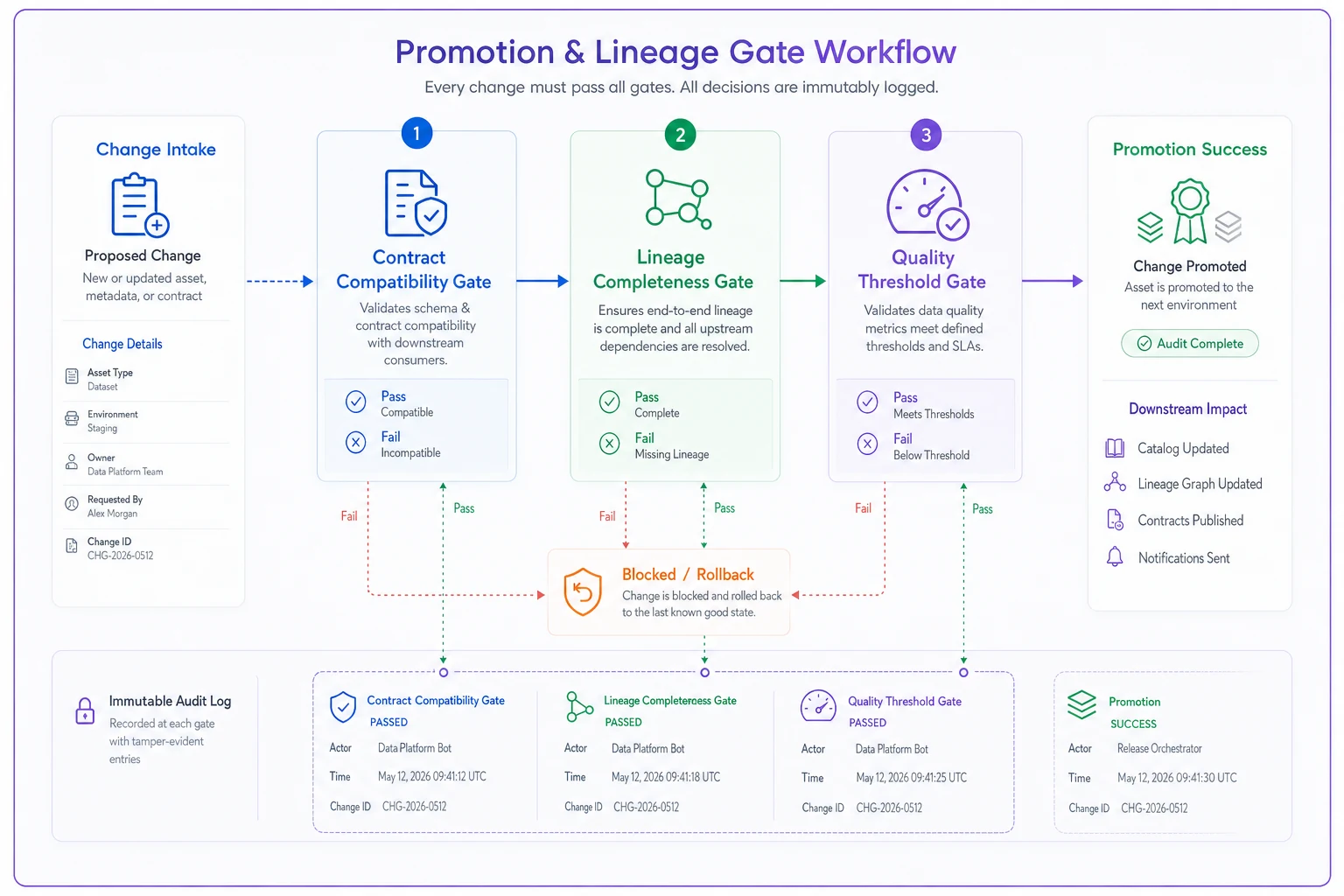
Each gate should produce a timestamped, immutable record of what passed and what didn't. That record is part of your audit trail too.
Operational runbook: model promotion and rollback
Promoting a reliability or anomaly model into production is where architecture meets consequence. A bad model doesn't crash — it quietly generates wrong work orders or suppresses real alarms. So the runbook has to assume the model can be wrong and make undoing it straightforward.
-
Shadow deploy. Run the new model alongside the current one on live data without acting on its outputs. Compare for a defined window — usually one to two full maintenance cycles.
-
Divergence review. Where the new and old models disagree, a human reviews a sample. Disagreement isn't automatically bad, but unexplained disagreement blocks promotion.
-
Canary activation. Let the new model drive decisions for a limited scope — one asset class or one site — with heightened monitoring.
-
Full promotion. Only after the canary meets its acceptance thresholds.
-
Tag and freeze. Record the model version, the contract versions it depends on, the training lineage, and the exact promotion timestamp in an immutable log.
Rollback has to be equally disciplined:
-
Single-command revert to the previously frozen version — no rebuild, no scramble.
-
Automatic re-tag so the audit trail shows the rollback as a first-class event, not a silent switch.
-
Consumer notification so downstream teams know outputs may shift.
-
Post-rollback reconciliation to identify any decisions made during the bad window that need review.
The tag-and-freeze step is what makes rollback fast. If you can't name exactly which version was running before, "roll back" becomes "rebuild from guesses," which under audit pressure is how small problems become findings.
A real scenario
A regional water utility running EAM across roughly a dozen treatment and pumping sites had a familiar problem. They'd started single-platform, then bolted on a condition-monitoring feed and a direct analytics connection to the EAM's reporting replica. Two symptoms showed up together: dashboards slowed to a crawl during month-end financial runs, and asset availability numbers didn't match between the operations team and finance. The gap wasn't huge — a few percentage points — but it was enough that leadership stopped quoting the figure in board materials.
The root cause was topology, not the platform. Analytics, finance reconciliation, and sensor ingestion were all reading and writing against the same operational store, and there was no immutable record of state changes. Nobody could reconstruct why the two availability numbers diverged.
They moved to a hybrid event-store + EAM shape over about two quarters. Work-order and reading events went to an append-only store; analytics and finance both rebuilt their views from that stream instead of querying the operational replica directly. They wrote contracts for the two highest-traffic event types first, then added compatibility and lineage gates.
The results were unglamorous and exactly what you'd want. Month-end dashboard slowdowns disappeared because analytics no longer competed with financial runs on the same store. The availability discrepancy resolved once both consumers derived from the same event stream — and more importantly, when it drifted again months later, they traced the cause in under a day instead of the week-plus it used to take. The auditors' favorite question — "show me how this number was produced" — went from a dreaded exercise to a lineage query. This is the same principle behind avoiding the EAM–ERP handoff failures that create reconciliation nightmares in the first place.
Common mistakes that quietly compound
A few patterns show up repeatedly when integration architecture goes wrong at scale:
-
Point-to-point sprawl. Every new consumer gets its own direct connection to the EAM. Fine at three connections, unmanageable at fifteen. Route through an event stream or a governed interface instead.
-
Contracts as documentation, not enforcement. A contract nobody enforces is a wish. If a breaking change can reach production without failing a gate, the contract isn't real.
-
No immutability anywhere. If your only record of state is the current state, you cannot answer historical audit questions. Something in your architecture needs to be append-only.
-
Treating models as deploys, not experiments. Shipping a reliability model straight to production without a shadow window is how you generate weeks of subtly wrong work orders.
-
Ignoring units and quality flags. The most damaging data errors are the ones that pass every type check.
If you're still early enough to be choosing a platform rather than reworking one, integration and governance tradeoffs deserve as much weight as the features — which is exactly the lens in this Cloud EAM buyer's guide.
Where automation earns its place
Most of what's described here is easier to sustain when routine enforcement runs on its own. Contract compatibility checks, lineage completeness verification, freshness and completeness monitoring, and the tag-and-freeze bookkeeping around promotions are all things that humans do poorly and inconsistently by hand — not because they're careless, but because these checks need to happen on every change, every time, without exception.
This is the honest, unglamorous role for AI-assisted automation in an EAM data platform: it watches the gates so people don't have to, flags contract violations before they reach production, keeps the lineage record current, and makes rollback a single deliberate action rather than a panicked reconstruction. The point isn't to remove judgment — divergence reviews and canary decisions still need a human — it's to make sure the boring, high-consequence checks don't get skipped when things get busy.
Pulling it together
EAM integration architecture isn't a one-time decision you make at purchase. It's a shape you either design deliberately or inherit by accident, and the cost of inheriting it accidentally compounds every time you add a site or a new data consumer.
The topology you pick should follow directly from your scale and how hard your auditors push. Single-platform when you're small and simple. Hybrid event-store when you're regulated and multi-site. Dual-read only when you have the team to keep two stores honest. Getting that choice wrong isn't fatal early on, but it gets expensive to unwind.
Whatever topology you land on, the parts that keep it trustworthy are the same: enforced data contracts so meaning survives change, promotion and lineage gates so bad changes can't slip through, and disciplined rollback runbooks so you can always prove what ran and undo it cleanly. Get those right and your asset data stays credible as you grow. Skip them, and no dashboard, model, or platform feature will save the numbers once people stop believing them.
EAM integration architecture isn't a one-time decision you make at purchase. It's a shape you either design deliberately or inherit by accident, and the cost of inheriting it accidentally compounds every time you add a site or a new data consumer.
Whatever topology you land on, the parts that keep it trustworthy are the same: enforced data contracts so meaning survives change, promotion and lineage gates so bad changes can't slip through, and disciplined rollback runbooks so you can always prove what ran and undo it cleanly. Get those right and your asset data stays credible as you grow. Skip them, and no dashboard, model, or platform feature will save the numbers once people stop believing them.
Ready to elevate your asset operations?
Join 1,500+ businesses using Ownitly to optimize asset utilization, reduce downtime, and ensure compliance.