


A practical guide for asset managers deciding which instruments stay on the calendar, which move to risk‑based scheduling, and how to prove the choice held up.
Most calibration programs don't fail because the intervals are wrong. They fail because nobody wrote down why an interval exists, and the person who set it up left three years ago. Then an auditor asks a simple question — "why is this pressure transmitter calibrated every six months instead of annually?" — and the room goes quiet.
That silence is the actual problem this article is about. Not the math of interval-setting (there's already a solid breakdown of interval rules, drift history, and evidence capture in the risk-based calibration scheduling guide). This one is narrower: how do you decide, per instrument, whether routine calibration or a risk-based schedule is the right call — and how do you document that decision so it survives an audit and a staff turnover.
What Routine Calibration Actually Buys You
Routine calibration — fixed-interval, everything on the same calendar — gets a bad reputation in reliability circles. People treat it like a lazy default. It isn't. It's a deliberate trade: you give up optimization to gain predictability and defensibility.
When every gauge in a category gets calibrated every 12 months, three things become dead simple. Scheduling is trivial. Budgeting is trivial. And explaining it to an auditor takes one sentence: "policy is annual, here's the policy." No drift-history argument to reconstruct, no risk-scoring rationale to defend. That defensibility is worth real money in regulated environments where the cost of arguing about a schedule can exceed the cost of the calibration itself.
The failure mode with routine calibration isn't the concept — it's applying it uniformly across a fleet where 15% of instruments are drifting fast and 60% barely move at all. You end up over-calibrating the stable ones and under-catching the unstable ones. Routine scheduling is a good tool used badly more often than it's a bad tool.
Where Risk-Based Scheduling Earns Its Keep — and Where It Quietly Costs You
Risk-based scheduling flips the logic. Interval becomes a function of consequence-of-failure and observed drift behavior, not a blanket policy. A transmitter feeding a safety interlock on a reactor gets a tight interval; a temperature gauge on a non-critical utility line stretches out.
Stop losing track of critical assets.
Ownitly helps you monitor, maintain, and manage every asset efficiently and reliably.
- Centralized asset tracking
- Automated maintenance alerts
- Compliance monitoring & reporting
No credit card required
On paper this is obviously smarter. In practice, the hidden cost is administrative overhead. Every risk-based interval is a decision that must be justified, revisited, and defended. Someone has to own the drift data, keep the risk scores current, and rerun the logic when an instrument's history changes.
| Factor | Routine (Fixed-Interval) | Risk-Based |
|---|---|---|
| Setup effort | Low | High |
| Ongoing maintenance | Very low | High — requires active data ownership |
| Technician time efficiency | Poor on mixed fleets | Good when maintained |
| Audit defensibility | Strong (policy-based) | Strong if rationale is current, weak if stale |
| Best fit | Homogeneous, stable, low-consequence assets | Mixed criticality, available drift history |
| Failure mode | Over/under-calibration | Silent decay into unmaintained intervals |
| Data dependency | Minimal | Heavy — needs clean drift records |
The row that matters most is the last one. Risk-based scheduling is only as trustworthy as your drift-history data. If your calibration records are inconsistent — different techs recording "as-found" differently, missing pre-adjustment readings — you cannot honestly run a risk-based program. You'll be scoring risk on noise.
What tends to happen across a lot of programs is that the risk-based framework gets built with real enthusiasm during a project, then quietly rots. Two years later, half the "risk-based" intervals haven't been reviewed since launch — which means they're now just fixed intervals wearing a costume, with none of the documentation clarity of an honest routine schedule.
The Decision That Actually Matters: Per Instrument, Not Per Program
The biggest mistake is treating this as a program-wide switch. Teams hold a meeting, decide "we're going risk-based" like it's a religion, then try to convert thousands of instruments and drown.
-
Keep on routine. High-volume, low-consequence, historically stable. Think non-critical indicating gauges, ambient sensors, redundant measurements. The optimization upside is tiny and the documentation cost of risk-scoring each one isn't worth it. Leave them on the calendar.
-
Move to risk-based. Instruments where consequence-of-failure is high and you have enough calibration history to see how they actually drift. This is where risk-based scheduling pays for itself — you can tighten intervals on the ones that need it and safely extend the ones that don't.
-
Can't decide yet — collect data first. Critical instruments with thin or messy history. These feel like risk-based candidates but you don't have the drift record to justify an interval yet. Keep them on a conservative routine interval and explicitly flag them as "routine, pending sufficient history." That last phrase is doing a lot of work — it tells a future auditor the choice was intentional.
That third bucket is the one everyone skips, and it's the one that saves you. It gives you an honest, documented answer for the instruments that don't fit cleanly.
A One-Page Decision Flow You Can Actually Use
The process below isn't complicated, but following it in sequence matters — most programs that end up with stale risk-based intervals skipped one of the middle steps. Run each instrument class through this, in order:
-
Is consequence-of-failure low? → If yes, and the class is homogeneous, keep routine. Stop here.
-
Do you have clean, consistent drift history — typically several calibration cycles? → If no, keep routine, pending data. Flag for review. Stop here.
-
Does the drift history show meaningful variation between instruments in the class? → If no (they all behave similarly), a single routine interval tuned to the class is fine and cheaper to run.
-
If yes to consequence AND yes to variation → move to risk-based and assign a data owner.
-
Assign a review trigger to anything risk-based — either a time-based review or an event trigger (e.g., an out-of-tolerance result forces re-evaluation).
Here's a simple visual of that decision flow to keep by your team when reviewing instrument classes.
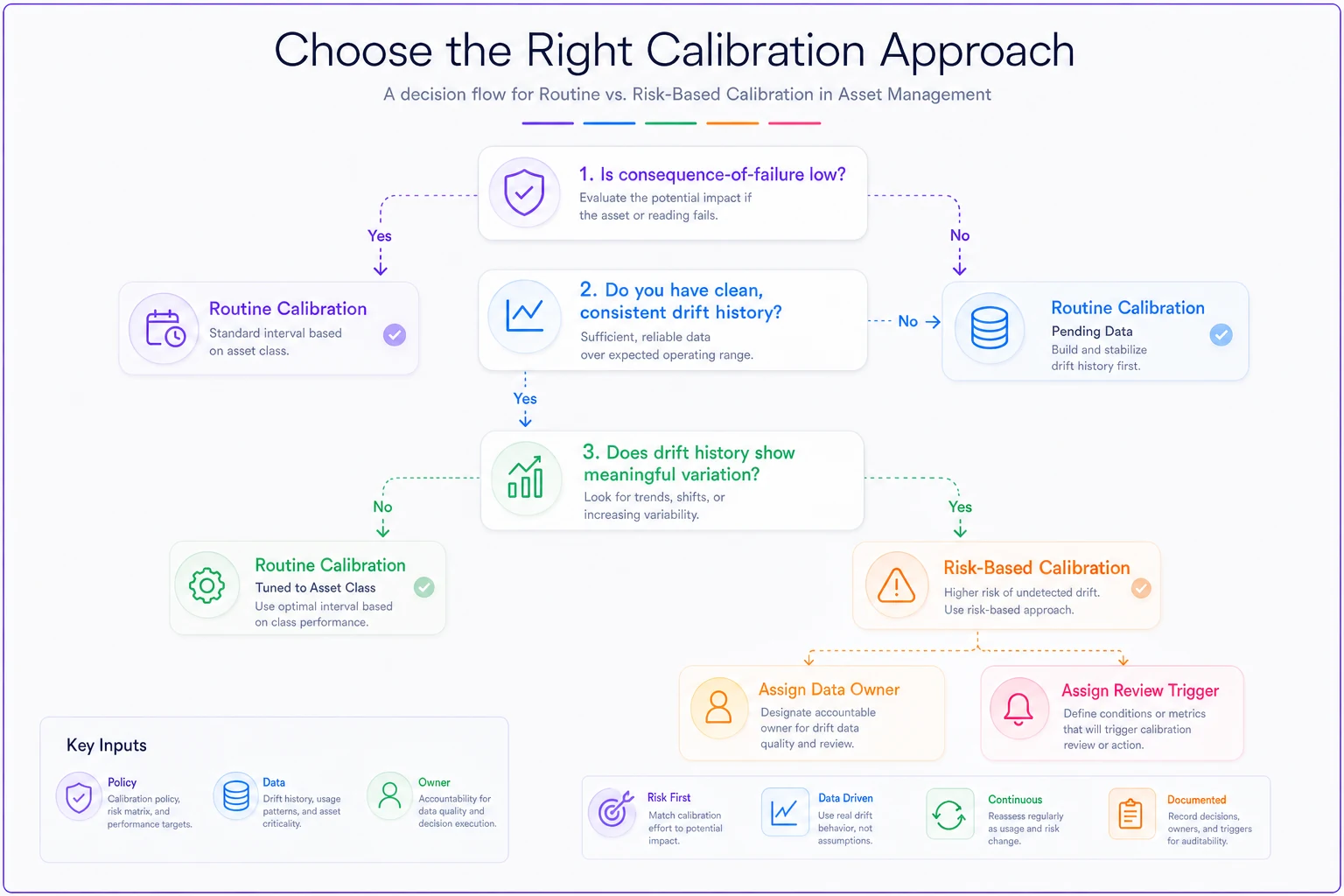
Step 5 is the one that prevents the silent-decay failure mode. A risk-based interval without a review trigger is a liability.
Documenting the Choice So It Survives an Audit
This is the part most programs get wrong, and it's cheaper to fix than anything else. The decision itself is usually fine — it's the record of the decision that's missing.
You don't need a novel per instrument. You need a short, consistent rationale attached to the calibration record that answers three questions: what did we choose, why, and when do we revisit it.
Minimum documentation checklist per instrument (or class):
-
[ ] Scheduling method
routine or risk-based (explicitly stated, not implied)
-
[ ] The chosen interval and its effective date
-
[ ] One-line rationale tied to consequence and/or drift behavior
-
[ ] Data basis — how many calibration cycles the decision rests on (for risk-based)
-
[ ] Review trigger — date-based, event-based, or both
-
[ ] Named owner accountable for the interval
-
[ ] Date and author of the last decision review
Put the data-basis count (e.g., "6 cycles") on the same line as the interval so an auditor doesn't have to cross-reference other records.
A few sample log excerpts, so this isn't abstract:
Routine example:
> TT-4412 | Method: Routine | Interval: 12mo | Eff: 2026-03-01 | Rationale: Non-critical utility line, redundant measurement, stable class history | Review: Annual policy review | Owner: J. Okafor
Risk-based example:
> PT-1187 | Method: Risk-based | Interval: 4mo | Eff: 2026-02-15 | Rationale: SIF interlock input, consequence=high; as-found drift 0.6–0.9% over last 6 cycles | Data basis: 6 cycles | Review: On any OOT result OR 18mo | Owner: R. Patel
Pending-data example:
> FT-3305 | Method: Routine (pending history) | Interval: 6mo conservative | Eff: 2026-01-10 | Rationale: Critical flow, insufficient drift history for RBI justification | Review: Reassess after 4 cycles | Owner: R. Patel
Notice what the risk-based excerpt does that the routine one doesn't — it carries its own justification and its data basis inline. If an auditor pulls that record, the argument is already made. Nobody has to reconstruct it from memory.
When Routine Calibration Is Genuinely the Right Answer
Skip the risk-based approach when:
-
The instrument class is homogeneous and historically boring — same make, same service, similar drift.
-
Consequence-of-failure is low enough that over-calibrating costs less than the effort to optimize.
-
You don't have clean drift data yet. Most programs overestimate their data quality here — be honest about it.
-
The regulatory environment values a simple, uniform, easily-audited policy over optimization.
There's no shame in a fleet that's 70% routine and 30% risk-based. That's a common and healthy ratio. Pushing everything into risk-based scoring usually produces worse outcomes than a well-documented routine program, because the risk logic goes unmaintained.
When Moving to Risk-Based Is a Mistake
Don't convert an instrument class to risk-based when:
-
Your calibration records are inconsistent between technicians. Fix the recording discipline first — risk-based scheduling built on noisy as-found data is worse than a fixed interval, because it looks rigorous while being arbitrary.
-
Nobody will own the ongoing review. An unowned risk-based interval decays into an undocumented fixed interval within a couple of years.
-
The consequence-of-failure is genuinely low. You're adding administrative cost to optimize something that didn't need optimizing.
If those problems exist, shore them up first. Risk-based scheduling is a tool, not a magic bullet.
A Short Real Scenario
A mid-sized specialty chemicals site had around 900 calibrated instruments, all on a blanket annual routine schedule. Two problems were compounding: critical transmitters occasionally drifted out of tolerance before the annual check, and technicians were burning time recalibrating dozens of stable, non-critical gauges that hadn't moved measurably in years.
They didn't convert everything. They pulled out the roughly 120 instruments tied to safety and product-quality consequences, checked which ones had at least four or five clean calibration cycles on record, and moved that subset to risk-based intervals. About 40 of those tightened — some to four or six months — and a similar number extended because the history justified it. The remaining 780 or so stayed routine, now with a one-line rationale attached to each class.
The outcome wasn't dramatic, which is the point. Out-of-tolerance surprises on the critical subset dropped noticeably over the following year, and total technician calibration hours came down a bit because the extensions offset the tightenings. The bigger win was the audit — their next regulatory review, the calibration schedule questions took maybe twenty minutes instead of the usual grinding half-day, because every interval, routine or risk-based, carried its own written reason.
The Takeaway
The routine-vs-risk-based question is usually framed as a sophistication contest, and that framing leads people astray. Routine calibration isn't primitive; it's the correct choice for a large share of any real fleet. Risk-based scheduling isn't automatically better; it's a higher-maintenance tool that only pays off with clean data and an owner.
Decide per instrument class, be honest about your drift-data quality, and write down the why next to every interval. The programs that pass audits cleanly aren't the ones with the fanciest scheduling logic — they're the ones where every interval, fixed or risk-based, can explain itself without needing the person who set it up to still be in the building.
If you want the underlying interval-setting mechanics for the risk-based side, the detailed interval-rules and drift-history methodology covers that ground; this piece is just about making — and recording — the choice.
Decide per instrument class, be honest about your drift-data quality, and write down the why next to every interval. The programs that pass audits cleanly aren't the ones with the fanciest scheduling logic — they're the ones where every interval, fixed or risk-based, can explain itself without needing the person who set it up to still be in the building.
Ready to elevate your asset operations?
Join 1,500+ businesses using Ownitly to optimize asset utilization, reduce downtime, and ensure compliance.