

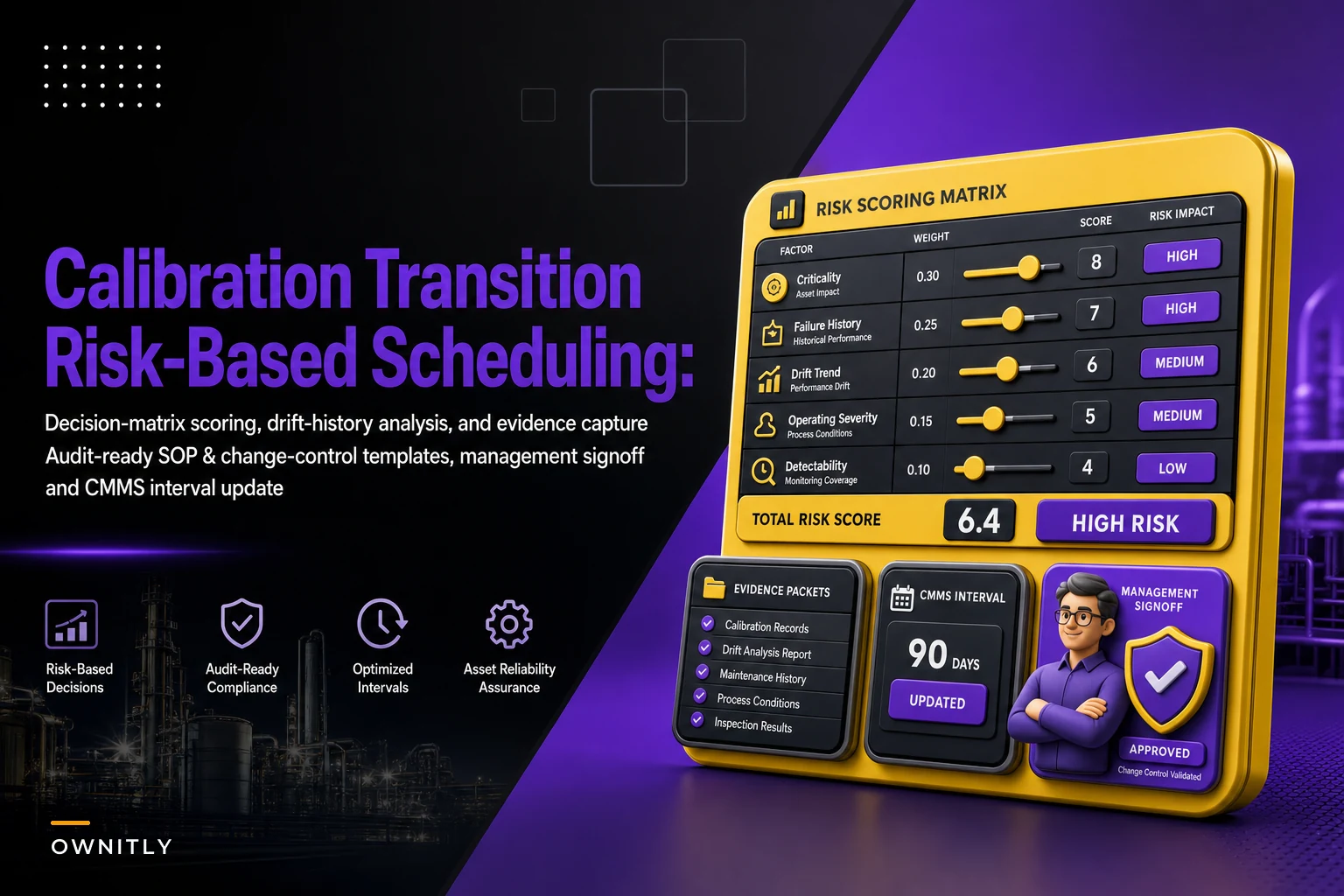

Most calibration programs don't fail because the engineering is wrong. They fail because the paperwork behind the decision is thin. You can have five years of clean drift data showing a pressure transmitter never moves, but if the SOP still says "calibrate every 6 months" and there's no signed record explaining why you stopped, an auditor will write you up — and honestly, they'd be right to.
This isn't a post about whether risk-based scheduling works. If you're here, you already know it does, and you've probably already worked through the engineering side in our deeper piece on risk-based calibration scheduling for instrumentation. This post is about the messy transition: the actual act of pulling an instrument off a fixed interval, documenting the justification so it survives scrutiny, and rewiring your SOPs and change control so the whole thing holds together during an inspection.
The focus here is narrow on purpose — how to transition from routine calibration to risk-based scheduling for instruments that genuinely deserve it, without creating a compliance gap in the process.
The gap nobody plans for: the window between "we decided" and "it's documented"
Here's the failure pattern that trips up almost every team doing this for the first time.
An engineer runs a drift analysis, sees that a batch of RTDs and a couple of flow meters have been rock-steady for years, and quietly extends the interval in the CMMS. Done, right? The instruments are performing better than the standard required, so where's the harm?
The harm shows up about eight months later during an audit. The auditor pulls the instrument master, sees the interval changed from 180 days to 365, and asks one question: "Show me the approved change that authorized this." And there's nothing. No decision record, no acceptance criteria, no signoff, no updated SOP. The underlying engineering call was correct. The governance around it didn't exist. That's a finding, and depending on your industry it can be a serious one.
Teams consistently treat the interval change as a technical edit when it's actually a controlled document change. The instant you override a routine interval, you're overriding a written procedure. If that procedure says "calibrate quarterly" and reality now says "calibrate annually based on risk," those two statements are in direct conflict until you formally reconcile them. The reconciliation is the actual work. Everyone remembers the drift chart; almost nobody closes the loop on the SOP.
Step one: build a screening pass before you build a decision matrix
Don't start by analyzing everything. Most teams try to evaluate their entire instrument population at once, drown in it, and give up. You want a cheap screen first — one that kills the obviously-ineligible instruments so your real analysis only touches candidates worth the effort.
Stop losing track of critical assets.
Ownitly helps you monitor, maintain, and manage every asset efficiently and reliably.
- Centralized asset tracking
- Automated maintenance alerts
- Compliance monitoring & reporting
No credit card required
-
It has at least 3–5 calibration cycles of recorded history — you can't justify extending an interval on two data points with no visible drift trend
-
It is not a safety-critical or regulatory-mandated fixed interval — some intervals are set by regulation or a safety case and simply aren't yours to move
-
Its failure mode is detectable some other way — process alarms, redundancy, cross-checks — so a slow drift wouldn't go unnoticed between calibrations
-
It has no open deviation, repair, or modification that would make its history unrepresentative of current condition
-
Its tolerance band is wider than its historical drift by a comfortable margin, not a sliver
That last one matters more than people expect. An instrument drifting 0.4% against a 0.5% tolerance is passing every calibration, but it has almost no headroom. Extending its interval is how you turn a pass into a future out-of-tolerance event. Screen those out early.
Whatever doesn't clear the screen stays on its fixed interval, and that's fine. The goal isn't to move everything — it's to move the right things defensibly.
The decision matrix: scoring, not vibes
Once you have candidates, every single one needs to go through the same scoring logic so decisions are consistent and reproducible. The point of a matrix isn't bureaucracy — it's that two different engineers scoring the same instrument should land in roughly the same place. If your justification depends on who made the call, it won't hold up.
Here's a workable structure. Score each factor, weight it, and the total determines the recommended path.
| Factor | What you're measuring | Low risk (1) | Medium (2) | High risk (3) |
|---|---|---|---|---|
| Drift stability | Max drift ÷ tolerance across history | < 30% of tolerance | 30–60% | > 60% |
| Process criticality | Impact if the reading is wrong | Indication only | Affects quality | Affects safety/compliance |
| Failure detectability | Can drift be caught independently? | Redundant / alarmed | Partial cross-check | No independent check |
| Calibration history length | Cycles of representative data | 6+ cycles | 4–5 cycles | ≤ 3 cycles |
| Consequence of OOT | What a failed cal actually triggers | Minor rework | Batch review | Recall / reportable |
| Environmental stress | Operating conditions on the instrument | Benign, stable | Moderate | Harsh / cycling |
A low aggregate score means the instrument is a strong candidate for an extended, risk-based interval. A mixed score usually means extend cautiously — move from 6 months to 9, not straight to 24. A high score in any single safety or consequence row should veto the extension regardless of the total. Good drift history doesn't rescue an instrument whose failure could be a reportable event with no independent detection.
One thing worth naming: teams tend to over-weight drift stability because it's the easiest number to pull. But a perfectly stable instrument that's invisible when it fails is more dangerous than a slightly-drifty one that's cross-checked three ways. Detectability should carry real weight in your scoring, not just sit as a tiebreaker.
A simple visual of the decision flow helps teams follow the sequence.
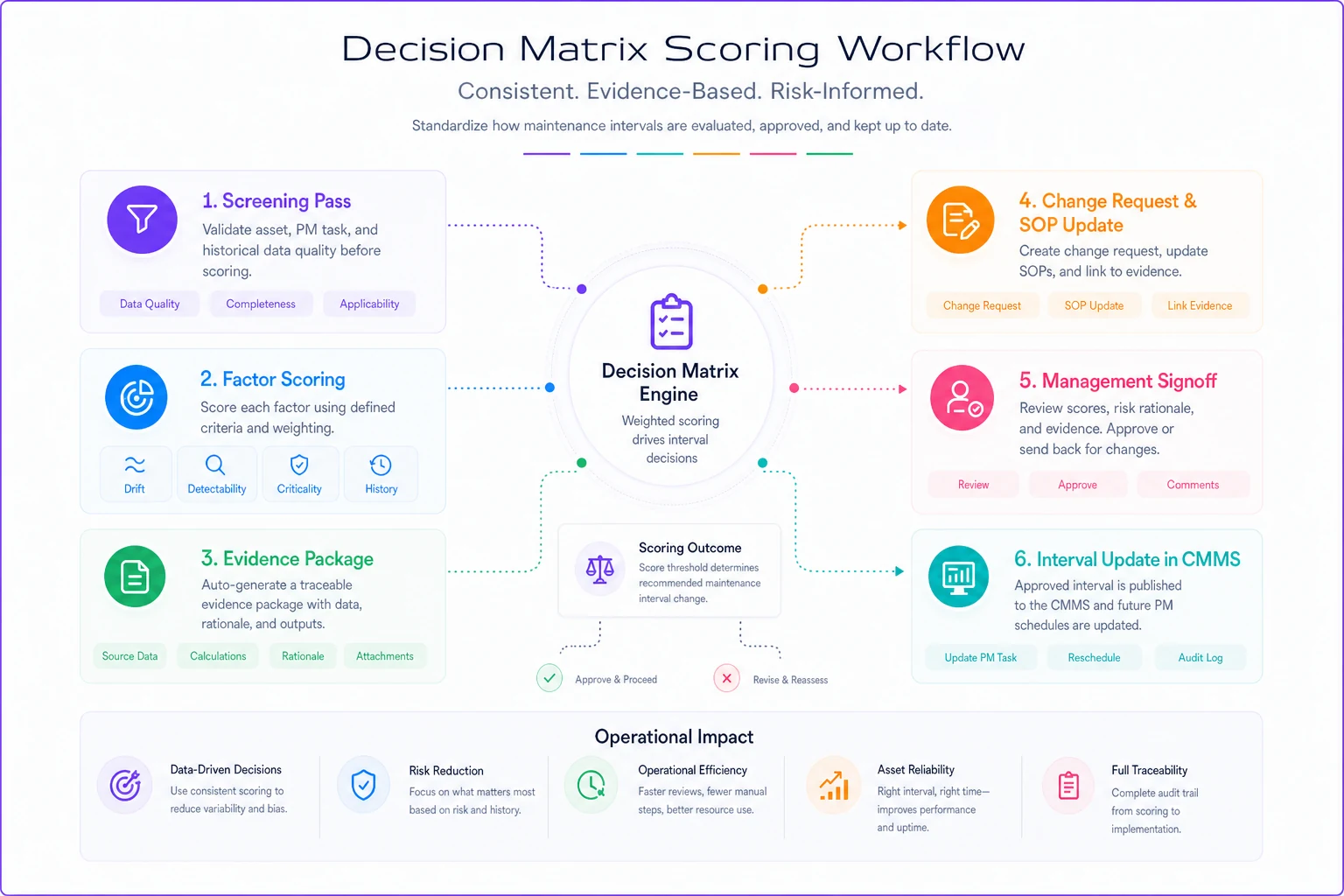
Detectability should carry real weight in your scoring, not just sit as a tiebreaker.
Evidence capture: what actually has to exist per instrument
The decision matrix produces a recommendation. The evidence package is what makes it auditable. For every instrument you move off a fixed interval, you need a self-contained record that a reviewer could pick up cold and understand in five minutes.
A drift history analysis template that works looks roughly like this:
-
Instrument identity — tag number, make/model, location, measurement type, current tolerance
-
Calibration history table — date, as-found value, as-left value, reference standard used, technician, pass/fail
-
Drift calculation — per-cycle drift, maximum observed drift, drift as a percentage of tolerance, trend direction
-
Acceptance criteria — the explicit rule you're testing against (e.g., "max historical drift must remain below 40% of tolerance across all recorded cycles")
-
Result against criteria — pass/fail, with the margin stated numerically
-
Proposed new interval — and the reasoning for that specific number, not just "longer"
-
Review trigger — the condition that forces re-evaluation (one out-of-spec result, a repair, a process change)
The acceptance criteria line is where most packages fall apart. "Instrument is stable" is not acceptance criteria. "Maximum drift across 6 cycles was 0.18%, which is 36% of the 0.5% tolerance, below our 40% threshold" is acceptance criteria. The second version is falsifiable — someone can actually check it. The first is an opinion.
Keep the as-found numbers in the evidence package front and obvious so a reviewer can immediately see whether the interval was justified.
Keep the as-found data front and center. As-found is the honest number — it's what the instrument was reading before anyone touched it. As-left tells you the tech did their job; as-found tells you whether the interval was right. Your entire drift argument lives in the as-found column.
Updating the SOP and change control so the two agree
This is the step that separates a clean transition from a finding waiting to happen. The sequence matters, and doing it out of order is the most common failure mode here.
Do not change the CMMS interval first. The moment the system says 365 days but the SOP says 180, you're non-compliant with your own procedure — even if your engineering is better than the procedure requires. Change control has to lead.
-
Raise a change request that references the specific instruments, the decision matrix scores, and the evidence packages. One change request can cover a batch of similar instruments if their justification logic is identical — don't bundle unrelated instruments just to save paperwork, because one weak justification contaminates the whole package.
-
Update the governing SOP so the fixed-interval language is replaced with the risk-based rule. The SOP should describe the method for how intervals are set and reviewed, not hard-code every interval — otherwise you're rewriting the SOP every time one instrument moves.
-
Get management signoff from the roles your quality system actually requires — typically the responsible engineer, a quality representative, and an operations owner. The signoff record should name what's being approved, reference the evidence, and date it.
-
Then, and only then, change the interval in the system — with a note linking back to the approved change request.
-
Set the review trigger inside the system so a repair or an out-of-spec result automatically flags the instrument for re-evaluation.
A management signoff block doesn't need to be elaborate. It needs: instruments affected, old interval, new interval, justification reference, acceptance criteria met (yes/no), approver name/role/date, and a review-trigger statement. One page. The point is that it's unambiguous about who approved what, based on what evidence, on what date.
The review trigger deserves a specific callout. An extended interval isn't permanent — it's a hypothesis you're continuing to test. If an instrument you moved to annual calibration comes back out-of-tolerance at its next cal, that result has to pull it straight back into scrutiny, not just get logged and forgotten. Build that reaction into the workflow, or the program slowly drifts toward "we extended everything and stopped checking."
Where software earns its keep here (and where it doesn't)
Most of this is governance discipline, not technology. You can run a credible transition with spreadsheets and a well-managed document control process. But there are two places where the manual version quietly breaks down at scale.
The first is keeping drift history clean and queryable. When as-found data lives in scanned PDFs and paper certs, building a defensible drift trend means someone manually transcribing years of calibrations per instrument. That transcription is where errors creep in, and errors in your justification evidence are exactly what you can't afford. A system that captures as-found/as-left data in structured form at the point of calibration turns drift analysis into a query instead of a research project.
The second is the link between an approved change and the live interval. The dangerous gap — system says one thing, SOP says another — is almost always a sync problem. When change control, SOP references, and the calibration schedule live in separate places, nothing stops someone from editing the interval without an approval existing. Platforms that tie the interval change to an approved change record — where you literally can't move the interval until the signoff exists — close that gap structurally instead of relying on people remembering the right sequence. That's the part worth paying for. Not the analysis, the enforcement of sequence.
Everything else is process. Don't let a tool promise to do your risk thinking for you.
A realistic look at the numbers
A mid-sized specialty chemicals plant had around 600 field instruments on fixed intervals, most sitting at 6-month calibrations regardless of history. Calibration labor and standards were running them somewhere in the range of a few hundred thousand a year, and the bulk of those calibrations were coming back with as-found values barely different from as-left — the instruments weren't moving.
They screened the full population and found roughly 180 instruments that cleared the eligibility gate. After running the decision matrix, about 120 of those were approved to move from 6-month to 12-month intervals, and a smaller group of very stable, well-cross-checked indicators went to 18 months. Safety-instrumented systems stayed untouched.
The outcome wasn't dramatic in headline terms, but it was real: calibration volume on that subset dropped by close to half, freeing up technician time that had been going to instruments that didn't need touching. More importantly, when they got audited about a year later, the risk-based decisions held up — because every moved instrument had a scored matrix, a drift package with real acceptance criteria, and a signed change record behind it. The auditor's attention moved on quickly, which is exactly what you want.
What made it work wasn't the engineering. It was that the documentation was built before the intervals changed, not assembled under pressure afterward.
When this makes sense, and when to leave it alone
This makes sense when you have genuine calibration history, stable instruments consuming labor on calibrations that never find anything, and a document control process mature enough to handle the change properly.
This is a bad idea when your calibration records are incomplete or inconsistent. You cannot build a drift justification on data you don't fully trust, and extending an interval on shaky history is just hiding risk behind a longer clock.
Who should not do this: teams with no functioning change control. If you can't guarantee that an interval change is tied to an approved record, you'll create the exact system-versus-SOP gap that causes findings. Fix the governance first. Risk-based scheduling can wait a quarter; a non-compliant program can't.
The transition from routine calibration to risk-based scheduling is mostly an exercise in discipline — screen hard, score consistently, prove it with falsifiable acceptance criteria, change the paperwork before the system, and set a trigger that pulls instruments back under review the moment reality disagrees with your decision. Get that sequence right and the engineering takes care of itself.
The transition from routine calibration to risk-based scheduling is mostly an exercise in discipline — screen hard, score consistently, prove it with falsifiable acceptance criteria, change the paperwork before the system, and set a trigger that pulls instruments back under review the moment reality disagrees with your decision. Get that sequence right and the engineering takes care of itself.
Ready to elevate your asset operations?
Join 1,500+ businesses using Ownitly to optimize asset utilization, reduce downtime, and ensure compliance.