

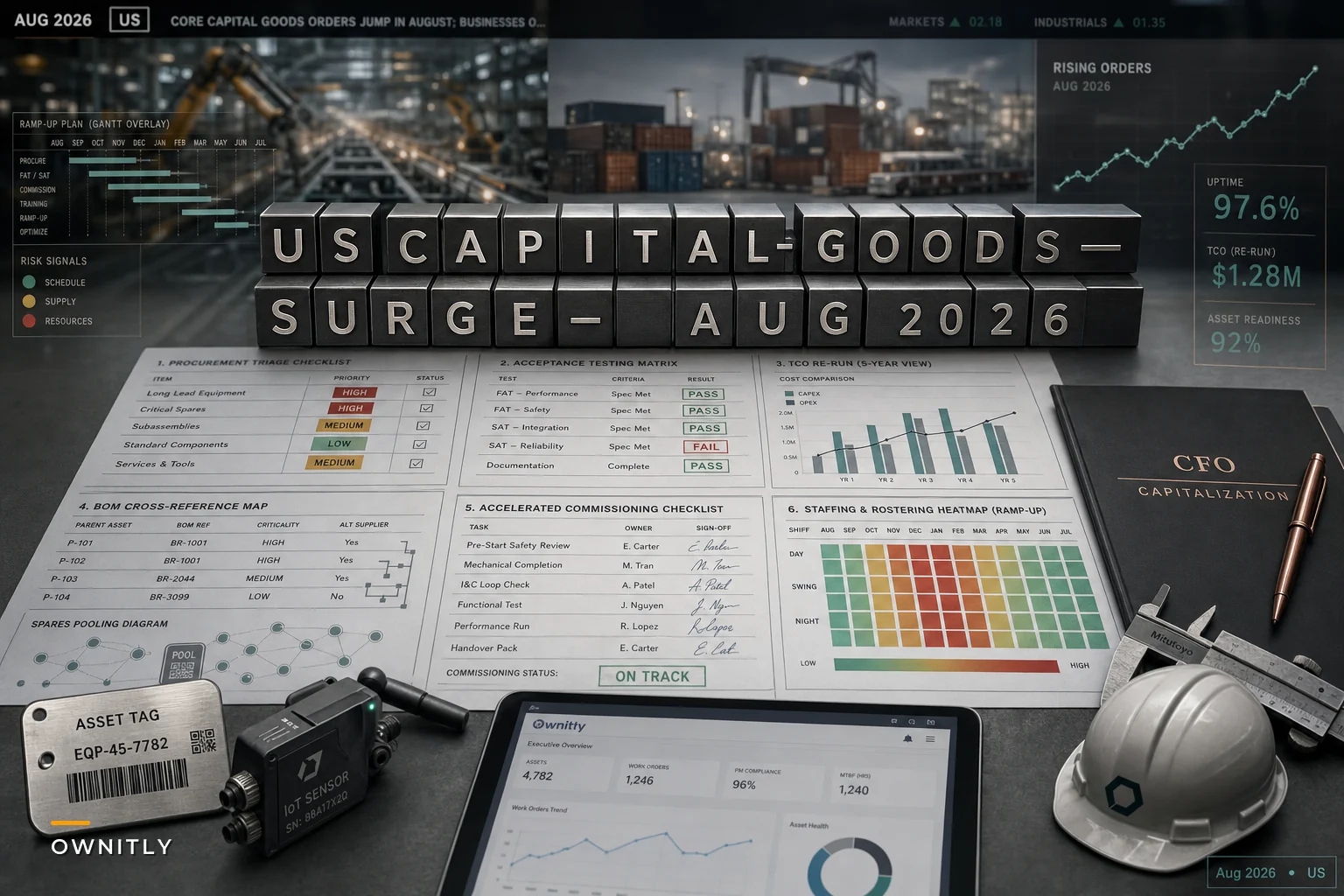

The August numbers caught a lot of people off guard. Core capital goods orders — the non-defense, non-aircraft slice that actually tracks business investment in real equipment — jumped more than analysts expected, according to Reuters' September 25 coverage. For economists, that's a signal about the broader investment cycle. For asset managers, it's something far more concrete: a lot of new machines are about to show up on loading docks, and somebody has to make them productive.
That somebody is usually a maintenance and reliability team already stretched thin. New equipment arriving in volume isn't a win by default. Commissioning gets rushed, spares strategies lag behind the install base, master data is a mess from day one, and finance is waiting on capitalization evidence nobody prepared. The procurement surge is the easy part. Absorbing it operationally is where budgets quietly bleed.
What follows isn't a celebration of growth or a warning against it. It's what actually happens in the 90–180 days after a procurement wave lands, and seven specific moves that keep new asset investment from becoming a carrying-cost problem.
The real problem a capital-goods surge exposes
A surge doesn't create new operational weaknesses. It amplifies the ones already there — the ones that were easy to ignore at normal volume.
When a plant adds two or three assets a quarter, sloppy onboarding is survivable. The install is one-off, techs learn the quirks organically, paperwork gets cleaned up eventually. When a plant adds twenty assets in a quarter because the capital plan got pulled forward, that same informal process falls apart. There's no time to learn each machine on the fly. No slack to clean up records "eventually." And the mistakes compound — a bad asset hierarchy multiplied across twenty new units becomes a reporting problem that follows you for years.
Most teams treat asset onboarding as an event instead of a repeatable workflow. One-off installs hide the absence of a standard. A wave of installs makes that absence impossible to ignore. The sites that handle a surge well aren't the ones with more people — they're the ones who already had a disciplined intake process they could simply run more often.
Move 1: Lock down an asset intake standard before the first crate arrives
The fastest way to lose control of a CAPEX wave is to let each new asset get recorded differently depending on who happened to receive it. Duplicate records, inconsistent naming, and missing parent-child relationships almost always trace back to the first 48 hours after delivery — when nobody had a template and everyone improvised.
Stop losing track of critical assets.
Ownitly helps you monitor, maintain, and manage every asset efficiently and reliably.
- Centralized asset tracking
- Automated maintenance alerts
- Compliance monitoring & reporting
No credit card required
Build a single intake checklist that every new asset must pass through before it's considered live in the system:
-
Asset ID assigned per the existing naming convention (not a free-text guess)
-
Parent location and functional hierarchy confirmed
-
Manufacturer, model, and serial number captured from the nameplate — photographed, not retyped from a PO
-
Criticality rating assigned using your standard rubric
-
Warranty start date and terms recorded
-
Nameplate spec sheet and O&M manual attached
-
Initial PM plan linked or flagged as pending
-
Capitalization status and asset tag number noted for finance
This is boring, and that's the point. A ten-minute intake discipline per asset saves you from a six-month data cleanup later — and from making reliability decisions on records you can't trust. The teams that survive a surge are the ones who are religious about the boring stuff.
Move 2: Re-run the TCO math before you default to the OPEX bucket
A sudden influx of equipment forces a decision most teams make lazily: what gets capitalized, what gets expensed, and how maintenance cost over the asset's life shapes real cost of ownership. During a surge, finance is reforecasting fast and the pressure is to classify quickly and move on.
That's a mistake. The purchase price is frequently the smallest part of what a new asset actually costs. A piece of rotating equipment bought for $180k can easily carry $40k–$60k in spares, PM labor, and consumables over its first five years — and that's before any unplanned failure. Onboard a fleet of similar units and that per-asset math multiplies into a number large enough to change which models you'd buy again.
This is the moment to pull real lifecycle cost modeling into the conversation rather than treating it as an afterthought. The mechanics — depreciation logic, budgeting controls, how to turn reliability data into funded, defensible investment decisions — matter most during a procurement wave. Teams that reforecast CAPEX without a TCO lens end up with assets that look cheap on the capital budget and expensive on the maintenance budget for the next decade.
Move 3: Scale the spares strategy to the install base, not the old baseline
A failure pattern that shows up almost every time new equipment arrives in volume: spares inventory stays frozen at the old level while the install base jumps. Then a new unit fails in month four, the critical part isn't stocked, lead time is eight weeks, and a brand-new asset sits idle while everyone scrambles.
The inverse is just as costly. Panicked over-stocking of spares for every new machine ties up cash and fills shelves with parts that may be obsolete before they're ever used.
Triage new spares by criticality and lead time, not gut feel:
| Asset criticality | Spare lead time | Stocking decision |
|---|---|---|
| High | Long (6+ weeks) | Stock on-site before commissioning |
| High | Short (<2 weeks) | Stock minimum, rely on fast reorder |
| Medium | Long | Stock shared/pooled across sites |
| Medium | Short | Reorder on demand |
| Low | Any | Do not stock; order as needed |
A surge is also the right time to ask whether spares should be pooled across sites rather than duplicated at each one — especially when you're adding identical models in multiple locations. Common parts across a standardized fleet are one of the few genuine upsides of a bulk purchase. Capture it deliberately instead of letting each site build its own silo.
Move 4: Don't let commissioning become the acceptance gate's weak point
When equipment arrives faster than usual, acceptance testing is the first thing that gets compressed. The vendor wants to close out, the project team wants the install marked complete, and the easy path is to sign off on a cursory walkthrough.
The problem is that commissioning is your one leverage point with the supplier. Once you've accepted the asset, defects become your cost. A valve that was never properly stroke-tested, a drive commissioned with default parameters, a lubrication point missed during install — these surface three months later as early-life failures that were actually acceptance failures.
Build acceptance criteria into the work order for every new asset, and tie vendor sign-off to documented evidence: performance test results, calibration records, as-built configuration, photos of the installed condition. During a wave, standardize this into a repeatable acceptance packet so every unit clears the same bar regardless of which crew installed it. Nothing gets marked accepted without the evidence to prove it should be.
Move 5: Stagger PM schedules so you don't build a maintenance cliff
A subtle trap of onboarding many assets at once: if they all go live in the same month with identical PM intervals, their maintenance comes due in the same month too. Twelve new units with quarterly PMs all installed in October means every October and January your techs face a wall of simultaneous work orders.
In practice this usually shows up as a backlog spike that looks seasonal but is actually self-inflicted — a scheduling artifact from how the assets were onboarded, not a reflection of real demand.
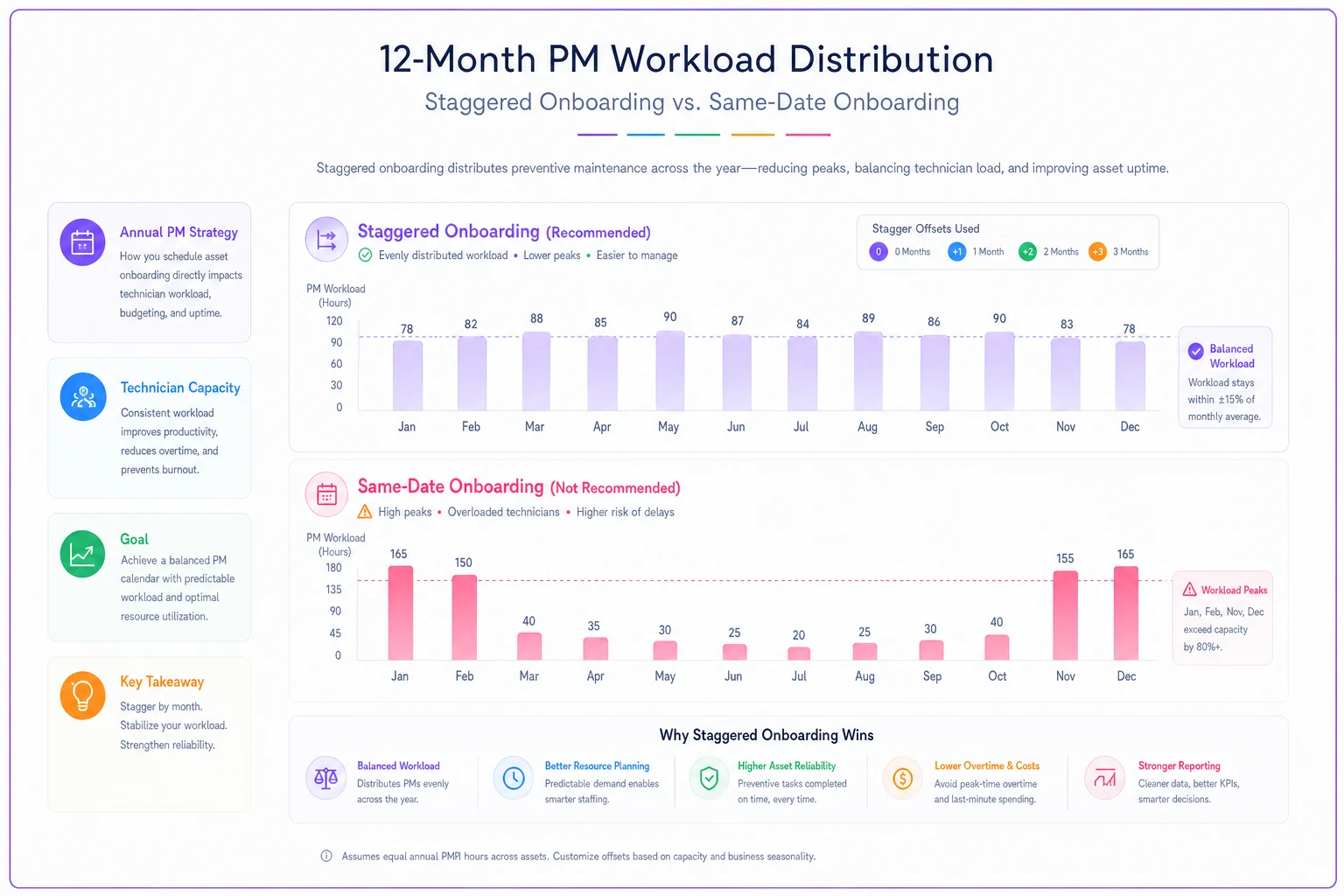
This visualization shows how staggering PM start dates spreads workload across the year.
Stagger the first PM due dates deliberately. Offset initial intervals by a few weeks so the recurring load spreads across the calendar. It costs nothing to do at onboarding and is painful to unwind later. One of those decisions that seems trivial in the moment and shapes your labor planning for the entire asset lifecycle.
Move 6: Staff and skill-plan for the new fleet before it's running
New equipment often means new technology — a different control system, an unfamiliar drive family, a machine type the existing crew hasn't worked on. A lot of teams are about to be responsible for maintaining assets nobody on staff is actually trained to maintain.
The onboarding window is when vendor training is cheapest and most available. Negotiate it into the purchase while you still have leverage. What tends to happen otherwise is that training gets deferred to after go-live, the first failure arrives before anyone's ready, and you end up paying premium rates for the vendor to fly someone out for an emergency the crew could have handled themselves.
-
List every new asset type and the specialized skills it requires
-
Mark which skills already exist on the team and at what depth
-
Identify single points of failure — skills held by only one person
-
Schedule vendor or internal training during commissioning, not after
-
Document new procedures while the install is fresh and the vendor is still on-site
That last point matters more than it looks. The best time to capture SOPs for a new machine is while the people who installed it are still standing next to it.
Move 7: Prepare the capitalization evidence while the trail is warm
Finance needs audit-grade evidence that capitalized assets exist, were placed in service, and are being maintained. During normal operations this is a steady trickle. During a surge it becomes a flood of new asset records that all need the same documentation — and that evidence is far easier to assemble now than during an audit two years from now.
Treat capitalization evidence as part of onboarding, not a separate finance exercise. When an asset clears intake and acceptance, the record should already carry what finance needs: the asset tag tied to the EAM record, placed-in-service date, cost basis reconciled against the PO, and the PM plan that proves it's being maintained. Getting the EAM-to-ERP reconciliation right at onboarding prevents the reconciliation nightmares that surface when the two systems drift apart across a wave of new records.
Teams that skip this don't feel the pain for a year or two. Then an audit lands, and someone spends weeks reconstructing evidence that would have taken minutes to capture at the source.
A realistic scenario of what this looks like
Consider a mid-sized food processing operation that pulled its capital plan forward and added roughly fourteen new packaging and conveying assets in a single quarter — about triple its normal onboarding pace.
The first batch went in the old way: informal intake, compressed acceptance, PM plans copied from an existing template with identical intervals. Within four months, two patterns emerged. First, a cluster of early-life failures traced back to commissioning steps that got skipped under time pressure — defects the team ended up absorbing because the acceptance evidence was too thin to push back on the vendor. Second, the copied PM intervals stacked up and the maintenance team hit a backlog wall where new-asset PMs collided with existing routines.
For the second batch, the team ran a standard intake checklist, tied vendor sign-off to documented acceptance evidence, staggered PM start dates, and captured spares requirements by criticality before commissioning. The early-failure rate on the second batch dropped noticeably, the backlog spike flattened out, and when finance came asking for capitalization evidence it was already attached to the records. Same equipment, same crew — the difference was entirely in how the onboarding was run.
When this level of rigor isn't worth it
Not every situation calls for a full standardized intake process. If you're adding one or two non-critical assets a year, a lightweight checklist is plenty. Building heavy workflow around rare events is its own kind of waste.
The rigor becomes worth it the moment onboarding volume outpaces your team's ability to handle each asset informally. That's exactly the threshold a capital-goods surge pushes teams across. If your normal pace is a few assets a quarter and you're suddenly facing a dozen or more, the informal approach that worked fine before will quietly fail — and you won't see it until the data problems and early failures start showing up months later.
Where good systems quietly earn their keep
None of these seven moves require anything exotic. They require a system that can enforce a repeatable intake standard, carry acceptance evidence on the work order, stagger PM schedules, flag spares gaps against criticality, and keep EAM and ERP records reconciled as new assets land. A well-configured EAM platform — one with AI-assisted workflow automation built in — turns each of these from a manual scramble into a process that runs the same way every time. That consistency matters when volume spikes and there's no room to improvise.
The value isn't in the software for its own sake. A surge punishes improvisation and rewards teams that already had disciplined onboarding workflows in place. Those teams simply ran their process more often and absorbed the wave. Teams that relied on tribal knowledge and manual cleanup found out the hard way that what worked at two assets a quarter doesn't scale to fourteen.
A capital-goods surge is good news for the business. Whether it's good news for the operations team depends entirely on whether the equipment gets onboarded with discipline or absorbed in a scramble. The orders are already in. Build the intake standard before the crates arrive — not after the first new asset fails.
Build the intake standard before the crates arrive — not after the first new asset fails.
Ready to elevate your asset operations?
Join 1,500+ businesses using Ownitly to optimize asset utilization, reduce downtime, and ensure compliance.