


Most teams that move to risk‑based calibration make the same quiet mistake: they treat it as an all‑or‑nothing switch. Either an instrument is on a calendar — every 6 months, every year, whatever the historical SOP says — or it's on a risk‑based interval driven by drift history and criticality. In practice, the smartest programs keep a surprising number of instruments on fixed calendars on purpose, and can defend every one of those decisions to an auditor in about two minutes.
The hard part isn't the math behind interval extension. That's mostly covered when you set up risk-based calibration scheduling with proper interval rules and drift history. The hard part is the keep decision: knowing when a calendarized routine check is the right answer, and documenting why in a way that survives an audit two years later when nobody remembers the original conversation.
This guide is only about that one decision. When do you keep routine, when do you convert, and what evidence do you leave behind.
The real problem: "risk‑based" quietly becomes "whatever we can justify extending"
There's a pattern that shows up once a risk‑based program matures. The first year, extensions are conservative and well‑reasoned. By year two or three, the interval‑extension logic starts getting pointed at everything, because extending intervals reduces calibration labor and the numbers look good on a budget slide.
Then an auditor pulls a sensor that drifted out of tolerance, asks why its interval was extended from 6 to 18 months, and the honest answer is "because the drift data supported it and we were trying to cut cost." That's not automatically wrong — but if the instrument sits on a safety‑relevant loop and the extension wasn't tied to documented risk, you've got a finding.
The inverse also happens. Teams keep everything on the original calendar because converting feels risky, and they burn technician hours recalibrating instruments that haven't moved a measurable amount in four cycles. That's waste dressed up as caution.
The decision isn't "calendar vs risk‑based." It's: does this specific instrument belong in the group where a fixed interval is the lower‑risk, more defensible choice?
When keeping a routine (fixed‑interval) calibration is actually the right call
There are specific situations where converting to a risk‑based interval adds risk or audit exposure without buying you anything. Keep the calendar when:
Stop losing track of critical assets.
Ownitly helps you monitor, maintain, and manage every asset efficiently and reliably.
- Centralized asset tracking
- Automated maintenance alerts
- Compliance monitoring & reporting
No credit card required
-
A regulation, standard, or customer contract names the interval. If a pharma GMP requirement, a 17025 scope, or a customer spec says "annual," your drift data doesn't override that. You can petition to change it, but until you do, the calendar stays and your justification is the citation.
-
You don't have enough calibration history to trust an extension. Risk‑based intervals need data. A newly installed flow meter with two calibration points isn't a candidate — you need several in‑tolerance cycles before drift behavior means anything.
-
The instrument sits on a safety‑instrumented function or a critical control loop. When the consequence of undetected drift is a safety event, environmental release, or batch loss, the value of a predictable, frequent check usually outweighs the labor savings.
-
The instrument is cheap to check and expensive to get wrong. A thermocouple on a sterilization cycle costs almost nothing to verify. Stretching its interval to save a few technician‑minutes is a bad trade.
-
Drift history is erratic, not slow and linear. Risk‑based extension assumes predictable drift. If an instrument sometimes passes comfortably and occasionally fails hard with no pattern, a fixed, conservative interval is the honest response.
Fixed‑interval calibration isn't the "old way." It's the correct tool when consequence is high, data is thin, or an external rule removes your discretion.
When conversion to a risk‑based interval is the better decision
Convert when the instrument has earned it and the stakes allow it:
-
Three or more consecutive in‑tolerance calibrations with comfortable margin — as‑found results well inside the acceptance limit, not scraping it.
-
Slow, predictable, directional drift that you can project forward with confidence.
-
Low to moderate consequence of failure — an indication loop, a non‑critical trend measurement, redundant instrumentation.
-
No external mandate fixing the interval.
-
A clear acceptance criterion you can write down
e.g., "extend only while as‑found error stays below 50% of tolerance across the trailing three cycles."
That last point is where most conversions fall apart in an audit. Teams extend the interval but never write the condition under which the extension holds. Then the instrument drifts to 70% of tolerance, nobody flags it, and the interval quietly stays extended into a failure.
A concise decision flow
Run every candidate instrument through this. It's deliberately short.
-
Is the interval fixed by a regulation, standard, or contract? - Yes → Keep routine. Evidence = the citation. Stop. - No → continue.
-
Do you have at least 3 consecutive in‑tolerance calibrations with history you trust? - No → Keep routine until data accumulates. Stop. - Yes → continue.
-
Is the consequence of undetected drift high (safety, environmental, batch/product loss)? - Yes → Keep routine, or convert only with a formal risk assessment and tightened acceptance criteria. - No → continue.
-
Is the drift slow, directional, and predictable? - No (erratic) → Keep routine. Stop. - Yes → continue.
-
Can you write a numeric acceptance criterion that automatically reverts the instrument to routine if breached? - No → Keep routine until you can. - Yes → Convert to risk‑based interval, with the revert condition documented.
Notice that "keep routine" is the default at almost every branch. That's intentional. Conversion should be a decision you actively earn, not the path of least resistance.
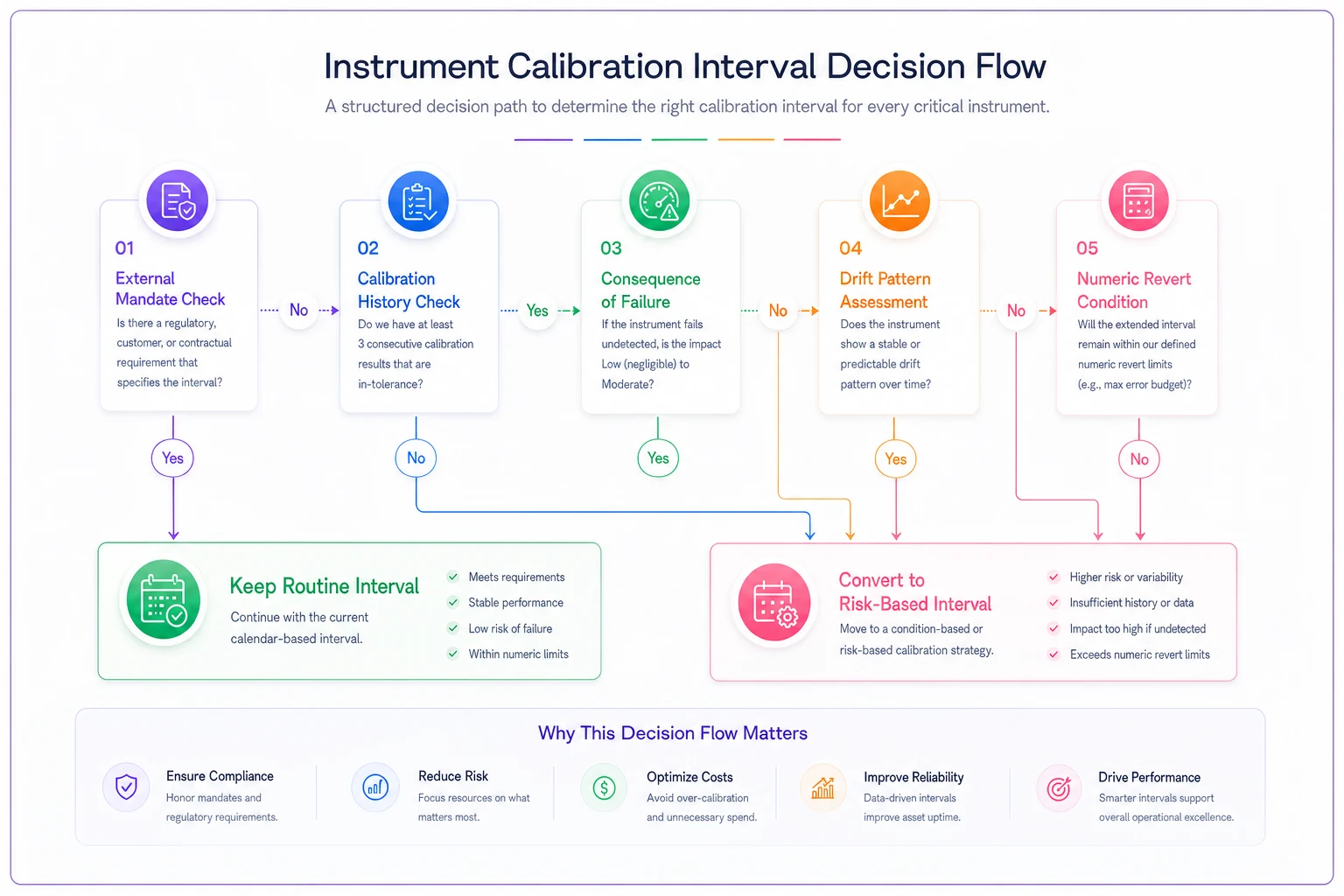
> How the decision flow works in practice: Start at Step 1 with a regulation or contract check. If no mandate exists, move to Step 2 and verify you have sufficient calibration history. If history is adequate, Step 3 evaluates consequence of failure. Instruments that clear that gate go to Step 4 for drift pattern review. Only instruments with slow, predictable drift reach Step 5, where a written numeric revert condition is the final gate before conversion is approved.
Acceptance criteria that hold up
The criteria below are what separate a defensible program from one that looks like interval creep. Pick concrete thresholds and write them into the SOP.
| Criterion | Keep Routine | Convert to Risk‑Based |
|---|---|---|
| External mandate on interval | Present | Absent |
| Calibration history | < 3 in‑tolerance cycles | ≥ 3 in‑tolerance cycles |
| As‑found margin | Variable or > 50% of tolerance | Consistently < 50% of tolerance |
| Drift pattern | Erratic / step changes | Slow, linear, directional |
| Failure consequence | High / safety‑relevant | Low to moderate |
| Revert condition defined | Not yet written | Written and numeric |
The single most useful column is the last row. A risk‑based interval without a written revert condition is not a risk‑based interval — it's an un‑reviewed extension. Build the table into your SOP review cycle and it becomes a forcing function: if a converted instrument can't produce a revert condition on demand, it goes back to fixed calendar until it can.
SOP phrasing templates
For instruments retained on a fixed interval by mandate:
> "Instrument [TAG] is calibrated at a fixed interval of [X months] in accordance with [standard/reg/contract clause]. This interval is not subject to risk‑based extension. Any change requires formal variance approval under [procedure ref]."
For instruments retained on a fixed interval by engineering judgment:
> "Instrument [TAG] is retained on a fixed [X‑month] interval due to [high failure consequence / insufficient calibration history / erratic drift behavior]. Retention reviewed on [date] by [role]. Reassessment scheduled at [date] or after [N] additional calibration cycles, whichever comes first."
For instruments converted to a risk‑based interval:
> "Instrument [TAG] interval extended from [X] to [Y months] based on [N] consecutive in‑tolerance calibrations with as‑found error ≤ [Z%] of tolerance. Extension remains valid only while as‑found error stays below [Z%] of tolerance. If exceeded at any calibration, the instrument reverts to the [X‑month] routine interval and the extension is re‑evaluated. Decision approved by [role] on [date]."
That revert clause is doing real work. It turns a one‑time judgment into a self‑correcting rule.
Sample evidence records for audits
When an auditor questions a keep‑or‑convert decision, you want a single record that answers it. A usable decision record contains:
-
Instrument tag and description
-
Loop/function it serves and its criticality rating
-
The decision
retain routine or convert
-
Which decision‑flow branch produced the outcome
-
Supporting data
last 3–5 as‑found/as‑left results with tolerance
-
Acceptance criterion applied (with the numeric threshold)
-
Revert condition (for conversions)
-
Approver, role, date
-
Next review date or cycle trigger
> Sample retained‑routine record: > Tag: TT‑204 (reactor jacket temperature) · Criticality: High (batch‑affecting) · Decision: Retain routine, 6 months · Branch: Step 3 (high consequence) · As‑found last 4 cycles: +0.3°C, +0.2°C, +0.4°C, +0.2°C (tol ±1.0°C) · Note: Margin excellent, but consequence high and loop is batch‑affecting — conversion declined. · Reviewed by J. Okafor (QA Eng) 2026‑03‑11 · Next review: 2026‑09‑11.
> Sample converted record: > Tag: PT‑118 (header pressure, indication only) · Criticality: Low · Decision: Convert 6 → 18 months · Branch: Step 5 (all conditions met) · As‑found last 3 cycles: 8%, 11%, 9% of tolerance · Criterion: extend while as‑found ≤ 50% tol · Revert: any cycle > 50% tol returns to 6 months · Approved M. Lindqvist (Cal Mgr) 2026‑02‑02 · Next cal: 2027‑08‑02.
The difference an auditor notices: both records show the reasoning, not just the outcome. The retained‑routine record even documents that the margin would have supported extension and was declined anyway. That kind of record kills a finding before it starts.
Three short instrumentation examples
Temperature probe (sterilizer RTD). Consistent, tiny drift — the kind of data that tempts you to extend. But it sits on a sterilization cycle where undetected failure means a compromised load. Decision flow stops at Step 3: high consequence. Keep routine. The record notes the excellent margin and the deliberate choice to decline extension. Cheap to check, expensive to get wrong.
Pressure sensor (non‑critical header indication). Three cycles at roughly 8–11% of tolerance, slow and directional, no mandate, low consequence. Textbook conversion. Extended 6 → 18 months with a revert clause at 50% of tolerance. If a future cycle lands at 55%, it drops back to 6 months automatically — no meeting required. Convert.
Flow meter (newly installed, custody‑adjacent). Only two calibration points, and it feeds a measurement that touches reconciliation numbers. Decision flow stops at Step 2: insufficient history. Keep routine at the conservative interval for now. Revisit after three in‑tolerance cycles. "Not enough data yet" is a perfectly defensible record.
A short real scenario
A mid‑size specialty chemicals site ran about 410 field instruments, nearly all on fixed 6‑ or 12‑month calendars. Calibration labor was eating a meaningful chunk of the maintenance budget, and leadership pushed for risk‑based intervals across the board.
Instead of converting everything, the calibration team ran the whole population through a keep‑or‑convert pass. Roughly 60% stayed on fixed intervals — mandated, high‑consequence, or thin on history. About 160 instruments qualified for extension, each with a written revert condition.
The result wasn't a dramatic cost collapse. Calibration labor dropped somewhere in the 18–22% range, which was real money but not the half‑off number leadership had imagined. The more important outcome showed up at the next external audit: zero calibration‑interval findings, because every extension and every retention had a decision record behind it. The auditor spent less time on calibration than in prior years — the records answered the questions before they were asked. The team's own takeaway was blunt: the value wasn't the instruments they converted. It was being able to defend the ones they didn't.
Who should be cautious before converting anything
Not every program is ready to run this cleanly:
-
Teams without reliable as‑found data capture. If your records only show pass/fail and not the actual as‑found values, you can't apply margin‑based criteria. Fix the data first.
-
Sites where calibration records live in spreadsheets across multiple people. The revert logic only works if someone actually checks it at every cycle. Scattered records mean extensions quietly outlive their justification.
-
Programs under active regulatory scrutiny. If you've got an open finding on calibration, converting intervals mid‑stream looks like you're reducing oversight. Stabilize first.
Where a calibration or EAM system helps isn't glamorous: it's keeping the as‑found margin, the acceptance criterion, and the revert condition attached to each instrument so the check happens automatically at every calibration instead of depending on someone remembering. The decision is still yours — the system just makes sure the revert rule doesn't get forgotten two cycles later.
Closing thought
A mature risk‑based calibration program isn't the one that extended the most intervals. It's the one that can walk an auditor through why each instrument sits where it does — including the ones deliberately kept on a calendar. Keep routine calibration in your risk‑based program as a first‑class, documented choice, not a leftover. Write the revert conditions. Keep the decision records. The savings follow naturally, and the findings don't.
Ready to elevate your asset operations?
Join 1,500+ businesses using Ownitly to optimize asset utilization, reduce downtime, and ensure compliance.