
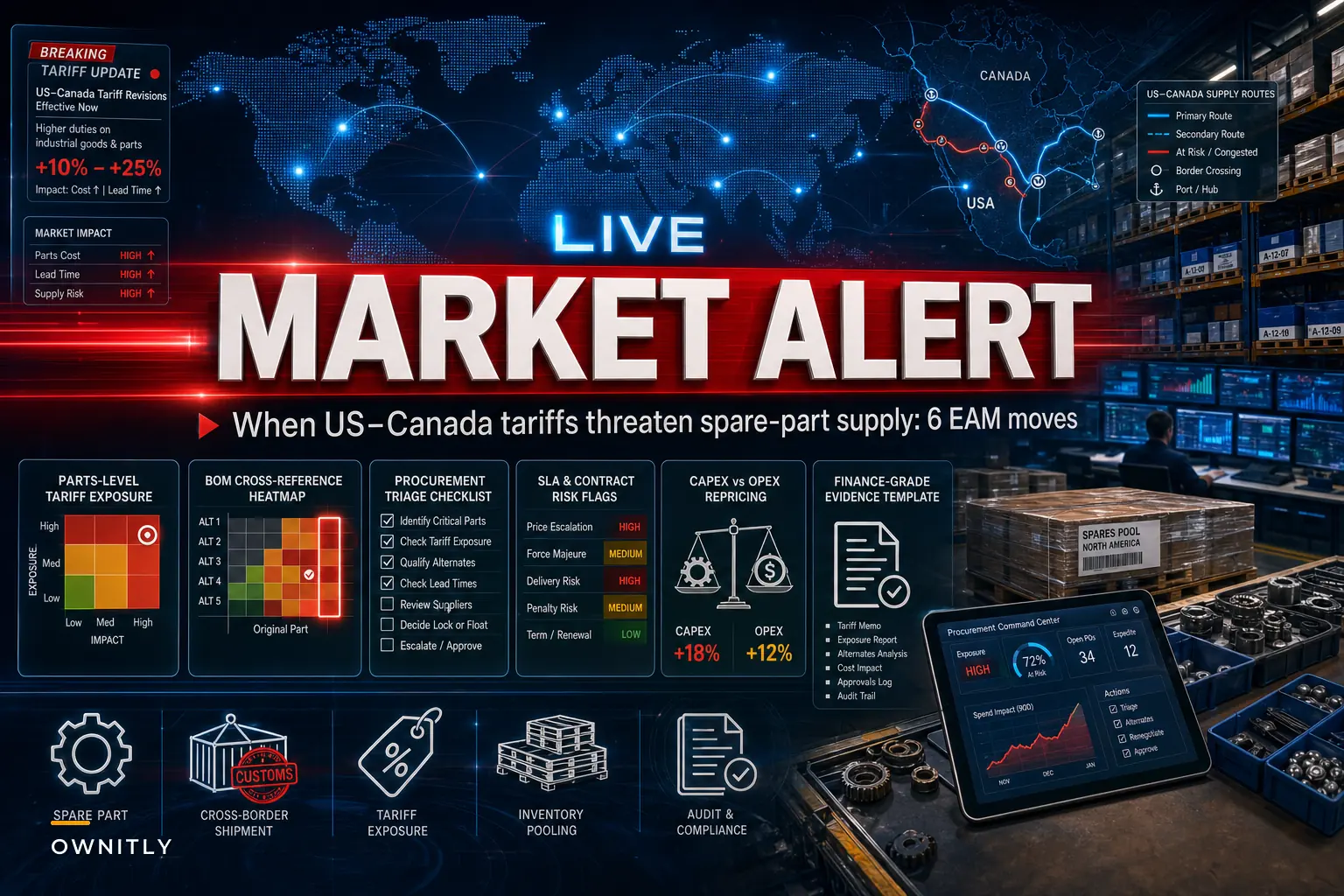

The tariff announcements this week don't actually tell you what your spare part will cost in March. The White House said it's dropping some Canadian product tariffs while replacing them with duties on other categories, and Reuters reported the two governments are working on a deal to ease steel and auto tariffs. Good news on paper. But if you're responsible for keeping a line running, "they're working on a deal" is not a number you can plug into a budget.
That's the real problem. Tariff volatility doesn't just raise costs — it destroys your ability to plan. A fixed 15% duty is annoying but workable. A duty that might be 15%, 0%, or 25% depending on which product list gets revised next quarter is operationally worse, because you can't commit to a sourcing decision without risking being wrong either way.
This isn't an article about predicting policy. Nobody serious is doing that right now. It's about building a tariff spare parts strategy that holds up whether duties go up, down, or sideways — because uncertainty itself has a cost, and most maintenance organizations are absorbing it without ever measuring it.
Where the real exposure hides
Most asset managers assume their tariff exposure lives in obvious places — big steel castings, imported motors, anything that shows up as a line item in a capital project. That's partly true, but it misses where the actual damage happens.
The exposure that hurts is in the parts you don't think about. The $340 sensor that crosses the border twice during remanufacturing. The bearing kit where the housing is domestic but the rollers are Canadian-sourced. The control board that's "made in the US" but whose critical sub-component gets reclassified when a product list changes. Your BOM tells you the finished part. It rarely tells you the country-of-origin story underneath, and that's exactly where tariff reclassifications bite.
In a lot of maintenance operations, nobody actually knows their cross-border exposure at the part level until a price shock forces them to find out. Procurement knows the vendor. Maintenance knows the function. Finance knows the spend. But almost no one has a single view connecting which critical spares depend on cross-border supply chains and what happens to uptime if those lead times double.
That gap is the whole ballgame. You can't protect against a risk you can't see.
Six moves that work regardless of which way tariffs go
These aren't sequential steps. They're a set of levers, and which ones you pull depends on your asset base and how much cross-border exposure you're actually carrying.
Stop losing track of critical assets.
Ownitly helps you monitor, maintain, and manage every asset efficiently and reliably.
- Centralized asset tracking
- Automated maintenance alerts
- Compliance monitoring & reporting
No credit card required
1. Rebuild your critical-spares list around tariff exposure, not just criticality
Your existing critical-spares list is probably organized by failure impact — what breaks the line, what has a long lead time, what kills safety. Keep that. But add a second axis: cross-border sourcing dependency.
A part can be low-criticality and high-exposure, or high-criticality and fully domestic. The ones that should concern you are high on both. Those are where you want buffer stock, qualified alternates, and a conversation with finance before a price shock — not after.
The practical move is a scoring overlay:
| Factor | Low (1) | Medium (2) | High (3) |
|---|---|---|---|
| Uptime impact if unavailable | Redundant asset | Degraded operation | Line stops |
| Cross-border sourcing | Fully domestic | Mixed origin | Single foreign source |
| Lead-time sensitivity | <2 weeks | 2–8 weeks | >8 weeks |
| Alternate availability | Multiple qualified | One possible | None identified |
Anything scoring 10 or above gets active management. Anything scoring 4 or below, leave it alone. The middle you revisit quarterly.
This keeps you from the common mistake of trying to tariff-proof your entire inventory, which is both impossible and expensive. The scoring doesn't need to be perfect — it just needs to be consistent enough to separate the parts that matter from the ones that don't.
2. Find your domestic alternates before you need them
The slowest, most painful version of this problem is discovering you need a domestic alternate the week your Canadian supplier's part jumps 22%. Qualification takes time — engineering sign-off, a trial fit, sometimes a short run to confirm it doesn't introduce a new failure mode.
A plant identifies that a gearbox seal kit is single-sourced from across the border. Instead of waiting, they spend an afternoon cross-referencing the BOM, find two domestic suppliers with compatible specs, and run one through a qualification cycle during a planned outage. Cost of that proactive work: maybe a few hundred dollars in engineering time. Cost of doing it reactively during an unplanned failure with tariff pricing attached — easily ten times that, plus the downtime.
Run alternate qualification during planned outages to avoid introducing production risk during the evaluation.
The underlying discipline here is BOM cross-referencing, and it pays off far beyond tariffs. The same workflow that finds a domestic alternate also protects you against obsolescence and single-source risk in general.
3. Lock your pricing where you can, float where you can't
Not every supplier relationship can carry a fixed-price agreement, but more can than most teams bother to negotiate. When tariff direction is genuinely uncertain, a supplier who wants your volume may accept a price-hold clause through a defined window — essentially letting them absorb some tariff risk in exchange for guaranteed business.
The decision rule is straightforward: lock pricing on high-exposure, high-criticality parts where a sudden jump would blow your budget. Let the low-exposure stuff float, because managing a contract on a $40 part costs more than the part does.
Where this goes wrong is teams trying to lock everything, which irritates suppliers and burns procurement time on parts that don't matter.
4. Rethink pooling before you rethink purchasing
Most organizations skip this one because it feels like more work than buying extra stock. But if you run multiple sites, a tariff spike on a specific part is a strong argument for pooling that part across locations rather than each site independently over-ordering ahead of a price change.
Instead of five sites each buying three units at the new higher price "just in case," you hold a shared buffer and move units where they're needed. You carry less total inventory, you're less exposed to the tariff on the margin units you would have bought defensively, and you avoid the quiet disaster of each site hoarding spares that sit on a shelf for two years.
Pooling has hidden carrying costs and accounting complications if you don't set it up properly though — transfer pricing, ownership, who eats the write-down when a pooled part goes obsolete. We walked through how to structure that cleanly in this playbook on pooling spares across sites, and it's worth reading before you move a single pooled unit, because a badly designed pool just relocates your cost problem instead of solving it.
A quick workflow to apply these moves looks like this:
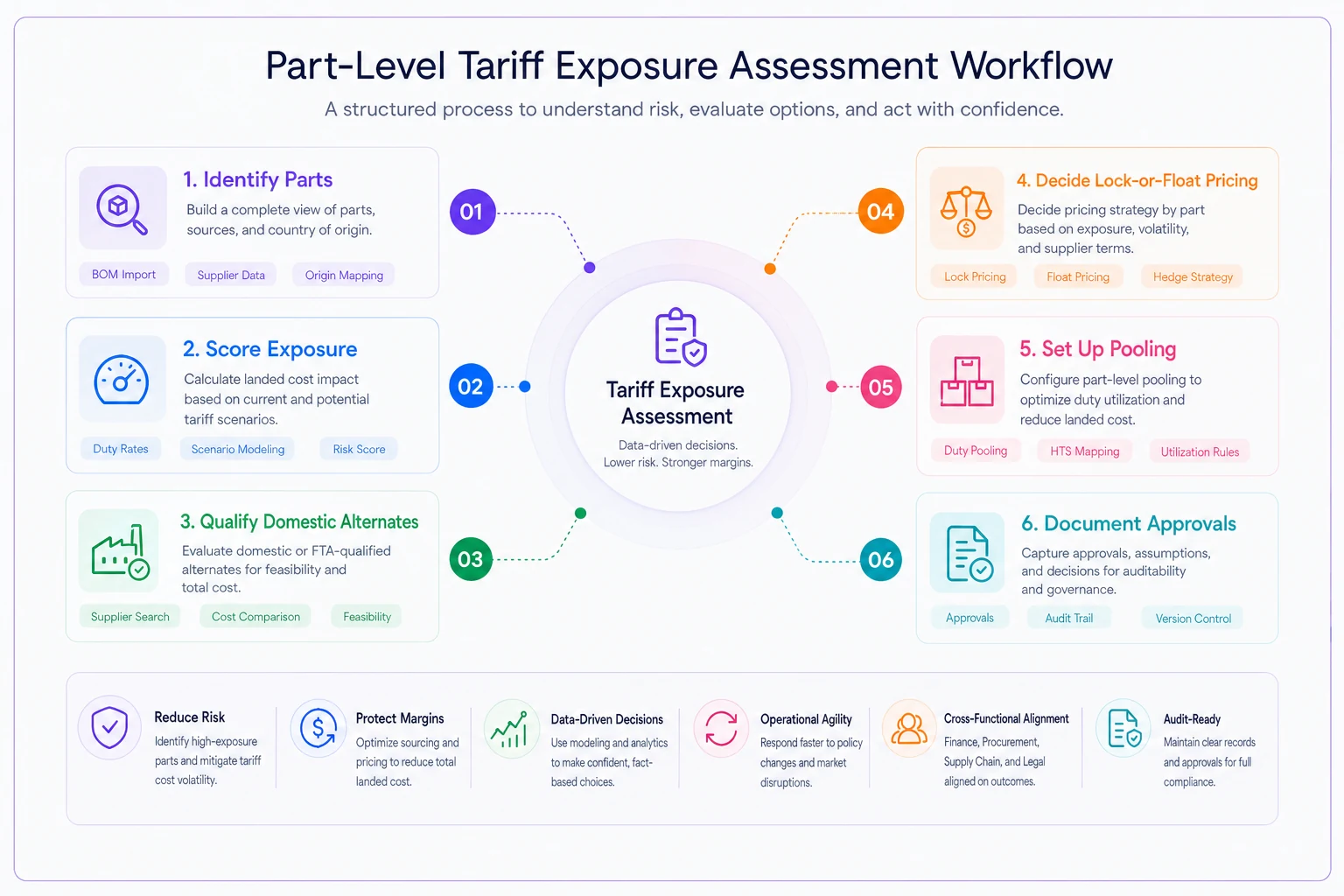
Use the workflow to prioritize which levers to pull first based on exposure scores and criticality.
5. Build the cost-approval evidence trail now
When part costs jump because of a tariff reclassification, finance is going to ask questions. Why did this work order cost 30% more than the estimate? Why did you defer that overhaul? Why did you buy forward on this component?
If you can't answer with documentation, you lose the argument — and worse, you lose credibility for the next budget cycle. The teams that come through tariff volatility well are the ones who tie every tariff-driven cost decision to a clear record: here's the original quote, here's the tariff-adjusted quote, here's the alternate we evaluated, here's why we chose what we chose.
This is where having purchasing, work-order, and asset data connected in one EAM platform earns its keep — not because of any single feature, but because the cost story is already assembled when finance asks. When procurement reconciliation, part costs, and work-order history live in separate systems, rebuilding that trail after the fact is the kind of task that eats a week and still comes out incomplete.
6. Reprice deferred-maintenance decisions against the new math
Every maintenance organization carries a mental list of "we'll do it next year" jobs. Tariff shifts change the math on those, and almost nobody re-runs the numbers.
If a planned overhaul depends on parts that are about to get more expensive, deferring it might cost more, not less. If parts are about to get cheaper because a tariff is being lifted, maybe you wait. The point is to stop treating the deferral list as static when the input prices underneath it just became volatile.
A quick checklist for reviewing the deferral list under tariff uncertainty:
-
Does this job depend on cross-border-sourced parts?
-
Is the tariff direction on those parts up, down, or unknown?
-
What's the downtime cost if the asset fails before the deferred work gets done?
-
Does buying the parts now (at known cost) beat waiting for uncertain pricing?
-
Can we decouple the labor from the parts — order parts now, schedule work later?
That last one is underrated. You can often lock in today's part price without committing to the full job, which hedges the tariff risk while keeping your schedule flexible.
A real scenario
A mid-sized food-processing operation running three plants had roughly 40% of its critical rotating-equipment spares tied to cross-border suppliers. When the earlier round of tariff changes hit, each plant reacted independently — managers started forward-buying bearings, seals, and drive components to get ahead of expected price increases.
Within a quarter they'd tied up somewhere around $90k–$110k in extra inventory, a chunk of which was duplicated across sites. Then a portion of those tariffs got revised downward, and they were sitting on parts bought at a premium that the market no longer justified.
The fix wasn't complicated, just disciplined. They built a single exposure-scored spares list across all three plants, set up a shared pool for the dozen highest-exposure parts, and put a price-hold agreement in place with their two biggest suppliers. The next time tariff noise hit, they weren't guessing. Forward-buying dropped to the parts that actually warranted it, pooled inventory covered the gaps, and carrying cost came back down by a meaningful margin — not a dramatic turnaround, but the kind of steady improvement that shows up as fewer panic purchases and fewer dead parts on the shelf.
When this level of effort isn't worth it
If your cross-border exposure is genuinely small — a handful of low-cost parts with easy domestic alternates — don't build an elaborate tariff spare parts strategy. You'll spend more on the process than you'll ever save. A simple watch-list and a couple of qualified alternates is enough.
This full approach makes sense when you're running multiple sites, carrying significant single-source foreign dependencies on critical assets, or operating in a sector where a single stocked-out part stops production. If a day of downtime costs more than your entire annual spares budget for a part category, the planning effort pays for itself the first time it prevents one bad surprise.
Single site with mostly domestic sourcing? Honestly, most of this is overkill. Keep an eye on the two or three parts that could hurt you and move on.
The point isn't the tariffs
Tariffs will keep moving. The deal Reuters described might close, or it might stall, and a new product list will reshuffle exposure again next quarter. Chasing each announcement is a losing game.
What actually protects uptime and budget is knowing your part-level exposure before the shock, having alternates qualified before you need them, and keeping the cost evidence assembled so you can defend your decisions when they're questioned. That's not reactive — that's the difference between a maintenance organization that gets whipsawed by every policy change and one that treats tariff volatility as just another managed risk: visible, scored, and handled before it becomes an emergency.
What actually protects uptime and budget is knowing your part-level exposure before the shock, having alternates qualified before you need them, and keeping the cost evidence assembled so you can defend your decisions when they're questioned. That's not reactive — that's the difference between a maintenance organization that gets whipsawed by every policy change and one that treats tariff volatility as just another managed risk: visible, scored, and handled before it becomes an emergency.
Ready to elevate your asset operations?
Join 1,500+ businesses using Ownitly to optimize asset utilization, reduce downtime, and ensure compliance.