



Most asset programs put enormous effort into the front end. Procurement specs get scrutinized, capitalization rules get debated, commissioning packets get signed off. Then the asset runs for fifteen years, and when it finally comes time to retire it, nobody can agree on who owns the decision, what evidence is required, or when finance should stop depreciating it.
That gap is where real money leaks and real audit findings get born. A retired pump sitting on the fixed asset register for three years after it was scrapped. A transformer "disposed of" with no evidence it was handled according to environmental rules. An engineering team that decommissioned a line in the field while accounting kept carrying it at book value because nobody told them. These aren't rare edge cases — they're the predictable result of treating retirement as an event instead of a governed workflow that spans engineering, maintenance, procurement, and compliance.
This article is about that system: how the retirement workflow connects four departments that usually don't talk to each other, where it breaks as the asset base grows, and what a defensible end-of-life process actually looks like.
The real problem: retirement is a decision with four owners and no one in charge
What makes asset retirement structurally hard is that the decision isn't owned by any single function, but every function has veto power or downstream exposure.
-
Engineering decides whether the asset is technically fit for continued service.
-
Maintenance holds the failure history and the cost-to-keep-running data.
-
Procurement controls disposal channels, resale, and vendor recovery.
-
Compliance owns the environmental and regulatory obligations that follow the physical asset out the door.
-
Finance has to recognize the write-off, stop depreciation, and keep the register clean for audit.
When no single workflow stitches these together, each group acts on its own clock. Engineering flags an asset as obsolete in a reliability review. Maintenance keeps generating work orders against it because the CMMS never got the memo. Finance keeps depreciating it. Procurement eventually scraps it but files no disposal evidence. Six months later an auditor asks for proof the asset was retired properly and you've got five different versions of the truth.
What tends to happen across asset-heavy operations is that the decision usually isn't the problem. Everyone agrees the thing should go. The problem is that the decision never travels cleanly through all five systems, and the evidence trail gets assembled retroactively — which is exactly when it falls apart.
Why retirement criteria stay vague (and what that costs)
Most organizations never write down what actually triggers a retirement. They have replacement budgets and capital plans, but the formal criteria for "this asset should now be retired" live in people's heads.
Stop losing track of critical assets.
Ownitly helps you monitor, maintain, and manage every asset efficiently and reliably.
- Centralized asset tracking
- Automated maintenance alerts
- Compliance monitoring & reporting
No credit card required
This gets expensive in two directions. On one side you keep assets too long — pouring maintenance spend into equipment that passed its economic retirement point years ago. On the other you retire assets prematurely because a champion left and nobody could defend keeping them, and now you've written off book value you didn't need to.
| Retirement trigger | Owned by | What it measures | Common failure |
|---|---|---|---|
| Economic (cost-to-keep > replace) | Maintenance + Finance | Annual repair spend vs. depreciated replacement | Repair costs scattered across work orders, never aggregated per asset |
| Technical obsolescence | Engineering | Parts availability, spec compliance, performance drift | Nobody tracks when spares go end-of-life |
| Regulatory | Compliance | New emissions, safety, or efficiency mandates | Regulatory changes not mapped to affected asset classes |
| Reliability | Maintenance | Failure frequency vs. criticality threshold | Failure data exists but isn't trended per asset |
| Strategic | Operations leadership | Line or process being discontinued | Field decommissioning happens before systems update |
The second column matters more than it looks. Each trigger is owned by a different function, which means a complete retirement decision requires assembling inputs from people who report to different VPs. If your process doesn't force that assembly, the loudest trigger wins and the others get ignored.
One pattern worth flagging: technical obsolescence and economic retirement are deeply linked, and both get driven by spare parts reality. When critical spares go end-of-life, your effective retirement date just moved forward whether you planned it or not. This is why obsolescence tracking isn't a procurement side-task — it's a leading indicator for retirement. If you haven't connected those workflows, it's worth reading how parts obsolescence detection and BOM cross-referencing feeds directly into end-of-life planning.
What breaks at scale
With fifty assets, you can run retirement informally. Someone remembers. A spreadsheet tracks it. The plant manager signs off and tells accounting.
With five thousand assets across multiple sites, informal retirement quietly becomes a liability factory. A few things break predictably:
The register and the field drift apart. Physical decommissioning and accounting retirement happen on different timelines, in different systems, driven by different people. The bigger the asset base, the wider the gap. Registers where 8–12% of "active" assets had already been physically removed aren't unusual — ghost assets still accruing depreciation, still showing up in insurance valuations, still implying maintenance obligations that no longer exist.
Disposal evidence becomes inconsistent. At small scale one person handles disposals and knows what documentation matters. At scale, disposals get handled by whoever's available, and the evidence standard varies by person and by site. Then a regulated disposal — oil-filled equipment, refrigerants, anything with an environmental obligation — gets handled like scrap, and you've got a compliance exposure sitting in a landfill with your company's name on the manifest.
The accounting hand-off becomes a game of telephone. Engineering knows the retirement date. Finance needs the disposal date, the proceeds, and the net book value at write-off. Those are different dates and different data, and when they travel by email and memory, they arrive late, wrong, or not at all. This is the same category of breakdown that shows up in capitalization, and the controls that fix it rhyme closely with the EAM-to-ERP reconciliation and audit-ready evidence approach used on the front end of the asset lifecycle.
Nobody can reconstruct the decision later. Two years after a retirement, an auditor or a lawyer asks: who decided, on what basis, with what approval, and what happened to the physical asset? If that trail was never captured as part of the workflow, you're reconstructing it from fragments. Reconstructed evidence is the weakest kind.
The disposal evidence package: what "defensible" actually contains
The core discipline that holds retirement governance together is a standardized disposal evidence package — assembled during the retirement, not after. Think of it as the end-of-life equivalent of a commissioning packet.
A defensible package should include:
-
Retirement authorization — who approved, against which criteria, with a dated signature
-
Asset identity confirmation — tag number, serial, location, matched to the register record
-
Condition and reason — why it's being retired, tied to the specific trigger
-
Disposal method record — scrapped, sold, recycled, returned to vendor, or transferred
-
Regulatory handling evidence — manifests, certificates of destruction, environmental sign-offs for any controlled materials
-
Financial close-out data — disposal date, proceeds received, net book value, cost center
-
Chain-of-custody — who physically handled the asset from decommission to final disposition
-
Photographic evidence — before disposal and, where relevant, proof of destruction
The mistake most teams make is assembling these fields from whatever happens to exist afterward. The right move is to make the package a required gate — the retirement can't be marked complete, and finance can't write off, until the package is populated. That's the difference between evidence you created and evidence you recovered. Auditors can tell the difference, and so can opposing counsel.
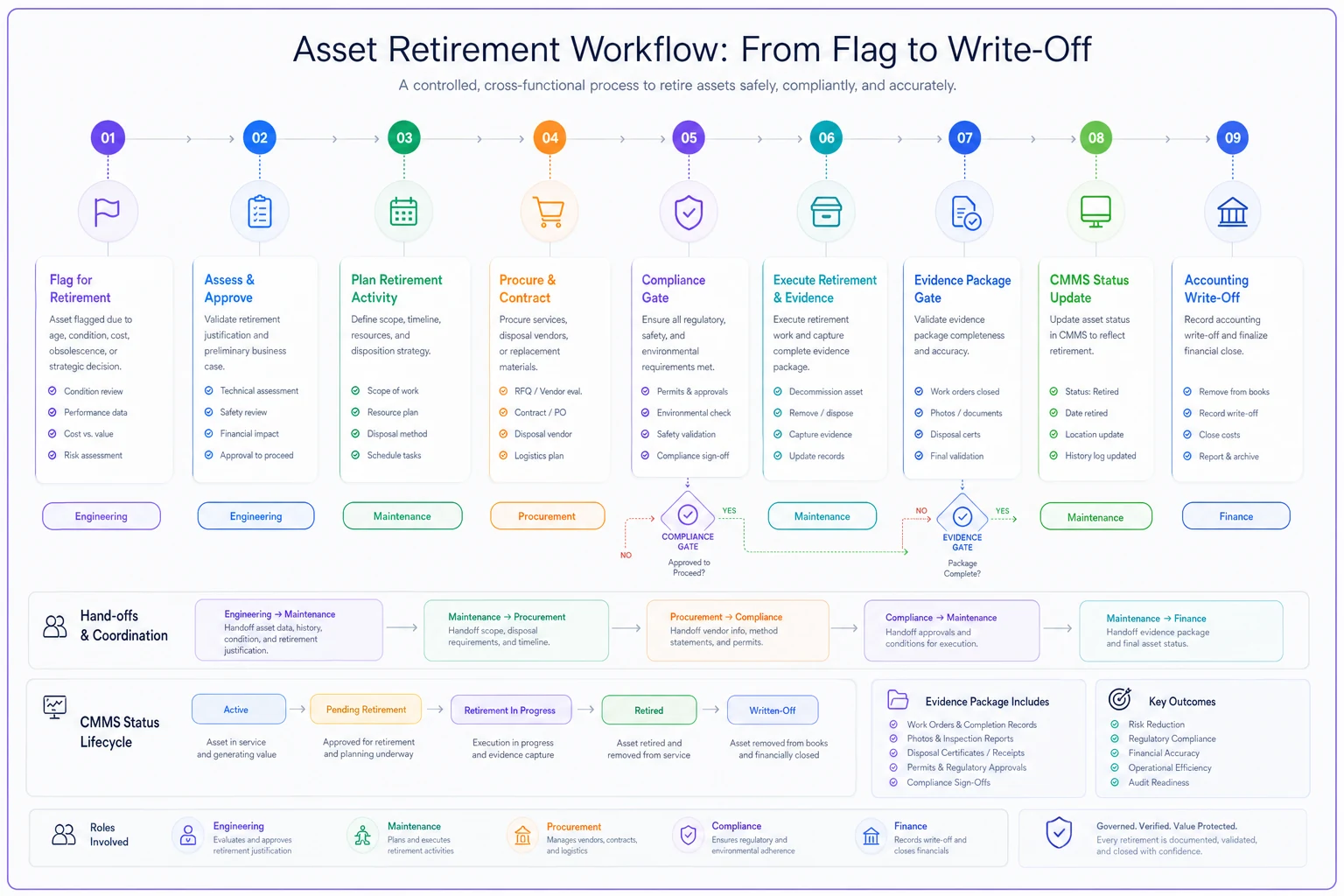
The workflow, from flag to write-off
Below is how a connected retirement process should actually move through the organization. The point isn't the steps themselves — it's that each one has a clear owner and a clean hand-off to the next.
-
Flag — A retirement candidate is identified (reliability review, obsolescence alert, regulatory change, or line discontinuation). The triggering data is attached automatically, not described in prose.
-
Multi-function review — Engineering, maintenance, and finance each confirm their input against the criteria table. This is where premature or overdue retirements get caught.
-
Authorization — The appropriate approval level signs off based on asset value and criticality. High-value or high-risk assets escalate.
-
Compliance screening — Before anything physical happens, the asset is screened for regulated materials and disposal obligations. This gate prevents the "scrapped a transformer full of oil" scenario.
-
Decommission and secure — Maintenance physically takes the asset out of service, LOTO where needed, and the CMMS status flips so no new work orders generate against it.
-
Disposal execution — Procurement runs the disposal through the approved channel, capturing proceeds and chain-of-custody.
-
Evidence close — The disposal package is completed and locked.
-
Accounting hand-off — Finance receives disposal date, proceeds, and NBV, processes the write-off, and removes the asset from the active register.
-
Reconciliation — A periodic check confirms the register matches the field: nothing retired is still depreciating, nothing scrapped is still "active."
Step 5 — flipping the CMMS status at decommission — is the quiet hero of this sequence. It's the single change that stops ghost work orders, prevents maintenance budget from being spent on dead assets, and gives finance a clean trigger.
Flipping the CMMS status at decommission stops ghost work orders and prevents maintenance budget from being spent on dead assets.
Here's a simple visual of that workflow.
In practice it's also the step most often skipped, because the person swinging the wrench isn't thinking about the register.
When heavy retirement governance makes sense — and when it's overkill
Not every asset deserves a nine-step workflow with multi-function sign-off. Applying the full process to a $400 pump wastes everyone's time and trains people to route around the controls.
When the full governance process is worth it:
-
High-value assets where the write-off materially hits the books
-
Anything with regulated disposal obligations — environmental, safety, hazardous materials
-
Assets in regulated industries where retirement records are discoverable
-
Equipment where resale or vendor recovery value is significant enough to need a controlled channel
When a lightweight path is fine:
-
Low-value, non-regulated consumable equipment
-
Bulk retirements of identical low-criticality items that can be handled as a batch
-
Assets fully depreciated with zero book value and no disposal obligation
One more thing worth saying directly: if your asset register isn't trustworthy — duplicate records, wrong statuses, field and system already badly out of sync — don't bolt a retirement workflow on top of it. You'll just be governing bad data more carefully. Fix the register first, then add the retirement controls. A governance process built on a dirty register produces confident, well-documented, wrong answers.
A realistic scenario
Consider a mid-sized manufacturer running roughly 3,400 assets across three sites. Their retirement process was entirely informal — plant managers decided, told accounting by email, and the physical asset got handled by whoever was around.
An insurance valuation review found about 290 assets still on the active register that had been physically removed from the floor. Some had been gone for over two years. The company had been paying insurance premiums and property-related assessments on ghost assets, and depreciation was still running on roughly $600k of equipment that no longer existed. Worse, two transformers had been disposed of with no environmental handling evidence — a finding that turned a cleanup discussion into a compliance one.
After introducing a standardized retirement workflow — explicit criteria, a required disposal evidence package, a mandatory CMMS status change at decommission, and a quarterly register-to-field reconciliation — things changed over about three quarters. The ghost-asset count dropped to single digits. The accounting hand-off, which used to lag physical disposal by three to six months, tightened to a couple of weeks. Every regulated disposal now left the site with a complete evidence package instead of a hope.
Nothing about that transformation was exotic. It was the same decision they were already making, forced to travel cleanly through every system that cared about it.
Where the systems have to connect
Asset retirement governance isn't a compliance task bolted onto the end of the lifecycle. It's the final hand-off in a chain that started at procurement and capitalization, and it fails for the exact same reasons those hand-offs fail — different owners, different systems, different clocks, and no forced reconciliation between the physical world and the financial record.
Modern EAM platforms help here not because they automate the decision — you still want humans weighing engineering, cost, and compliance — but because they enforce the sequence. The status change at decommission can trigger the accounting hand-off. The disposal package can be a required gate before write-off. The reconciliation between register and field can run on a schedule instead of surfacing only when an auditor asks. That enforcement is what turns a scattered set of good intentions into a trail you can actually defend.
Get the retirement workflow right and the payoff is quiet but real: a clean register, no ghost assets dragging your valuations, no regulated equipment leaving the site without evidence, and no scramble to reconstruct a decision two years after the fact. The end of an asset's life deserves the same discipline as the beginning — and it's usually the half that gets neglected.
Ready to elevate your asset operations?
Join 1,500+ businesses using Ownitly to optimize asset utilization, reduce downtime, and ensure compliance.