


Parts obsolescence management isn't about the obvious stuff. Everyone knows their 30-year-old control valves will eventually need replacing. The real damage happens when a $47 bearing goes obsolete without warning and suddenly you can't run three production lines because the manufacturer discontinued it six months ago and nobody noticed.
It starts small. A tech needs a replacement part. They check the storeroom—empty. They order from the usual vendor—discontinued. They scramble for alternatives—nothing matches the specs exactly. Meanwhile, equipment sits idle, production schedules collapse, and everyone's asking why nobody saw this coming.
When a single obsolete bearing takes down three production lines for eight weeks
Parts obsolescence management isn't about the obvious stuff. Everyone knows their 30-year-old control valves will eventually need replacing. The real damage happens when a $47 bearing goes obsolete without warning and suddenly you can't run three production lines because the manufacturer discontinued it six months ago and nobody noticed.
It starts small. A tech needs a replacement part. They check the storeroom—empty. They order from the usual vendor—discontinued. They scramble for alternatives—nothing matches the specs exactly. Meanwhile, equipment sits idle, production schedules collapse, and everyone's asking why nobody saw this coming.
The detection problem most systems miss
Your CMMS probably tracks part numbers, quantities, and reorder points. What it doesn't track: which parts are approaching end-of-life, which vendors just got acquired, or which product lines are being phased out. Standard inventory management assumes parts remain available indefinitely. Obsolescence management requires tracking completely different signals.
Stop losing track of critical assets.
Ownitly helps you monitor, maintain, and manage every asset efficiently and reliably.
- Centralized asset tracking
- Automated maintenance alerts
- Compliance monitoring & reporting
No credit card required
Take a food processing plant with 1,400 unique spare parts across their equipment. Around 85 of those parts come from vendors who've been acquired in the last two years. Another 120 parts haven't been reordered in 18 months—not because they're not needed, but because the equipment runs reliably. When those parts eventually fail, procurement discovers half are discontinued and the scramble begins.
The detection challenge breaks into three layers.
First, lifecycle flags that actually mean something. Not just "active" or "obsolete"—you need stages like "current production," "limited availability," "last-time buy," and "engineering sample only." These flags need to update based on vendor communications, not manual reviews every quarter.
Second, vendor monitoring can't be passive. When Rockwell acquires a smaller controls manufacturer, every part number from that manufacturer enters obsolescence risk. When a bearing company announces they're consolidating product lines, you have maybe six months before specific SKUs disappear. Most organizations find out when they try to order.
Third, cross-referencing needs to happen before crisis mode. That specialized seal might have three functional equivalents from different manufacturers, but discovering this during an emergency shutdown costs ten times more than mapping it proactively.
BOM cross-referencing that actually works
Bill of Materials management usually focuses on what you need to build or maintain equipment. Parts obsolescence management flips this—you need to know every place a specific part appears across all equipment, all sites, and all maintenance procedures.
A chemical plant discovered this the hard way when a specific pressure transducer went obsolete. They had 47 of these transducers installed across various vessels and monitoring points. But the BOM only showed primary equipment associations. The same transducer appeared in auxiliary cooling systems, backup monitors, and portable test equipment—none of it properly documented in the main BOM structure.
Effective cross-referencing requires three data relationships most CMMS platforms struggle with. First, primary-to-alternate part mapping with qualification notes. Not every alternate works in every application. That bearing might have the same dimensions but different temperature ratings. The replacement valve might fit physically but require different mounting hardware.
| Primary Part | Alternate Options | Qualification Requirements | Lead Time Impact |
|---|---|---|---|
| SKF 6204-2RS | FAG 6204-2RSR | Direct replacement, verify seal material | Same (3-5 days) |
| NTN 6204LLU | Higher temp rating, check clearance specs | +2 days | |
| Generic 6204-2RS | Test under load before critical applications | Same day available | |
| Parker 2-011 | Viton equivalent | Chemical compatibility verification required | +1 week for Viton |
| EPDM version | Not suitable for petroleum applications | Stock item |
The qualification requirements matter more than the part numbers. A paper mill installed generic bearings as emergency replacements across their production line. Dimensions matched perfectly. Six weeks later, three bearings failed within days of each other—the generic versions couldn't handle the moisture levels in their operating environment.
Replacement qualification workflows
Finding alternatives is step one. Qualifying them for actual use is where operations succeed or fail. Most organizations either over-qualify—treating every replacement like a nuclear plant component—or under-qualify, installing whatever fits and hoping for the best.
Smart qualification starts with application criticality mapping. A temperature sensor in a redundant monitoring system needs different qualification than the same sensor controlling process safety interlocks. Tracking this differentiation across thousands of parts requires systematic workflows, not engineering judgment calls during emergencies.
The qualification process typically involves four gates that your maintenance evidence requirements need to capture:
-
Dimensional and specification matching—documented with actual measurements, not just catalog specs
-
Application testing under normal operating conditions
-
Accelerated wear testing or historical reliability data from the vendor
-
Formal engineering approval with documented acceptance criteria
A packaging facility developed a tiered qualification system after spending around $400k on unnecessary testing. Category A parts with direct safety impact required full qualification. Category B parts that were production critical needed operational testing plus vendor certification. Category C parts—convenience items basically—only needed dimensional verification. This cut their qualification time by roughly 60% while maintaining reliability standards.
Prioritize qualification resources based on application criticality to avoid over-testing low-risk alternates.
Workflow automation becomes critical when managing dozens of obsolescence events simultaneously. Manual tracking through emails and spreadsheets guarantees something gets missed. You need triggered workflows that assign qualification tasks, track test results, and maintain approval chains without constant human oversight. AI-assisted operational platforms can handle a lot of this automatically—monitoring vendor feeds, flagging status changes, and routing qualification tasks to the right people without someone manually checking a spreadsheet every morning.
Spares reclassification based on obsolescence risk
Traditional spare parts classification looks at criticality and consumption rate. Obsolescence management adds a third dimension: availability risk. A low-consumption spare might be critical when needed and impossible to source if obsolete—those two factors together create a very different stocking decision than either one alone.
A water treatment plant learned this after their spare parts optimization project. They reduced inventory of slow-moving spares by 40%, saving around $180k annually in carrying costs. Eighteen months later, they spent $340k on emergency procurement and expedited shipping when three of those "optimized" parts turned out to be obsolete with 20-week replacement lead times.
Reclassification needs to happen continuously, not during annual reviews. Every obsolescence signal should trigger automatic reclassification workflows. When a vendor announces end-of-life, affected parts immediately move to "stock maximum quantity" status. When alternates get qualified, parts can move back to normal stocking levels.
-
High criticality + High obsolescence risk
Maximum stock, identify multiple alternates immediately
-
High criticality + Low obsolescence risk
Normal critical spares stocking
-
Low criticality + High obsolescence risk
Strategic last-time buy
-
Low criticality + Low obsolescence risk
Standard MIN/MAX levels
Executing this requires your CMMS to track and update obsolescence risk scores automatically. Manual classification reviews every quarter mean you're always three months behind reality.
Integration with CMMS fields and automation triggers
Most CMMS platforms weren't designed for obsolescence management. They track what you have, not what might disappear. Adding obsolescence management means extending standard fields and building new workflow triggers.
The field structure starts with basics: obsolescence status, last vendor notification date, projected end-of-life, and qualified alternatives count. But useful automation requires deeper integration. Link obsolescence status to reorder triggers—when status changes to "last-time buy," automatically calculate maximum reasonable quantity based on consumption history and equipment lifecycle.
A manufacturing plant built these triggers after missing three last-time buy opportunities in a single year. Their system now monitors vendor notifications, automatically updates part statuses, triggers procurement reviews for affected parts, and generates replacement qualification work orders for parts entering obsolescence. The automation prevented the kind of migration disasters they'd seen when switching systems without proper data governance.
Vendor EOL notices need special handling. These arrive as PDFs, emails, or website announcements—rarely in structured data formats. Smart organizations establish vendor data feeds or at minimum, standardized communication channels for obsolescence notices. But even then, someone needs to match vendor part numbers to internal inventory codes, update all affected BOMs, and trigger appropriate workflows.
The workflow triggers cascade through operations in a fairly predictable sequence:
-
Obsolescence notice received → Update part status
-
Part status changed → Check all equipment using this part
-
Equipment identified → Evaluate criticality and alternates
-
No qualified alternates found → Trigger qualification workflow
-
Qualification complete → Update BOMs and reorder points
-
Last-time buy authorized → Execute purchase and update inventory strategy
The diagram below outlines how these triggers flow through systems and teams.
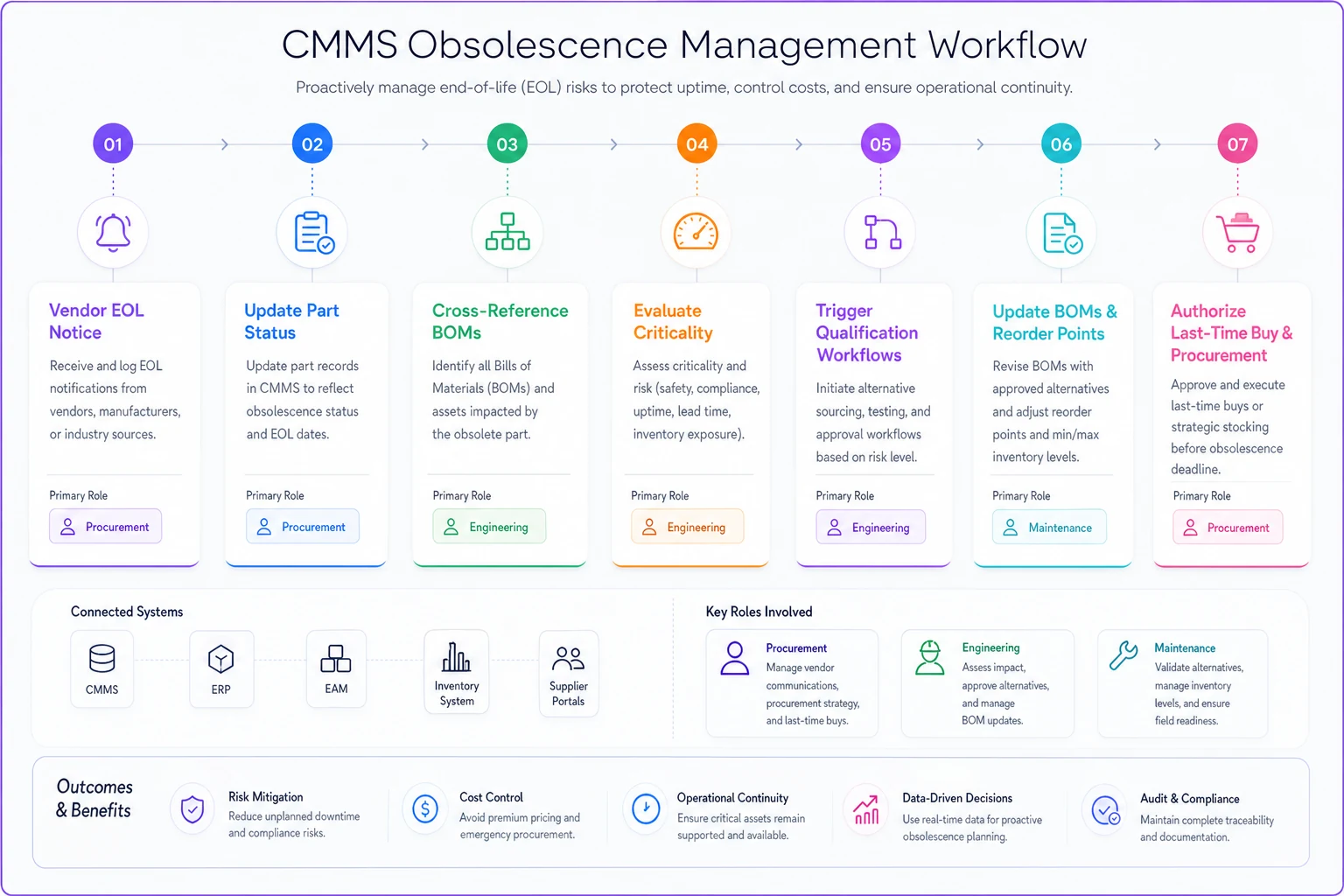
These automation steps reduce human oversight and accelerate response to obsolescence events.
Real implementation at a pharmaceutical packaging facility
A pharmaceutical packaging operation with 3 sites and roughly 2,200 unique spare parts faced cascading obsolescence issues. Modern equipment—less than 10 years old—but around 15% of their electronic components were already obsolete or approaching end-of-life.
The problem surfaced during a servo drive failure. The $1,800 component had been discontinued 18 months earlier. The replacement model required different mounting, different wiring, and firmware updates to the control system. What should have been a 4-hour repair became a 3-day engineering project with $67k in emergency contractor costs.
They implemented a systematic obsolescence management program over six months. First, they audited all parts and identified 320 with meaningful obsolescence risk. They categorized these by equipment criticality and began systematic replacement qualification. For 89 parts with no available alternates, they executed last-time buys totaling around $420k—painful upfront, but far less than future emergency costs.
The operational changes went deeper than inventory. They modified their CMMS to track obsolescence indicators and established monthly vendor communication reviews. They created pre-qualified alternate lists for critical components and built escalation triggers—when any critical part showed obsolescence risk, it immediately triggered engineering review and procurement planning.
Results after 18 months: zero production delays from parts obsolescence, $280k reduction in emergency procurement costs, and about 74% faster mean-time-to-repair for equipment with pre-qualified alternates. The $420k investment in last-time buys looked expensive at the time but saved an estimated $1.3M in avoided downtime. That math tends to change minds pretty quickly.
The compound effect of proactive obsolescence management
Parts obsolescence management seems like a back-office inventory problem until it shuts down production. Organizations that handle it well understand it's actually an operational risk management system that touches procurement, engineering, maintenance, and production planning.
The key isn't having perfect information about every part—that's impossible with thousands of SKUs across multiple vendors. The key is building detection mechanisms that surface risks early, qualification workflows that run before you need them, and inventory strategies that balance carrying costs against availability risk.
Smaller operations often assume obsolescence management only matters for aging equipment. That's not quite right anymore. Modern equipment faces faster obsolescence cycles. Electronic components that used to have 10-year lifecycles now change every 3-5 years. Software-dependent parts become obsolete when manufacturers stop supporting older firmware. Even mechanical components face obsolescence as manufacturers consolidate product lines and eliminate low-volume SKUs.
The operational discipline required here pays dividends beyond avoiding emergencies. You develop better vendor relationships, deeper understanding of equipment dependencies, and more robust maintenance strategies. The same workflows that catch obsolescence risks also surface standardization opportunities and cost reduction possibilities that would otherwise go unnoticed.
Organizations getting this right treat obsolescence management as an operational capability, not a procurement task. They build it into their CMMS workflows, their vendor relationships, and their maintenance planning cycles. Because by the time a part is officially obsolete, the window for managing it has already closed—the real work happens in the 12-18 months before, when signals are weak but actions can still prevent the crisis from happening at all.
Organizations getting this right treat obsolescence management as an operational capability, not a procurement task. They build it into their CMMS workflows, their vendor relationships, and their maintenance planning cycles.
Because by the time a part is officially obsolete, the window for managing it has already closed—the real work happens in the 12-18 months before, when signals are weak but actions can still prevent the crisis from happening at all.
Ready to elevate your asset operations?
Join 1,500+ businesses using Ownitly to optimize asset utilization, reduce downtime, and ensure compliance.