

Most maintenance organizations already have the raw material for a real contractor scorecard. Acceptance photos, torque logs, sign-off sheets, warranty tags, closeout packets — it's all sitting in the CMMS or buried in someone's email. The problem is that almost nobody turns that evidence into a number, and even fewer tie that number to when the invoice gets paid.
So contractors optimize for the thing that's actually measured: closing the work order fast. Not doing it right. Not leaving behind clean evidence. Just closing it.
This piece is about fixing that specific gap — building a contractor performance scorecard for maintenance that pulls directly from acceptance artifacts, feeds a dispute-resolution workflow that isn't a shouting match, gates payment on defensible criteria, and rolls into a supplier development cadence that actually improves your worst vendors instead of just replacing them.
The scoring problem nobody wants to admit
Most contractor scorecards are built from perception, not evidence.
A typical scorecard has categories like "Quality," "Responsiveness," and "Professionalism," each rated 1–5 by whoever fills out the form at quarter-end. That's not a measurement system. That's a vibe check. And it produces two predictable failures.
First, ratings cluster. Almost every contractor lands between 3.5 and 4.2 because nobody wants to start a fight by scoring a 2. Second, when a contractor does get a bad score, they push back — "based on what?" — and the asset manager has nothing concrete to show. The score collapses under the first real challenge.
What actually works is the opposite: the score becomes a byproduct of evidence you were collecting anyway. If the closeout packet requires torque verification photos and 30% of a contractor's jobs are missing them, that's not an opinion. That's a 70% compliance rate. Nobody argues with a count.
The scorecard stops being a judgment and becomes an accounting of what happened.
What acceptance artifacts should feed the score
An acceptance artifact is any piece of evidence produced at the point of work completion that proves the work met a defined standard. The trick is deciding which artifacts are worth scoring against, because scoring everything just creates noise.
Stop losing track of critical assets.
Ownitly helps you monitor, maintain, and manage every asset efficiently and reliably.
- Centralized asset tracking
- Automated maintenance alerts
- Compliance monitoring & reporting
No credit card required
-
Completion evidence — before/after photos, meter readings, test results that match the acceptance criteria on the work order
-
Compliance evidence — permits, LOTO records, hot-work sign-offs, whatever your regulatory environment requires
-
Data quality — did the contractor return usable failure codes, labor hours, and parts consumed, or did they dump everything into "general repair, 4 hrs"
-
Timeliness — not "were they fast" but "did the closeout packet arrive within the SLA window with nothing missing"
-
Rework linkage — did a job they closed reopen within a defined window
That last one is the sleeper metric. A contractor can nail every photo and every form and still be quietly terrible if 15% of their work bounces back within 60 days. Rework rate, tied by asset ID back to the original job, is often the single most honest quality indicator you have.
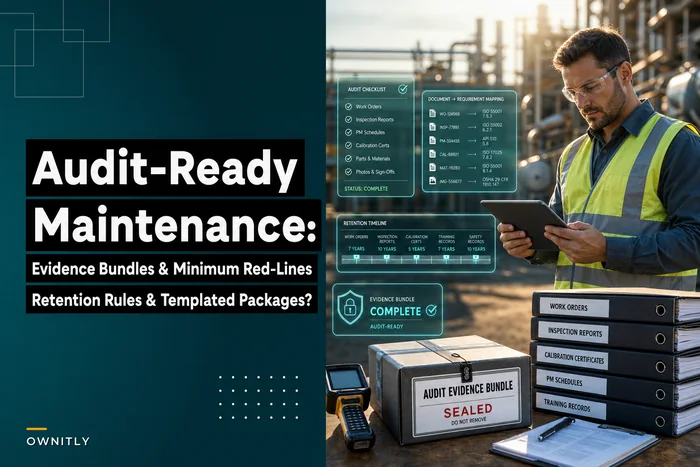
If you've already built structured closeout requirements — and if you've read our take on audit-ready maintenance evidence bundles, you know how much this depends on defining the minimum red-lines up front — then most of these artifacts already exist. You're just not scoring them.
A scoring model that survives a challenge
The scorecard needs to hold up when a contractor's account manager sits across the table and asks how you got the number. That means weighted, evidence-backed, and reproducible.
| Dimension | Weight | Data source | How it's scored |
|---|---|---|---|
| Evidence completeness | 25% | Closeout packet vs. required artifact list | % of required artifacts present and legible |
| Acceptance pass rate | 25% | Work orders passing acceptance on first submission | % passed without resubmission |
| Rework rate (60-day) | 20% | Reopened WOs linked to prior completion | Inverse of reopen % |
| Data quality | 15% | Failure codes, labor, parts fields | % of fields correctly populated |
| SLA adherence | 15% | Closeout timestamp vs. SLA target | % within window |
Every dimension pulls from a count, not an impression. When a contractor asks "why am I an 82?", you can show them: 91% evidence completeness, 88% first-pass acceptance, 12% rework, and so on. The conversation shifts from defending an opinion to reviewing the record.
Two hard-earned notes on weighting. Don't over-weight timeliness — if speed is your heaviest category, you're paying contractors to rush and skip evidence. And keep the model stable across quarters. If you re-weight every review cycle, contractors can't calibrate, and the score loses meaning.
Wiring the score to payment gates
This is where scorecards go from decoration to leverage. A score nobody feels changes nothing.
-
Submission gate — invoice can't be submitted until the required artifact list for that work type is attached. Missing torque photos? The invoice can't enter the queue.
-
Acceptance gate — the work order must pass first-line acceptance review. Failed acceptance kicks it back to the contractor, not to a payment hold.
-
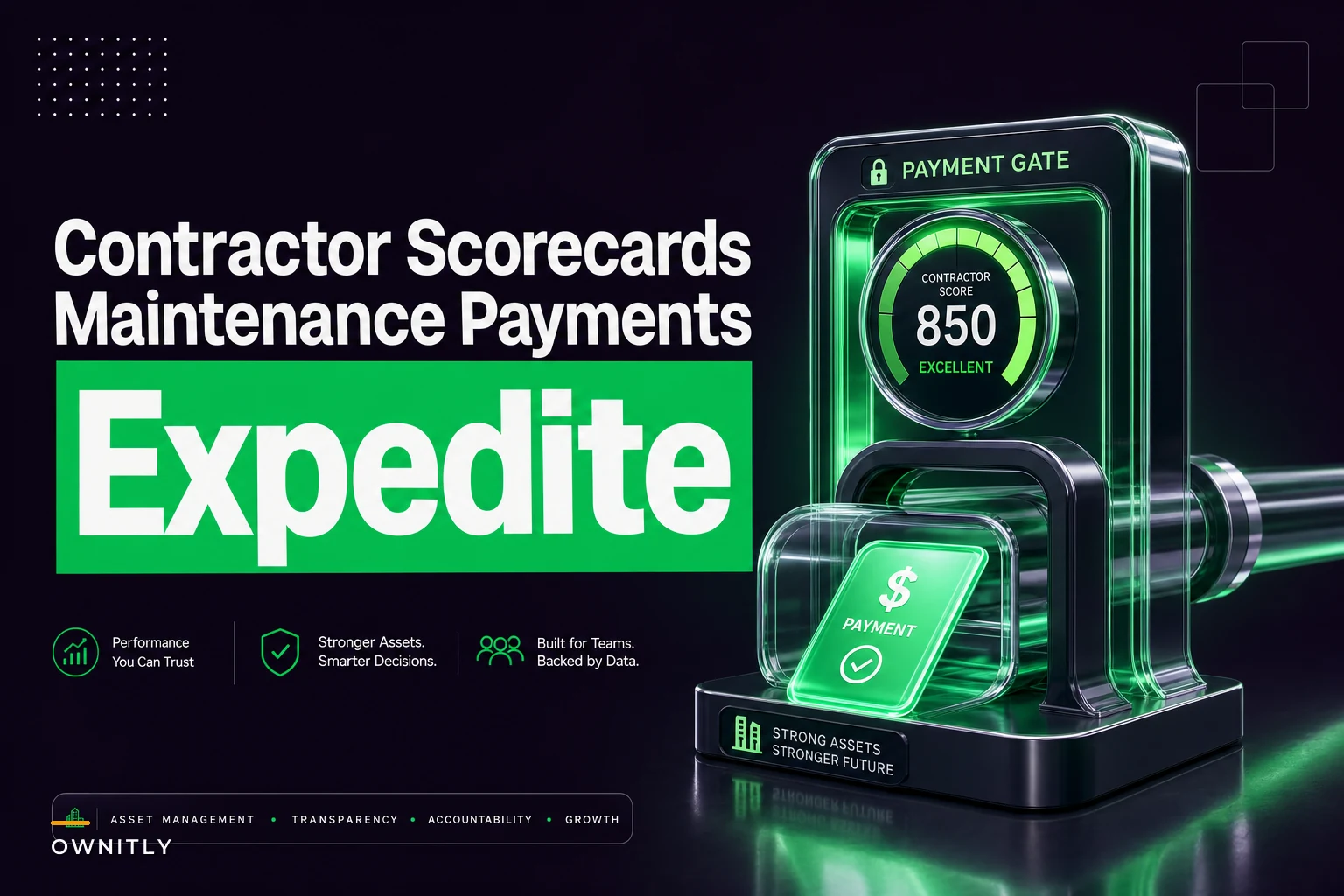
Score-based release tier — contractors above a threshold (say, a rolling 85) get expedited payment terms, e.g. net-15. Contractors below it move to standard net-45 with mandatory closeout review on every job.
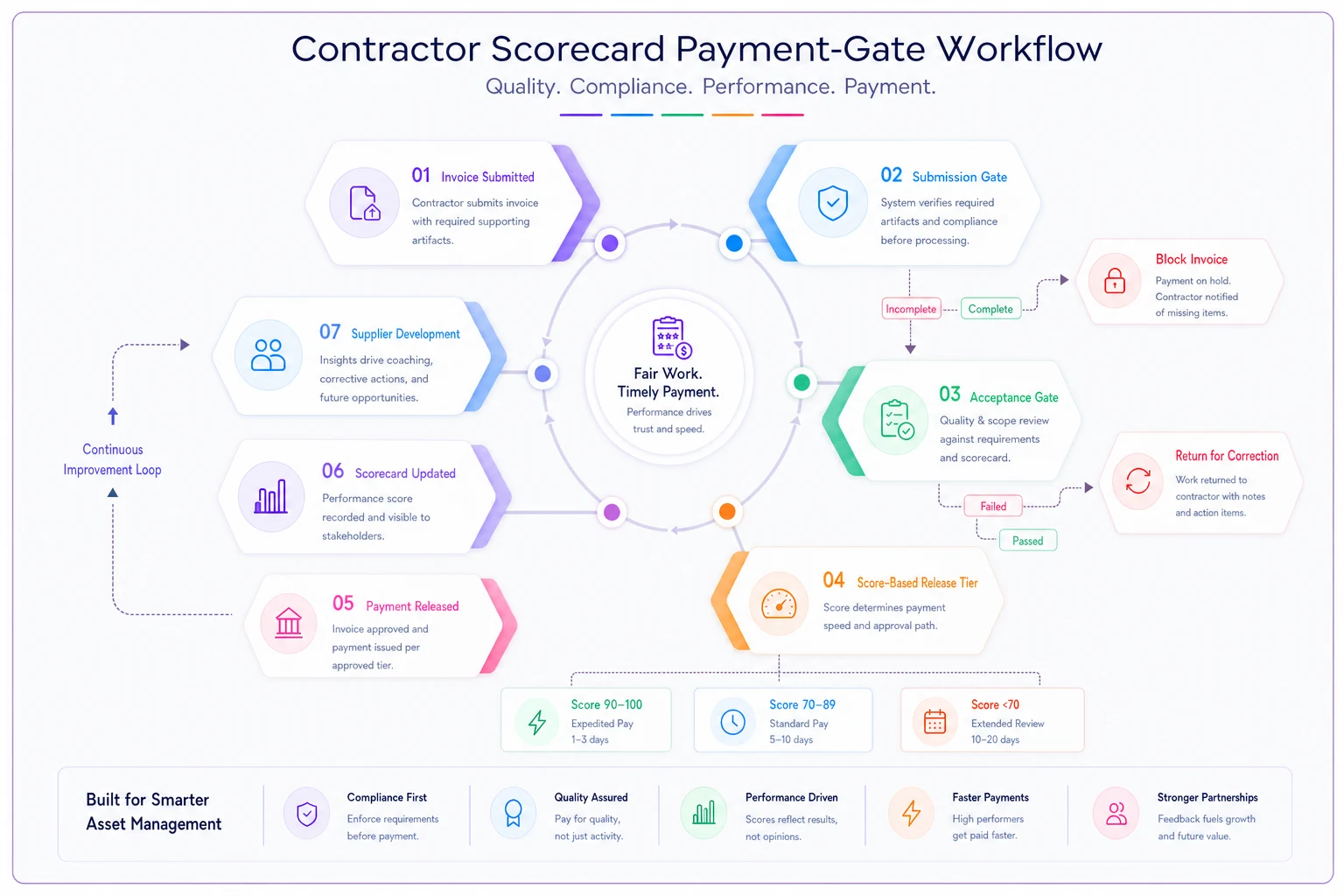
That third tier does something subtle. You're not penalizing anyone — you're rewarding good contractors with faster cash, which they care about more than almost anything. A small electrical contractor running $40k–$60k a month with you feels the difference between net-15 and net-45 in their bones. It becomes a reason to keep the evidence clean without you ever threatening a thing.
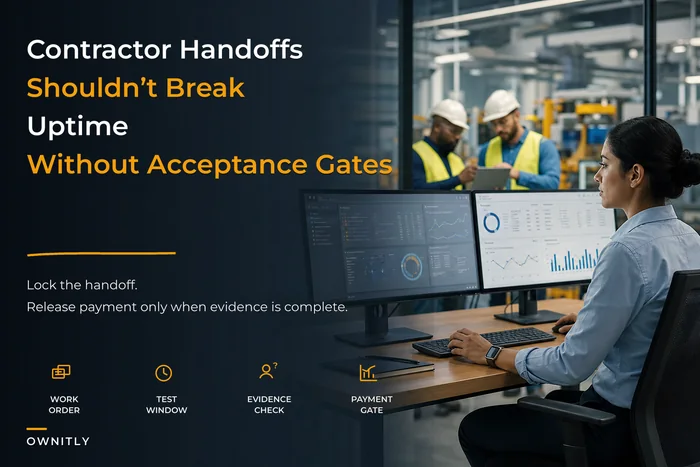
The operational model behind clean handoffs like this — SLAs, acceptance tests, governance gates — is something we broke down in detail in our piece on contractor handoffs and outsourced maintenance. The scorecard is what makes those gates measurable over time.
Dispute resolution that doesn't torch the relationship
Gates create disputes. That's fine — disputes are healthy if there's a defined path. What kills programs is ad-hoc disputes handled by whoever picks up the phone, because the outcome depends entirely on who yells loudest.
Tier 1 — Evidence clarification (2 business days). The most common dispute isn't "the work was bad," it's "the artifact was there, you missed it." Contractor resubmits or points to the missing evidence. Roughly half of all disputes die here because they were genuinely just a filing miss.
Tier 2 — Technical review (5 business days). A reliability engineer or maintenance supervisor — someone not involved in the original acceptance — reviews the evidence against the acceptance criteria. This person needs to be neutral, and it matters that they weren't the one who failed the job originally.
Tier 3 — Joint review (scheduled monthly). Anything unresolved goes to a standing meeting between your contract owner and the contractor's account lead. By the time something reaches Tier 3, it's usually a criteria-interpretation problem — which is exactly what you want surfaced, because it means your acceptance standard is ambiguous.
A healthy dispute rate is not zero. If you have zero disputes, your gates aren't actually gating anything. And a spike in Tier 3 disputes for one work type is a signal your acceptance criteria are unclear. Fix the criteria and the disputes usually evaporate.
The supplier development cadence
A scorecard that only measures is a report card. A scorecard that develops your suppliers is an operating system. The difference is whether there's a cadence attached.
-
Monthly — automated scorecard delivered to each contractor, no meeting required. Just visibility. Contractors who can see their own trend often self-correct before anyone says a word.
-
Quarterly — development review for anyone in the mid-tier. Pick the one lowest dimension and set a single improvement target. Not five. One. "Get evidence completeness from 78% to 90% this quarter."
-
Annually — full portfolio review that feeds re-tender and preferred-supplier decisions.
Give contractors a single improvement target each quarter — it's far more effective than handing them a laundry list of problems.
The one-target rule matters more than it looks. Contractors handed a laundry list of ten problems fix none of them. Give them a single number to move and most will move it.
A real scenario
A regional facilities group managing HVAC and electrical maintenance across roughly 40 sites had eight contractors and no real scorecard — just an annual "how'd they do" survey filled out from memory.
Their problems were the usual ones. Closeout packets showed up incomplete constantly, so their internal team spent a chunk of every week chasing missing permits and photos. Rework was invisible because reopened work orders weren't linked back to the original job or contractor. Payment disputes dragged for weeks because there was no defined path — every one went straight to a phone call between the ops manager and the contractor's owner.
They built a scorecard off the five dimensions above, pulling from artifacts they were already supposed to be collecting, and wired it to a two-tier payment gate. Nothing complicated — the submission gate refused invoices missing required artifacts, and top-tier contractors moved to net-15.
Over about two quarters, evidence completeness across the portfolio climbed from the low 70s to the low 90s. First-pass acceptance improved because contractors stopped submitting half-finished packets that would only bounce. The chasing didn't disappear entirely, but internal admin time spent hunting for missing closeout documents dropped by roughly a third. Two mid-tier contractors that everyone had quietly written off turned out to be fixable once they could actually see their compliance gaps — both climbed into the top tier within a year.
They didn't fire anyone. The scorecard didn't cut vendors, it fixed them.
When this is worth doing — and when it isn't
This kind of scorecard is real work to stand up, so it's worth being honest about fit.
It makes sense when:
-
You run five or more contractors and can't intuitively track them all
-
Contractor spend is large enough that payment terms are meaningful leverage
-
You already have structured acceptance criteria and closeout requirements
-
Rework is happening but you can't currently see who's causing it
It's a bad idea when:
-
You have one or two contractors you know intimately — a formal scorecard is overhead you don't need
-
Your acceptance criteria aren't defined yet. A scorecard built on vague standards just formalizes the ambiguity, and every dispute becomes a fight over what "acceptable" meant
-
You're not willing to actually enforce the payment gates. A gate you override under pressure trains contractors that it's theater
That last point is the real killer. The fastest way to destroy a scorecard's credibility is letting a favored contractor skip the gate "just this once." The first exception is the last time anyone takes the system seriously.
Where to start
Don't try to build all five dimensions at once. Pick the two that hurt most — usually evidence completeness and rework rate — and stand those up first. Get the counts flowing, let contractors see their numbers for a quarter with no payment consequences, then turn on the gates once everyone trusts the data.
Get the counts flowing, let contractors see their numbers for a quarter with no payment consequences, then turn on the gates once everyone trusts the data.
The whole thing lives or dies on one principle: the score has to come from evidence, not opinion. Once a contractor can't argue with the count, the conversation stops being about blame and starts being about the work. That's the entire point — a scorecard isn't there to punish your contractors. It's there to make the good ones faster to pay and the mediocre ones easier to improve.
Ready to elevate your asset operations?
Join 1,500+ businesses using Ownitly to optimize asset utilization, reduce downtime, and ensure compliance.