


Most asset managers figure out they have a contractor governance problem when equipment fails. The pump that was supposedly overhauled last month is down again, the contractor's warranty expired yesterday, and nobody captured evidence of what work actually happened. The acceptance test? A signature on a paper form in a filing cabinet nobody can find. Companies with solid outsourced maintenance governance maintain noticeably better uptime than those running on handshakes and loose documentation. The difference isn't about finding better contractors—it's about building operational controls that make contractor accountability automatic.
The real cost of loose contractor management
Walk through any facility with significant outsourced maintenance and you'll find the same problems. Work orders marked complete with no evidence. Contractors paid in full before anyone verified the equipment actually works. Critical assets failing weeks after expensive repairs because nobody defined what "fixed" actually meant.
A regional water utility learned this the hard way when three pump stations failed within six weeks of major overhauls. Each contractor claimed they'd completed the work to spec. When operations staff dug into the records, they found generic invoices, no test results, and work orders that just said "pump serviced." The utility spent around $340,000 on emergency repairs and overtime that quarter—roughly triple what proper acceptance testing would have cost.
The problem compounds when you're managing 40+ contractors across multiple sites. Each contractor has their own reporting style, their own definition of "complete," and their own interpretation of warranty terms. Without structured governance, you're basically hoping contractors do good work and document it properly. That's not a strategy.
Why standard SLAs fail in maintenance operations
Generic service level agreements look great in procurement meetings but fall apart in actual maintenance workflows. "Respond within 4 hours" means nothing if the contractor shows up without parts. "Complete repairs within 24 hours" becomes meaningless when nobody defined what completion actually looks like.
Stop losing track of critical assets.
Ownitly helps you monitor, maintain, and manage every asset efficiently and reliably.
- Centralized asset tracking
- Automated maintenance alerts
- Compliance monitoring & reporting
No credit card required
Prescriptive SLAs for maintenance need specific operational triggers and measurable outcomes. Instead of "maintain equipment availability," you need "restore equipment to baseline performance within X hours, verified by these three test parameters." That distinction shows up fast in your mean time to repair metrics.
Take vibration analysis contractors as an example. A loose SLA might say "provide monthly vibration reports." A prescriptive SLA defines exact measurement points, acceptable vibration thresholds by equipment class, escalation triggers for out-of-spec readings, and required evidence formats. One leaves room for interpretation. The other creates accountability.
The measurement piece matters most. Your SLAs need acceptance criteria that maintenance technicians can actually verify—not "equipment operates properly" but "discharge pressure between 145-155 PSI at 1750 RPM with vibration below 0.15 IPS." When contractors know they'll face specific acceptance tests, work quality tends to improve.
Building contractor acceptance tests that actually protect operations
Acceptance testing for maintenance work requires more structure than most organizations realize. You can't just check if equipment turns on—you need documented proof it meets operational parameters and won't fail next week.
A pharmaceutical manufacturer restructured their acceptance testing after losing $2.8 million to repeated HVAC failures. Their new framework requires contractors to complete a staged acceptance process before any payment clears.
The flow looks like this: Work Complete ↓ Stage 1: Functional Verification (Motor amperage, pressure, temp outputs vs. baseline) ↓ Pass → 40% Payment Released Stage 2: Performance Testing (Extended run under load, calibration verification) ↓ Pass → 40% Payment Released Stage 3: Integration Validation (Confirm repaired equipment works with connected systems) ↓ Pass → Final 20% Released after 30-day stability period
Each stage is a payment gate. Contractors get 40% after functional verification, another 40% after performance testing, and the final 20% after integration validation plus a 30-day stability window. This structure eliminated their recurring failure problem within six months.
Stage 1: Functional verification covers basic operational checks with documented readings—motor amperage, pressure readings, temperature outputs—all compared against baseline specifications. No payment until these parameters fall within acceptable ranges.
Stage 2: Performance testing means extended run tests under normal load conditions. For rotating equipment, that's 4-8 hours of monitored operation. For instrumentation, calibration verification across the full measurement range. Contractors submit timestamped test data before moving forward.
Stage 3: Integration validation confirms the repaired equipment works properly with connected systems. A rebuilt compressor might run fine in isolation but trip offline when the control system calls for load changes. Integration testing catches these issues before contractors leave site.
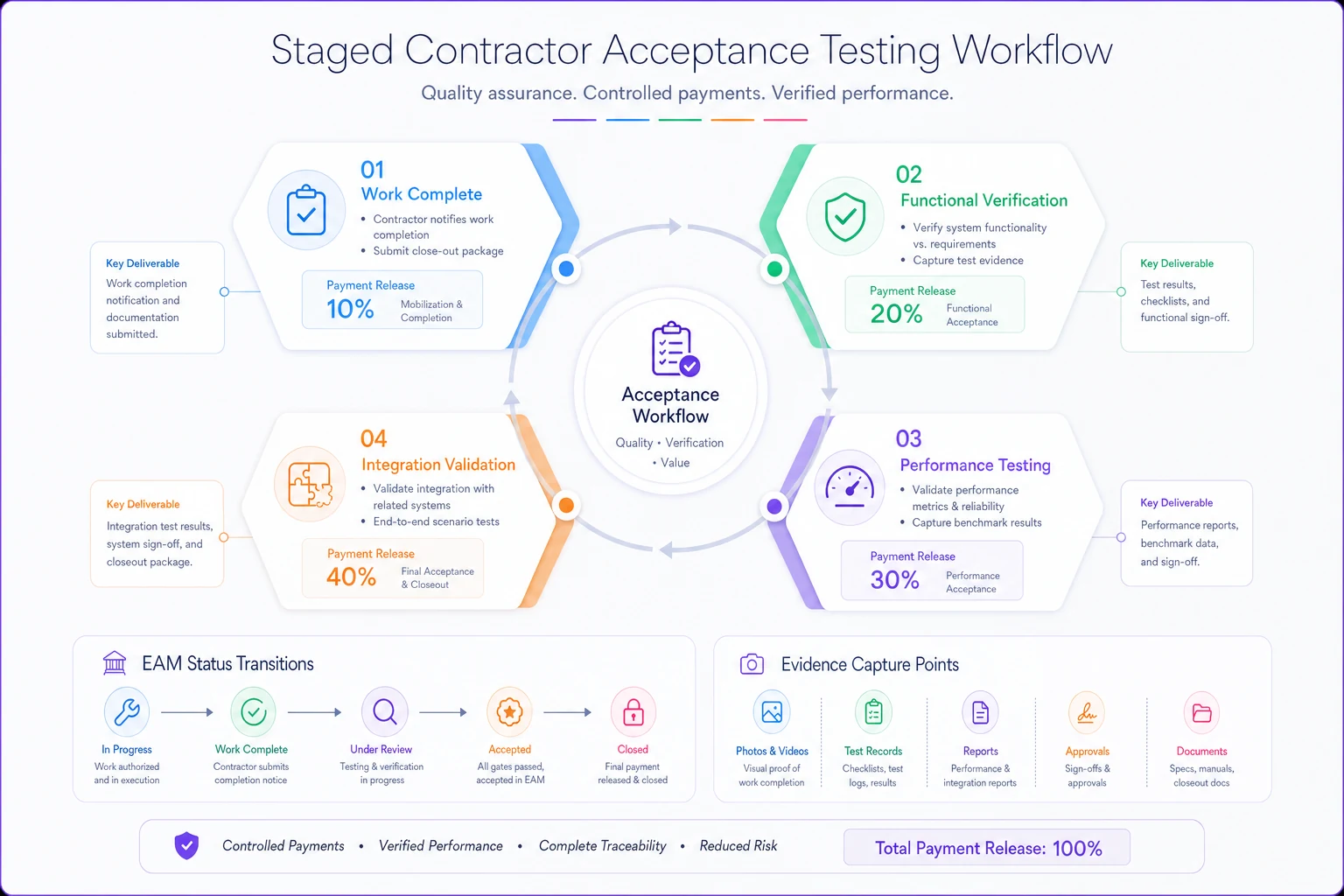
The staged flow above shows where evidence is captured and when payments release—use it to align your EAM status changes with payment gates.
Each stage ties payment to objective verification rather than subjective signoff, which forces contractors to deliver verifiable workmanship.
Payment gates that enforce quality without creating cashflow problems
Traditional maintenance contracts pay on completion, which creates zero incentive for quality. Smarter payment structures tie compensation directly to verified outcomes and sustained performance.
| Gate | % Released | Trigger |
|---|---|---|
| Gate 1 | 25% | Contractor mobilizes with correct parts |
| Gate 2 | 35% | Work physically complete, basic function restored |
| Gate 3 | 25% | Acceptance tests passed, documentation submitted |
| Gate 4 | 15% | 30-day performance verification, no callbacks |
This structure protects operations while keeping contractors financially healthy. They get enough upfront to cover costs but must deliver quality for full payment. The 30-day holdback particularly motivates thorough work—contractors know they'll lose money on callbacks if problems emerge.
Some organizations worry about contractor pushback on payment gates. In practice, quality contractors often prefer this structure because it differentiates them from competitors who cut corners. One facilities management company uses tiered payment gates as a selling point, guaranteeing clients won't pay full price unless equipment performs to spec for 30 days post-repair.
The key is making gates objective. "Equipment works properly" creates arguments. "Vibration readings below 0.12 IPS for 30 consecutive days" leaves no room for interpretation.
Embedding acceptance artifacts into your EAM workflows
The best acceptance criteria in the world mean nothing if nobody captures the evidence. Modern EAM systems can enforce evidence collection automatically, but most organizations never configure these controls properly.
Start by defining mandatory evidence types for each work order category. Pump overhauls require before/after vibration spectra, pressure curves, and seal leak test results. Electrical maintenance needs thermographic images, insulation resistance readings, and torque verification sheets. Make these requirements non-negotiable—the work order literally won't close without them.
Your EAM should treat evidence like audit-ready maintenance bundles, with specific metadata requirements and retention rules. Each piece of evidence needs timestamps, GPS coordinates for mobile work, technician identification, and equipment serial numbers. This metadata proves work actually happened when and where contractors claimed.
A mining operation transformed their contractor management by requiring photo evidence at four stages: before work, during critical steps, after completion, and during acceptance testing. Their EAM automatically watermarks each image with timestamp, GPS, and work order number. Contractors can't submit generic photos or reuse old images—the system validates metadata before accepting uploads.
Automatically watermark images with timestamp, GPS, and work order number to prevent contractors reusing photos.
The evidence gating happens through work order status transitions. Moving from "Work Complete" to "Pending Acceptance" requires uploading test results. Advancing to "Accepted" needs supervisor sign-off. Reaching "Closed" demands all warranty documentation. No evidence, no status change, no payment.
Configure escalation rules for missing evidence. If acceptance test results aren't uploaded within 4 hours of work completion, the system alerts the maintenance manager. After 8 hours, it notifies the operations director. After 24 hours, it locks the contractor out of new work orders until documentation gets submitted. These automated escalations keep contractors compliant without requiring someone to chase them down manually.
Who actually owns contractor governance (and why it usually fails)
Contractor governance fails when ownership is fuzzy. Procurement manages contracts, maintenance supervises work, operations suffers consequences, and finance processes payments. Without clear ownership, accountability gaps emerge everywhere.
The most effective model designates a contractor governance owner within maintenance operations. This person doesn't manage every contractor interaction—they own the governance framework. Defining SLA structures, approving acceptance test templates, monitoring payment gate compliance, analyzing contractor performance metrics.
This role needs real authority. They must be able to reject work that doesn't meet acceptance criteria, regardless of schedule pressure. They need access to modify payment authorizations based on test results. Most importantly, they need backing from operations leadership when contractors push back on decisions.
A chemical plant created this role after eighteen months of contractor-related downtime. Their contractor governance manager standardized acceptance procedures across all maintenance categories, implemented evidence requirements in their EAM, and established monthly contractor scorecards. Contractor-related failures dropped significantly within a year while maintenance costs decreased through reduced rework.
The governance owner also maintains the contractor performance database. Every acceptance test result, every payment gate outcome, every warranty claim gets logged against the contractor profile. That historical data drives future selection decisions and contract negotiations. Contractors with poor acceptance test pass rates face higher insurance requirements or get excluded from critical equipment work.
The 30-60-90 day performance validation framework
Acceptance testing at work completion only tells part of the story. Equipment that tests fine today might fail next month due to poor workmanship. Leading organizations address this with staged performance validation that extends well beyond initial acceptance.
-
30-day validation Basic performance metrics remain within acceptable ranges. No unexpected alarms, no degradation in key parameters, no callbacks for related issues. This checkpoint catches immediate quality problems that acceptance testing missed.
-
60-day assessment Deeper performance analysis including trend reviews and efficiency calculations. Has energy consumption increased? Are bearing temperatures creeping up? This checkpoint identifies gradual degradation that suggests an improper repair.
-
90-day certification Full performance validation including vibration analysis, oil analysis, and thermographic inspection where applicable. This confirms the repair delivered expected asset life extension, not just temporary function restoration.
Each checkpoint ties to payment and warranty terms. Contractors might receive 85% at initial acceptance, 10% at 30-day validation, and the final 5% at 90-day certification. Warranty periods start after 90-day certification, not at work completion. This motivates lasting repairs over quick fixes.
An automotive manufacturer implemented this framework after discovering roughly a third of contractor repairs failed within 90 days. Staged validation caught problems early enough for warranty remediation instead of emergency repairs. They also found patterns—certain contractors consistently passed 30-day checks but failed 60-day assessments, suggesting substandard parts that degraded quickly.
The validation framework feeds back into contractor scoring. Contractors earn points for passing each checkpoint without issues, which influences future work allocation and contract terms. High-scoring contractors get preferential scheduling and streamlined approvals. Low-scoring contractors face additional oversight and reduced work scope.
When governance gates actually hurt operations
Not every maintenance task needs elaborate acceptance testing. Over-governing routine work creates bureaucratic friction that delays critical repairs and frustrates quality contractors.
Reserve full governance gates for high-risk, high-cost work. Major overhauls, critical equipment repairs, and specialized technical work deserve comprehensive acceptance testing. Requiring three-stage sign-offs for belt replacements or filter changes just creates delays nobody wants.
| Tier | Work Type | Acceptance | Payment Gates | Evidence |
|---|---|---|---|---|
| Tier 1 | Routine maintenance | Visual + functional check | 1 gate (completion) | Basic photo |
| Tier 2 | Standard repairs | Single-stage test + documented readings | 2 gates (completion + 30-day) | Structured package |
| Tier 3 | Critical work | Full multi-stage testing | 4 gates | Comprehensive with detailed retention rules |
The tier assignment should be automatic based on equipment criticality, repair cost, and contractor history. New contractors working on critical equipment always get Tier 3. Established contractors doing routine maintenance on non-critical assets might operate at Tier 1.
A food processing plant learned this lesson after their governance requirements caused a two-day production delay. They'd required full acceptance testing for every contractor task, including routine greasing and belt adjustments. Maintenance technicians spent more time documenting simple work than actually doing maintenance. After restructuring to risk-based tiers, they eliminated around 60% of documentation requirements without compromising critical equipment reliability.
Building acceptance criteria that contractors can't game
Vague acceptance criteria invite creative interpretation. "Equipment operates normally" means whatever the contractor wants it to mean.
Strong acceptance criteria include:
-
Quantifiable parameters with acceptable ranges
-
Specific test conditions and durations
-
Required measurement instruments and calibration status
-
Environmental conditions during testing
-
Load conditions and operational modes
For a centrifugal pump overhaul, weak criteria might state "pump operates properly with acceptable vibration." Strong criteria specify "vibration below 0.15 IPS at 1780 RPM, measured at bearing housings with calibrated accelerometer, tested at 100% flow for minimum 2 hours, ambient temperature 60-80°F."
Criteria should reference industry standards where applicable but include site-specific requirements. A coastal facility might need tighter corrosion resistance standards than inland plants. A pharmaceutical operation requires different cleanliness validation than food processing. Generic industry standards don't capture those operational nuances.
Document acceptance criteria in reusable templates organized by equipment type and repair category. Motor rewinds follow one template, gearbox rebuilds another. This standardization ensures consistent quality expectations while reducing documentation burden—contractors know exactly what tests they'll face before bidding work.
Update templates based on failure analysis. If rebuilt pumps keep failing due to seal problems, add seal leak testing to the acceptance criteria. Let operational experience drive criteria evolution rather than letting templates go stale.
The hidden cost of evidence storage nobody talks about
Comprehensive evidence capture generates massive data volumes. Thermographic images, vibration spectra, and test reports consume gigabytes of storage monthly. Without proper management, evidence storage costs can quietly exceed the value of governance benefits.
A power generation company discovered they were spending around $180,000 annually storing redundant contractor evidence—multiple photos of the same equipment from slightly different angles, full-resolution images where compressed versions would suffice, raw vibration data files when summary reports contained all relevant information. After implementing evidence optimization rules, they cut storage costs by roughly 70% without compromising audit requirements.
Your evidence strategy needs defined resolution standards, retention periods, and archival rules. Current work evidence might need full resolution for 90 days, then compress for year-one storage, and convert to summary reports for long-term retention. Critical failure investigations keep full evidence packages indefinitely, but routine maintenance evidence ages off after predetermined periods.
Think carefully about evidence types. Video evidence seems valuable but generates enormous storage overhead. A two-minute equipment run video can exceed 500MB. The same acceptance validation might require just three timestamped photos totaling 15MB. Unless video provides unique value, photo evidence usually suffices.
Cloud storage seems like the obvious solution, but bandwidth limitations at remote sites make upload challenging. An offshore platform or rural pumping station might take hours to upload large evidence packages. Local storage with periodic synchronization often works better for distributed operations. AI-powered platforms can help here too—automatically compressing files, extracting key metadata, and maintaining audit compliance without manual intervention, which matters a lot when you're managing dozens of sites.
What happens when contractors fail acceptance tests
Failed acceptance tests create immediate operational dilemmas. Do you let the contractor try again, eating schedule delays? Bring in another contractor, potentially violating contract terms? Accept substandard work to maintain production? Each choice carries risks.
Your governance framework needs clear failure protocols before you're in that situation. First-time failures on non-critical work might allow immediate re-work at contractor expense. Repeated failures or critical equipment issues trigger escalation to alternative contractors. The key is making these triggers automatic, not subject to negotiation during operational pressure.
A pharmaceutical manufacturer structures failure response around patient impact. If failed acceptance testing could affect product quality, they immediately mobilize internal resources or pre-qualified backup contractors. The original contractor covers all additional costs plus predetermined penalties. For non-critical building maintenance, contractors get one re-work opportunity within 24 hours before triggering replacement.
Document every failure meticulously. Failed test results, root cause analysis, remediation attempts, and final resolution all become part of the contractor's performance record. This documentation supports future disqualification decisions and potential legal action for repeat offenders.
Some contractors deliberately fail initial tests, knowing they'll get another chance. Combat this by making failures expensive. Charge contractors for re-testing time, operator overtime during delays, and lost production value. One utility charges contractors $500/hour for technician time during re-testing, plus any production losses. Their first-time pass rate improved 40% after implementing those charges.
Integrating contractor governance with warranty management
Warranty enforcement fails when governance ends at acceptance. A twelve-month parts warranty means nothing if you can't prove the contractor installed the part correctly and it failed despite proper operation.
Your governance framework should automatically trigger warranty workflows when accepted work fails prematurely. The system compares failure dates against warranty periods, pulls relevant acceptance test results, and initiates contractor notification. No manual investigation required—the evidence trail exists from initial acceptance through failure.
A mining operation recovered $450,000 in warranty claims after implementing integrated governance-warranty workflows. Previously, warranty claims required manual research through paper records and email threads. By the time they assembled evidence, contractors disputed claims or warranty periods had expired. Their automated system now captures everything: acceptance evidence, operational parameters during the warranty period, and failure documentation.
The integration requires careful data architecture. Each work order needs linked warranty terms, not just completion dates. Each acceptance test result must reference specific components and part numbers. Operating data during the warranty period should be readily accessible to prove proper operation. Without that data connectivity, warranty enforcement stays manual and mostly ineffective.
Consider warranty reserve requirements for contractors working on critical equipment. They maintain a financial reserve equal to potential warranty exposure, released only after warranty expiration with no claims. This ensures contractors remain financially motivated to honor warranties even when they'd prefer to walk away from problems.
Scaling governance across multiple sites and contractors
Single-site governance is manageable. Multi-site operations with dozens of contractors create complexity that breaks traditional management approaches. The same contractor might perform differently across sites. The same equipment might need different acceptance criteria based on operational context. The same governance framework might face different regulatory requirements by region.
Start with a core governance standard that applies everywhere, then layer site-specific requirements. Core standards cover evidence requirements, payment gate structures, and performance metrics. Site additions handle environmental conditions, regulatory documentation, or unique operational parameters.
A water utility managing 40 treatment plants standardized about 80% of their governance framework while allowing 20% site customization. Every contractor faces the same payment gates and evidence requirements. But acceptance criteria adjust for local water quality, coastal versus inland environments, and plant-specific equipment configurations. That balance ensures consistency without ignoring operational realities.
Technology becomes essential at scale. Manual contractor governance might work for five contractors at one site. Fifty contractors across ten sites demands automated workflows, centralized performance tracking, and platforms that can flag unusual test results or identify patterns across contractors and sites that would be nearly impossible to spot manually.
The governance team structure matters too. Instead of site-level governance managers, consider regional specialists who oversee multiple sites. They spot patterns individual sites might miss, share best practices across locations, and maintain consistency while respecting local needs. One specialist might cover mechanical contractors across all sites while another handles instrumentation and controls.
Outsourced maintenance governance isn't about distrusting contractors—it's about building systems that make quality work the path of least resistance. When contractors know they'll face specific acceptance tests, evidence requirements, and performance validations, they tend to deliver better work from the start.
The framework components work together. Prescriptive SLAs set clear expectations. Acceptance tests verify work quality. Payment gates create financial accountability. Evidence requirements prove compliance. Performance validations ensure lasting repairs. Remove any component and the system weakens.
Most organizations see measurable improvement within 90 days of implementing structured governance. Rework rates drop, emergency failures decrease, and contractor relationships actually improve because expectations are clear. The upfront effort of building templates, configuring workflows, and training staff pays back through reduced downtime and lower total maintenance costs.
The biggest risk isn't contractor failure—it's assuming informal governance will protect your operations. Every undocumented acceptance, every payment without verification, every warranty claim without evidence erodes equipment reliability. Building systematic contractor accountability takes effort, but the alternative is accepting that contractor handoffs will keep degrading your uptime.
Strong outsourced maintenance governance turns contractors into true operational partners—they understand requirements, deliver to specifications, and stand behind their work. That's worth the investment.
Ready to elevate your asset operations?
Join 1,500+ businesses using Ownitly to optimize asset utilization, reduce downtime, and ensure compliance.