

Most asset organizations treat data residency as an IT checkbox buried somewhere in a cloud vendor contract. Then a regulator in one country asks for maintenance evidence that physically sits on a server in another, a legal-hold notice lands during an active audit, and suddenly the "checkbox" becomes a three-week scramble involving legal, IT, and whichever operations lead happens to be nearest the CMMS.
The problem usually isn't that companies lack policies. It's that those policies live inside a data-privacy document written for customer PII, while the actual evidence — inspection photos, calibration certificates, permit records, sensor histories — flows through a completely separate operational system with its own storage rules, its own retention logic, and export behavior nobody ever mapped against the law.
This piece is about building the matrix that connects those two worlds. Not a legal treatise. A working operational map that tells your team, for any given asset record, where it can live, how long it must stay, how it gets frozen when litigation hits, and what you're actually allowed to hand across a border during an audit.
Why residency and evidence obligations drift apart in the first place
The split usually starts with how EAM systems get deployed. A multinational stands up one global instance to keep master data clean — same asset taxonomy, same work-order structure, same reporting everywhere. Great for analytics. Terrible for residency, because now German inspection records, Brazilian permit files, and Saudi calibration certificates all sit in whatever region the primary tenant was provisioned in.
Meanwhile the retention obligations attached to those records are wildly different. A pressure-vessel inspection record might need to be kept for the life of the asset plus several years in one jurisdiction, while an equivalent record elsewhere carries a shorter statutory floor but a stricter rule about where it's stored and who can access it from abroad.
What shows up consistently across regulated operators is that nobody owns the intersection. Legal owns retention schedules but doesn't know the EAM stores photos in an object-storage bucket in a different region than the structured work-order data. IT knows where the servers are but reads "7 years" off a generic policy and applies it uniformly — which ends up being both over-retention (cost, liability) and under-retention (compliance gap) simultaneously. Operations owns the evidence itself and assumes both other teams have it handled.
The drift is structural. Three functions, three source-of-truth documents, zero shared mapping. That gap is exactly what a cross-border audit exposes.
The four obligation types that actually collide
Before building the matrix, it helps to separate the obligations that pull in different directions. They're not the same thing, and treating them as one blob is why most residency policies fail under pressure.
Stop losing track of critical assets.
Ownitly helps you monitor, maintain, and manage every asset efficiently and reliably.
- Centralized asset tracking
- Automated maintenance alerts
- Compliance monitoring & reporting
No credit card required
-
Retention obligations — how long a record must be kept. Driven by statute, contract, and asset lifecycle. Often the longest-lived requirement.
-
Residency / localization obligations — where the record must physically or logically live. Some jurisdictions require in-country storage for certain categories; others only restrict transfer, not location.
-
Export / transfer restrictions — whether and how a record can cross a border. This is where audits get ugly, because an auditor requesting evidence may be triggering a transfer the law restricts.
-
Legal-hold obligations — the requirement to preserve records the moment litigation or investigation is reasonably anticipated, which overrides normal retention and deletion schedules.
The collisions are the interesting part. A legal hold in one country can require you to preserve records that a residency rule in another country says can't leave its borders — so you have to preserve in place rather than pulling copies into a central hold repository. Retention maximums (some privacy regimes require deletion after a period) can conflict with retention minimums for safety evidence. And an export restriction can turn a routine audit response into a formal cross-border transfer requiring specific legal mechanisms.
If your policy doesn't distinguish these four, it quietly assumes they all point the same direction. They don't.
Building the jurisdiction matrix
The matrix is the artifact that makes the abstract concrete. The point is that any operations lead can look at a row and know what to do with a given record type in a given place — without opening a legal thread every time.
| Jurisdiction | Record category | Retention floor | Storage constraint | Cross-border export | Legal-hold handling |
|---|---|---|---|---|---|
| EU (member state) | Safety inspection + permits | Asset life + statutory tail | EU/EEA region preferred; adequacy-dependent | Transfer mechanism required for non-adequate destinations | Preserve in-region; no central copy without safeguards |
| US | Maintenance + calibration evidence | Per contract / OSHA-style floor | No hard localization | Generally permitted | Standard hold repository acceptable |
| Country with data-localization law | Operational + personnel-linked records | Statutory minimum | In-country storage mandated | Restricted; may require regulator involvement | Preserve in place only |
| Jurisdiction with short deletion mandate | PII-linked technician records | Deletion after set period | Local preference | Restricted | Hold overrides deletion — document the override |
A few things this matrix forces into the open.
The "storage constraint" column immediately breaks the fantasy of a single global tenant with no regional segmentation. If even one row says in-country storage is mandated, your architecture needs regional data boundaries, full stop.
The "legal-hold handling" column is where most companies discover their evidence system can't actually do preserve-in-place. If your only hold mechanism is copying everything into a central litigation folder, you've built a process that violates residency the moment a hold touches a localized jurisdiction.
And the mismatch between retention floors and deletion mandates in the last two rows is the classic trap — one uniform retention number applied across the entire estate will break something somewhere.
The evidence workflow that has to sit underneath the matrix
A matrix is useless if the underlying evidence isn't tagged well enough to route by it. This is where residency policy meets day-to-day operational reality, and where the real work lives.
-
Evidence is created in the field or by a sensor, tagged with asset location and record category at the point of capture.
-
The system maps location and category to the correct jurisdiction row and applies the storage region, retention class, and export flag automatically.
-
Records route to the correct regional storage boundary — not a single global bucket.
-
Retention timers start from the correct trigger event (in-service date, inspection date, decommission), which differs by record type.
-
When a legal hold is declared, affected records are frozen in their existing location, with the override logged, rather than copied across borders.
-
Audit or discovery requests are served through a controlled export path that checks the export flag before anything crosses a boundary.
The single most common breakdown is step one. Metadata discipline at capture determines whether every downstream residency control works or collapses into manual triage. This is the same principle behind good field-evidence and chain-of-custody standards — if the record isn't born with its context, no policy layered on top can reliably recover it.
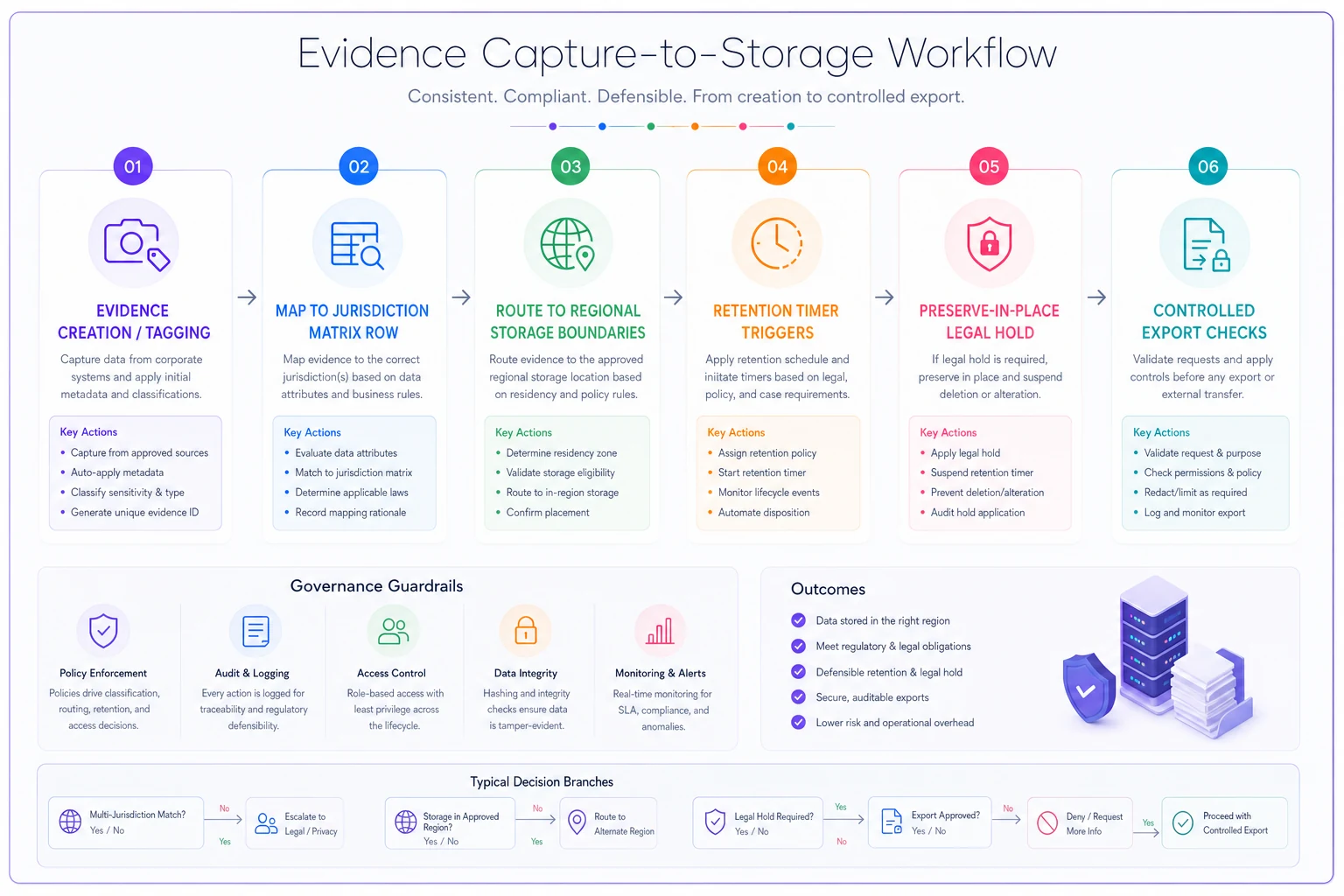
A simple diagram of the capture-to-storage steps helps non-technical stakeholders see where metadata discipline matters.
Encryption and access templates that respect the border
Residency isn't only about where the bytes sit. It's about who can reach them and under what jurisdiction the keys live. A record physically stored in-country but decryptable by an admin key controlled from outside that jurisdiction may still constitute an unlawful transfer under some regimes.
-
Regional key management. Keys for a localized jurisdiction's data should be managed within that jurisdiction's boundary, not held by a single global key authority. This matters more than most teams realize when an audit actually arrives.
-
Access scoped by jurisdiction, not just role. A reliability engineer with global asset-viewing rights shouldn't automatically be able to pull raw evidence out of a localized region. Access templates should combine role and jurisdiction.
-
Export as an explicit, logged action. Viewing a record in place and exporting a copy across a border are different privileges. Treat them differently.
-
Encryption-at-rest and in-transit as a default, not a jurisdiction-specific add-on — so the variable you're managing is key custody and access, not whether encryption exists at all.
These controls tie directly into broader security posture. If you've already built out OT/IT security and evidence controls for regulated environments, the residency layer should extend that model rather than create a parallel one — same identity, logging, and access primitives, now made jurisdiction-aware.
Legal-hold procedures when preserve-in-place is mandatory
The default corporate legal-hold reflex is centralization: pull everything relevant into one preserved repository so counsel controls it. That reflex breaks the instant a hold touches a localized jurisdiction.
Preserve-in-place means the record stays where it lives, but its deletion and modification are locked, the hold is logged against the specific records, and access for legal review happens through a controlled, jurisdiction-aware path rather than by copying data out. It's more complex to operate, but it's the only approach that survives a residency challenge.
-
Hold is triggered and scoped by asset, time range, and jurisdiction.
-
Affected records are flagged and their retention/deletion timers suspended in place.
-
For localized jurisdictions, no copy leaves the region — review happens through in-region access.
-
For unrestricted jurisdictions, standard collection may proceed.
-
Every override of normal retention or deletion is documented, because when a deletion mandate conflicts with a hold, you need to show why you kept data past its normal purge date.
-
Release of the hold is logged, and normal retention timers resume from where they left off.
The mistake that comes up repeatedly: companies build a hold process that assumes copy-and-centralize, then discover during an actual matter that this exact action created a new compliance problem in a localized jurisdiction. Design the preserve-in-place path before you need it.
A real scenario
A mid-sized industrial operator running plants across three regions — a European base, a US operation, and a facility in a country with a hard data-localization law — had consolidated onto a single global EAM instance provisioned in one region. Clean data model, solid reporting, no complaints for two years.
Then a regulator in the localized jurisdiction requested inspection and maintenance evidence for a specific asset line. The records existed, but they physically sat in the primary tenant's region, outside the country. The localization law required those records to be stored in-country. The company was simultaneously out of compliance on storage and facing an audit that would surface it.
Remediation took roughly four to five months and involved standing up a regional data boundary for that jurisdiction, re-tagging historical evidence by location and category — the painful part, since a large portion of older records had no reliable location metadata — and rebuilding the access model so global roles couldn't reach localized evidence without a jurisdiction-scoped path.
What actually changed the trajectory wasn't the technology. It was the matrix. Once they had a single table mapping record category to jurisdiction to storage-and-export rules, the architecture decisions became obvious, and the re-tagging effort could be prioritized by risk rather than done blindly. Post-remediation, new evidence was born correctly tagged and routed automatically, and their next cross-border request was served in days rather than the multi-week fire drill the first one triggered. The total cost of remediation ran into six figures — considerably more than building the boundary correctly from the start would have cost.
When a single global instance actually makes sense
Not every organization needs regional segmentation, and over-engineering residency is its own form of waste.
A single global instance is defensible when your entire footprint sits within jurisdictions that don't impose hard localization, where transfers between your operating countries are covered by adequacy or standard transfer mechanisms, and where your record categories don't carry personnel-linked data that triggers stricter localization rules. Many US-only or single-region operators fall here. Building regional boundaries for a footprint that doesn't legally require them adds cost and coordination overhead for no compliance benefit.
When it's a bad idea — and who should not attempt it
Regional segmentation is the wrong first move if you don't yet have clean evidence metadata. Splitting storage across regions before you can reliably tag records by location and category just multiplies the number of places your data is disorganized. Fix capture-time metadata first.
It's also premature for organizations without any real legal-hold capability. If you can't preserve records in place even within a single region, adding cross-border complexity will guarantee a mishandled matter.
And operators who lack a single owner for the residency-evidence intersection shouldn't attempt this as a distributed effort. The failure mode described earlier — legal, IT, and operations each owning a fragment — reproduces itself at larger scale if you try to build a jurisdiction matrix by committee with no one accountable for the whole thing.
What changes as the estate grows
Small footprint, one region: residency is nearly free. Keep records, meet retention, exports are trivial.
Add a second region with different retention floors and the retention logic can no longer be a single number. You need retention classes tied to record category and jurisdiction.
Add a jurisdiction with localization requirements and the architecture itself has to change — regional boundaries, regional key custody, jurisdiction-aware access. This is the threshold most companies cross without noticing, because the EAM keeps working fine operationally. The gap only appears when a regulator or a lawsuit asks the question.
At full multinational scale, the matrix stops being a document and becomes an operational control enforced automatically at capture and routing. Manual application across tens of thousands of records per year simply doesn't hold. The organizations that handle this well aren't the ones with the thickest policy binders — they're the ones whose evidence workflow makes the correct residency decision automatically, every time a record is born, so humans only get involved on genuine edge cases.
Closing thought
The reason residency and evidence obligations blow up during audits is that they were managed as separate problems by separate teams reading separate documents. The jurisdiction matrix is what forces them into one view — retention, residency, export, and legal-hold, mapped against the actual record categories your operation produces every day.
Build the matrix first. Let it drive your architecture, your encryption and access templates, and your legal-hold procedures — not the other way around. The companies that get audited without drama aren't the ones who reacted fastest. They're the ones who already knew, for every record, where it lives, how long it stays, and what happens when someone across a border asks to see it.
Ready to elevate your asset operations?
Join 1,500+ businesses using Ownitly to optimize asset utilization, reduce downtime, and ensure compliance.