


Most regulated asset operations have two security models running in parallel, and they barely talk to each other. On one side you have the OT world — PLCs, historians, SCADA, the calibration bench — protected by network segmentation and a "don't touch it if it's running" philosophy. On the other side you have IT, where your EAM, ERP, identity provider, and document management live, governed by access controls and change management. The problem is that your asset lifecycle events don't respect that boundary. A calibration record starts on an OT device and ends up as audit evidence in an IT system. A work order authorizes a technician to physically modify a controlled asset, and proof of that modification has to survive auditor scrutiny three years later.
That gap between the two worlds is exactly where evidence integrity breaks, where segregation-of-duties assumptions quietly fail, and where a regulator finds the hole. This is a framework for closing that gap — treating the whole thing as one governed system instead of two disconnected ones.
Why the OT/IT seam is where controls actually fail
The standard mental model treats OT security and IT security as separate disciplines with a firewall between them. Fine for protecting availability. Terrible for protecting evidence, because the evidence chain crosses that seam constantly.
Think about what a single instrument recalibration actually touches. The measurement happens on OT-side equipment. The technician's identity might be authenticated on a local HMI with no connection to your corporate directory. The result gets transcribed — sometimes literally by hand, sometimes through a flaky integration — into the EAM. The EAM then generates the compliance record. Somewhere in that flow, the person who performed the work and the person who approved it need to be different people, and you need to prove that separation held.
In practice, this breaks in three predictable places:
-
Identity doesn't survive the crossing. The OT device knows a local operator account. The EAM knows a corporate user. Nobody can reliably tie the two together, so "who actually did this" becomes an inference rather than a fact.
-
Timestamps come from ungoverned clocks. OT devices drift. If your evidence timeline depends on the local clock of a bench instrument that hasn't synced in eight months, your chronology is legally soft.
-
The record is mutable after the fact. The reading gets keyed into a field that anyone with edit rights can change, and the system keeps no defensible history of the original value.
Auditors rarely fail you on the policy. They fail you on the seam — the moment where a controlled action moves from the physical/OT world into the digital record and something can't be proven end to end.
Mapping lifecycle events to control requirements
The useful move is to stop thinking about "security controls" as a generic layer and instead map specific controls to specific EAM lifecycle events. Every lifecycle event has a different risk profile and a different evidence obligation. A read-only inspection doesn't need the same rigor as a firmware change on a safety-instrumented system.
Stop losing track of critical assets.
Ownitly helps you monitor, maintain, and manage every asset efficiently and reliably.
- Centralized asset tracking
- Automated maintenance alerts
- Compliance monitoring & reporting
No credit card required
Here's a working breakdown of how control intensity should scale with the event:
| Lifecycle event | OT/IT boundary risk | Identity/SoD requirement | Evidence integrity requirement |
|---|---|---|---|
| Asset commissioning / master record creation | Medium | Creator ≠ approver; role-gated | Signed baseline record, immutable |
| Routine inspection | Low | Single authenticated performer | Metadata + timestamp, tamper-evident |
| Calibration / adjustment | High | Performer ≠ verifier | Signed result, hash-chained to prior cal |
| Firmware / config change on OT device | Critical | Change author ≠ approver ≠ implementer | Full signed change package, immutable, exportable |
| Decommissioning / disposal | High | Requestor ≠ authorizer | Signed disposal evidence, retained per schedule |
| Work order closeout on controlled asset | Medium–High | Technician ≠ QA acceptance | Acceptance artifacts, chain-of-custody preserved |
Most organizations apply one control standard across all events — usually the weakest one that keeps the line running. That's how you end up with a firmware change on a critical asset carrying the same evidentiary weight as a visual inspection. Control intensity has to be event-specific, and the framework should make the required rigor obvious to the person doing the work, not buried in a procedure nobody reads.
Identity and segregation of duties across the seam
Segregation of duties is where the OT/IT split does the most quiet damage. On the IT side you likely have proper role definitions, provisioning workflows, and periodic access reviews. On the OT side you often have shared logins, a sticky note with the HMI password, and a contractor who "just needs access for the shutdown."
The failure pattern is consistent: SoD is enforced beautifully inside the EAM and completely undermined at the device. If your EAM records that Technician A performed the work and Supervisor B approved it, but both actions were taken from a shared OT terminal that anyone on the floor could sit at, your SoD control is theater.
A defensible approach requires identity to be federated across the boundary, or at minimum reliably bridged:
-
Establish a single source of truth for identity and map every OT-side account back to a real named individual. Shared accounts are only acceptable for non-attributable, non-controlled actions.
-
Define SoD conflicts as data, not as a document. The pairs that must never be the same person — performer/verifier, requestor/authorizer, change author/implementer — should live in the system and be enforced at the point of action.
-
Bind physical access to digital identity for controlled events. A badge scan, a device-side authentication that resolves to the corporate directory, or at worst a co-signed manual attestation.
-
Run access recertification on both sides on the same cadence. OT access reviews tend to lag IT reviews by years. That gap is a finding waiting to happen.
The mistake people make is treating OT identity as "the vendor's problem" or "too hard to change on legacy equipment." You don't have to rip out the PLC. You have to make sure the record of who did what resolves to a named person, and that the SoD pairs held. If governance around role definitions and lifecycle rules matters to you here, it's worth revisiting how you structure EAM data governance with roles, lifecycle rules, and audit gates — the same role model that prevents duplicate records is the backbone of enforceable SoD.
Hashing, immutability, and signed evidence: choosing the right level
There's a tendency to either ignore immutability entirely or overbuild it into something that slows every transaction. Neither works. The right answer is a tiered approach where the integrity mechanism matches the evidentiary stakes.
Here's how the options actually stack up:
-
Application-level write protection. Record locks after closeout; edits require a new versioned record. Cheap, easy, and enough for low-risk events. Weakness: it trusts the application and the database admin.
-
Cryptographic hashing of the record. Generate a hash of the evidence at closeout and store it separately. If anyone alters the record, the hash no longer matches. Good middle ground — detects tampering without heavy infrastructure.
-
Hash-chaining across sequential records. Each new calibration or change record includes the hash of the prior one, forming a chain. You can't quietly delete or reorder history without breaking it. Genuinely useful for calibration histories where drift over time is the whole point.
-
Digital signatures on evidence packages. The performer and verifier cryptographically sign the evidence bundle. Binds identity to the record in a way that survives export and system migration. Essential for critical events.
-
External/immutable ledger anchoring. Periodically anchor your hash values to an external immutable store. Strong defense against insider tampering, but adds operational overhead. Reserve it for the highest-stakes records.
In practice, a reasonable tiering looks like this: routine inspections get application-level write protection plus a hash. Calibrations get hash-chaining so the drift history is provably intact. Firmware changes and disposals get full digital signatures on the evidence package. You're not applying maximum rigor everywhere — you're applying appropriate rigor per the lifecycle event table above.
One thing worth flagging: hashing is worthless if the thing you hashed was already wrong or transcribed by hand from a drifting clock. Immutability protects a record after it exists. It does nothing for the integrity of the moment of capture. That's why field-capture standards matter just as much as the crypto — how you handle tamper-evidence, metadata, and chain-of-custody at the point of inspection determines whether the record was trustworthy before you ever locked it down.
Building the exportable audit bundle
Auditors don't want access to your live system. They want a self-contained, verifiable package they can examine offline. If producing that package is a two-week scramble across four systems, you have a process problem that will eventually become a compliance problem.
An exportable audit bundle for a controlled lifecycle event should be assembled automatically and contain everything needed to prove the event without touching the source systems:
-
The asset master record and its state at the time of the event
-
The authorizing work order, permit, or change request with its approval chain
-
The identity of every actor, resolved to named individuals, with the SoD pairs shown
-
The evidence artifacts themselves — readings, photos, test results, sign-offs
-
Timestamps from a governed, synchronized clock source
-
The hash values and/or signatures proving nothing was altered since closeout
-
The retention schedule and disposition rules attached to the record
The workflow that produces this should run at closeout, not on demand months later. When a controlled work order closes, the system gathers the artifacts, computes the hashes, applies signatures, and produces the bundle as a byproduct of finishing the work. The auditor request that comes months later becomes a lookup, not a project.
Pro-tip: Automate bundle assembly at closeout to avoid auditor scramble.
Below is a simple workflow showing the automatic bundle assembly.
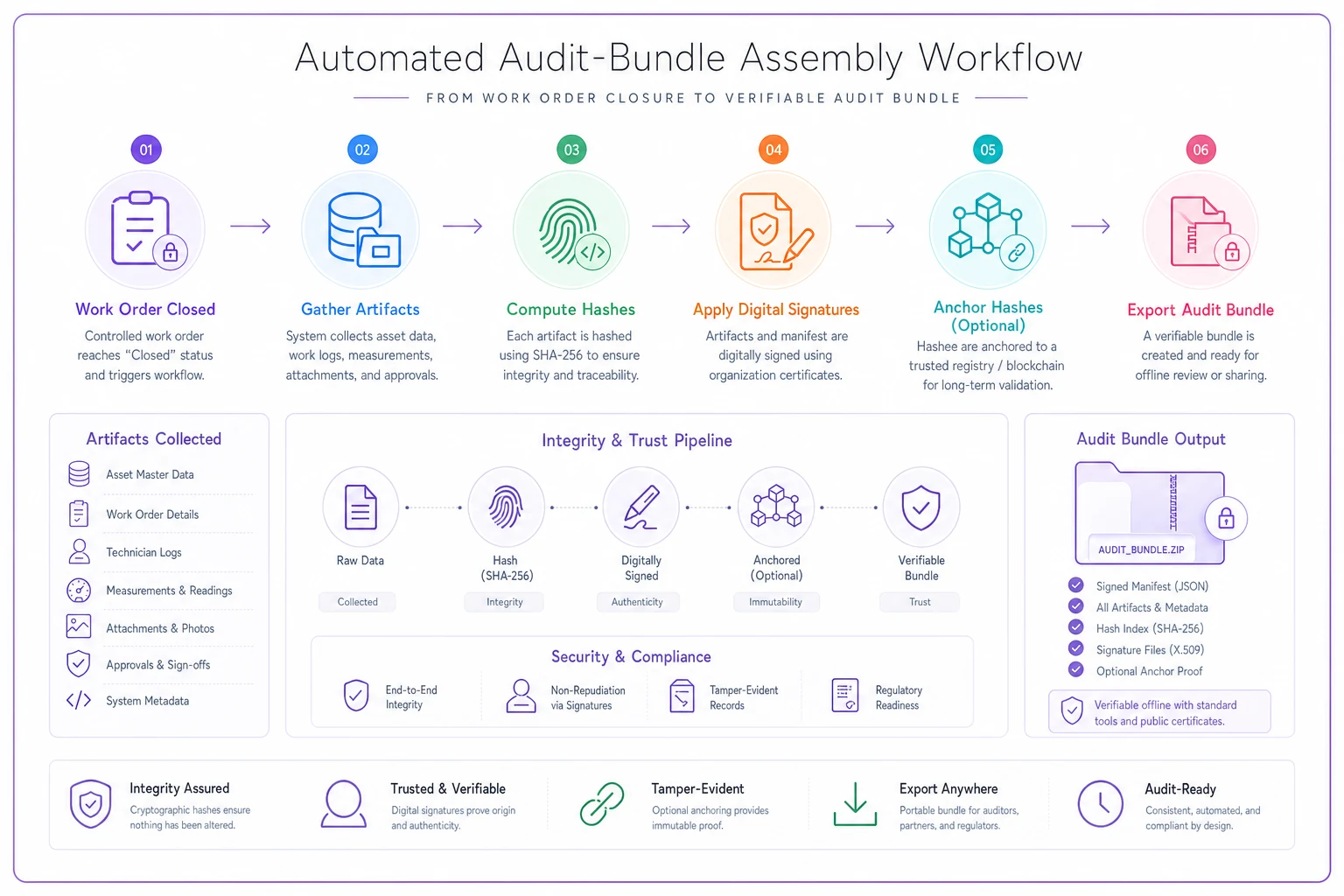
This is the difference between organizations that treat evidence as a deliverable and those that treat it as exhaust. The mature ones bake the bundle into the lifecycle. If you're working out the minimum contents and retention rules, the mechanics of building audit-ready evidence bundles with minimum red-lines and templated record packages go into the templating side of this in more detail.
Sample controls and how they tie to incident playbooks
Controls that only exist for planned events fail during incidents — which is precisely when evidence matters most and when discipline is under the most pressure. A firmware rollback during a 2 a.m. trip is exactly the scenario where someone uses the shared login "just this once" and the chain breaks.
-
C-1
No controlled action without resolved identity.
Enforced at point of action across OT and IT. Engages on every lifecycle event and every incident action. -
C-2
Performer ≠ verifier on all Class-critical events.
Enforced by the SoD data model. During incidents, if a single-person action is unavoidable, it triggers a mandatory retroactive independent review within a defined window. -
C-3
Evidence hashed at closeout, no exceptions.
Automated. Incident actions get the same treatment so post-incident forensics hold up. -
C-4
Change to any OT config produces a signed change package.
Applies whether the change is planned or an emergency response. -
C-5
Every controlled action links to its authorizing artifact
— work order, permit, or emergency authorization.
That last one connects directly to how you handle work authorization under pressure. When permits and lockout are already embedded in the work-order lifecycle, incident actions inherit the same evidence discipline instead of bypassing it. The pattern for embedding permit-to-work and LOTO into the work-order lifecycle with verification and audit-ready templates is what keeps your incident playbook from becoming an evidence gap.
Your incident playbook and your evidence framework should be the same controls running at different pacing. If your incident response requires suspending evidence controls to move fast, the controls were designed wrong.
A real scenario
A specialty chemicals site running around 1,400 instrument calibrations a year kept failing the same audit point: they couldn't reliably prove performer/verifier separation on bench calibrations. The bench station used a shared operator login, calibration results were keyed into the EAM afterward by whoever was free, and the timestamps came from the instrument's own clock, which nobody was syncing.
An auditor pulled a sample of 30 calibration records and flagged 7 where the "performer" and "verifier" resolved to actions taken from the same shared terminal within the same minute — indistinguishable from one person doing both. Roughly a 23% exception rate on a sampled control, which is enough to escalate the finding.
They didn't replace any equipment. What changed was the seam. They bridged the bench login to named identities through a badge-tap at the station, moved result capture to the point of calibration instead of after-the-fact transcription, synced the instrument clocks to a governed time source, and started hash-chaining calibration records so drift history was provably continuous. Each closed calibration now produced a signed bundle automatically.
The next audit cycle, the same 30-record sample pulled clean. Assembling the evidence went from a multi-day scramble to about an hour of exporting bundles. The finding closed — and the part operations actually cared about — technicians stopped losing an afternoon every audit season reconstructing records from memory and paper.
When this level of rigor makes sense — and when it doesn't
Not every asset needs signed, hash-chained, externally-anchored evidence. Applying critical-tier controls to a non-regulated conveyor motor is just friction that trains people to route around your controls.
This makes sense when:
-
You operate under a regulator who samples records and issues findings
-
Asset actions affect safety, environmental compliance, or product quality
-
Evidence must survive years and possibly a system migration
-
You have controlled OT assets whose configuration changes carry real risk
This is overkill when:
-
The asset is non-regulated and non-safety-critical
-
No external party will ever demand defensible proof of who-did-what
-
The cost of the control genuinely exceeds the exposure
Who should be careful here: teams tempted to buy their way to compliance with a single tool. The technology — hashing, signatures, immutable stores — is the easy part. The hard part is the identity bridge across the OT/IT seam and the discipline to capture evidence at the moment of action rather than reconstructing it later. Cryptographic guarantees on top of hand-transcribed, ungoverned-clock data just gives you tamper-proof records of unreliable information.
Bringing it together as one governed system
The reason OT/IT evidence controls fail in regulated environments isn't a lack of tools or policy. It's that the two halves of the operation are governed as separate worlds while the asset lifecycle flows straight through both.
Identity fragments at the seam. Timestamps come from ungoverned clocks. Records that started as physical measurements end up as mutable text fields. Each of those small gaps becomes an audit finding, because auditors probe exactly where the physical and digital worlds meet.
The framework that holds up treats the lifecycle event as the organizing unit — mapping each event to its OT/IT boundary risk, its SoD requirement, and its evidence integrity level, then producing the signed, exportable bundle as a byproduct of finishing the work rather than a project you dread every audit cycle. Modern EAM platforms with proper identity federation, automated evidence assembly, and configurable integrity controls make this practical to run day to day. But the platform only enforces the model you've defined.
Get the mapping right first — which events, which controls, which proof — and the tooling becomes the thing that keeps you honest instead of the thing you fight. That's the difference between a compliance program that survives an audit and one that survives it without stealing a week from your operations team every time.
Ready to elevate your asset operations?
Join 1,500+ businesses using Ownitly to optimize asset utilization, reduce downtime, and ensure compliance.