

A crew is halfway into a pump seal replacement. The isolation was done that morning, the permit's sitting on a clipboard in the shop, and the tech who applied the last lock left at shift change without logging which valve he tagged. Now the oncoming crew has to figure out whether the system is actually safe to open — or spend forty minutes walking the line to confirm.
That gap is what this article is about. Not whether you have a permit-to-work process. Almost everyone does. The problem is that the permit and the lockout/tagout steps live outside the work order — on paper or in a separate binder, disconnected from the record that actually drives the job. When the two aren't linked, safety documentation becomes something people chase after the fact instead of a gate the job can't move past.
Getting permit to work CMMS integration right isn't about digitizing forms. It's about making the permit, the isolation verification, and the evidence artifacts part of the work order's data model — with required fields, exception logic, and templates that produce an audit trail without anyone assembling it by hand.
Why the disconnect happens in the first place
Most sites bolted their permit process onto their maintenance workflow years apart. The LOTO program came out of a safety audit or an OSHA finding. The CMMS came out of a maintenance-planning initiative. Different owners, different systems, different logic. Nobody ever went back and stitched them into one flow.
What you end up with is a work order that says "replace seal on P-204" and a permit sitting in a log somewhere, referenced by a number the planner may or may not have written into the WO notes. The two records point at the same physical job but share almost no structured data. There's no field on the work order that says this task requires a hot-work permit or this asset has three energy isolation points. That knowledge lives in someone's head, or on a laminated procedure sheet taped to the panel.
In real operations, this surfaces most often during shift handoffs or contractor changeovers. The person who set up the isolation isn't the person doing the work, and the permit doesn't travel cleanly with the job. The failure isn't that people skip permits — it's that the permit and the work get managed as two parallel universes that only occasionally sync up.
What "embedded" actually means
There's a real difference between attaching a PDF permit to a work order and embedding the permit as the work order's gating logic. The first is a filing convenience. The second changes how the job behaves.
Stop losing track of critical assets.
Ownitly helps you monitor, maintain, and manage every asset efficiently and reliably.
- Centralized asset tracking
- Automated maintenance alerts
- Compliance monitoring & reporting
No credit card required
| Approach | Where the permit lives | What triggers it | Audit evidence |
|---|---|---|---|
| Attached | PDF or scan stapled to the WO | Manual — planner remembers | Someone assembles it later from scans and logs |
| Referenced | Permit number typed into WO notes | Manual cross-reference | Two systems you reconcile after the fact |
| Embedded | Structured fields inside the WO record | Asset criticality + task type auto-flags requirement | Generated automatically from required metadata |
When it's embedded, the work order itself knows that P-204 is a hazardous-service pump, that opening it requires a confined-space adjacency check, and that the WO cannot move from "assigned" to "in progress" until the LOTO verification fields are populated. The permit stops being a document and becomes a set of conditions the workflow enforces.
That's the whole point. A permit that's just a scanned attachment can be ignored, backdated, or filled in from memory a week later. A permit that's a required state transition in the work order can't.
The metadata that has to be captured — and why each field earns its place
The temptation is to make the permit form long and comprehensive. That's a mistake. Long forms get gamed — people copy the last one, tick every box, and move on. The better approach is a tight set of required fields, each of which either gates the next step or produces defensible evidence.
Keep required fields tight and map each one to a gate or an audit artifact so the form isn't just busywork.
-
Permit type and expiry — hot work, confined space, electrical, line-breaking. Tied to a hard clock. A permit that expired at 2pm should visibly flag the WO, not sit quietly valid-looking.
-
Isolation points list — each energy source, its location, and the isolation method. Not "system isolated" but "valve HV-31 closed and locked, breaker CB-7 racked out and tagged."
-
Lock/tag identifiers — which physical lock, applied by whom, at what time. This is the field that dies most often on paper, and it's the one auditors care about most.
-
Verification signature (independent) — the person who confirmed isolation should not be the person who performed it, and the record should capture both.
-
Point-of-work evidence — a photo of the applied locks and the zero-energy verification (gauge reading, test-before-touch result).
-
Restoration/removal record — who removed each lock, when, and confirmation the guard/system is back to normal state.
Fields 3, 4, and 6 are the ones that turn a permit from a promise into proof. A lot of programs capture the intent to isolate beautifully and the actual physical state almost not at all. The photo and the independent verification are what hold up when someone asks, six months later, whether the line was really dead when the flange came off.
For the evidence artifacts specifically, the same standards you'd apply to any field record apply here — timestamps, capture location, and a clear chain of who touched what. If you've already built out field-evidence and photo-capture standards for your mobile techs, the LOTO verification photo should slot into that same discipline rather than becoming a separate, looser process.
Exception rules: where most integrations quietly fail
Any competent team can design the happy path. Permit issued, isolation verified, work done, locks removed, WO closed. The real design work is in the exceptions, because that's where safety incidents and audit failures actually live.
Permit expires mid-job. The task ran long. The permit's clock ran out. If the system just lets the WO continue, the expiry field is decorative. The rule should force a stop — the WO can't log further progress, and a renewal permit has to be issued and linked before work resumes. Both the old and new permit should stay attached to the WO history.
Isolation performer and verifier are the same person. On a thin night shift, this happens constantly. Someone applies the lock and, being the only qualified person around, "verifies" their own work. The rule can't just block it — that stalls the job. It should flag it, require a supervisor override with a name attached, and mark the WO as carrying a documented exception. That override record is itself audit evidence: it shows the deviation was seen and authorized, not hidden.
Contractor crew, site-controlled isolation. When an outside crew does the work but your team owns the energy isolation, the permit spans two organizations. The rule needs to capture both sides — your isolation record and their acknowledgment that they verified zero energy before touching anything. This is exactly where the parallel-universe problem bites hardest, because the contractor's paperwork and your CMMS almost never talk.
Lock left on after WO closure. A WO gets closed but a removal record for one of the three locks never got entered. The system should refuse to close, or at minimum throw a hard exception, when applied-lock count doesn't match removed-lock count. This single reconciliation rule catches an astonishing number of orphaned isolations.
Exceptions aren't edge cases to handle later. They're the whole reason to integrate at all. If your process only works when everything goes perfectly, paper was already good enough.
A short real scenario
A mid-sized food-processing plant — three lines, roughly 40 maintenance and utility assets under active LOTO, a maintenance headcount around 18. Their permits lived on paper, their WOs lived in a CMMS, and the two connected only through a permit number scribbled in the notes when someone remembered.
Their pain wasn't a catastrophic incident. It was death by a thousand small failures. During an insurance audit, they were asked to produce complete permit-plus-isolation records for a sample of about 25 high-hazard jobs from the prior quarter. They could fully assemble maybe 15 of them. The rest were missing a verification signature, a removal time, or the physical lock IDs. Not because the work was unsafe — the crews were good — but because the record was scattered and partly reconstructed from memory.
The reconstruction effort ate roughly two weeks of a supervisor's time, and the audit came back with a finding that bumped their premium. After they moved the permit into the work order as required, gated metadata — with the lock-count reconciliation rule and mandatory verification photo — the next audit sample came back complete on around 24 of 25, and the one gap was a documented, signed exception rather than a hole. Supervisor time to prep for the audit dropped from two weeks to something closer to a day and a half.
The point isn't the numbers. Nothing about the crews' safety behavior changed. Only the structure of the record changed — and that's what audits actually test.
The workflow, described end to end
Here's how an embedded flow runs in plain terms, so the logic is clear before you go configuring anything:
[WO Created for Critical Asset] ↓ [Permit Requirement Auto-Flagged from Asset Tag] ↓ [Isolation Points Pre-Populated from Asset Register] ↓ [Planner Releases WO — Permit Block Required to Proceed] ↓ [Tech Fills Isolation Fields on Mobile Device] → Locks applied, each point confirmed → Test-before-touch logged → Verification photo captured ↓ [Independent Verifier Confirms] → Same person? → Override + Supervisor Name + Exception Stamped ↓ [Work Proceeds — Permit Clock Active] → Clock expires? → WO blocked until renewal linked ↓ [Lock Removal Recorded — Each Lock by ID] → Applied count vs. removed count reconciled → Mismatch = WO will not close ↓ [WO Closed — Audit Bundle Complete] Permit + Isolation Records + Photo + Sign-offs + Exceptions
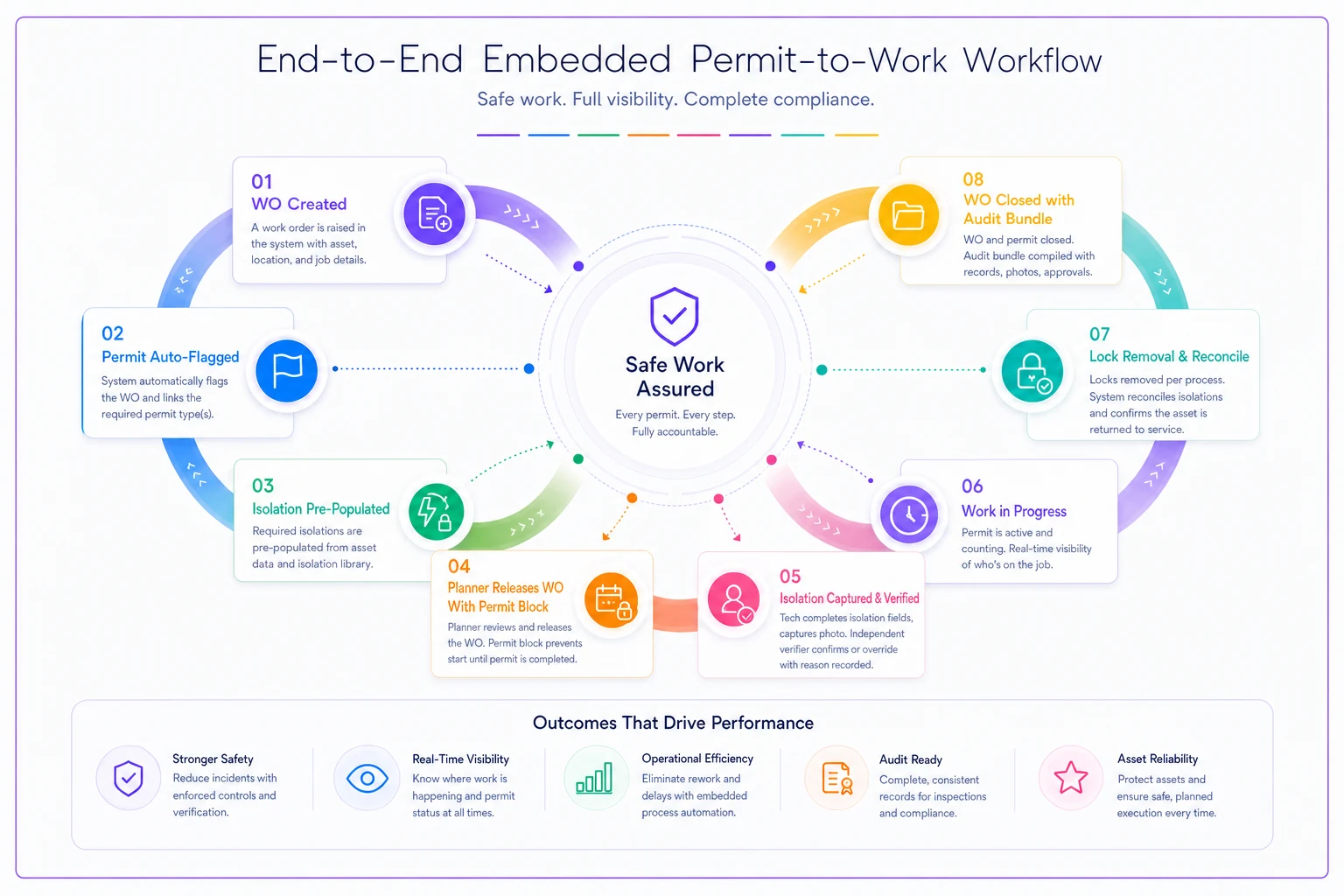
This diagram maps the steps above and highlights the gating points.
A planner builds a work order for a task on a critical asset. Because the asset is tagged as requiring energy isolation, the WO template automatically pulls in a permit requirement and pre-populates the known isolation points from the asset's isolation register. The planner can't release the WO to a tech without that permit block present.
The tech picks up the job on a mobile device. Before the status can move to "in progress," the isolation fields have to be filled — locks applied, each point confirmed, test-before-touch logged, and a verification photo captured. An independent verifier confirms. If the verifier is the same person, the override-with-supervisor rule kicks in and stamps an exception on the record.
Work proceeds. If the permit clock runs down, the WO surfaces the expiry and blocks further logging until a renewal is linked. When the job's done, the tech records lock removal — each one, by ID. The system checks removed count against applied count. Mismatch means the WO won't close.
At closure, the permit, the isolation records, the verification photo, the independent sign-off, and any documented exceptions are already assembled as a bundle attached to the WO. Nobody builds the audit packet later. It exists because the workflow required each piece at the moment it was true. That's the same principle behind assembling audit-ready evidence bundles — capture at the point of work, not by reconstruction afterward.
Audit-ready templates: build them from the outputs, not the inputs
A common mistake is designing the permit template around what's convenient to fill in. The better approach is working backward from what an auditor will ask for — then making sure every one of those items is a required field.
-
Permit type, issue time, expiry time, and issuing authority
-
Full isolation-point list with methods and physical lock IDs
-
Independent verification record with two distinct names
-
Point-of-work evidence (photo, test reading) with timestamp
-
Any exceptions with the authorizing override and reason
-
Complete restoration record reconciled against applied isolations
-
Immutable timeline — who did what, when, in sequence
If your template captures all of that as structured data, the "audit-ready" part isn't a separate export process. The record is the audit packet. What trips teams up is treating audit-readiness as a reporting feature instead of a data-capture requirement. You can't report your way out of fields that were never populated.
When this is worth doing — and when it isn't
Embedding permits into the work-order lifecycle is real work. Worth being honest about where the payoff actually lands.
When it clearly makes sense:
-
You run assets with genuine energy-isolation hazards and multiple daily permits
-
You have contractor crews and shift handoffs where isolation ownership changes hands
-
You've had an audit finding, an insurance question, or a near-miss tied to permit documentation
-
Your permit records currently live somewhere your work orders don't
When it's probably overkill:
-
A small shop with a couple of low-hazard assets and one or two people who do everything and are always present
-
A site where the entire permit population is a handful a month and reconstruction is trivial
Who should not rush this:
Teams whose asset isolation registers are a mess. If you don't actually know how many energy points P-204 has, embedding a permit that pre-populates isolation points will just embed bad data faster. Fix the isolation register first, then integrate. Building structured permit metadata on top of an unreliable asset record produces confident-looking documentation that's quietly wrong — which is worse than paper, because it looks trustworthy.
The one shift that matters
Everything above comes down to a single change in how you think about a permit. Stop treating it as a document that accompanies the work. Start treating it as a set of conditions the work order enforces, with metadata that gates each transition and produces evidence as a byproduct of doing the job correctly.
Paper permits fail audits not because people are careless but because paper can't enforce anything — it can't refuse to let a job close with a lock still applied, can't flag an expired clock, can't insist on a second signature. Structured, embedded metadata can.
The crews at most sites are already doing the isolation right. The gap is almost never the physical safety work — it's the record. Put the permit inside the work order, and both your safety defensibility and your audit prep stop depending on whoever happened to be holding the clipboard at shift change.
The crews at most sites are already doing the isolation right. The gap is almost never the physical safety work — it's the record. Put the permit inside the work order, and both your safety defensibility and your audit prep stop depending on whoever happened to be holding the clipboard at shift change.
Ready to elevate your asset operations?
Join 1,500+ businesses using Ownitly to optimize asset utilization, reduce downtime, and ensure compliance.