

A remote inspection that looks perfect in the moment can still collapse under scrutiny later. The technician captured the crack, the corrosion, the loose bolt. The photo is clear. The work order closed clean. And then a regulator, an insurer, or an internal auditor asks the question nobody thought about at capture time: how do we know this photo was taken where and when it claims, and that nobody touched it afterward?
That's the gap most inspection programs don't discover until it costs them something. The evidence exists — it just isn't defensible. Remote inspection evidence standards are almost entirely about the difference between "we have a photo" and "we have proof."
This isn't about capturing more evidence. Most teams are already drowning in photos. It's about capturing evidence that survives challenge — tamper-evident, properly stamped, traceable from the field device to the archived bundle without gaps.
The four ways field evidence quietly loses its integrity
Before getting into templates, it helps to understand exactly where evidence breaks. Integrity fails in a small number of predictable ways, and they're rarely dramatic.
Metadata gets stripped in transit. A tech shoots a photo on their phone and sends it through a messaging app or email. Most consumer platforms compress the image and strip EXIF data — including GPS coordinates and the original timestamp. By the time it lands in the record, it's a clean-looking JPEG with no verifiable origin. The photo is real. The proof is gone.
Timestamps drift or get overwritten. Device clocks aren't reliable. A tablet that lost connectivity for a few days can be minutes or hours off. Worse, some systems apply the upload timestamp instead of the capture timestamp — so a photo taken Tuesday at a site shows Thursday when it synced back at the depot. Auditors notice.
Files get "cleaned up" before archiving. Someone rotates the image, crops a distracting background, or brightens a dark corner to make the defect visible. Reasonable intentions. But any re-save alters the file, breaks the original hash, and hands an opposing party an easy argument that the evidence was manipulated.
Nobody can say who touched it. The photo moves from phone to shared drive to CMMS to an audit folder, and there's no record of the handoffs. When you can't reconstruct the path, you can't defend the outcome.
None of these are dramatic failures. They're quiet ones. Everything looks fine until the one time it actually matters.
Tamper-evidence: the mechanism, not the promise
"Tamper-evident" gets thrown around loosely. It doesn't mean the file can't be changed — anything can be changed. It means that if it's changed, you'll know.
Stop losing track of critical assets.
Ownitly helps you monitor, maintain, and manage every asset efficiently and reliably.
- Centralized asset tracking
- Automated maintenance alerts
- Compliance monitoring & reporting
No credit card required
The mechanism that actually delivers this is hashing. At capture, you generate a cryptographic hash (SHA-256 is the practical standard) of the raw file. That hash is a fingerprint. Change a single pixel and the hash changes completely. Store the hash separately from the file — ideally at capture, timestamped and logged — and you now have a way to prove the archived file is bit-for-bit identical to what came off the device.
A few practical rules that make this real rather than theoretical:
-
Hash at the point of capture, not at the point of upload. If you hash after the file has already traveled through a compressing channel, you're fingerprinting an already-damaged copy.
-
Never edit the original. If enhancement is genuinely needed for visibility, create a derived copy, label it clearly as derived, and keep the original untouched with its hash intact. The derived image is an aid. The original is the evidence.
-
Log the hash independently. A hash stored in the same file it protects is worthless. It needs to live in a separate, append-only record.
Generate the hash at capture and write it to an independent, append-only log that your audit process can reference.
The mistake teams make here is treating tamper-evidence as a storage feature — "we back up our photos" — rather than a capture discipline. Backups protect against loss. They do nothing for integrity.
Metadata conventions: what to stamp and how to stamp it
Metadata is where most of the defensibility actually lives, and it's the part most programs standardize the least. Two techs on the same crew will produce records with completely different metadata quality unless the convention is enforced at capture.
| Metadata field | What it captures | Why it matters | Common failure |
|---|---|---|---|
| Capture timestamp (UTC + local) | Exact moment of capture from a synced clock | Anchors the evidence in time | Upload time substituted for capture time |
| GPS coordinates + accuracy | Where the photo was taken, with the accuracy radius | Confirms the right asset/location | Coordinates missing or accuracy too coarse to be meaningful |
| Asset ID / tag | Ties evidence to a specific asset record | Prevents "which pump was this?" disputes | Free-text notes instead of a linked ID |
| Technician / device ID | Who and what captured it | Establishes the responsible party | Shared device, no user attribution |
| Inspection/work-order reference | Links evidence to the job | Connects the photo to the scope | Orphaned photos with no parent record |
| File hash | Integrity fingerprint | Proves no tampering | Never generated |
A detail people consistently miss on GPS: coordinates without an accuracy radius are half-useful. A reading accurate to 4 meters and one accurate to 80 meters look identical as a lat/long pair, but only one of them actually places the tech at the asset. Capture the accuracy value alongside the coordinates. Indoor or shielded environments often produce poor GPS — you want that visible in the record rather than silently assumed.
On timestamps, standardize on UTC as the source of truth and store local time as a display convenience. Cross-site programs where techs work across time zones end up in painful reconciliation problems when everything is logged in wandering local time. UTC removes the ambiguity.
This also connects directly to how you write field procedures. If your capture steps don't specify which metadata is mandatory versus optional, techs will optimize for speed and skip the fields that feel like overhead. The micro-SOPs approach for mobile technicians is worth aligning here — acceptance criteria for a photo should include metadata completeness, not just image clarity.
Chain-of-custody without the courtroom theater
Chain-of-custody sounds heavier than it needs to be. Strip away the legal framing and it comes down to one simple requirement: at every point in the evidence's life, you can say who had it and what happened to it.
-
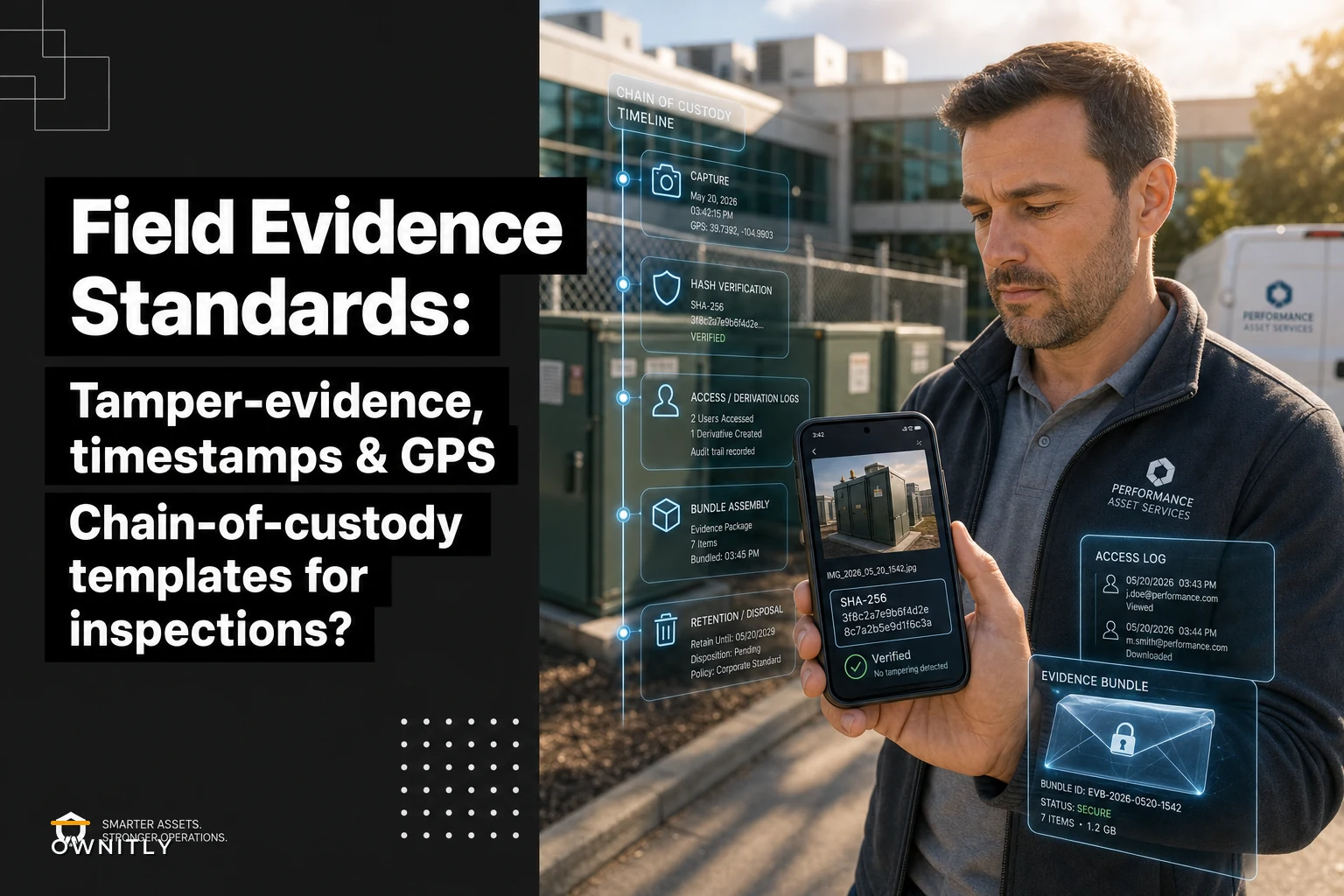
Capture — device, user, timestamp, GPS, hash generated.
-
Transfer to system of record — logged automatically, ideally without passing through a lossy channel. Hash re-verified on arrival.
-
Any access or derivation — who viewed, who exported, who created a derived copy, and when.
-
Bundle assembly — which items were pulled into an evidence package, by whom, for what purpose.
-
Retention and disposal — where it's stored, under what retention rule, and when it's eligible for deletion.
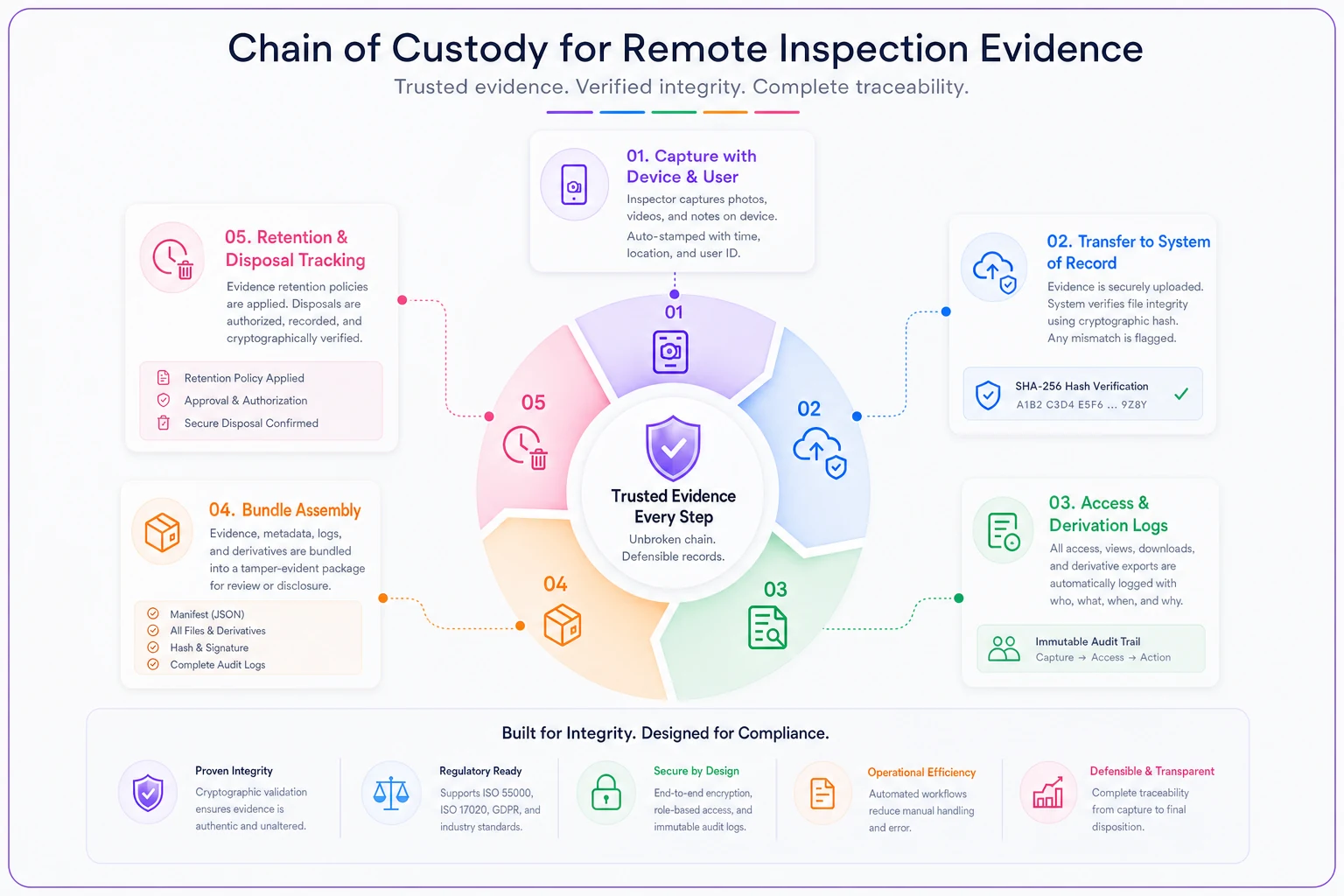
A simple visual of the lifecycle helps teams spot handoff gaps.
The single biggest chain-of-custody killer is the manual re-upload. A tech captures on one app, someone at the office downloads and re-uploads into the "official" system. That step is an untracked handoff, and it usually strips metadata on the way through. Every manual copy is a break in the chain. The goal is to move evidence from capture to record with as few human handoffs as possible.
A useful practical test: pick any archived photo and try to reconstruct its full history from the logs alone. If you can't get from "captured by whom, where, when" all the way to "assembled into this bundle by whom, on what date" without asking a person, your chain has gaps.
Automated evidence-bundle templates for audits and inspections
Once capture and custody are solid, the bundle is what an auditor actually receives. A bundle isn't a folder of photos — it's a structured package that anticipates questions before they're asked.
-
Cover manifest — inspection reference, asset ID, date range, technician, and a list of every included item with its hash.
-
The evidence items — original files, each with intact metadata, plus any clearly labeled derived copies.
-
Integrity report — the hash of each file at capture versus the hash at bundle assembly, confirming they match.
-
Chain-of-custody log — the reconstructed history for each item.
-
Acceptance record — who reviewed the inspection against acceptance criteria and signed off.
-
Retention tag — the governing retention rule and disposal-eligible date.
Templating this matters because ad-hoc bundle assembly is where consistency dies. One auditor gets a well-organized package; the next gets a zip file with vague filenames. Standardized templates mean every bundle answers the same questions in the same order — and that consistency is often what separates an audit that wraps in an afternoon from one that drags across weeks.
If you're working through the broader record structure — minimum red-lines, retention rules, what belongs in every package — audit-ready maintenance evidence bundles covers the groundwork that pairs directly with the field-evidence layer described here.
The automation payoff is real but narrow. What you want automated is the stamping, hashing, logging, and assembly — the parts humans do inconsistently. You do not want to automate judgment about what a defect means. Let the platform handle metadata capture, hash generation, custody logging, and bundle templating so techs can focus on inspecting, and auditors get a package that's already defensible.
A real scenario: a mid-size utility contractor
A contractor running pole and substation inspections across a regional service area had roughly 40 field techs capturing evidence on phones and tablets. Photos flowed back through a mix of email, a shared drive, and manual uploads into their CMMS. On paper it worked.
Then a disputed inspection surfaced during an insurance review. The contractor needed to prove that a specific set of around 60 photos were taken at the claimed locations on the claimed dates. Most had been forwarded through email at some point — metadata stripped. Timestamps on several reflected upload, not capture. Nobody could reconstruct who had touched the files. They ended up re-inspecting a portion of the sites to rebuild defensible evidence, which cost a few weeks of crew time and a credibility hit from admitting the original records couldn't stand.
The fix wasn't more photos. They moved capture into a single app that hashed and stamped at the point of capture, pushed evidence straight into the record without the email detour, and generated templated bundles per inspection. The next audit cycle, pulling a complete, integrity-verified bundle took minutes instead of a scramble.
Worth noting: the techs weren't doing more work. They were doing the same work through a channel that didn't quietly destroy the proof along the way.
When this level of rigor makes sense — and when it's overkill
Not every inspection needs courtroom-grade evidence, and pretending otherwise creates process fatigue.
This makes sense when:
-
Inspections feed regulatory compliance or safety attestations.
-
Evidence could end up in insurance claims, warranty disputes, or litigation.
-
You operate across multiple sites or time zones where reconciliation gets messy.
-
Contractors or third parties capture evidence you'll be held accountable for.
This is probably overkill when:
-
The inspection is purely internal, low-stakes, and never leaves the team.
-
You're capturing progress photos with no downstream accountability.
Small teams running a handful of internal-only inspections should be careful here. Loading full hashing and custody logging onto every routine walk-through will get ignored, and ignored process is worse than no process. Apply the rigor where the evidence has consequences and keep the lightweight path for everything else.
The through-line
The programs that pass audits cleanly aren't the ones with the most photos. They're the ones where every piece of evidence carries its own proof — stamped at capture, fingerprinted against tampering, traceable through every handoff, and assembled into bundles that answer questions before they're asked. Strong remote inspection evidence standards don't ask techs to work harder. They ask the capture process to stop quietly destroying the integrity of good work. Get the stamping, hashing, and custody logging right at the point of capture, template the bundle, and the difference shows up exactly where it counts — the moment someone challenges what you captured six months ago.
Ready to elevate your asset operations?
Join 1,500+ businesses using Ownitly to optimize asset utilization, reduce downtime, and ensure compliance.