


Most predictive maintenance programs don't fail because the model was bad. They fail because nobody could explain, six months later, why a model flagged a pump, who approved pushing it into production, or what evidence existed when a compliance auditor asked whether the work order it generated was actually defensible.
That gap — between "the data science team built something that works" and "the operation can trust, trace, and reverse what it does" — is where predictive maintenance model governance EAM programs live or die. It's harder than it looks, because a model that writes work orders isn't just an analytics artifact anymore. It's part of your maintenance control chain, with operational, financial, and audit consequences all happening at once.
This piece walks through the full model-ops lifecycle the way it needs to run inside an EAM environment: training → shadow → gated production → audit-replay. Not as a data science pipeline, but as an operational control system with gates, evidence, and named owners. The emphasis is on what breaks at each stage, who's responsible, and how you tie promotion and rollback decisions directly to work-order generation.
Why predictive models break differently inside EAM
A recommendation engine that misfires costs you a bad product suggestion. A predictive maintenance model that misfires either:
-
generates a work order that sends a crew to a healthy asset (wasted labor, unnecessary downtime), or
-
stays silent on an asset that's actually degrading (the failure you were trying to prevent).
Both are expensive. The second one is the one that ends up in an incident review with legal in the room.
The deeper issue is that these models drift silently. Sensor firmware gets updated, a vibration probe is remounted a few millimeters off, a new lubricant changes the thermal signature, operating load shifts seasonally — and suddenly the feature distribution the model learned on no longer matches reality. The model keeps producing confident outputs. The work orders keep flowing. Nobody notices until the false-positive rate creeps up and crews start ignoring alerts, which is the worst possible outcome because now your real alerts get ignored too.
What shows up across a lot of asset-heavy operations is that the governance failure almost never lives in the model itself. It shows up in the handoffs: data science throws a model over the wall, ops wires it to work-order creation, compliance finds out it exists during an audit. Three groups, three mental models, zero shared evidence trail.
So before touching lifecycle stages, you need to settle who owns what.
Role responsibilities: ops, data science, compliance
Governance collapses when responsibilities are assumed instead of assigned. Here's the division that actually works in practice, broken down by what each group decides versus what they execute.
Stop losing track of critical assets.
Ownitly helps you monitor, maintain, and manage every asset efficiently and reliably.
- Centralized asset tracking
- Automated maintenance alerts
- Compliance monitoring & reporting
No credit card required
| Responsibility | Data Science | Operations / Reliability | Compliance / Risk |
|---|---|---|---|
| Model training & validation metrics | Owns | Reviews | Audits retention |
| Feature/data lineage documentation | Owns | Provides asset context | Verifies completeness |
| Shadow-mode threshold tuning | Proposes | Owns decision | Observes |
| Promotion-to-production gate approval | Recommends | Co-approves | Co-approves |
| Work-order generation rules from alerts | Advises | Owns | Reviews defensibility |
| Rollback trigger & execution | Executes | Owns decision | Notified + logs |
| Audit-replay evidence packages | Produces | Validates operationally | Owns standard |
The pattern worth noticing: data science owns the model, but operations owns the consequences, and compliance owns the proof. No single group can promote a model to production alone. That's intentional friction. A model that writes work orders touching safety-critical assets should never ship on a data scientist's judgment alone, no matter how clean the validation curves look.
One mistake that comes up repeatedly is treating compliance as a final-stage gatekeeper who gets a 48-hour window to "sign off" on something already built. By then the lineage decisions, the retention assumptions, and the evidence format are locked in. Compliance needs to define the evidence template before training starts, not inspect it afterward.
The four-stage lifecycle as a control system
Think of each stage as a gate with an entry condition, an evidence requirement, and an exit decision. A model doesn't "progress" — it gets promoted by named approvers against documented criteria, and every promotion creates a record you can replay later.
Stage 1 — Training
Training is where most of your future audit problems get baked in, because this is where lineage either gets captured or lost forever.
The non-negotiables at this stage:
-
Frozen training dataset snapshot — not a query that "would return the same rows," an actual immutable snapshot with a hash. Six months later, "re-run the query" won't return the same data because the underlying tables changed.
-
Feature lineage map — every feature traced back to its source sensor, tag, or EAM field, including any transformations.
-
Label provenance — how were failures labeled? Confirmed failure records from work-order history? Technician judgment? This matters enormously for defensibility.
-
Validation metrics against an operationally meaningful baseline — not just AUC, but false-positive cost and missed-failure cost expressed in work-order and downtime terms.
Gate-level evidence template — Training exit:
-
Dataset snapshot ID + hash
-
Feature lineage document (versioned)
-
Label source and confidence notes
-
Validation metrics + baseline comparison
-
Known limitations / out-of-scope asset classes
-
DS sign-off + date
If your training data lineage is weak, every downstream gate inherits that weakness and you can't fix it later. Clean lineage at training is what makes audit-replay possible at all. If you're still fighting data trust problems upstream, that has to be solved first — a trusted asset performance measurement system with real data-lineage checks is effectively a prerequisite, not a parallel project.
Stage 2 — Shadow
Shadow mode is the stage people rush, and it's the single most valuable gate you have. The model runs on live data, produces alerts, but those alerts do not generate work orders. They get logged and compared against what actually happened.
This is where you learn what validation metrics can't tell you: how the model behaves on your live data distribution, not the clean historical set. A common pattern — a model with excellent offline metrics produces a 20–30% false-positive rate in shadow because real sensor streams have gaps, spikes, and recalibration events the training set smoothed over.
Run shadow long enough to cover the operational cycles that matter.
Run shadow long enough to cover the operational cycles that matter. For seasonal load variation, that might mean weeks. For a high-cycle asset, days might be enough. Rushing this to hit a go-live date is how you ship a model that erodes crew trust by month two.
What shadow mode needs to capture:
-
Every alert the model would have generated
-
Ground-truth outcome (did the asset actually degrade or fail?)
-
False-positive and false-negative counts against operational thresholds
-
Alert-to-outcome lead time (did it warn early enough to act?)
-
Any data-quality events during the window
The exit decision from shadow isn't "is the model good" — it's "are we comfortable letting this generate real work orders that cost real labor hours and touch real assets." That's an operations call, co-signed by compliance, informed by data science.
Stage 3 — Gated production
Production here doesn't mean full autonomy. It means the model's alerts now flow into work-order generation — but through gates calibrated to asset criticality.
A sensible gating structure tied directly to work-order generation:
-
Low-criticality assets model alert → auto-generated work order, planner reviews in normal queue.
-
Medium-criticality model alert → draft work order held for planner approval before dispatch.
-
High / safety-critical model alert → notification to reliability engineer, human confirmation required before any work order is created.
This tiering matters because the cost of a false positive scales with criticality, and so does the cost of blind trust. You want the model handling high-volume, low-stakes triage automatically while keeping humans in the loop exactly where the consequences are severe.
How the alert-to-work-order workflow actually runs in a healthy setup:
> Model emits alert with confidence score and contributing features → routing layer checks asset criticality tier → for auto-generate tiers, work order is created with the model version ID, alert ID, and feature snapshot attached → work order enters the normal maintenance queue → on close-out, the actual finding is captured and fed back as a labeled outcome for the next training cycle.
That last step — feeding close-out findings back as labels — is what separates a governed program from a static one. Most operations never close this loop, which is why their models slowly decay. The work-order close-out note is your next training label, if you capture it in a structured way.
Every work order generated from a model should carry, as metadata:
-
Model version ID
-
Alert ID + timestamp
-
Confidence score
-
Top contributing features
-
Gate tier applied (auto / draft / confirm)
Without this, you can't answer the audit question "why was this work order created," and you can't distinguish model-driven work from human-initiated work in your KPIs. This is also where solid EAM architecture and integration patterns stop being optional — the alert layer, the work-order system, and the model registry have to be wired together cleanly or the metadata just doesn't survive the handoff.
Stage 4 — Audit-replay
Audit-replay is the capability to reconstruct, for any past alert and the work order it generated, exactly what the model saw and why it decided what it did.
If a regulator or an incident investigation asks "on March 14th, why did this model flag Compressor 7 and generate a corrective work order," you need to produce: the model version running that day, the exact input features at that timestamp, the confidence output, the gate applied, and the resulting work-order record. All of it reconstructed — not reconstructed-from-memory.
This is impossible to bolt on later. It only works if every prior stage logged what it needed to. That's the whole point of treating earlier gates as evidence-producing control points rather than development milestones.
Here's a visual of the lifecycle and its gates.
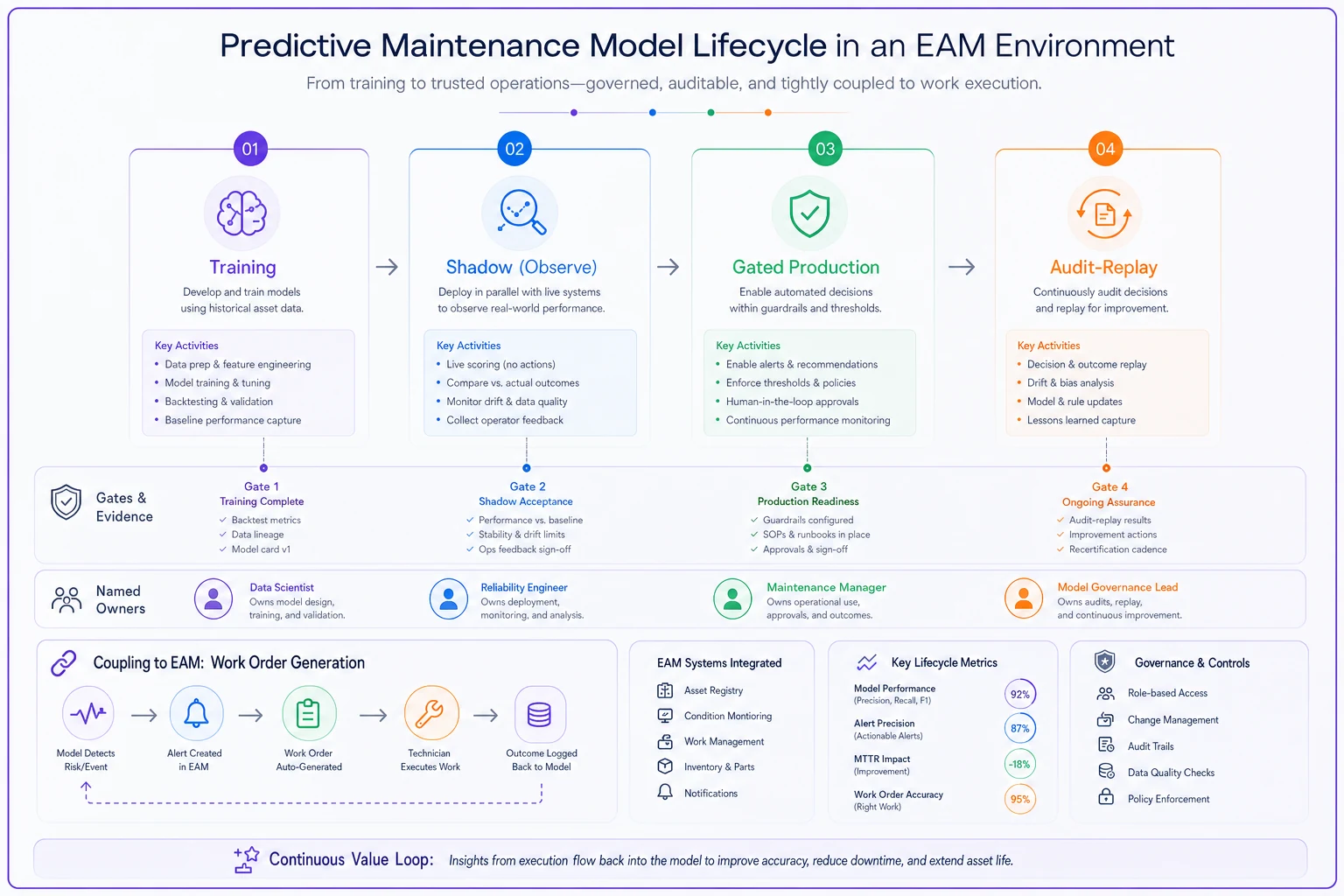
The diagram shows stages, the gate checks required at each handoff, and where evidence and approvals need to be captured.
Promotion and rollback templates tied to work-order generation
The two decisions that define a governed program are promote and rollback. Both need standing templates so they're not improvised under pressure.
Sample promotion record (shadow → production):
-
Model ID + version
-
Shadow window
to
-
Shadow false-positive rate
___ %
-
Shadow missed-failure count
___
-
Alert-to-outcome lead time (median)
___
-
Asset criticality tiers this model will serve
___
-
Gate tier assignment (auto / draft / confirm)
___
-
Work-order generation rules confirmed
Y / N
-
Metadata attachment verified
Y / N
-
DS recommendation
-
Ops approval + name + date
-
Compliance approval + name + date
-
Rollback trigger thresholds defined
Y / N
Sample rollback trigger template:
A model in production gets rolled back — reverted to the prior version or dropped to shadow/suspend — when any of these fire:
-
False-positive rate exceeds the agreed ceiling over a rolling window (e.g., sustained above the shadow baseline by more than a set margin)
-
A confirmed missed failure on a medium- or high-criticality asset
-
Input data-quality degradation beyond threshold (sensor dropout, feature drift alarm)
-
Any safety-related work order traced to a model error
Rollback execution record:
-
Trigger that fired
-
Model version rolled back from / to
-
Decision owner (ops) + name + time
-
Work orders generated during suspect window — flagged for review
list
-
Compliance notified
Y / N + time
-
Root-cause investigation opened
Y / N
The piece operations forget most often: when you roll back a model, you have to go back and review the work orders it generated during the suspect window. A rollback that ignores already-created work orders just leaves bad instructions sitting live in the maintenance queue.
When this full lifecycle makes sense — and when it's overkill
When it's worth the full apparatus:
-
Models that auto-generate or materially influence work orders on safety-critical or high-value assets
-
Regulated environments where you'll need to defend maintenance decisions
-
Multi-site programs where one model gets deployed across varied operating conditions
When a lighter version is fine:
-
A single pilot model on non-critical assets where every alert is human-reviewed anyway. You still want lineage and shadow testing, but the dual-approval gating can be lighter.
Who should NOT do this yet:
If you don't have clean asset master data and reliable failure-history labels, don't stand up a model-governance lifecycle on top of it. You'll be governing garbage very rigorously. Fix the data foundation first — predictive maintenance built on unreliable asset records produces confident, well-documented, wrong decisions.
A short real scenario
A mid-sized processing operation ran a vibration-based model across roughly 40 rotating assets. It launched straight to production — no real shadow period — and for about six weeks it looked fine. Then a sensor-firmware update shifted the signal baseline on a cluster of pumps, and the false-positive rate climbed to the point where planners were generating somewhere around a dozen unnecessary work orders a week. Crews started treating the alerts as noise.
The real cost wasn't just the wasted inspections. It was that an actual bearing degradation on a critical pump got ignored because "the model's been crying wolf all month," leading to an unplanned shutdown.
After rebuilding the program with a proper shadow stage, criticality-tiered gating, and model-version metadata on every generated work order, the picture changed noticeably. Shadow testing caught the next firmware-drift event before it reached production work orders. False positives on the auto-generate tier dropped to a level crews could live with, high-criticality alerts went through human confirmation, and when a model did need rolling back, the team could immediately pull the list of work orders it had touched. The alerts got trusted again — which is the entire point, because an alert nobody trusts is worse than no alert at all.
The real takeaway
Predictive maintenance governance isn't about making data scientists fill out forms. It's about recognizing that the moment a model starts generating work orders, it becomes part of your maintenance control system — and control systems need gates, owners, and reversibility.
Programs that hold up treat training, shadow, gated production, and audit-replay as a connected chain of evidence rather than a build-and-deploy pipeline. They assign promote and rollback decisions to named people across ops, data science, and compliance. And they attach enough metadata to every model-driven work order that six months later, under audit or after an incident, someone can reconstruct exactly what happened and why.
Get that right and predictive maintenance stops being a black box your crews quietly distrust, and becomes something the whole operation can actually lean on.
Predictive maintenance governance isn't about making data scientists fill out forms. It's about recognizing that the moment a model starts generating work orders, it becomes part of your maintenance control system — and control systems need gates, owners, and reversibility.
Programs that hold up treat training, shadow, gated production, and audit-replay as a connected chain of evidence rather than a build-and-deploy pipeline. They assign promote and rollback decisions to named people across ops, data science, and compliance. And they attach enough metadata to every model-driven work order that six months later, under audit or after an incident, someone can reconstruct exactly what happened and why.
Get that right and predictive maintenance stops being a black box your crews quietly distrust, and becomes something the whole operation can actually lean on.
Ready to elevate your asset operations?
Join 1,500+ businesses using Ownitly to optimize asset utilization, reduce downtime, and ensure compliance.