



Most asset organizations have quietly crossed a line. Somewhere between the first predictive alert pilot and the fifth model feeding live recommendations into the work queue, algorithms started making maintenance decisions — not just suggesting them. A condition score bumps a pump up the priority list. A model defers a calibration. A scheduler reshuffles a crew based on a failure probability that nobody in the room can fully explain.
That's mostly fine. Until a regulator, an insurer, or a plant manager after an incident asks the obvious question: who approved this, and what did they see when they approved it?
That question is where a lot of otherwise-mature programs fall apart. Not because they lack models or data, but because they never built the governance scaffolding that decides which algorithmic decisions require a human in the loop, what evidence that human needs, and who signs. This piece is about building that scaffolding — a decision taxonomy that maps automation-criticality to required evidence and approvals, plus the SOP language, workflows, and audit-trail templates to make it hold up in a regulated environment.
The real problem isn't trusting the model. It's inconsistency.
Walk into five sites running the same predictive platform and you'll often find five different unwritten rules about when a human overrides the algorithm. One reliability engineer rubber-stamps everything. Another re-derives every recommendation by hand and creates a three-week backlog. A third only intervenes when the model disagrees with his gut — which means the model's value shows up exactly where he already agreed with it.
That inconsistency is the actual risk. When an auditor pulls records, they're not looking for a perfect model. They're looking for a repeatable, defensible process — where similar decisions were handled similarly, the right people reviewed the right things, and the reasoning is reconstructable months later.
What breaks this at scale is simple math. A single plant might generate a handful of algorithmic recommendations a week. A fleet of twenty sites with multiple models per asset class can generate thousands. If your governance says "an engineer reviews everything," you've built a bottleneck that guarantees people will start approving in bulk without reading. And bulk-approval-without-reading is functionally the same as no governance at all — except now it's documented, which is worse.
So the goal isn't more review. It's graduated review: heavy scrutiny where the stakes justify it, light-touch or automated handling where they don't, and a clear line between the two that everyone actually follows.
Start with a decision taxonomy, not a policy document
The mistake most teams make is writing a governance policy first — a long document full of principles — then trying to retrofit real decisions into it. That's backwards. Start by cataloging the actual decisions your algorithms influence, then grade each one.
Stop losing track of critical assets.
Ownitly helps you monitor, maintain, and manage every asset efficiently and reliably.
- Centralized asset tracking
- Automated maintenance alerts
- Compliance monitoring & reporting
No credit card required
In practice, algorithmic maintenance decisions tend to sort into a handful of types:
-
Prioritization shifts — the model moves a work order up or down the queue.
-
Interval changes — extending or compressing a PM or calibration frequency.
-
Deferrals — pushing a scheduled task because condition data says the asset is healthy.
-
Suppression — the model tells you not to act on an alert (the quietest and most dangerous category).
-
Resource reallocation — crews, spares, or outage windows reassigned based on risk scoring.
-
Automated work-order generation — a recommendation that creates and dispatches work with no human touch.
Each carries wildly different consequences. A deferral on a redundant, non-safety-critical fan is nothing like a deferral on a relief valve in a regulated process unit. So the second axis is automation-criticality — a blend of asset criticality, safety and regulatory exposure, reversibility, and model maturity.
That two-axis view drives the entire governance model. Here's a mapping that holds up in regulated environments:
| Criticality tier | Example decision | Human-in-the-loop requirement | Required evidence | Approval authority |
|---|---|---|---|---|
| Tier 0 — Autonomous | Reprioritize non-critical, redundant asset within queue | None (post-hoc sampling only) | System log of inputs + model version | Auto, 5% audited monthly |
| Tier 1 — Notify | Interval tweak on non-safety asset, reversible | Human informed, can veto within window | Model output, condition trend, prior interval | Reliability engineer (passive) |
| Tier 2 — Review | Deferral on critical rotating equipment | Human must actively approve before action | Condition evidence, failure-mode mapping, model confidence, override rationale field | Reliability lead sign-off |
| Tier 3 — Dual control | Interval extension on safety/regulated instrument | Two-person approval, evidence package | Full evidence bundle + calibration/drift history + regulatory reference | Engineer + compliance/area owner |
| Tier 4 — Governed exception | Suppressing an alert on safety-critical asset | Committee review, documented justification | Risk assessment, compensating controls, time-bound expiry | MoC board / named accountable executive |
The power of this table isn't the specific tiers — yours will differ. It's that every algorithmic decision in your environment can be placed into exactly one row, and that row tells everyone what has to happen. No more improvising per engineer.
The evidence gradient is where most programs are too thin — or too heavy
Required evidence should scale with the tier, and getting this wrong is a common, expensive mistake in both directions.
Too thin at the high tiers, and your Tier 3 interval extension on a regulated instrument comes back to haunt you in an audit because the only record is a checkbox and a timestamp. Too heavy at the low tiers, and you've mandated a full evidence bundle for a routine queue reshuffle — which means reviewers stop reading and start clicking.
A workable evidence gradient, moving up the tiers:
-
Tier 0–1 The system automatically captures model version, input features, output, and timestamp. No human writing required. This is the floor — if you can't reconstruct what the model saw, nothing above it is defensible.
-
Tier 2 Add a mandatory free-text rationale field the approver must complete, plus a snapshot of the condition evidence (the actual trend chart, not a link that may rot). The rationale is the most valuable record you'll capture — it's what a reviewer six months later uses to understand why, not just what.
-
Tier 3 Add the structured evidence bundle — calibration history, drift records, failure-mode linkage, the model's confidence or uncertainty estimate, and a reference to the governing procedure or regulation. This is where your existing evidence-bundle discipline should plug straight in.
-
Tier 4 Add a formal risk assessment, documentation of compensating controls, and a hard expiry date. Suppressions and high-criticality exceptions should never be permanent. If the exception is still needed in 90 days, it should force a re-review, not quietly persist.
Pro-tip: for Tier 3+ approvals, snapshot the evidence immutably at approval time so reviewers later see exactly what the approver saw.
One pattern worth stealing: for anything Tier 3 and above, capture the evidence that was present at the time of approval as an immutable snapshot, not a live reference. Live references are the quiet killer of audit-readiness — the chart updates, the asset record changes, and suddenly the record of what the approver actually saw no longer exists. This is the same chain-of-custody thinking that applies to OT/IT security and evidence controls in regulated industries — preserve the state at the moment of decision.
Sample SOP clauses you can actually adapt
Governance only works if it's written in language that lands in an SOP and survives a procedure review. Vague principles ("decisions shall be appropriately reviewed") are worthless at audit time. Here's the kind of specific, testable clause language that holds up.
On automation boundaries:
> "Algorithmic recommendations classified as Tier 2 or above (per the Decision Criticality Matrix, Appendix A) shall not be actioned, dispatched, or closed without documented approval from the designated authority for that tier. System configuration shall prevent auto-execution of Tier 2+ recommendations."
Note the second sentence. A policy that says humans must approve, running on a system that technically allows auto-execution, is a finding waiting to happen. The control has to be enforced in configuration, not just in prose.
On rationale capture:
> "For all Tier 2+ approvals, the approver shall record a rationale sufficient for an independent reviewer to understand the basis of the decision without consulting the approver. 'Agree with model' or equivalent is not an acceptable rationale."
On alert suppression:
> "Suppression of any alert on a safety-critical or regulated asset constitutes a Tier 4 decision and shall require: (a) a documented risk assessment, (b) identification of compensating controls, (c) a defined expiry not to exceed 90 days, and (d) approval by the Management of Change board. Suppressions shall auto-expire and re-trigger the alert at the expiry date."
On model changes:
> "Any change to a model version, threshold, or feature set that affects Tier 2+ recommendations shall be treated as a change under the MoC procedure. Prior model version, change rationale, and validation evidence shall be retained for the full record-retention period."
That last clause is the one people forget, and it's the one that bites hardest. When an auditor asks why an asset was deferred eight months ago, the model that made that call may no longer exist. Without version retention, you can't reconstruct the decision — which means you can't defend it.
The approval workflow: designing for the bottleneck, not the happy path
A governance workflow that only works when volumes are low isn't really governance — it's a nice idea that collapses the first busy week. Design it around the pinch points from the start.
A workflow structure that scales without rubber-stamping or backlog:
-
Algorithm emits recommendation with model version, inputs, confidence, and a proposed action.
-
Auto-classification engine assigns the criticality tier based on asset class, decision type, and regulatory flags. This classification is itself logged and periodically audited — misclassification is a governance failure in its own right.
-
Tier 0–1 flows through automatically or with passive notification. A sampling rule pulls a defined percentage into monthly audit.
-
Tier 2 lands in a review queue routed to the designated authority, with the evidence snapshot pre-assembled so the reviewer isn't hunting for context. The rationale field is mandatory to close.
-
Tier 3 requires two named approvers; the system enforces segregation (the same person can't fill both roles) and blocks action until both sign.
-
Tier 4 generates an MoC case, routes to the board, and sets the expiry clock the moment it's approved.
-
Every approval, veto, and timeout writes to an append-only audit trail.
Below is a visual of the approval workflow.
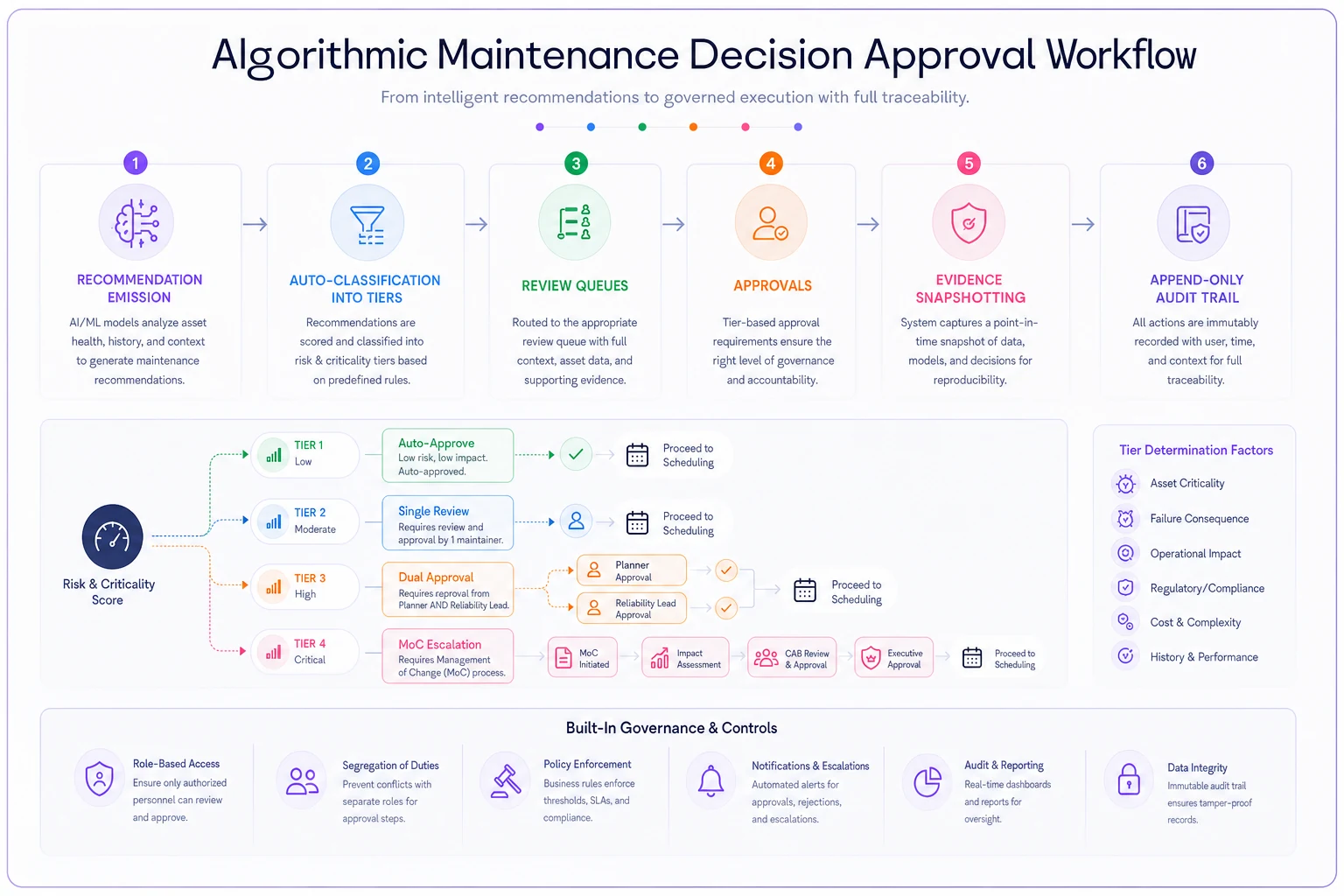
The segregation-of-duties enforcement in step 5 matters more than it looks. In real operations, the failure mode isn't malice — it's the engineer who "approves on behalf of" a colleague who's on shift elsewhere, because the work needs to move. If the system permits one person to hold both approvals, that shortcut will get taken under pressure, and it will show up in exactly the decision you least want to defend.
The same discipline that governs permit and lockout verification applies here — algorithmic approvals belong inside the work-order lifecycle, not in a separate spreadsheet that nobody reconciles. If you've already built verified, metadata-rich controls into your work orders, as in embedding permit-to-work and LOTO into the work-order lifecycle, the algorithmic-approval layer slots into the same structure rather than inventing a parallel one.
Audit-trail templates: what a defensible record actually contains
An audit trail that just logs "approved by J. Reyes, 14:32" is almost worthless. When something goes wrong, the trail has to answer: what did the algorithm recommend, based on what inputs, which model version, what did the human see, what did they decide, and why.
-
Decision ID and linked work order / asset ID
-
Model identifier and version (not "the vibration model" — the exact versioned artifact)
-
Input features and values at time of recommendation
-
Model output and confidence/uncertainty estimate
-
Assigned criticality tier and the classification logic that produced it
-
Evidence snapshot reference (immutable)
-
Approver(s) with role and timestamp
-
Rationale text (and veto rationale, if applicable)
-
Action taken and any expiry/re-review date
-
Any subsequent override or reversal, linked back to the original
Keep it append-only. If an approval gets reversed, the reversal is a new entry that references the old one — you never edit history. Auditors and legal teams care deeply about this. An editable approval log gets treated as an unreliable one.
A real scenario: a regional water utility
A mid-sized water utility running pumping and treatment assets had rolled out condition monitoring across roughly 400 critical assets. The models were good. The governance was a mess — a single reliability engineer was nominally approving every algorithmic deferral and interval change, somewhere around 60–80 recommendations a week. In reality he was batch-approving most of them on Friday afternoons.
The breaking point came during a regulatory review of a deferred calibration on a chlorine-dosing instrument. The instrument had drifted, there'd been a near-exceedance, and the question was: who approved the deferral, and on what basis? The record said "approved" — no rationale, no evidence snapshot, and a model version that had since been retired.
The fix wasn't more technology. It was the taxonomy. They graded their decisions, and it turned out only about 15% of weekly recommendations were genuinely Tier 2+. The rest were low-criticality reshuffles that didn't need an engineer at all. By pushing Tier 0–1 to automatic handling with sampling, the engineer's actual review load dropped from roughly 70 items to about a dozen a week — and those dozen got real scrutiny, real rationale, and immutable evidence snapshots.
Within two review cycles, the dosing-instrument class moved to Tier 3 dual control with full drift-history bundles. The next regulatory review pulled four records at random and got complete, reconstructable decisions in minutes. Same team, same models. The difference was entirely in which decisions got human attention and what evidence came with them.
When heavy governance makes sense — and when it doesn't
This full taxonomy makes sense when you operate safety-critical or regulated assets, run multiple models across many sites, or face audit and legal exposure where you'll need to reconstruct past decisions. If any of those are true, the inconsistency cost is already hurting you — you just might not have been audited yet.
This is overkill when your algorithmic footprint is a single pilot on non-critical assets with a human reviewing everything anyway. Don't build a five-tier MoC-linked governance structure for three recommendations a week. Build the Tier 0–1 logging discipline now — it's cheap and it's your foundation — then add tiers as volume and criticality grow.
Who should not roll this out as a big-bang policy: organizations that haven't yet cataloged their actual algorithmic decisions. If you can't list the decision types your models influence, writing the governance policy first just produces a document nobody can apply. Catalog first. Grade second. Write SOP language third.
The part that quietly determines whether this works
Everything above lives or dies on one thing: the governance has to be enforced in the system, not just in the procedure binder. A tier that's documented but not configured — where the platform still lets someone auto-close a Tier 3 decision, or approve both halves of a dual control — is a false sense of safety. The record will look governed right up until the one decision that matters, where someone took the shortcut the system allowed.
This is where a workflow platform that can classify recommendations, enforce tier-based approval routing, block auto-execution above a threshold, snapshot evidence immutably, and write an append-only trail stops being optional. Not because software is the point — the taxonomy is the point — but because human discipline alone doesn't survive a busy Friday with 70 recommendations in the queue. The system has to make the right path the only available path.
Build the decision taxonomy first. Grade honestly — most of your algorithmic decisions are lower-criticality than they feel, and concentrating real review where it counts is what makes the whole thing sustainable. Then wire the evidence, approvals, and audit trail so that six months from now, when someone asks who approved the deferral and what they saw, the answer is sitting there, complete and reconstructable, without anyone having to track down the engineer who's since left the company.
Ready to elevate your asset operations?
Join 1,500+ businesses using Ownitly to optimize asset utilization, reduce downtime, and ensure compliance.