

The first 90 minutes after a critical asset fails are chaotic in a way that no dashboard captures. People are running on adrenaline, decisions get made verbally, cash gets spent on emergency parts, and half the record of what actually happened lives in someone's text messages. Then weeks later, finance asks why there's a $14k charge with no PO, or an auditor wants to know who authorized running the compressor on a temporary seal for eleven days.
That gap — between the physical response and the operational record — is where most organizations quietly bleed money and credibility. A good industrial asset incident response playbook isn't really about the emergency itself. It's about making sure the emergency flows cleanly into your EAM lifecycle, so that stabilization, decisions, evidence, and money all reconcile at the end.
This piece walks through the whole system: how stabilization connects to work-order creation, how temporary-repair vs. hold decisions get governed, what belongs in an evidence packet, how finance reconciles the mess afterward, and what post-incident governance actually looks like when it works.
Why incidents break the EAM lifecycle in the first place
Under normal operations, your maintenance workflow is orderly. A condition triggers a work order, the work order gets triaged, someone plans it, parts get reserved, work gets executed, and it closes with evidence attached. Predictable, linear, manageable.
An incident inverts that sequence. The physical work starts before the record exists. A technician is already isolating the asset while the notification is still buried in an email thread. By the time anyone creates a work order, the crew has spent two hours, pulled parts from three bins, and made a judgment call about whether to run degraded or shut down entirely.
So the record is always playing catch-up. And it usually never fully does.
The damage isn't in the response itself — most crews are competent under pressure. The damage is in the reconstruction. Nobody logs anything live, so three days later someone tries to rebuild the timeline from memory, and what lands in the EAM is smoothed-over, incomplete, and missing exactly the details finance and compliance need.
-
The trigger is a phone call, not a system event. Whoever gets called owns the incident informally, but that ownership never gets written down.
-
Speed is (correctly) prioritized over documentation. Nobody's stopping to fill out a form while a bearing is smoking.
-
The people making stabilization decisions aren't the ones who understand the accounting consequences. A lead tech deciding "temporary fix, run it" doesn't know that decision changes how the cost gets capitalized.
-
There's no defined handoff back into the normal lifecycle. The incident just ends, and everyone goes home.
A few structural reasons this keeps happening:
The trigger, the speed, the decision-makers, and the missing handoff combine to make incidents a reconstruction exercise instead of a live-recorded event.
The five phases that actually need to connect
Think of incident response not as one event but as five phases that each have to hand off cleanly to the next. When a handoff fails, the whole record downstream is compromised.
Stop losing track of critical assets.
Ownitly helps you monitor, maintain, and manage every asset efficiently and reliably.
- Centralized asset tracking
- Automated maintenance alerts
- Compliance monitoring & reporting
No credit card required
| Phase | Primary goal | What breaks if skipped | Owner |
|---|---|---|---|
| Stabilize | Make the asset/area safe, stop further damage | Injuries, secondary failures, scope creep | Shift lead / on-call |
| Work-order creation | Capture the incident as a real record, live | Timeline gets reconstructed later, badly | Coordinator |
| Repair-vs-hold decision | Decide temporary fix, hold, or full repair | Assets run degraded with no authorization | Reliability / ops manager |
| Evidence packet | Preserve what happened and why | No defense in audit, no RCA input | Assigned tech + coordinator |
| Reconciliation & governance | Close the loop on cost, cause, and control | Untracked spend, repeat failures | Finance + asset manager |
The trap most teams fall into is treating these as sequential paperwork steps. They're not. Phases one through four overlap in real time. The evidence packet starts filling up during stabilization, not after.
Treating the five phases as an overlapping workflow, with explicit owners at each handoff, prevents the downstream record from fragmenting.
Stabilize first — but instrument the stabilization
The instinct to fix first and document later is right. The mistake is assuming those are separate activities.
The cheapest documentation you'll ever capture is the stuff taken in the moment, on a phone, by the person already standing there. A photo of the failed component before it's touched. A voice note describing what tripped. A screenshot of the last sensor reading. None of this slows down the response — it takes seconds — but it's the difference between an evidence packet built from facts and one built from recollection.
-
Make it safe. Isolate, lock out, clear the area. Nothing else matters until this is done.
-
Capture the "as-found" state. Before anyone starts wrenching, one person takes photos or video and notes the readings. Thirty seconds.
-
Open the incident record now, even if it's empty. A one-line entry — "Compressor B tripped 02:14, isolating" — timestamped, so the clock starts on the real event, not on when someone got around to it.
-
Name the incident owner explicitly. Verbally is fine, but it goes into the record. One person owns the decision trail.
-
Log every action as it happens, roughly. Not a novel. Bullet points with times.
Imperfect live capture beats perfect reconstruction every time.
The operational point here: the incident owner's first job isn't fixing the asset — it's making sure someone is capturing the response while the fixers fix. On any incident big enough to matter, split those roles. One hand on the wrench, one hand on the record.
Small operations resist this because they don't have spare people at 2 a.m. Fair enough. But even a solo responder can leave a running voice memo and snap photos. Imperfect live capture beats perfect reconstruction every time.
The decision that quietly costs the most: temporary repair vs. hold
Once the asset is safe, the real judgment call arrives. Do you:
-
Temporarily repair and return to service in a degraded or workaround state,
-
Hold — keep the asset down until a proper fix is possible, or
-
Full repair on the spot if parts and time allow?
This is the single most consequential decision in the whole incident, and it's usually made by whoever's most senior on shift, with almost no framework behind it. That's where things go sideways.
A temporary repair that "buys us a week" often turns into a month because nothing forces the follow-up. The asset runs degraded, everyone moves on, and the temporary fix silently becomes permanent — until it fails again, worse.
What separates disciplined operations is that a temporary repair is never a standalone decision. It's a decision plus a mandatory follow-on work order with a hard due date, a named owner, and defined operating restrictions in the meantime. The temporary fix and its expiration are created in the same breath.
A workable decision guide:
-
Temporary repair makes sense when the workaround has a known, bounded risk; running degraded is safer than staying down (or the downtime cost is severe); and you can commit to a real fix within a defined window with parts already sourced.
-
Hold makes sense when the failure mode is unclear, the workaround introduces safety or environmental risk, or a temporary fix would destroy evidence needed to understand what actually happened.
-
Nobody should choose a temporary repair when they can't name who owns the permanent fix, or when the temporary fix is really just "run it and hope." That's not a decision — that's deferral.
One pattern worth flagging: temporary repairs love to hide in the gap between in-house crews and contractors. If the on-shift crew slaps a workaround on and hands the "real fix" to an outside vendor, the follow-through often evaporates. Tightening those handoffs matters — this is the same discipline covered in the operational model for outsourced maintenance with SLAs and acceptance gates, and it applies double under incident pressure.
Turning the incident into a real work order (not a placeholder)
This is where the EAM lifecycle either absorbs the incident cleanly or chokes on it.
The empty record you opened during stabilization now needs to become a proper work order — but incidents don't fit neatly into normal triage rules because the work already happened. You're documenting retroactively while also planning the follow-on.
In practice, a single incident usually spawns multiple linked records:
-
The incident work order capturing the emergency response, labor, and parts consumed.
-
One or more follow-on work orders for permanent repairs, inspections, or the eventual replacement of the temporary fix.
-
Possibly a root-cause / investigation record if the failure is severe or repeating.
Keeping these linked is what lets you later answer "what did this failure actually cost us, all in?" If they float around as unconnected records, the true cost of the incident scatters across the system and nobody ever sees the full number.
The classification here also feeds directly into how everything downstream gets prioritized. Getting the initial coding right — criticality, failure mode, asset linkage — is the same foundational discipline as day-to-day work-order triage and classification, just executed under worse conditions. A miscoded incident record poisons your failure history and skews every reliability metric that reads from it.
The common failure at this stage: the incident work order gets closed fast to clear the board, and the follow-on work orders never get created. The emergency looks resolved in the system while a degraded asset keeps running in reality. Your EAM says everything's fine; the plant floor knows otherwise.
Evidence packets: what belongs in one, and why
An evidence packet is the durable record of what failed, what you did, and why you decided what you decided. It's not bureaucracy — it's what protects you in an audit, feeds your root-cause analysis, and justifies the money you spent.
The mistake is treating evidence as something you assemble at the end. By then, half of it is gone. The as-found photos got deleted, the failed part got thrown out, the reasoning behind the temporary-repair decision lives only in someone's head.
A complete incident evidence packet generally includes:
-
As-found condition — photos or video before intervention, plus the last known-good and failure sensor readings.
-
Timeline — timestamped log of detection, isolation, and each major action.
-
Decision record — the temporary-vs-hold call, who made it, and the reasoning, including operating restrictions imposed.
-
Parts and labor — what was consumed, pulled from where, and any emergency purchases with authorizations.
-
The failed component itself — tagged and quarantined if it's needed for teardown analysis. Don't let it get scrapped.
-
Follow-on commitments — links to the work orders that close out the temporary fix.
-
Sign-offs — who authorized return to service and under what conditions.
The chain-of-custody principle matters here too, especially when the failure might lead to a warranty claim, insurance recovery, or dispute. If the failed part gets handled by six people and stored in a random cabinet, its evidentiary value drops to nothing. Tag it, log who has it, and store it deliberately.
One overlooked point: the evidence packet is also your best input to prevent the next incident. When teardown analysis and the decision record are captured together, patterns emerge — the same failure mode, the same rushed workaround, the same missing spare. Packets that only exist to satisfy auditors waste that intelligence entirely.
Finance reconciliation: closing the money loop
This is the phase everyone forgets until it becomes a problem. Incidents spend money in the least controlled way your organization spends money — emergency purchases, expedited freight, overtime, sometimes a contractor mobilized at premium rates in the middle of the night.
None of it follows the normal procurement path, because there wasn't time. Which means when finance goes to reconcile, they're staring at charges with no matching purchase orders and no clear tie to an asset.
-
What did this incident cost, fully loaded? Labor, parts, expedited freight, contractor premiums, and the downtime cost itself.
-
How should each piece be treated? Some incident spend is expensed maintenance; some — especially if the "repair" is really an upgrade or replacement — needs to be capitalized. The temporary-vs-permanent distinction you made at 2 a.m. now has accounting consequences.
-
Do the emergency purchases reconcile against actual parts consumed? Emergency buys have a way of over-ordering. If you bought four seals and used one, the other three need to land in inventory, not vanish.
The recurring problem: emergency spend gets approved verbally, entered late, and coded generically. Six weeks later nobody can reconstruct whether the $9k contractor invoice was for the temporary fix, the permanent repair, or both — because they were never separated in the record. Linking every cost to a specific incident work order at the time of spend is the only thing that makes clean reconciliation possible later.
Post-incident governance: making sure it doesn't repeat
The last phase is where good operations separate from the rest. Most organizations close the incident and move on. The ones that actually improve run a short, disciplined review that turns the incident into a change.
You don't need a heavy process for every event — that just guarantees it won't get done. Scale the review to the severity:
-
Minor incidents a coordinator confirms the follow-on work orders exist and the evidence packet is complete. Done.
-
Significant incidents a focused review of the timeline, the decision quality, and whether the temporary fix has a real closeout date.
-
Major or repeat failures a full root-cause effort with actions that get tracked to completion.
-
[ ] Incident work order created with a real timestamp from the event, not from later entry
-
[ ] Incident owner named in the record
-
[ ] As-found evidence captured before intervention
-
[ ] Temporary-vs-hold decision documented with reasoning and restrictions
-
[ ] Follow-on work orders created and linked, with due dates
-
[ ] Failed component tagged and preserved if needed
-
[ ] All emergency spend linked to the incident record
-
[ ] Return-to-service authorization signed off
-
[ ] Emergency purchases reconciled against parts consumed
-
[ ] Review completed and any actions assigned with owners
The governance question that matters most isn't "what failed?" It's "did our response work, and where did the record break?" Because the response usually goes fine. It's the handoffs — into the work order, into the evidence packet, into finance — that fail. Reviewing the process, not just the physics, is what actually fixes the system.
A real scenario: how the gap shows up and closes
A mid-sized food processing operation — a few production lines, around forty critical assets — had a refrigeration compressor fail during a night shift. The crew handled it well physically: isolated it, brought a backup online, kept product cold. Textbook stabilization.
The problem showed up three weeks later. Finance flagged roughly $22k in charges tied to that week with no clean documentation — an emergency contractor call-out, expedited parts, and overtime. The compressor was still running on a temporary seal replacement because the permanent repair work order had never been created. And when they went to file a warranty claim on the failed component, they discovered it had been tossed.
The fix wasn't complicated, and it didn't require buying anything new. They established a simple rule set: any critical-asset failure opens an incident record immediately, names an owner, and can't be closed without linked follow-on work orders and a reconciled cost summary. Temporary repairs auto-generate a follow-on with a hard due date. Failed components on major assets get quarantined by default.
Here's a quick visual of the handoff flow that clarified where gaps open.
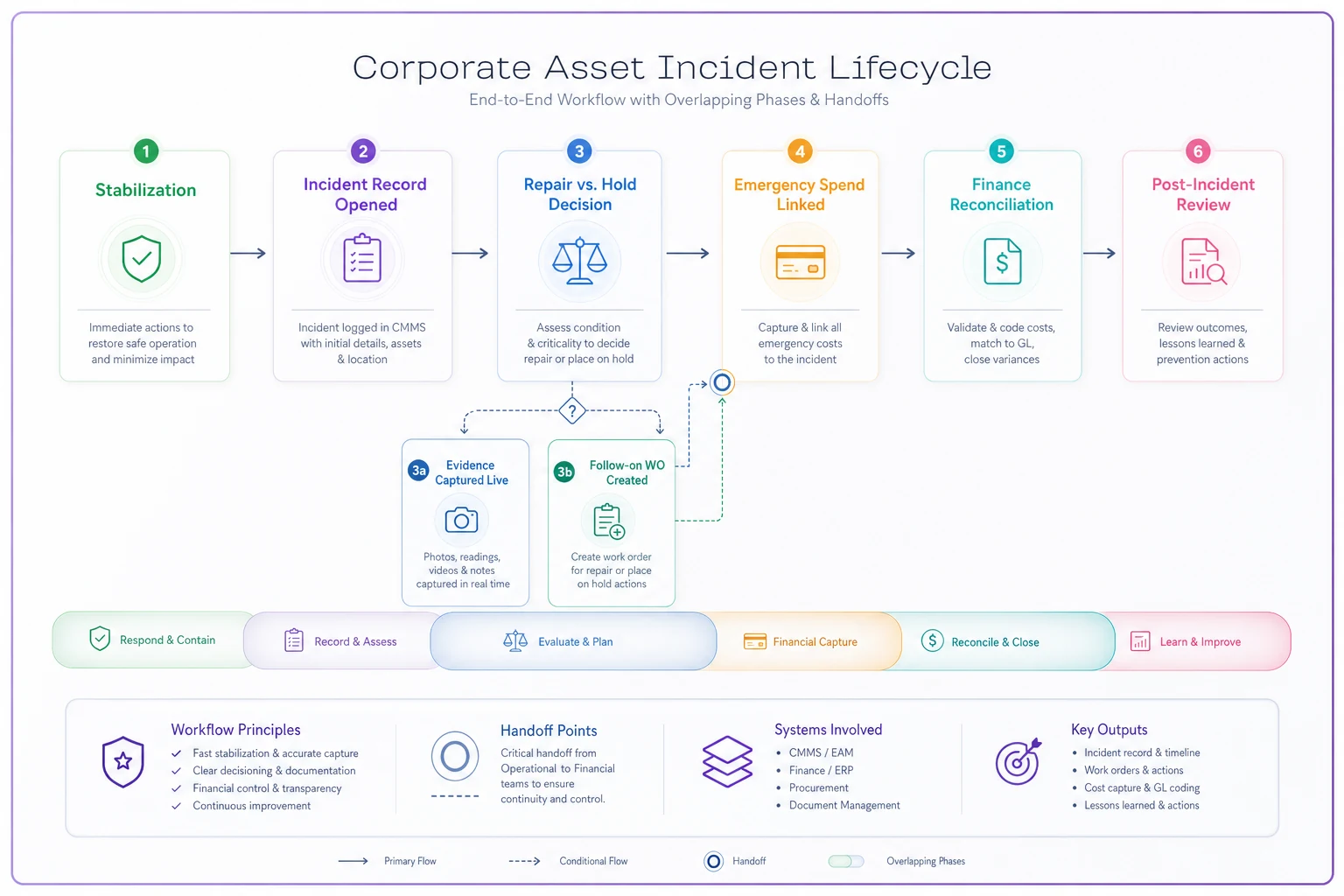
Over the following months, incident spend stopped scattering. Reconciliation that used to take finance days of detective work per incident dropped to something they could close in an afternoon. Two temporary repairs that would previously have quietly become permanent got properly closed out before they failed again. Nothing dramatic — just a system that stopped losing track of itself.
The point isn't the emergency — it's the handoff
Critical assets will fail. Crews will respond. Most operations already handle the physical side reasonably well. What quietly costs organizations real money and exposes them in audits isn't the failure itself — it's everything that leaks out of the record between the moment the asset trips and the moment finance closes the books.
An incident-response framework that actually works treats stabilization, work-order creation, the temporary-vs-hold decision, evidence, and reconciliation as one continuous chain, with a named owner at each handoff. The physical response is the easy part. Making sure the emergency flows cleanly back into your EAM lifecycle is the discipline that separates operations that learn from their failures from the ones that keep paying for the same one twice.
Critical assets will fail. Crews will respond. Most operations already handle the physical side reasonably well. What quietly costs organizations real money and exposes them in audits isn't the failure itself — it's everything that leaks out of the record between the moment the asset trips and the moment finance closes the books.
An incident-response framework that actually works treats stabilization, work-order creation, the temporary-vs-hold decision, evidence, and reconciliation as one continuous chain, with a named owner at each handoff. The physical response is the easy part. Making sure the emergency flows cleanly back into your EAM lifecycle is the discipline that separates operations that learn from their failures from the ones that keep paying for the same one twice.
Ready to elevate your asset operations?
Join 1,500+ businesses using Ownitly to optimize asset utilization, reduce downtime, and ensure compliance.