
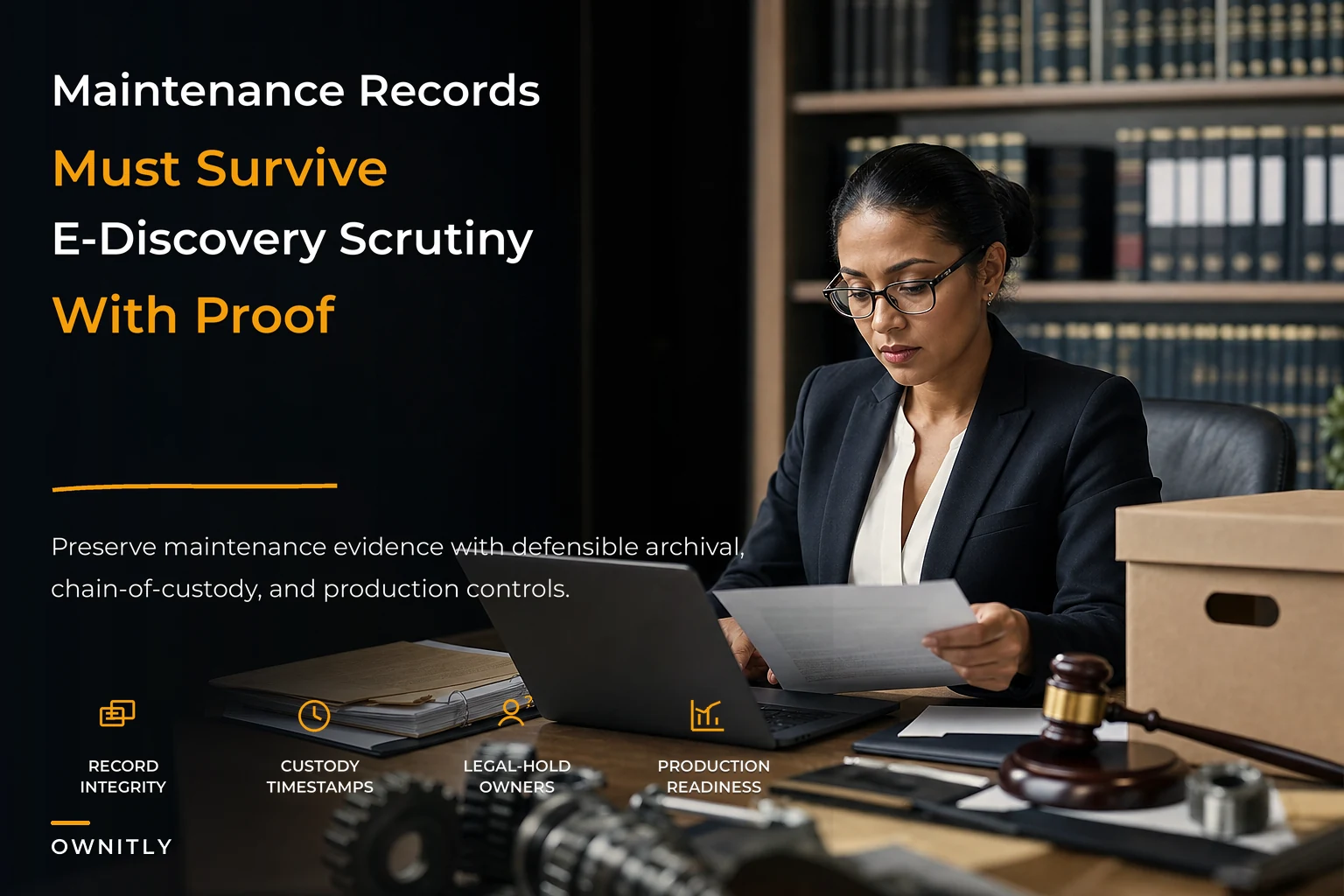

Most maintenance teams don't think about legal defensibility until they're sitting across from opposing counsel, watching a lawyer pick apart a work order that was perfectly fine operationally but completely useless as evidence. By that point, there's nothing to fix. The record either survives scrutiny or it doesn't.
The uncomfortable truth: your maintenance system was built to keep assets running, not to defend decisions three years after the fact in front of a judge who has never seen a pump. Those are two different jobs. Operationally, a technician closing a work order with "replaced seal, tested OK" is fine. In litigation, that same note can sink you — because there's no way to prove who wrote it, when, whether it was edited afterward, or whether the record you're producing is the same one that existed at the time of failure.
This article is about the gap between "records we keep" and "records that survive discovery." It's a systems problem, not a filing problem. And it breaks in predictable places as organizations scale across sites, jurisdictions, and contractors.
Why maintenance records fail as evidence
The failure almost never comes from a missing record. It comes from a record that exists but can't be trusted.
-
Is this the complete record, or a filtered subset? If your CMMS lets anyone delete or overwrite fields, opposing counsel will argue you produced a curated version.
-
Can you prove the record wasn't altered after the incident? Without immutable audit trails, "we didn't change it" is just a claim.
-
Do the timestamps mean anything? A work order "completed" date that reflects when someone got around to closing it in the system — not when the work actually happened — is a landmine.
In real operations, this usually happens because the maintenance workflow was optimized for speed. Techs batch-close work orders on Friday. Supervisors edit descriptions for clarity weeks later. Someone corrects an asset tag and the change silently overwrites the old value. Each of these is harmless day-to-day. Each of them destroys admissibility.
One pattern worth noticing: organizations with the cleanest-looking records are sometimes the most exposed. Tidy, uniform, freshly-edited notes look great in an audit and terrible in a deposition, because uniformity implies after-the-fact cleanup. Evidence that holds up usually looks a little messy — timestamps that don't align perfectly, original phrasing left intact, edits logged rather than absorbed.
The three layers of a defensible record
Legal defensibility for maintenance data isn't one control. It's three layers stacked on top of each other, and skipping any one of them undermines the others.
Stop losing track of critical assets.
Ownitly helps you monitor, maintain, and manage every asset efficiently and reliably.
- Centralized asset tracking
- Automated maintenance alerts
- Compliance monitoring & reporting
No credit card required
Layer 1 — Content integrity. The actual data: what was done, to which asset, by whom, when, with what parts and readings. This is what most teams focus on, and it's necessary but nowhere near sufficient.
Layer 2 — Chain of custody. The provenance metadata that proves the content is authentic and unaltered. Who created the record, every access and modification since, and cryptographic or system-enforced proof that the version you're producing matches the version that existed at the relevant time.
Layer 3 — Retention and production governance. The policies that determine how long records live, where they're archived, how legal holds override normal deletion, and how you can find and produce a defensible set on demand.
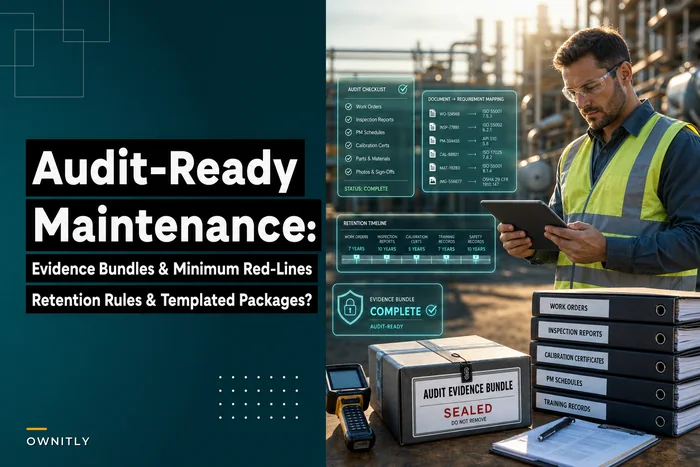
Most maintenance operations have Layer 1, a weak Layer 2, and no meaningful Layer 3. That's the gap. We've written before about building audit-ready maintenance evidence bundles — those bundles are essentially Layers 1 and 2 packaged for a specific event. E-discovery defensibility is the system-level version: it has to work across every record, not just the ones you assembled for a known incident.
Here's a simple view of how the layers stack and interact.
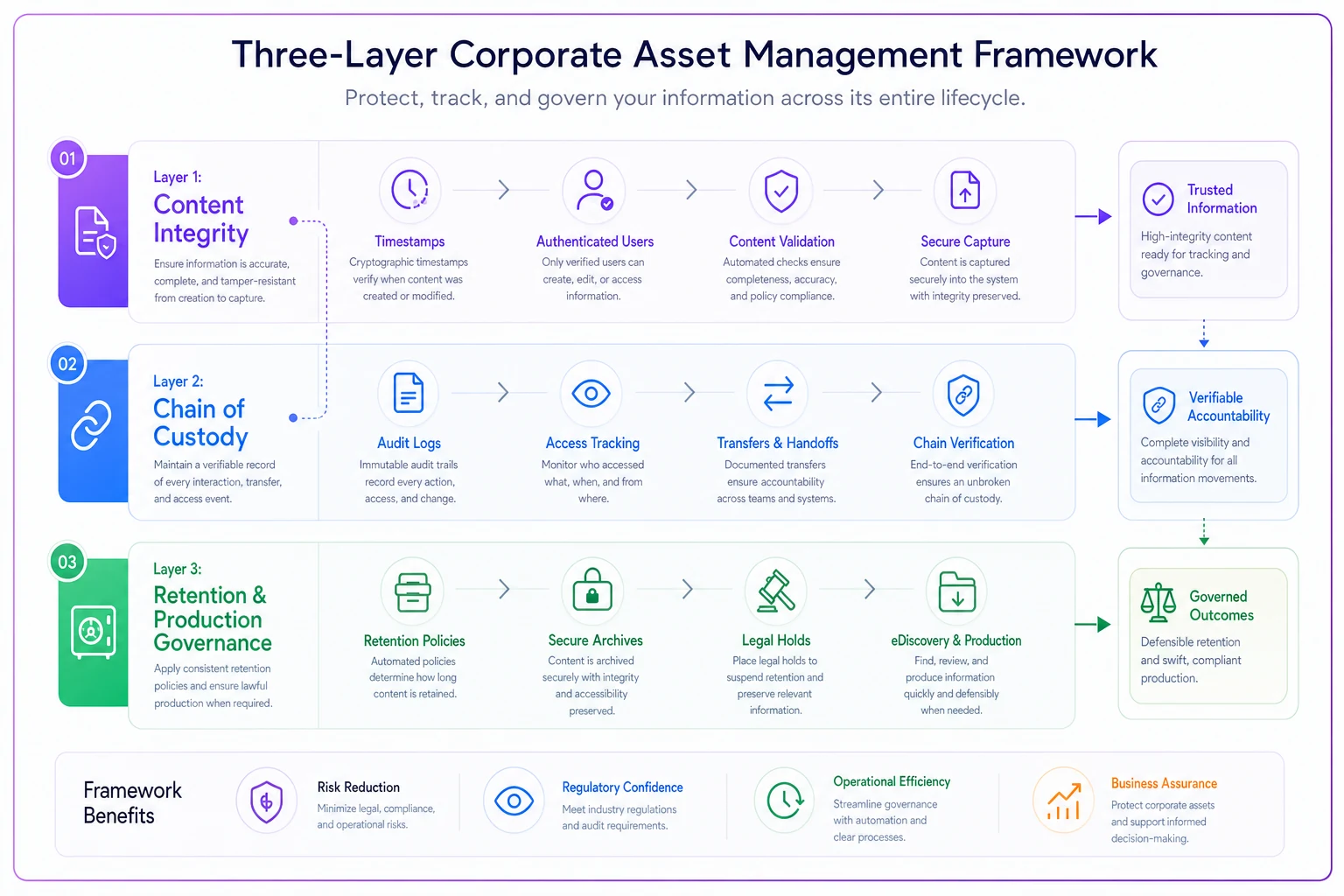
The diagram emphasizes that all three layers must be in place for records to be defensible.
Chain-of-custody metadata: what actually needs to be captured
Teams either over-engineer or under-engineer this, and both are expensive.
Under-engineering looks like relying on the CMMS's default "last modified by" field. That tells you the last person who touched it and nothing about the dozen people before them. Over-engineering looks like trying to notarize every field change, which nobody sustains past the first quarter.
The workable middle is a defined metadata standard applied consistently. For each maintenance record that could plausibly become evidence, you want:
| Metadata element | Why it matters in discovery | Common failure |
|---|---|---|
| Immutable creation timestamp | Establishes when the record entered the system | System uses "close date," not creation date |
| Author identity (authenticated) | Ties the record to an accountable person | Shared logins on shop-floor terminals |
| Full modification log | Proves nothing was quietly changed | Edits overwrite instead of appending |
| Event timestamp vs. entry timestamp | Distinguishes when work happened from when it was logged | Only one date field exists |
| Source device / location | Corroborates field presence | Mobile entries stripped of geo/device data |
| Attachment hashes | Proves photos/readings weren't swapped | Images stored without integrity checks |
| Legal hold status | Prevents inadvertent deletion under hold | No hold flag exists at all |
The distinction between event time and entry time is the one people underestimate most. A vibration reading taken at 06:14 and logged at 14:40 that same day is completely defensible — if both timestamps are preserved. Collapse them into a single field and you've created an inconsistency that a competent attorney will exploit for hours.
Preserve both event and entry timestamps separately; collapsing them invites legal challenges.
Our work on OT/IT security and evidence controls for regulated industries goes deeper on the authentication and access-control side of this — because chain of custody is only as strong as the identity system underneath it. Shared logins quietly undo everything else.
What breaks at scale
A single site with fifty assets and one supervisor can fake defensibility through sheer familiarity. Someone remembers what happened. That collapses the moment you add sites, contractors, and jurisdictions.
Multi-site fragmentation. Each site adopts slightly different naming conventions, close-out habits, and archival practices. When a corporate-level lawsuit pulls records from eight facilities, you get eight incompatible evidence styles, and the weakest one sets the tone for the whole production.
Contractor records living outside your system. Third-party crews do a significant share of critical work, and their documentation often sits in their systems — or on paper, or in a text thread. If a contractor did the work that failed, their records are discoverable too, and you may have zero control over their integrity. This is where many defensibility strategies quietly fall apart: the record that matters most isn't yours.
Retention drift. Different jurisdictions and regulations impose different retention minimums, and they conflict. Keep everything forever and you increase both storage costs and discovery exposure — every extra record is something opposing counsel can request. Delete on a rigid schedule and you risk destroying something under a legal hold you didn't know existed. At scale, nobody can hold all these rules in their head, so retention drifts into either hoarding or accidental spoliation.
Migration amnesia. Every CMMS migration is a chance to lose provenance. Records get imported with a new "created date" of the migration day, wiping the original timeline. If you migrated in 2024 and get sued over a 2022 failure, your entire history now appears to have been created after the fact.
The through-line: defensibility isn't a property of individual records. It's a property of the system that produces, stores, and governs them. Fix one record and you've fixed nothing.
Cross-jurisdiction retention and admissibility
Retention and admissibility are related but not the same, and confusing them causes real damage.
Retention is how long you must (or may) keep a record. It's driven by regulation, contract, statute of limitations, and internal policy. Different jurisdictions set different floors — and the relevant one isn't always where the asset sits. It can be where the company is incorporated, where harm occurred, or where a contract was signed.
Admissibility is whether a court will accept the record as evidence at all. This is governed by rules of evidence, and it turns heavily on authenticity and the business-records exception — the idea that records made in the regular course of business, at or near the time of the event, by someone with knowledge, are trustworthy.
That last phrase is the whole game. "At or near the time of the event, by someone with knowledge." This is exactly why event-time vs. entry-time metadata matters, and why batch-closing work orders a week later weakens admissibility even when the content is accurate.
A practical way to think about cross-jurisdiction exposure:
-
Map your jurisdictions. List every regulatory regime, contract, and statute that could govern retention for each asset class. This is tedious and nobody wants to do it, which is exactly why it's usually skipped.
-
Take the maximum retention floor. When rules conflict, the longest applicable retention usually wins for that record type. Build the policy around the ceiling of the floors.
-
Define what "the record" includes. A work order is rarely just the work order. It's the linked photos, readings, permits, parts issuances, and approvals. Retention and holds must travel with the bundle, not the header row.
-
Encode the business-records posture. Make sure your standard workflow naturally produces records "at or near the time of the event" — because you can't retrofit contemporaneousness after a lawsuit starts.
-
Test with a mock production. Pick a random asset and try to produce a complete, defensible, timeline-accurate record set for a hypothetical incident. Whatever breaks in the drill is what will break in litigation.
Step five is the one that separates organizations who think they're defensible from those who actually are.
Building the e-discovery playbook before you need it
The worst time to figure out your e-discovery process is after you've received a litigation hold notice, when the clock is already running and every action is under scrutiny. The playbook has to exist before any of that happens.
-
Trigger and hold. Who has authority to issue a legal hold, how it propagates to the CMMS and archives, and how it overrides normal retention and deletion. If an automated purge can run during an active hold, you have a spoliation problem waiting to happen.
-
Scope identification. How you determine which assets, date ranges, sites, and contractors are in scope — and how you defensibly document that scoping decision.
-
Preservation. How in-scope records are frozen without altering them. Copying records to a "review folder" and editing there is a classic mistake; the act of copying can strip metadata.
-
Collection and export. How you produce records with their full chain-of-custody metadata intact, in a format that preserves timestamps, authors, and modification logs.
-
Contractor coordination. How you obtain and preserve third-party records, ideally through contract terms established before any dispute.
-
Custodian roles. Who the accountable data custodians are, and who signs the affidavit attesting that the production is complete and authentic.
This is where AI-assisted operational platforms can genuinely help — not as magic, but as consistency enforcement. The reason defensibility breaks is human variability: someone forgets to preserve event-time, someone shares a login, someone edits instead of appends, someone's purge job doesn't check hold status. A well-configured maintenance platform can enforce immutable audit logging by default, apply retention and hold rules automatically across sites, and flag records with missing custody metadata before they become a liability. Automated legal-hold propagation alone eliminates one of the most common and most severe spoliation risks. The point isn't to replace legal judgment — it's to make the boring, error-prone consistency work happen automatically so records are defensible without depending on anyone remembering to make them defensible.
When heavy defensibility controls actually make sense
Not every asset needs courtroom-grade records, and treating them all equally wastes money and buries the records that actually matter.
This makes sense when:
-
Assets carry safety, environmental, or public-health consequences on failure
-
You operate in litigious or heavily regulated sectors
-
Contractor work drives a significant share of critical maintenance
-
You've already been through discovery once and know how ugly it gets
This is overkill when:
-
The asset is low-consequence and easily replaced
-
Failure creates no meaningful liability exposure
-
The cost of custody controls exceeds any plausible legal risk
Who should not do this: organizations that haven't first tiered their assets by consequence. Applying maximum controls to everything is a sign you haven't done the risk analysis — and it makes the important records harder to find, not easier. Defensibility is a tiering exercise before it's a technology exercise.
A real scenario
A regional water utility operating across roughly a dozen treatment and pumping sites got hit with a claim after a pressure-related failure that a nearby property owner blamed for structural damage. The relevant maintenance history spanned about two and a half years across three facilities, plus two outside contractors.
The problem surfaced fast. Their CMMS only stored a single "completed" date, so they couldn't distinguish when inspections actually happened from when they were logged — sometimes a gap of a week or more. Several key records had been edited months after the fact to clean up phrasing, with no log of the original text. One contractor's records existed only as PDFs emailed after the job, with no verifiable timestamps. And a migration eighteen months earlier had reset creation dates across the entire dataset.
None of the underlying maintenance was actually negligent. The work had been done. But the records couldn't prove it cleanly, and the legal team spent close to five months and somewhere in the range of $60k–$80k in outside counsel and forensic time just reconstructing and authenticating a timeline that should have been producible in an afternoon.
The rebuild afterward was straightforward once they knew where it hurt: separate event-time and entry-time fields, append-only edit logging, authenticated individual logins replacing shared terminal accounts, automated retention aligned to the longest applicable floor, and contract language requiring contractors to submit records into the utility's own system with intact metadata. When a smaller claim came up about a year later, the complete, authenticated record set was produced in under a day. The difference wasn't better maintenance. It was a system that made the maintenance provable.
The bottom line for asset leaders
The mistake almost everyone makes is treating this as a records-retention question — a storage-and-filing problem to hand off to IT. It isn't. Legal defensibility is a property of how your maintenance workflow captures, timestamps, authenticates, and governs data at the moment work happens. You cannot bolt it on after a lawsuit lands, because contemporaneousness and unbroken custody are exactly the things you can't recreate retroactively.
Start where the exposure is highest: your consequential assets and your contractor-performed work. Fix event-time vs. entry-time capture. Kill shared logins. Make edits append rather than overwrite. Get retention and legal-hold rules encoded into the system rather than living in someone's head. Then run a mock production and see what breaks. Whatever fails in the drill is precisely what would have failed in court — except now you get to fix it on your own schedule, before anyone's counsel is asking the questions.
Ready to elevate your asset operations?
Join 1,500+ businesses using Ownitly to optimize asset utilization, reduce downtime, and ensure compliance.