

Most asset-heavy organizations can produce evidence for last month. Ask them to reconstruct the exact state of a safety-critical work order from four years ago — the inspection photos, the calibration certificate that was valid at the time, the approver's signature, the version of the procedure that applied, and proof that none of it was altered after the fact — and the whole thing falls apart.
Not because the data was deleted. Because it was scattered across a since-retired CMMS, a file share nobody owns anymore, an email thread, and a mobile app whose vendor got acquired. The records technically exist. They just can't be assembled into a trustworthy, defensible bundle without a three-week archaeology project.
This article is about the architecture that prevents that. Not evidence capture — we've covered that elsewhere. This is about what happens to evidence after the work order closes: where it goes, how it stays provable, and how you pull a replayable audit bundle on demand years later. If you're responsible for an EAM evidence archival architecture, this is the layer most teams never design on purpose, and it's the layer that fails hardest at scale.
The quiet failure that only shows up under pressure
Archival failures don't announce themselves. Dashboards stay green. SLAs look fine. The problem is invisible right up until the moment someone — a regulator, a litigator, an insurer after a major incident — asks you to reproduce a historical state, and you discover the evidence rotted silently.
The pattern repeats across industries. A utility retires an old maintenance system, migrates the "important" records, and assumes the rest lives in a backup. Three years later an incident review needs the raw inspection data from a specific pump — and the backup is a database dump that nobody can restore because the schema is gone and the license expired. The data is there. It's just unreadable.
What makes this especially dangerous is that the people who built the original system are usually gone by then. The knowledge of how records connected leaves with them. So even when you find the files, you can't prove the relationships — which photo belonged to which inspection, which signature authorized which step. An auditor doesn't just want documents. They want the story, reconstructed with proof it wasn't edited to look good afterward.
Why this breaks in almost every organization
The root cause is that EAM systems are designed for operations, not memory. They're optimized for the active work: scheduling, dispatch, closing work orders fast. Long-term retention gets treated as a storage problem — "just keep the backups" — when it's actually an architecture problem.
Stop losing track of critical assets.
Ownitly helps you monitor, maintain, and manage every asset efficiently and reliably.
- Centralized asset tracking
- Automated maintenance alerts
- Compliance monitoring & reporting
No credit card required
A few structural reasons it falls apart:
Hot systems and cold needs are fundamentally different. Your live EAM needs sub-second query response for technicians in the field. Your archive needs to survive a decade and stay provable. Trying to serve both from the same place means you either pay premium storage costs forever, or you quietly delete things you'll later regret.
Evidence lives in pieces. The work order is in the EAM. The photos are in blob storage. The calibration cert is a PDF somewhere. The approval is a timestamp in an audit log. Nobody designed a single structure that binds all of it together with proof of integrity.
Migrations amputate history. Every CMMS migration is a chance to lose the past. Teams migrate open work orders and recent history, then declare victory. The old system goes dark, and with it the ability to reconstruct anything older. We dig into the cleanup side of this in the three-phase master data cleanup approach, but migration also quietly severs the chain that makes old evidence replayable.
"Immutable" usually means "we haven't changed it yet." Most teams confuse not editing records with being unable to edit them. Those are wildly different from a defensibility standpoint. If an admin could have altered a record, a good lawyer will argue they might have.
The core idea: separate the hot system from the system of record for the past
The architecture that actually works treats your live EAM as a source of evidence, not the keeper of it. Evidence flows out of the operational system into a tiered archive built for a completely different job — long retention, cryptographic integrity, and on-demand reconstruction.
Three layers, each with its own purpose:
| Layer | Purpose | Access pattern | Typical retention | Integrity mechanism |
|---|---|---|---|---|
| Hot operational | Active work, dispatch, live queries | Milliseconds, constant | 12–24 months active | Standard app controls, audit logs |
| Warm index | Fast lookup of historical evidence | Seconds, occasional | 2–7 years | Immutable index entries, append-only |
| Cold archive | Durable storage of raw evidence objects | Minutes to hours, rare | 7–25 years | Write-once storage, content hashing, signatures |
The thing that makes this usable is keeping the index separate from the archive. The cold archive holds the heavy, rarely-touched objects — photos, scans, raw sensor exports, closed work-order snapshots. The warm index holds lightweight, immutable pointers: a hash of each object, where it lives, what it belongs to, when it was sealed, and who sealed it.
When someone asks for a historical bundle, you query the fast index to find what you need and prove it's intact, then pull the heavy objects from cold storage only for that specific bundle. You're not scanning terabytes. You're resolving a handful of hashes.
Making records provably unchanged: hashing and signatures
This is the part teams get wrong most often, so it's worth being concrete.
When a work order closes and its evidence is sealed into the archive, you compute a cryptographic hash of each evidence object — the photo, the PDF cert, the work-order snapshot. A hash is a fixed-length fingerprint; change a single pixel and the fingerprint changes completely. You store that hash in the immutable index.
Include the manifest schema version in every seal so you can interpret manifests reliably years later.
Then you go one step further. You bundle the hashes of everything belonging to a single event — say, one completed inspection — and hash that. Now you have a single fingerprint representing the entire evidence set for that event. Chain these event-hashes together over time, with each new seal referencing the previous one, and you get an append-only structure where altering any historical record breaks the chain visibly.
-
Freeze the record when the work order reaches a terminal state. No more edits allowed in the operational system.
-
Compute object hashes for every piece of evidence attached to it.
-
Assemble the manifest — a structured list of every object, its hash, its metadata, and its relationships (which photo belongs to which step, which cert covers which asset).
-
Hash the manifest to create a single event fingerprint.
-
Chain and sign — reference the prior seal, apply the signature and trusted timestamp.
-
Write to cold storage using write-once (WORM) settings so the objects physically can't be overwritten within the retention window.
-
Publish the index entry to the warm layer so it's instantly findable.
The payoff: years later, you can re-hash any retrieved object and compare it to the sealed hash. Match means provably unchanged. Mismatch means tampering — and you'll know exactly which object.
Retrieval SLAs: deciding how fast "on demand" actually is
"On demand" means different things depending on who's asking and why. A regulator with a 30-day response window is not the same as a litigation hold that needs everything in 72 hours, which is not the same as an internal reliability review that can wait a week.
You can't afford to make all evidence instantly retrievable — cold storage is cheap precisely because it's slow. So you define retrieval tiers and match them to real obligations:
-
Index lookups — always fast. Finding what exists and proving its integrity should take seconds, regardless of how old it is. This is why the immutable index lives in the warm layer.
-
Recent cold objects (last 2–3 years) — minutes. Common for incident reviews and routine audits.
-
Deep cold objects (older) — hours. Acceptable for most regulatory and legal windows if you've committed to it in writing.
The mistake is leaving retrieval speed undefined until an auditor is already waiting. Then you discover your deep archive takes 12 hours to rehydrate and you've got a panicked weekend ahead of you. Write the SLA before you need it, size your storage tiers to match, and test a cold retrieval quarterly so you know your actual numbers instead of your vendor's brochure numbers.
A realistic target set for a mid-sized operation: index resolution under 5 seconds, warm-cold objects within 15–30 minutes, deep archive within 4–8 hours. Nothing heroic — just defined, tested, and defensible.
The export workflow: assembling a replayable audit bundle
This is where everything comes together, and honestly the capability that separates organizations that survive audits from ones that dread them.
A replayable audit bundle isn't a folder of PDFs. It's a self-contained package that lets an outside party reconstruct and verify a historical state without trusting your systems at all. A good bundle contains:
-
The work-order snapshot as it existed at closure
-
Every linked evidence object (photos, certs, sensor exports)
-
The manifest with all hashes and relationships
-
The signature and trusted timestamp
-
The version of the procedure/SOP that applied at the time
-
A verification file or instructions so a third party can re-hash and confirm integrity themselves
That last point about the procedure that applied at the time is the one people miss. If your inspection standard changed in 2024, an auditor reviewing 2022 work doesn't want the current standard — they want proof you followed the 2022 one. Your archive has to version and retain the governing documents alongside the evidence, or the bundle becomes misleading even when every hash checks out.
The export workflow runs like this: an authorized user specifies the scope (an asset, a date range, an incident), the system resolves the matching index entries, verifies every hash against the sealed values, pulls the objects from cold storage, assembles them with the manifest and governing documents, and produces a sealed, portable bundle with its own integrity proof. The whole thing gets logged, so you have a record of who exported what, when — because the act of producing evidence is itself an auditable event.
A simple diagram of the export workflow helps auditors and engineers align on the steps.
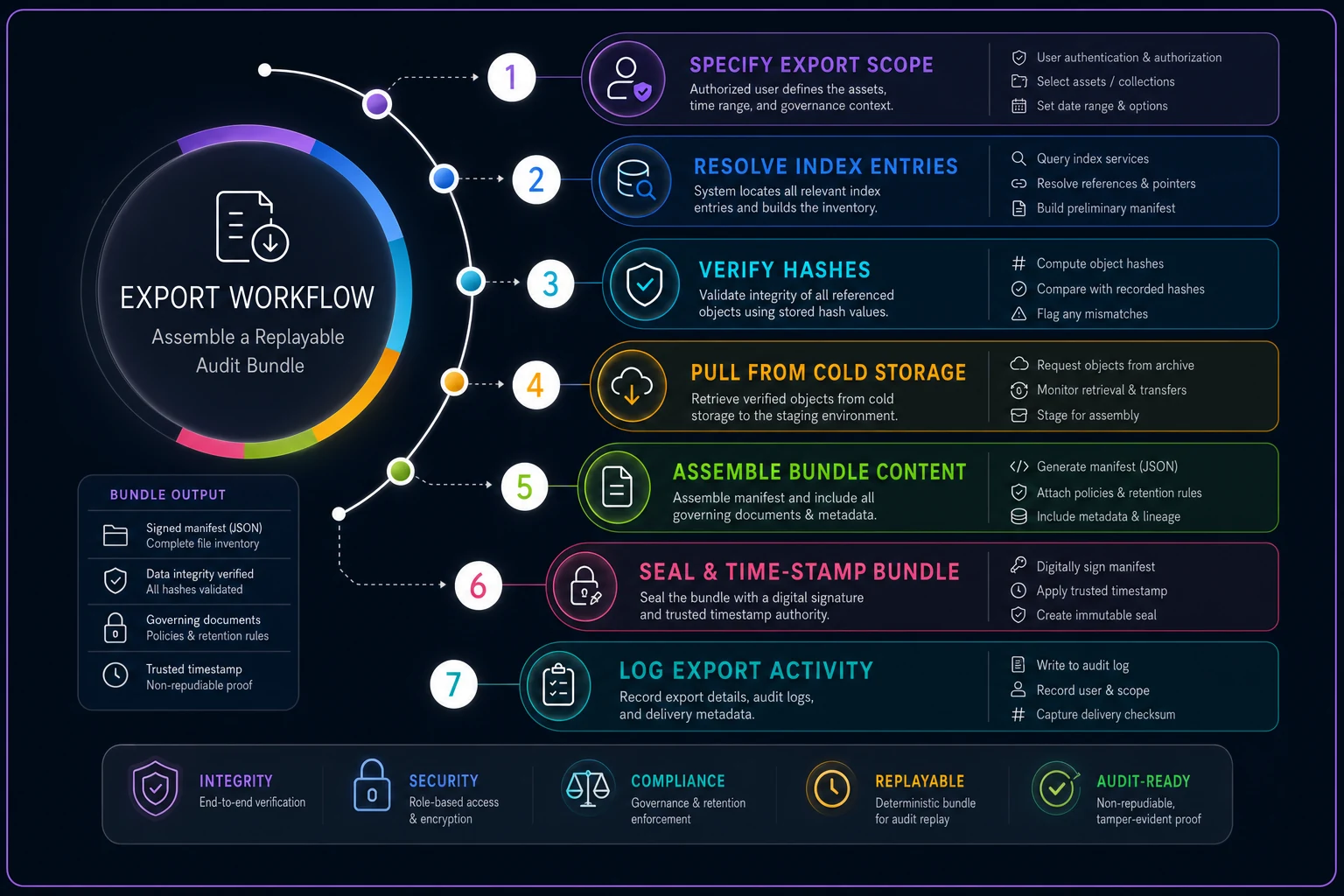
The assembled bundle should be portable and independently verifiable by the recipient.
A realistic scenario
A regional water utility running roughly 14,000 assets across a dozen sites got hit with a regulatory inquiry tied to a treatment-equipment failure. The regulator wanted the full maintenance and inspection history for a specific set of pumps going back about five years — including proof the records hadn't been altered after the incident.
Before they'd rebuilt their archival layer, this would have been a disaster. Their previous CMMS had been retired two years earlier. Old evidence lived in a mix of a frozen database backup and a shared drive with inconsistent folder naming. The first internal estimate to assemble a defensible package was "three to four weeks, and we're not confident in the integrity story."
After moving to a tiered archive with immutable indexing and sealed bundles, the same request looked completely different. The team scoped the export to the affected assets and the five-year window, the system resolved a few hundred index entries in seconds, verified every hash, and pulled the deep-cold objects within the afternoon. The assembled bundle — including the inspection SOPs as they existed at each point in time — was ready in under two days, with a verification file the regulator's own technical staff could run independently.
The cost difference wasn't just labor hours. It was credibility. A package produced in two days with independent integrity proof signals a controlled organization. A package cobbled together over a month signals one that's improvising — and improvising invites deeper scrutiny.
When this architecture makes sense
Worth building when:
-
You operate in a regulated industry with multi-year retention obligations
-
Your assets carry real safety or environmental consequences
-
You've already migrated CMMS platforms once (or will soon)
-
Litigation or insurance disputes are a realistic risk
-
Audits currently trigger multi-week scrambles
Probably overkill when:
-
Your retention needs are short and your risk profile is low
-
You're a single-site operation with a stable platform and simple records
-
You'd be building sophisticated integrity controls for evidence nobody will ever challenge
Who should not start here: teams whose capture is still broken. If field evidence is inconsistent, metadata is missing, and chain-of-custody isn't solid at the source, a well-designed archive just preserves garbage very reliably. Fix the input quality first. Sealing bad evidence doesn't make it good — it just makes it permanently, provably bad.
A readiness checklist before you commit
Run through this honestly before designing the archival layer:
-
Can you identify every place evidence currently lives (EAM, blob storage, email, mobile apps)?
-
Do your records have stable, unique identifiers that survive a migration?
-
Is there a clear "terminal state" that triggers freezing a record?
-
Do you version and retain governing SOPs, not just the evidence?
-
Have you defined retrieval SLAs tied to actual regulatory and legal windows?
-
Do you control the signing keys, and is key management actually managed?
-
Have you tested a full cold-storage retrieval end to end?
-
Can a third party verify your bundles without trusting your systems?
If you can't check most of these, that's your roadmap — in order.
How this connects to the rest of your operation
Archival isn't an island. It sits downstream of everything else and depends on the quality of what flows into it. The integrity of your sealed bundles is only as good as the data lineage feeding them, which is why a solid EAM data platform operating model matters before any of this — if you can't trust the lineage, you can't trust the seal.
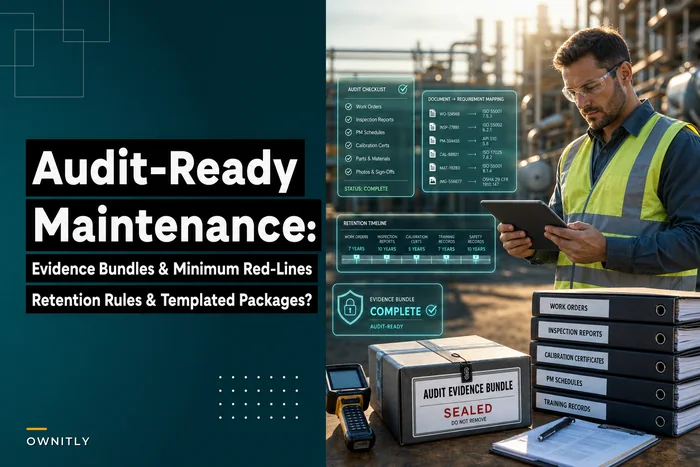
Your archive is also the long-term destination for the evidence bundles assembled at the point of work. The standards you set for audit-ready maintenance evidence bundles — minimum red-lines, retention rules, templated packages — define what actually gets sealed. Design those two layers together, or you'll end up archiving evidence that doesn't contain what auditors eventually ask for.
Modern EAM platforms with proper automation help here in a quiet, unglamorous way: they can trigger the seal automatically when a record hits its terminal state, compute and store hashes without relying on someone remembering to, and keep the immutable index current so retrieval stays fast. The value isn't the automation itself — it's that the discipline becomes structural rather than depending on a diligent person who might leave next year.
The organizations that handle audits calmly aren't the ones with the most documents. They're the ones who decided, deliberately and in advance, how the past would be kept — provable, findable, and reconstructable on demand. That decision is architecture. Make it before the inquiry arrives, not during it.
Ready to elevate your asset operations?
Join 1,500+ businesses using Ownitly to optimize asset utilization, reduce downtime, and ensure compliance.