


There's a specific kind of meeting that happens in asset-heavy organizations. Someone presents a MTBF chart, and within ninety seconds two people are disagreeing about whether the number is even real. The maintenance manager says the failures were miscoded. Finance says the asset hierarchy doesn't match the GL. Reliability engineering says the sensor data was pulling from a decommissioned tag. Nobody is lying. The number just can't survive contact with the people who understand where it came from.
That's not a KPI problem. It's an operating model problem. And it's almost always caused by the same thing: nobody drew clear lines around who owns which layer of the data, who is allowed to change what, and what has to be true before a number gets promoted into an executive dashboard.
Most organizations treat their EAM data as a byproduct of doing maintenance. The real fix is treating it as a product with owners, contracts, and release gates — which is what an EAM data platform operating model actually is. This piece walks through how to split responsibilities, where to put validation and lineage gates, how often master-data operations should run, and the concrete playbooks (healthchecks, incident triage, SQL/ETL rules, data-contract templates) that make the whole thing auditable.
The four roles nobody explicitly assigns — and why that's the root cause
When data trust breaks down, it's rarely because a specific person did something wrong. It's because four distinct jobs got smashed into two or three people who each assume someone else is handling the part they dropped.
Here's the split that actually works, and what each function is genuinely accountable for:
| Function | Owns | Does NOT own | Primary failure when missing |
|---|---|---|---|
| Historians / OT data | Raw sensor time-series, tag naming, sampling rates, deadbands | Business meaning of the tags, asset mapping | Silent gaps, unit drift, tags pointing at dead equipment |
| ETL / Data engineering | Movement, transformation, deduplication, lineage capture | Defining what a "failure" is, KPI thresholds | Broken joins, timezone bugs, silent row drops |
| CMMS / EAM operations | Work order coding, asset hierarchy, failure taxonomy, master data | Pipeline uptime, warehouse schema | Miscoded failures, duplicate assets, orphaned records |
| Reporting / Analytics | KPI definitions, dashboards, semantic layer, executive narrative | Fixing upstream data, changing source systems | KPIs that "look right" but hide upstream rot |
The pattern repeats constantly: the historian team thinks their job ends when the data lands. The CMMS team thinks their job is closing work orders, not maintaining the taxonomy those work orders roll up into. And the reporting team ends up quietly patching both — writing CASE statements to fix miscoded failure classes, hardcoding asset mappings — which means the "fixes" live in a dashboard nobody audits.
The single most useful boundary rule: reporting is never allowed to fix data. The moment analysts start correcting source problems in the semantic layer, your lineage is dead and your KPIs become un-auditable. Reporting can flag bad data. It cannot heal it. That rule alone forces problems back to the function that actually owns them.
If you've already worked through duplicate-record cleanup, you'll recognize how much of this depends on clean master data underneath — the same governance principles from an EAM data governance framework with roles and audit gates apply directly to who's allowed to touch the asset hierarchy here.
What breaks specifically as you scale from one site to a fleet
At a single site, informal coordination works. One reliability engineer knows every tag, every quirk, every "oh yeah that pump has been reading high since 2019." The operating model is that person's head. It's fragile but functional.
Stop losing track of critical assets.
Ownitly helps you monitor, maintain, and manage every asset efficiently and reliably.
- Centralized asset tracking
- Automated maintenance alerts
- Compliance monitoring & reporting
No credit card required
Then you go to five sites, or you acquire a company, or you consolidate three regional CMMS instances into one. Now the informal knowledge doesn't scale, and three things break in a predictable order.
First, taxonomy divergence. Site A codes bearing failures as "mechanical." Site B codes them as "rotating equipment." Site C has a free-text field. Roll those up and your fleet-wide bearing failure rate is fiction. This is the most common scale failure and the hardest to unwind because it's baked into years of historical work orders.
Second, lineage collapse. With one pipeline you can trace a number by asking the one engineer who built it. With forty pipelines feeding a warehouse, "where did this number come from" becomes a multi-day investigation unless lineage is captured automatically at each transformation step.
Third, master-data drift outpacing cleanup. New assets get created faster than anyone reconciles them. Duplicates accumulate. The asset count on the dashboard slowly diverges from what's physically in the field. Fleets where the EAM showed 15–20% more active assets than actually existed — purely from decommissioned equipment never being retired in the system — are more common than most people want to admit.
Organizations that handle this well don't try to prevent all drift. They accept that drift is constant and build a cadence that removes it faster than it accumulates. That's the difference between a one-time cleanup and an operating model.
Validation and lineage gates: where to put the checkpoints
Think of your data flow as having promotion stages, like code moving from dev to production. Data shouldn't jump straight from a sensor or a technician's phone into an executive KPI. It should pass gates, and each gate has an owner and a pass/fail rule.
-
Ingestion gate (owned by ETL). Does the data physically arrive complete? Row counts within expected range, no timezone corruption, schema matches the contract. Fail = pipeline halts, alert fires. Never let bad data proceed "for now."
-
Conformance gate (owned by CMMS ops). Do the records reference valid master data? Every work order maps to a real, active asset. Failure codes are in the approved taxonomy. Orphaned records get quarantined, not silently included.
-
Business-rule gate (owned by ETL + reporting jointly). Do the numbers make physical sense? Negative runtimes, MTBF longer than the asset's age, downtime exceeding calendar time — these are auto-caught.
-
Publication gate (owned by reporting). Is the KPI definition unchanged, versioned, and documented? A metric can't ship unless its definition and lineage are traceable back to source.
The mistake most teams make is putting all validation at the end — one giant quality check before the dashboard refreshes. When that fails, you have no idea which of forty upstream steps caused it. Distributed gates mean a failure tells you where it happened and who owns fixing it.
A simple workflow of data promotion stages:
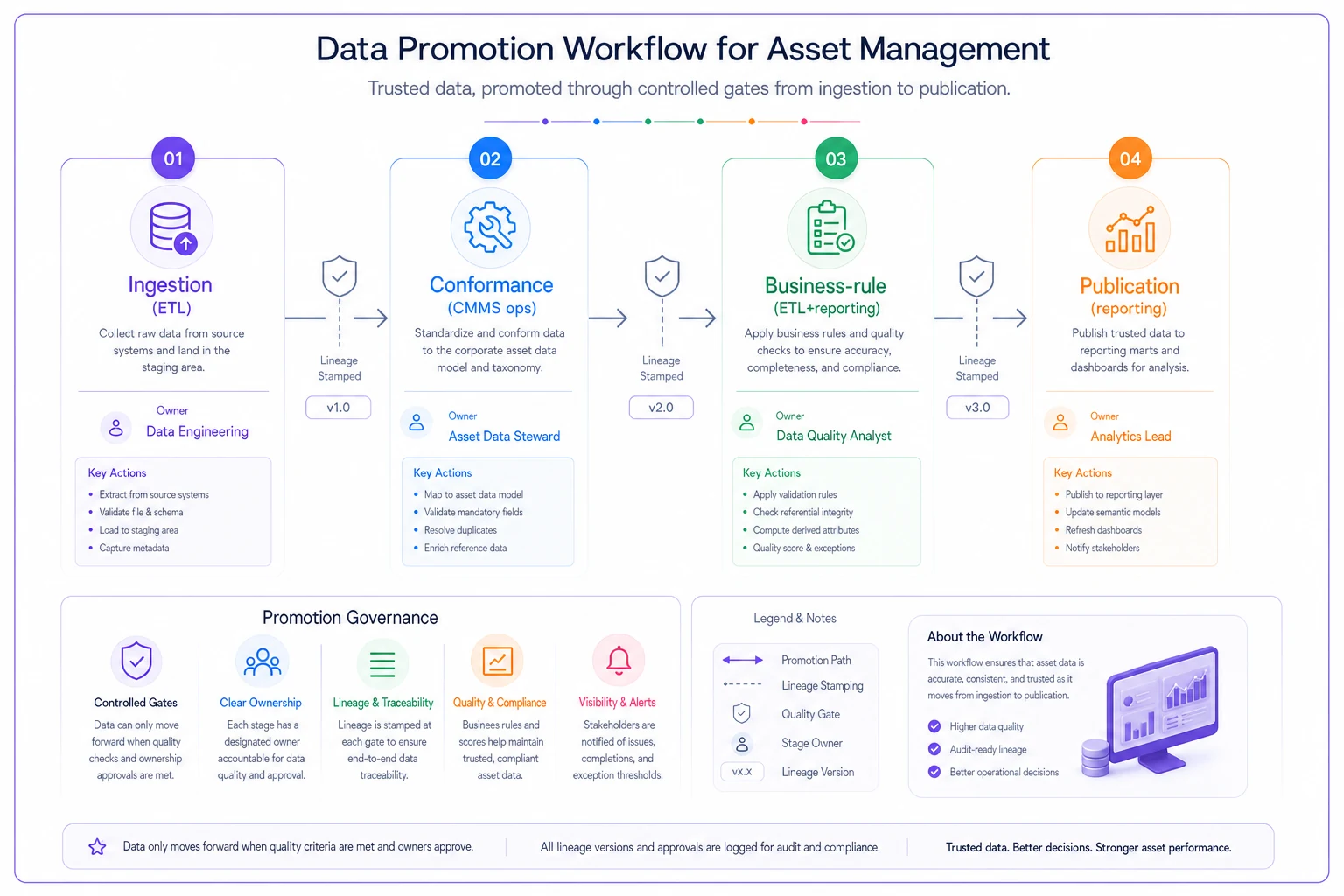
A concrete lineage practice worth stealing: stamp every derived row with the source system, extraction timestamp, and the version of the transformation logic that produced it. When someone challenges a number in a meeting, you can answer in minutes instead of launching a two-day investigation. The trust framework in building a trusted asset performance measurement system with data-lineage checks goes deeper on how lineage feeds executive reporting specifically.
Master-data operations cadence
Master data isn't a project. It's a heartbeat. The operating model needs defined rhythms, each with an owner and a specific scope.
-
Daily Automated new-record checks. Any asset or work order created in the last 24 hours that violates naming standards, lacks a parent in the hierarchy, or duplicates an existing record gets flagged into a review queue. Owner: CMMS ops.
-
Weekly Duplicate and orphan sweep. Fuzzy-match on asset descriptions, serial numbers, and location to catch near-duplicates. Reconcile work orders pointing at retired assets. Owner: CMMS ops with data engineering support.
-
Monthly Taxonomy conformance review. What percentage of work orders closed this month used approved failure codes vs. free text? Trend it. If free-text usage is climbing, you have a training or UI problem, not a data problem.
-
Quarterly Hierarchy and lineage audit. Walk a sample of KPIs back to source. Verify the asset hierarchy still matches physical reality via spot-checks against field data. Owner: reporting + reliability engineering.
The cadence prevents the "big migration" trap. Organizations that skip the heartbeat end up needing a massive cleanup every few years — expensive, disruptive, and it starts decaying again almost immediately. If you're already staring down a large cleanup, the phased approach in a three-phase master data cleanup plan with rollback controls is the right way in, but the whole point of a standing cadence is to never need that scale of rescue twice.
Concrete playbooks
Principles are cheap. Here's the operational substance.
Healthcheck playbook (run daily, automated)
-
Row counts per source vs. 30-day rolling average (flag if outside ±20%)
-
Number of work orders created against inactive/retired assets (should be zero)
-
Free-text failure code percentage for the trailing week
-
Sensor tags with zero variance for 24h+ (likely stuck/dead)
-
Records failing any validation gate, grouped by gate and owner
-
Time since last successful full lineage refresh
If the healthcheck is red, the affected KPIs get a visible "under review" flag rather than displaying a number nobody trusts.
Incident triage playbook
-
Reproduce. Can you regenerate the wrong number, or was it transient? Transient issues (a late-arriving batch) get a different response than systematic ones.
-
Locate the gate. Which validation gate should have caught this? If none exists, that's a finding — add the gate.
-
Assign by ownership. Ingestion problem → ETL. Miscoding → CMMS ops. Definition dispute → reporting. The role table above ends the "not my job" loop.
-
Contain. Flag the affected KPIs as under review. Don't let a suspect number keep informing decisions while you investigate.
-
Root cause and gate. Fix the immediate issue, then add or tighten the gate so this class of problem can't recur silently.
Sample validation rules (the shape, not a specific dialect)
-- Downtime cannot exceed elapsed calendar time SELECT assetid, workorderid, downtimehours, periodhours FROM wometrics WHERE downtimehours > periodhours; -- Work orders against retired assets SELECT wo.workorderid, wo.assetid FROM workorders wo JOIN assets a ON wo.assetid = a.assetid WHERE a.status = 'RETIRED' AND wo.createddate > a.retireddate; -- Failure code not in approved taxonomy SELECT workorderid, failurecode FROM workorders WHERE failurecode NOT IN (SELECT code FROM failuretaxonomy WHERE active = 1);
None of these are exotic. That's the point — the value is running them every day at a defined gate with a named owner, not their cleverness.
Data-contract template
-
Producer / Consumer who sends, who receives
-
Schema fields, types, allowed nulls
-
Freshness SLA e.g., landed by 06:00 daily
-
Volume expectations expected row range
-
Validation rules what constitutes a valid record
-
Breaking-change policy notice period before schema changes (this one prevents the most fires)
-
Owner + escalation contact
The breaking-change clause matters more than it looks. Most silent pipeline failures come from an upstream team changing a field with no notice. A contract makes that a violation, not a surprise.
A real scenario: three-site manufacturer, MTBF nobody believed
A mid-sized manufacturer with three plants had consolidated onto one CMMS about eighteen months earlier. The reliability KPIs were technically produced every month, but leadership had quietly stopped using them for capital decisions because every number got disputed.
The core problems were textbook: each plant had migrated its old failure codes as free text, so fleet failure analysis was essentially meaningless. The analytics team had built roughly a dozen CASE statements into their reporting layer to "normalize" codes — undocumented, and slowly diverging from what the plants actually meant. And around 12% of active assets in the system were equipment that had been physically removed but never retired, inflating the asset base and skewing every per-asset metric.
They didn't do a giant migration. They installed the operating model. Ownership got split explicitly across the four functions. Four validation gates went in. The CASE-statement patches got ripped out of reporting and pushed back to CMMS ops as a taxonomy remediation queue. A weekly duplicate/orphan sweep and daily healthcheck started running.
Over about two quarters: free-text failure coding dropped from the high-30s percent to under 10%. The phantom assets got retired, which actually made some KPIs look worse at first — availability numbers had been artificially propped up — but they were finally real. The meaningful outcome wasn't a single metric. It was that the monthly reliability review stopped being an argument about the data and became a discussion about what to do with it. Capital decisions started referencing the KPIs again because people trusted them.
When this level of rigor makes sense — and when it doesn't
When it makes sense:
-
Multiple sites or a recent consolidation/acquisition
-
KPIs feed capital allocation or regulatory reporting
-
Data disputes are actively slowing decisions
-
You're moving toward predictive or condition-based programs that depend on clean historian data
When it's overkill:
-
Single site, one engineer who genuinely knows every asset, low turnover
-
KPIs are directional and low-stakes
-
You don't yet have enough pipelines for lineage to be a real problem
Who should NOT start here: organizations whose master data is so broken that gates would fail everything on day one. If 40% of your assets are duplicates, don't build gates yet — do the cleanup first, then install the cadence so it never rots again. Gates on top of garbage just produce a very well-documented list of everything wrong.
Where software quietly earns its place
Most of this can run on scripts, a scheduler, and discipline. But discipline is exactly what degrades under pressure — the daily healthcheck gets skipped during an outage, the weekly sweep slips when someone's on leave, lineage stamping gets dropped to hit a deadline.
This is where an operational platform with built-in validation gates, automated lineage capture, and scheduled master-data healthchecks actually changes the economics. Not because it does anything a determined team couldn't script, but because it makes the cadence default instead of heroic. The gates run whether or not anyone remembers. The lineage is captured because the pipeline captures it, not because an engineer remembered to add a stamp. When the operating model is enforced by the system rather than by people's good intentions, it survives staff turnover and bad weeks — which is exactly when trust in your KPIs matters most.
The real point
Trustworthy analytics in asset management isn't a dashboard achievement. It's an organizational one. The KPIs are trustworthy when four functions know exactly what they own, when data passes gates before it gets promoted, when lineage answers "where did this come from" in minutes, and when master data has a heartbeat instead of a periodic emergency.
Get the operating model right and the arguments in the reliability review shift from is this number real to what do we do about it. That shift — from debating data to acting on it — is the entire return on this work.
Ready to elevate your asset operations?
Join 1,500+ businesses using Ownitly to optimize asset utilization, reduce downtime, and ensure compliance.