


Most multi-site rostering falls apart in the same quiet way. The schedule looks full. Every technician has a name against a shift. And yet, if you actually trace where those people were between 7am and 4pm, you'll find a chunk of the day evaporated into driving, waiting for site access, or arriving somewhere they weren't cleared to do the actual job.
Travel downtime is the tax nobody puts on the P&L, and it's usually the single largest hidden cost in a distributed maintenance operation. The frustrating part is that it's rarely a skills problem or a headcount problem. It's a matching problem — the wrong skill, at the wrong site, at the wrong time, because the roster was built on availability instead of geography and capability.
This piece is specifically about multi-site skill rostering maintenance — the mechanics of skill matrices, geo-aware rostering heuristics, temporary multi-site pooling, and the KPIs that tell you whether any of it is working. No broad reliability philosophy. Just the routing logic.
Where the day actually leaks
Pull a week of completed work orders across four or five sites and reconstruct the movement. What you find is usually uncomfortable.
A vibration analyst certified on your critical rotating equipment gets rostered to Site C on a Tuesday because that's where the shift had a gap. The high-priority pump job is at Site A, 40 minutes away. So either the job waits, or the analyst drives, does one task, and drives back. Two hours of paid time, maybe fifteen minutes of wrench time.
-
The roster is built off a shift calendar, not a skill-and-location grid
-
Site access clearances and permits aren't visible at the point of scheduling
-
Whoever builds the roster can't actually see who's certified for what, so they default to whoever's free
None of these are dramatic failures. They're small mismatches that compound. And because the roster looked full and everyone was "utilized," the leakage never shows up as an obvious line item — just backlog that never quite clears and overtime that keeps creeping.
Start with an honest skill matrix (not the one HR has)
Everyone claims to have a skill matrix. Most of them are a spreadsheet last updated eighteen months ago, listing certifications but not competence, and definitely not currency.
Stop losing track of critical assets.
Ownitly helps you monitor, maintain, and manage every asset efficiently and reliably.
- Centralized asset tracking
- Automated maintenance alerts
- Compliance monitoring & reporting
No credit card required
A rostering-grade skill matrix needs more than a tick in a box. For each technician, you want three things per skill:
-
1. Capability level — can they lead the task, assist only, or supervise?
-
2. Currency — when did they last actually perform it, and is the cert still valid?
-
3. Site clearances — which sites are they inducted and permit-eligible for right now?
That third column is the one people forget, and it's the one that quietly kills geo-aware rostering. It doesn't matter that a technician is your best hydraulics person if they aren't inducted at the site where the hydraulic job is. On paper they're perfect. In practice they can't walk through the gate.
Here's the shape of a usable matrix:
| Technician | Rotating equip. | Hydraulics | Instrumentation | Site A | Site B | Site C | Currency flag |
|---|---|---|---|---|---|---|---|
| J. Okafor | Lead | Assist | — | ✔ | ✔ | — | Current |
| M. Reyes | Assist | Lead | Assist | ✔ | — | ✔ | Rotating expired |
| T. Nowak | — | — | Lead | ✔ | ✔ | ✔ | Current |
| D. Silva | Lead | — | Assist | — | ✔ | ✔ | Current |
The moment you build this, two things jump out. First, your "coverage" for a critical skill is usually thinner than the org chart implied — often one or two people can actually lead the highest-risk tasks. Second, you find capability trapped behind missing site clearances, which is a cheap fix hiding a lot of value.
Geo-aware rostering heuristics that actually hold up
Once the matrix is honest, geography becomes the second axis. The goal is simple to state and annoying to execute: put the right skill at the site that minimizes total travel while still covering priority work.
You don't need a PhD optimization engine to get most of the benefit. A handful of heuristics, applied in order, get you surprisingly far.
Heuristic 1 — Anchor the scarce skills first. Roster your rarest capabilities before anything else, and anchor them to the site cluster with the most priority demand for that skill. Everyone else fills in around them. Rostering the plentiful skills first is the most common sequencing mistake — it forces your scarce people into whatever's left.
Heuristic 2 — Cluster by drive-time, not by map distance. Two sites 15km apart on the map can be 45 minutes apart in practice because of a single bridge or a shift-change traffic window. Build your site clusters off real drive times at the hours people actually travel. A "site pairing" that ignores the 4:30pm crawl looks great on paper and wrecks the afternoon.
Heuristic 3 — Assign home-base plus one. Give each technician a home site and at most one realistic secondary for the day. The instinct to keep people "flexible" across three or four sites is what generates the multi-hop days that eat hours. Constraining to home-plus-one is boring, and that's exactly why it works.
Heuristic 4 — Batch same-skill tasks into a single site visit. If someone is driving to Site B for one instrumentation job, pull forward every other instrumentation task at Site B that's due within the window. One trip, several completions. This is where routing logic overlaps neatly with good work-order triage rules — triage classification tells you what's genuinely due versus what can wait, so you're batching the right things and not dragging low-priority work forward just because it's geographically convenient.
Constrain technicians to a home-plus-one to reduce multi-hop days.
A simple visual of the heuristic workflow.
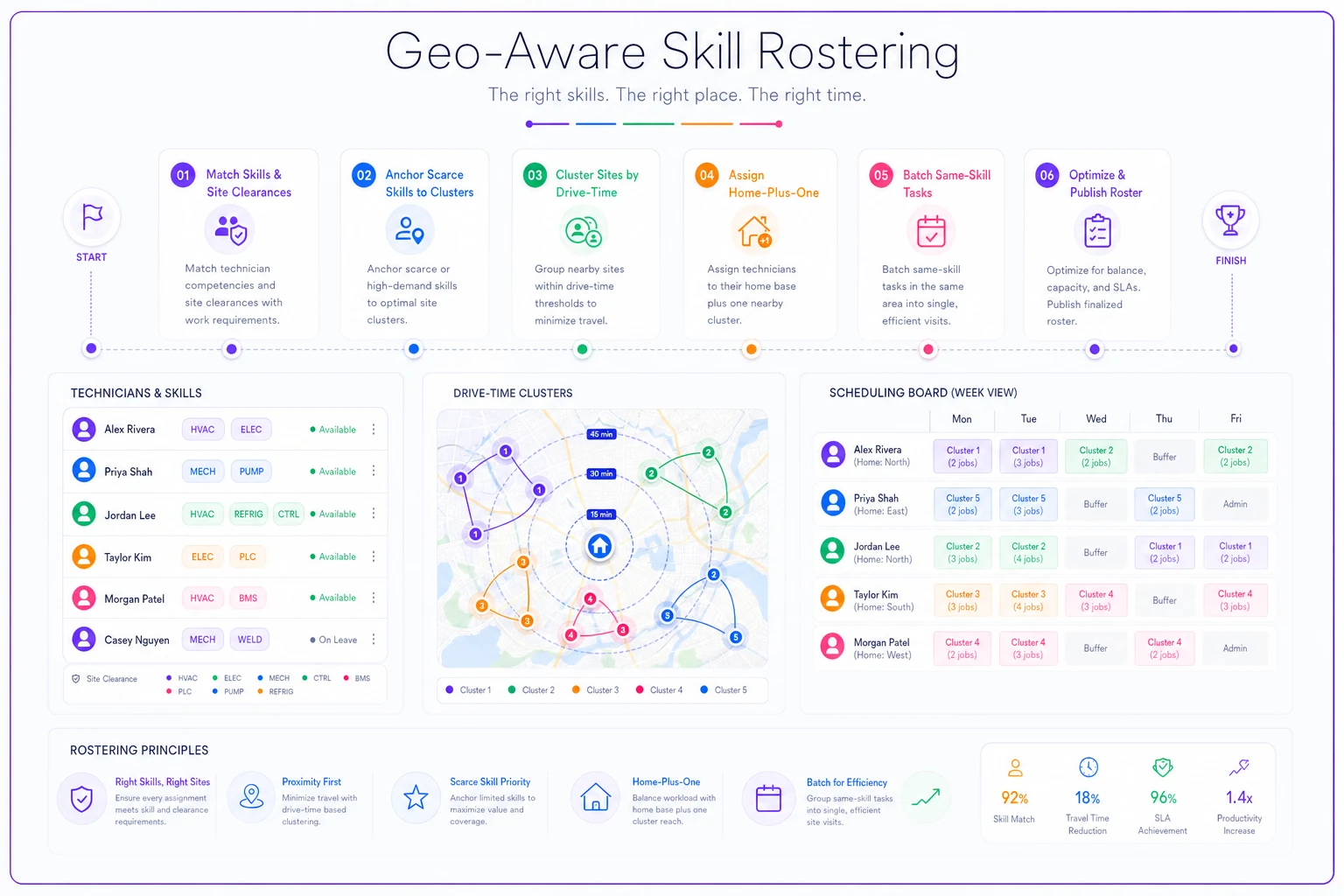
This illustrates the sequence of checks and assignments used in the heuristics.
A worked routing example
-
Site A
1 high-priority pump (needs rotating lead), 2 routine instrumentation checks
-
Site B
1 hydraulic repair (needs hydraulics lead), 1 instrumentation calibration
-
Site C
2 rotating inspections (assist-level fine)
You have Okafor (rotating lead, cleared A/B), Reyes (hydraulics lead, rotating expired, not cleared for B), and Nowak (instrumentation lead, cleared everywhere).
The naive roster sends Reyes to Site B for the hydraulic job — except Reyes isn't cleared for B. On a calendar-based roster, nobody notices until 7:15am at the gate. Now the hydraulic job is stranded and Reyes drives back.
The geo-aware version, applied in heuristic order:
-
Anchor scarce skills
hydraulics lead is scarce and Site B needs it — but your only hydraulics lead can't get on site. That surfaces the real constraint the day before, giving you time to fast-track Reyes's B induction or pull in a contractor.
-
Okafor (rotating lead, cleared A) takes the high-priority pump at Site A and stays put.
-
Nowak batches all instrumentation — two checks at A and the calibration at B — into a home-plus-one route (A morning, B afternoon), covering four tasks in two stops.
-
Site C's assist-level rotating inspections go to whoever's cleared and nearest, not your scarce rotating lead.
Same people. Same skills. The difference is the sequence and visibility of clearances at planning time, not at the gate.
Temporary multi-site pooling rules
Pooling technicians across sites for a defined period — a shutdown, a demand spike, a heat event — is powerful and dangerous in equal measure. Done loosely, it turns into permanent borrowing that hollows out a site's baseline coverage and breeds resentment.
Keep temporary pooling genuinely temporary with a few hard rules:
-
Trigger-bound. Pooling activates on a defined trigger (backlog over threshold, a scheduled outage) and deactivates when the trigger clears. No open-ended loans.
-
Minimum home coverage floor. Every site keeps a non-negotiable floor of skills that can never be pooled out — usually safety-critical and permit-signatory capabilities.
-
Named backfill. If you pool someone out of Site B, the roster must name who covers B's baseline. "We'll manage" is not a backfill.
-
Time-boxed with a review gate. Any pool lasting beyond ten working days gets escalated. Long pools are usually a sign you're actually understaffed, not temporarily surging.
When a pooling arrangement is really just a bandage over a structural shortage, that shortage shows up first as aged backlog that won't clear. If you're constantly pooling to attack the same site's backlog, the honest answer is a headcount or clearance decision, not a routing tweak.
The KPIs that tell the truth about travel
Utilization is the metric most teams lean on, and it lies. Someone can be 95% "utilized" while spending a third of that behind a windscreen. You need measures that separate productive time from movement.
The four worth tracking:
-
1. Wrench-time ratio. Actual task time ÷ paid shift time. This is the headline number. In distributed teams running off a calendar roster, it's common to find this sitting somewhere in the 40–55% range before anyone tackles routing. Getting it into the mid-60s is a realistic, meaningful win.
-
2. Travel-per-task. Average travel minutes per completed work order. Watch the trend, not the absolute. If it's climbing, your batching and clustering are slipping.
-
3. Gate-turnaround failures. Count of times a technician arrived at a site and couldn't start — missing clearance, missing permit, wrong induction. This should trend toward zero, and every occurrence is a matrix data problem you can fix.
-
4. Scarce-skill coverage ratio. For each critical skill, how many days this month did you have a cleared, current lead available at the site with priority demand? Low numbers here predict your next avoidable delay.
A note on measuring these: they're only as good as your movement data. If technicians log arrival and start times inconsistently, wrench-time becomes fiction. This is where an operational platform that timestamps site arrival, task start, and completion — ideally off mobile check-ins rather than end-of-day paperwork — quietly earns its keep. Not because it optimizes anything magical, but because it makes the leakage visible. AI-assisted rostering tools can also flag clearance mismatches before a shift is published, which is exactly the failure that strands people at the gate. But none of that matters if the underlying clearance data is out of date.
When this level of rostering discipline makes sense — and when it doesn't
Geo-aware skill rostering has real overhead. Worth being honest about where it pays off.
It makes sense when:
-
You run three or more sites with shared, mobile technicians
-
Drive times between sites are non-trivial (20+ minutes)
-
A few scarce skills are constant bottlenecks
-
Travel and overtime costs are creeping without a clear cause
It's overkill when:
-
You have a single site or a tight campus where travel is walking distance
-
Your skills are broadly interchangeable and everyone's cross-trained
-
You're a small team where a whiteboard genuinely suffices
Who should not start here: if your skill matrix is fiction and your clearance data is unknown, don't build routing heuristics on top of it. Fix the matrix first. Optimizing routes over bad capability data just produces confidently wrong schedules.
A short real scenario
A regional facilities group ran maintenance across five sites with a shared crew of roughly eighteen technicians. Rostering was calendar-based, built each Friday for the following week.
Their problem was mundane and expensive: overtime was drifting up quarter over quarter, and priority work orders kept slipping despite what looked like full rosters. When they reconstructed a fortnight of actual movement, wrench-time landed around 47% — nearly half the paid day going to travel, waiting, and gate turnarounds. They logged about a dozen gate-turnaround failures in that two-week window alone, mostly missing site inductions.
They didn't add people. They rebuilt the skill matrix with clearance columns, anchored their two scarce rotating-equipment leads first, constrained everyone to home-plus-one, and batched same-skill work into single visits. Six missing site inductions that had been quietly stranding capability got fast-tracked.
Over the following two months, wrench-time moved into the low 60s, gate-turnaround failures dropped to near zero, and the overtime creep flattened without any headcount change. Nothing dramatic — no reinvented process. They stopped rostering by who was free and started rostering by who was right and reachable.
The takeaway
The reason multi-site rosters leak isn't laziness or bad technicians. It's that the schedule optimizes for the wrong thing — filling shifts instead of matching capability to location. Build an honest skill matrix that includes clearances and currency, anchor your scarce skills first, cluster by real drive time, keep people to home-plus-one, and measure wrench-time instead of utilization.
Do that, and the travel tax you were paying without noticing turns back into completed work. The people were always there. They just needed to be pointed at the right gate.
Ready to elevate your asset operations?
Join 1,500+ businesses using Ownitly to optimize asset utilization, reduce downtime, and ensure compliance.