
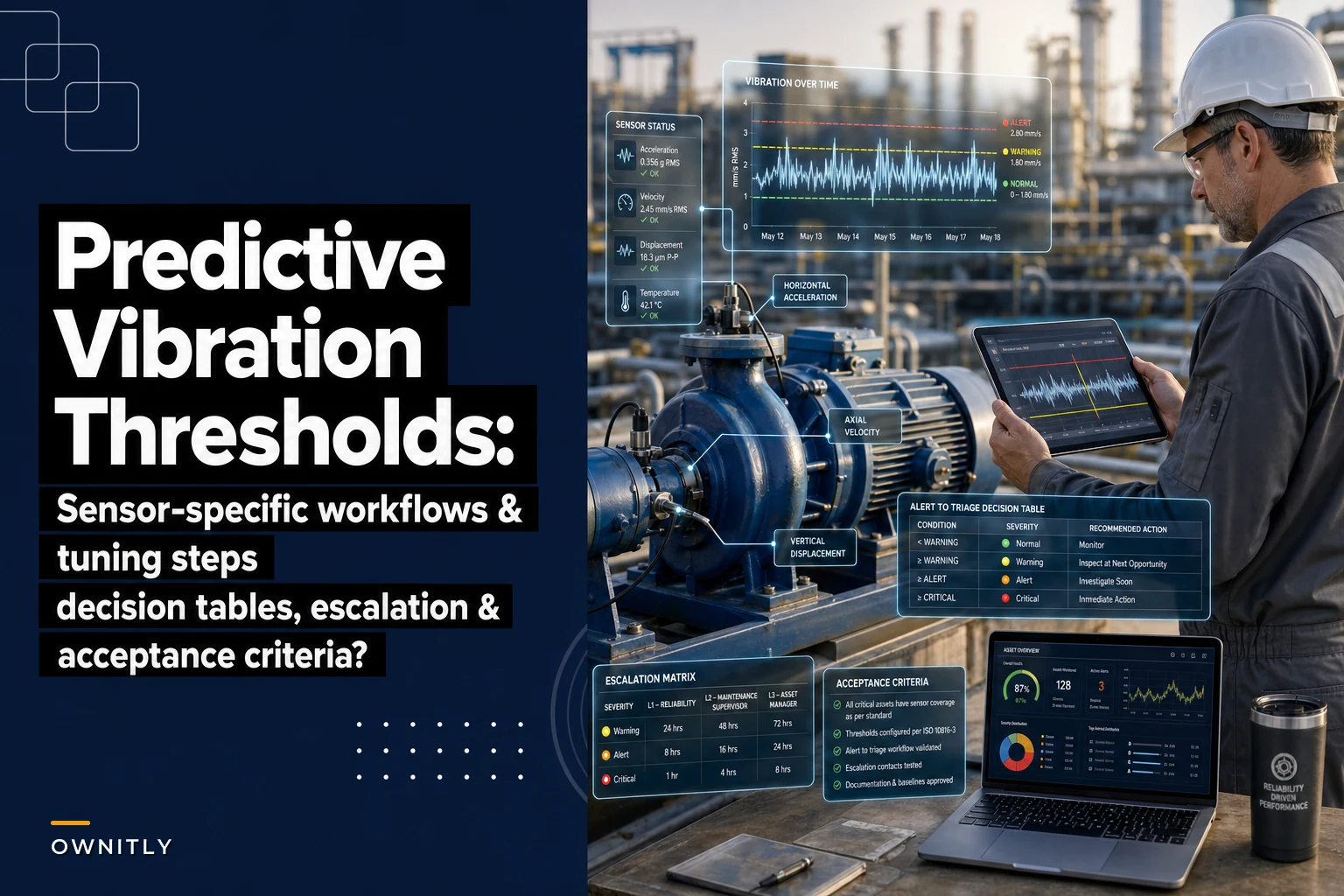

Most plants run their vibration monitoring systems with factory defaults across all equipment. That's like using the same blood pressure limits for a marathon runner and someone with heart disease. Your pumps, motors, fans, and compressors each generate different baseline vibration patterns based on their design, mounting, speed, and load conditions. When you apply generic thresholds, you either drown in false alarms or miss actual degradation until bearings are already throwing metal into the oil.
The real challenge with vibration threshold tuning isn't the math or the software configuration. It's building a systematic approach that maintenance teams can actually execute without a vibration analyst holding their hand through every adjustment. The difference between success and expensive failure usually comes down to having clear decision workflows that translate sensor data into specific actions.
Why generic thresholds create operational chaos
A food processing plant I worked with had 47 critical pumps monitored by wireless vibration sensors. They installed the system with vendor-recommended thresholds: 0.3 in/s for warning, 0.5 in/s for alarm. Within two weeks, they had over 1,400 alerts in their system. The maintenance supervisor just turned off notifications entirely.
Three months later, a main process pump failed catastrophically. The bearing had been deteriorating for weeks, showing a clear upward trend from 0.18 to 0.42 in/s. But because the generic alarm threshold sat at 0.5 in/s, and nobody was checking trends anymore, they missed it completely. Emergency repairs and lost production cost them somewhere around $84,000.
This pattern repeats everywhere. Operations teams get sensor systems installed, use default settings, get overwhelmed by noise, then basically abandon the technology until something breaks. The sensors keep collecting data, but nobody acts on it.
Generic thresholds fail because they ignore fundamental differences between equipment types. A direct-drive centrifugal pump running at 3,600 RPM generates completely different vibration signatures than a belt-driven fan at 1,200 RPM. Even identical machines in different locations show varying baseline vibration based on foundation stiffness, piping connections, and operating conditions.
Building sensor-specific baseline profiles
The first step in proper vibration threshold tuning involves establishing actual baselines for each monitored point. Not theoretical values from a manual — real measurements from your specific equipment under normal operating conditions.
Stop losing track of critical assets.
Ownitly helps you monitor, maintain, and manage every asset efficiently and reliably.
- Centralized asset tracking
- Automated maintenance alerts
- Compliance monitoring & reporting
No credit card required
Start by grouping your rotating equipment into families with similar characteristics:
Direct-drive pumps (1,800-3,600 RPM)
-
Baseline collection
30 days minimum
-
Measurement points
motor DE/NDE, pump bearing housing
-
Typical healthy range
0.08-0.15 in/s RMS
-
Key frequencies
1x running speed, vane pass frequency
Belt-driven fans (900-1,800 RPM)
-
Baseline collection
45 days (captures belt wear patterns)
-
Measurement points
motor bearings, fan bearings, both sheaves
-
Typical healthy range
0.12-0.22 in/s RMS
-
Key frequencies
belt frequency, fan blade pass
Gearboxes (variable speeds)
-
Baseline collection
60 days across load range
-
Measurement points
input/output bearings, gear mesh points
-
Typical healthy range
0.15-0.30 in/s RMS
-
Key frequencies
gear mesh, shaft speeds
For each monitored point, track the statistical distribution of vibration levels during normal operation. Calculate the mean, standard deviation, and 95th percentile values. These become your baseline references for setting meaningful thresholds.
A chemical plant had 23 cooling tower fans, all identical models. After baseline profiling, they discovered fans 1-8 consistently ran at 0.14-0.18 in/s, while fans 9-23 showed 0.22-0.28 in/s. The difference? Fans 9-23 sat on older concrete pads with degraded grout. Using the same threshold for all fans would have either missed problems in the first group or created constant false alarms in the second.
Acceleration vs velocity vs displacement measurements
Different sensor types and measurement parameters detect different failure modes. Most operations default to velocity measurements because that's what ISO standards recommend, but that misses critical information.
Acceleration (g's) catches high-frequency problems:
-
Early bearing defects (before they show in velocity)
-
Gear tooth cracks
-
Cavitation in pumps
-
Electrical problems in motors
Set acceleration thresholds based on bearing type and speed:
-
Ball bearings >1,800 RPM
Warning at 2g, Alarm at 4g
-
Roller bearings >1,800 RPM
Warning at 3g, Alarm at 6g
-
Sleeve bearings
Warning at 1g, Alarm at 2g
Velocity (in/s) indicates overall machine health:
-
Imbalance
-
Misalignment
-
Looseness
-
Advanced bearing wear
Velocity thresholds depend on machine criticality and mounting:
-
Critical equipment, rigid mount
Warning at 2σ above baseline, Alarm at 3σ
-
Non-critical, rigid mount
Warning at 3σ, Alarm at 4σ
-
Flexible mounting
Add 0.05 in/s to all thresholds
Displacement (mils) matters for shaft proximity probes:
-
Shaft runout
-
Oil whirl/whip
-
Rubs
Displacement thresholds follow API standards but need adjustment for shaft diameter and bearing clearance.
Decision tables for alert response
The biggest gap in most vibration programs isn't the technology or the thresholds — it's having clear instructions for what happens when an alert triggers. Operators and mechanics need specific decision trees, not general guidance about "investigating vibration issues."
| Alert Level | Vibration Change | Frequency Pattern | Immediate Action | Follow-up (within) |
|---|---|---|---|---|
| Warning (Yellow) | 25-50% above baseline | Single frequency dominant | Log in CMMS, check trend | 48 hours |
| Warning (Yellow) | 25-50% above baseline | Multiple harmonics | Schedule inspection | 24 hours |
| Alarm (Red) | >50% above baseline | 1x running speed | Check coupling/alignment | 4 hours |
| Alarm (Red) | >50% above baseline | High frequency (>10x) | Check lubrication immediately | 1 hour |
| Alarm (Red) | Sudden spike >100% | Any pattern | Stop equipment if safe | Immediate |
Each action needs specific detail. "Check lubrication" means:
-
Verify grease/oil level through sight glass or dipstick
-
Check for contamination (color, smell, particles)
-
Review lubrication records for last service
-
Add lubricant if low (specific amount for equipment)
-
Collect oil sample if contamination suspected
-
Document findings with photos
A paper mill reduced their vibration-related failures by roughly 60% after implementing these detailed decision tables. Before, operators would see an alert and either ignore it or immediately call maintenance. After, they followed specific inspection steps that resolved about 40% of alerts without maintenance involvement — usually just adding grease or tightening mounting bolts.
Escalation matrices based on criticality
Not all vibration alerts deserve the same response urgency. Your escalation path should consider both the severity of the vibration change and the criticality of the equipment.
A simple matrix approach works well here:
Critical Equipment (production stoppers)
-
Warning alert
Notify maintenance supervisor within 2 hours
-
Alarm
Page on-call technician immediately
-
Trending upward for 3 days
Schedule priority PM
-
Any bearing defect frequency
Generate priority work order
Important Equipment (impacts production rate)
-
Warning
Daily report to maintenance planner
-
Alarm
Notify supervisor same shift
-
Trending upward for 7 days
Schedule standard PM
-
Bearing defect frequency
Plan replacement parts
General Equipment (has backup/spare)
-
Warning
Weekly summary report
-
Alarm
Next day notification
-
Trending upward for 14 days
Add to backlog
-
Bearing defect frequency
Monitor trend
This seems straightforward, but most plants treat all alerts equally — they either panic about everything or ignore everything. Clear escalation rules ensure critical equipment gets immediate attention while preventing alert fatigue from non-critical assets.
Sample acceptance criteria for common machines
After repairs or new installations, you need specific criteria to verify equipment is actually fixed. Generic "vibration looks good" sign-offs lead to repeated failures.
Centrifugal Pumps
-
Overall velocity <0.18 in/s (new/rebuilt)
-
Overall velocity <0.28 in/s (in-service acceptable)
-
1x running speed <70% of overall
-
No bearing defect frequencies above noise floor
-
Axial vibration <50% of radial
Motor-Fan Sets
-
Overall velocity <0.25 in/s at fan bearings
-
Overall velocity <0.15 in/s at motor bearings
-
Fan imbalance (1x) <0.15 in/s
-
No belt frequency harmonics >0.05 in/s
-
Phase difference across coupling <30°
Gearboxes
-
Overall velocity <0.30 in/s at all bearings
-
Gear mesh frequency <0.20 in/s
-
Gear mesh sidebands <25% of mesh frequency
-
No modulation patterns indicating wear
-
Temperature rise <20°F above ambient
Compressors (reciprocating)
-
Overall velocity <0.35 in/s at crosshead
-
Overall velocity <0.25 in/s at motor
-
Piston passing frequency present but <0.20 in/s
-
No valve impact frequencies >2g acceleration
-
Foundation bolts <0.05 in/s
Document these criteria in your PM procedures and post-repair testing requirements. A refinery dropped their repair rework rate from around 18% to 4% after implementing strict acceptance testing with specific limits like these.
Practical tuning workflow
The actual process of adjusting thresholds shouldn't require a PhD in vibration analysis. Here's the workflow that consistently works:
Week 1-4: Baseline establishment Collect continuous data with wide-open thresholds (no alerts). Calculate statistical baselines for each point. Document operating conditions during baseline period.
Week 5-6: Initial threshold setting Set warning at mean + 2σ, alarm at mean + 3σ. Enable alerts to maintenance only (not operations). Review every alert to verify it represents actual condition change.
Week 7-12: Threshold refinement Adjust thresholds for chronic false alarms (raise by 10%). Tighten thresholds for critical equipment (lower by 10%). Document correlation between alerts and actual problems found.
Month 4-6: Seasonal adjustment Track how ambient temperature, load changes, and process variations affect vibration. Create seasonal threshold profiles if needed. Build exception list for known issues.
Ongoing: Continuous improvement Monthly review of missed failures (threshold too high). Monthly review of false alarm rate (threshold too low). Quarterly threshold adjustment based on data.
Most important: document every threshold change with justification. Something like — "Raised Fan-14 motor DE threshold from 0.22 to 0.26 in/s due to known foundation resonance at 1,750 RPM, confirmed not degradation via phase analysis." That note saves the next person hours of confusion.
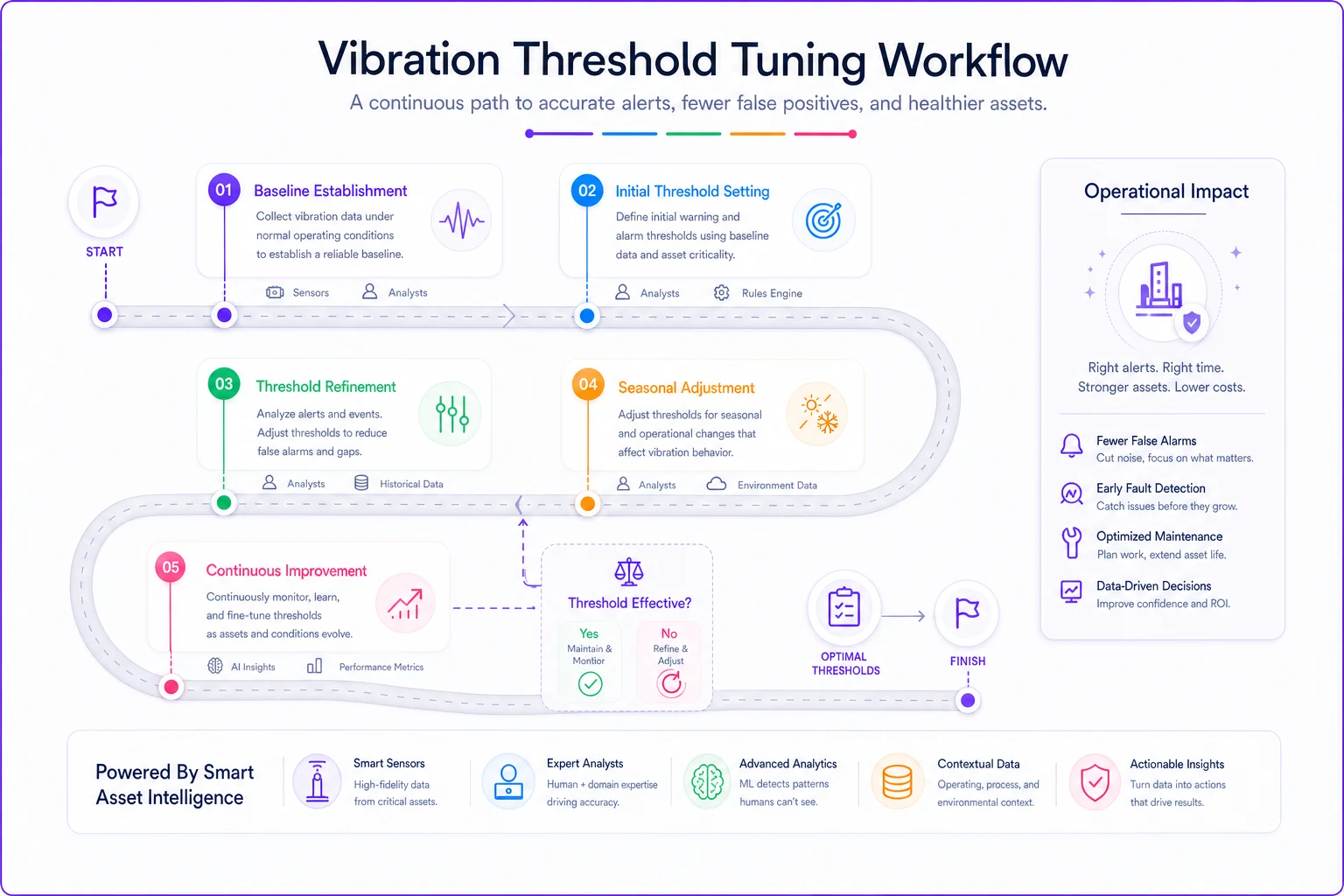
A visual summary of the tuning workflow.
Managing threshold tuning at scale
When you're monitoring hundreds of machines, manual threshold tuning becomes a real problem. But full automation usually fails because it can't account for operational context.
The sweet spot is semi-automated workflows. Use statistical methods to suggest threshold adjustments, but require human review before implementation. Track threshold performance metrics:
Require human sign-off for suggested threshold changes to preserve operational context and prevent automated misconfigurations.
-
False alarm rate by equipment type
-
Missed failure rate by threshold setting
-
Alert-to-action conversion rate
-
Mean time between threshold adjustments
Modern operational software platforms can simplify this considerably. Instead of manually tracking baselines in spreadsheets and updating thresholds across multiple systems, AI-assisted platforms can continuously analyze vibration patterns, flag suggested threshold adjustments based on actual equipment behavior, and automatically generate work orders when legitimate issues arise. This cuts down the manual overhead of threshold management while making sure critical alerts don't get buried.
More importantly, these platforms preserve institutional knowledge about why thresholds were set at specific levels. When your vibration analyst leaves, their understanding of equipment quirks and threshold rationale doesn't walk out the door with them.
Converting vibration data to maintenance action
The ultimate goal isn't perfect thresholds — it's preventing failures and optimizing maintenance intervals. Your threshold tuning strategy should connect directly to maintenance execution.
Build automatic work order generation rules:
-
Warning alert sustained for X hours → Create inspection task
-
Alarm condition → Create priority work order
-
Bearing frequency detected → Order replacement bearing
-
Upward trend exceeding rate limit → Schedule PM advancement
Track outcome metrics that matter:
-
Alerts resulting in found problems (should be >60%)
-
Problems found before functional failure (target >80%)
-
Threshold changes required per month (should decrease over time)
-
P-F interval improvement (earlier detection)
A food manufacturer reduced emergency maintenance calls by roughly 70% after implementing automated work order rules tied to their tuned thresholds. Their mechanics stopped chasing false alarms and started preventing actual failures.
Common threshold tuning mistakes
Certain patterns consistently destroy vibration programs:
Over-tightening after a failure. A bearing fails, so someone sets the threshold at 50% of the failure vibration level. Now you get alerts constantly on healthy equipment. Track your threshold changes and resist knee-jerk adjustments.
Ignoring load correlation. A pump shows high vibration every Monday morning. Instead of raising the threshold, investigate why. Maybe weekend shutdown/startup causes temporary misalignment. Fix the root cause, don't mask it with loose thresholds.
Copying thresholds between sites. What works at one plant fails at another. Different foundations, climates, and operating patterns require site-specific tuning. Start with equipment manufacturer recommendations, but always validate against local baselines.
Setting and forgetting. Thresholds need regular review. Equipment degrades, operating conditions change, seasons affect vibration. Schedule quarterly threshold reviews as formal PM tasks.
Chasing perfection. Some teams spend months trying to eliminate every false alarm. Meanwhile, equipment fails because nobody responds to alerts anymore. A 10-20% false alarm rate is a reasonable tradeoff for catching real problems early.
Making vibration thresholds work in real operations
Vibration threshold tuning is one of those technical tasks that directly impacts operational efficiency. Get it right, and your maintenance team prevents failures before they hit production. Get it wrong, and expensive sensors become digital paperweights that nobody trusts.
The approach outlined here — sensor-specific baselines, clear decision tables, criticality-based escalation, and rigorous acceptance criteria — comes from watching vibration programs succeed and fail across a lot of different facilities. The successful ones share common traits: they maintain systematic processes, document their decisions, and continuously refine based on actual outcomes.
Most importantly, they recognize that threshold tuning isn't a one-time setup task. It's an ongoing operational discipline that deserves the same attention as your PM optimization program or CMMS data quality efforts.
Start with one critical equipment group. Establish proper baselines, implement the decision tables, and track your results for 90 days. Once you prove the value with reduced false alarms and earlier problem detection, expand the approach across your facility. The investment in proper threshold tuning pays back through prevented failures, optimized maintenance resources, and operational teams that actually trust their monitoring systems.
Ready to elevate your asset operations?
Join 1,500+ businesses using Ownitly to optimize asset utilization, reduce downtime, and ensure compliance.