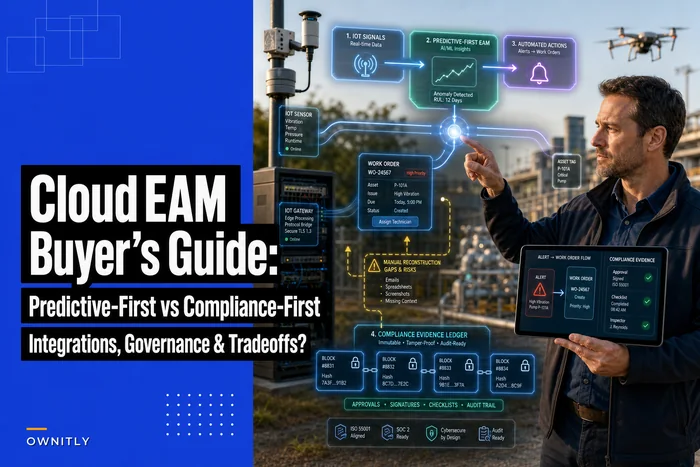



Most cloud EAM contracts in regulated organizations get negotiated hard on the wrong number. Uptime eats weeks of back-and-forth: 99.5 vs 99.9, maintenance windows, credit percentages. The things that hurt a regulated buyer usually aren't in the contract at all. Can you get a complete, signed, defensible record set out of the system on a deadline? Are records kept exactly as long as required, not a day less? Can you leave the vendor without losing ten years of history?
The platform being down for 40 minutes on a Tuesday is annoying. Not being able to produce a clean calibration and work-order history for a regulator inside the response window is a finding, sometimes worse. Contracts treat these two very differently, and the weighting is usually backwards.
This piece follows the contract through its life, from RFP to exit, because each clause gets tested at a specific point. Most buyers write the contract as if signing day is the test. It isn't. The tests come later, on a fairly predictable schedule.
The contract gets tested on a schedule nobody writes down
Look at where cloud EAM contracts fail in regulated shops (pharma and med device, utilities, aviation MRO, food manufacturing, labs) and the failures cluster in time:
-
Before signing, the RFP scored the wrong things, so the "winning" vendor was never asked to prove evidence or exit capability.
-
Around the first audit (usually 9–14 months after go-live), someone asks for an evidence package and finds out what "export" really means.
-
Year two, vendor releases and sub-processor changes quietly alter how signatures, audit trails or retention behave.
-
Renewal is your second and last cheap chance to fix language, and most teams treat it as a pricing conversation.
-
Exit is when you learn whether your data portability clause was a promise or just a sentence.
Ownership is a big part of why. Procurement runs the RFP. Legal negotiates the paper, usually starting from the vendor's template. IT signs off on security and integration. QA or compliance owns the audit relationship. Maintenance operations owns the actual records. In most organizations under about 2,000 employees, those five groups touch the contract at different moments and almost never sit at the same table. The person who will someday have to produce 600 work orders with signatures for an inspector is rarely in the room when "Customer may export Customer Data in a commercially reasonable format" gets accepted.
Growth makes it worse. A contract written for one site and 900 assets doesn't scale in a straight line. Record volume grows, attachment storage grows faster (photos, calibration certs, contractor PDFs), and export jobs that took twenty minutes start timing out. Acquisitions bring in sites with different retention obligations. The contract can't absorb any of that, because it never had measurable commitments to begin with.
Before signing: the RFP is where most of the contract actually gets decided
A typical RFP asks, "Does the solution support 21 CFR Part 11 compliant electronic signatures?" Every vendor says yes. The question is scored 1 point for yes, 0 for no. Every vendor gets the point, so the question did nothing.
Stop losing track of critical assets.
Ownitly helps you monitor, maintain, and manage every asset efficiently and reliably.
- Centralized asset tracking
- Automated maintenance alerts
- Compliance monitoring & reporting
No credit card required
This is the stage where regulated buyers lose most of their leverage. If vendors never had to demonstrate evidence export, retention enforcement and exit capability during selection, you'll struggle to get prescriptive commitments into the contract later. The vendor will reasonably say you didn't ask about this before.
If you're still deciding which kind of platform you need in the first place, the tradeoffs between predictive-heavy and compliance-heavy platforms are covered in the cloud EAM buyer's guide on predictive-maintenance-first vs compliance-first platforms. What follows assumes you already know you need a platform that can survive an audit, and you want to make sure the one you pick actually can.
A scored RFP that rewards proof, not answers
Use a scoring model where a written "yes" is worth very little and a demonstrated capability is worth a lot. A 0–4 anchored scale works well:
0–4 scale descriptions:
-
0 – Not supported, or vendor declines to answer
-
1 – Vendor states support in writing, no evidence
-
2 – Vendor provides documentation or screenshots
-
3 – Demonstrated live in a scripted demo using vendor data
-
4 – Demonstrated live using your sample data, within the timed task, by your team or with your team watching
Then weight the categories so the regulated stuff can't be outscored by a slick work-order UI. This weighting holds up reasonably well for compliance-heavy buyers:
| Category | Suggested weight | What a "4" looks like | Knock-out condition |
|---|---|---|---|
| Evidence export & audit trail | 25% | Your 200-WO sample exported with attachments, audit trail and signatures in under the target time, manifest matches | Audit trail not included in export |
| Retention & legal hold | 15% | Record-class retention rule configured live; legal hold applied to a scoped record set and shown to block purge | Holds only possible at whole-tenant level |
| E-signature integrity | 10% | Signed record exported; signature shows name, timestamp, meaning, and stays linked to the record version | Signature exported as free text only |
| Data portability / exit | 15% | Full-tenant export in documented open format, schema docs provided, attachments with hashes | Vendor won't commit export format in contract |
| Core maintenance workflow | 20% | Scripted PM, CM and inspection flows run by your planners | — |
| Integration (ERP, IdP, OT data) | 10% | Live API call against your sandbox | — |
| Commercial terms & SLO willingness | 5% | Accepts your SLO schedule with minor redlines | Refuses any measurable non-uptime SLO |
People push back that 5% for commercials is too low. Price still matters, but score it separately, after the capability shortlist. Blend price into the capability score and a cheap vendor that fails the evidence test can still win on total points. Then you're negotiating SLOs with a vendor that already showed you it can't meet them.
Running the scripted demo
The scripted demo carries most of the scoring weight, so give it some structure. A sequence that works:
-
Send a sample data pack two weeks before demos. Roughly 150–250 work orders across three or four asset classes, a few dozen calibration records with certificate attachments, some signed approvals, and at least one record set you'll later put under legal hold. Anonymize it, but keep the messiness: long text fields, odd characters, multi-page PDFs.
-
Give every vendor the same timed tasks. For example, "Produce the complete evidence package for all work orders on asset class X between these dates, including audit trail and signatures. Clock starts now."
-
Have QA, not procurement, judge the evidence tasks. Procurement can tell whether a file was produced. QA can tell whether it would survive an inspector.
-
Ask the vendor to break something on purpose. Edit a signed record and show what happens to the signature. Try to purge a record under hold. Exception handling tells you more than the happy path.
-
Request the full-tenant export spec in writing before scoring closes. File formats, schema documentation, how attachments are packaged, how audit trail and signature data are represented. If it doesn't exist as a document, that's a 1 at best.
-
Score independently, then calibrate. Each evaluator scores alone, then the group discusses any criterion where scores differ by 2+ points. Gaps like that usually mean the criterion wasn't defined clearly, which is worth fixing before the next vendor.
Don't let the vendor's sales engineer drive the keyboard during the evidence tasks. You end up watching someone who has done this export hundreds of times, which says nothing about whether your planner can do it at 4pm on a Friday when an auditor asks. Make them hand over the keyboard for at least one task.
Signing: turning promises into SLOs you can actually measure
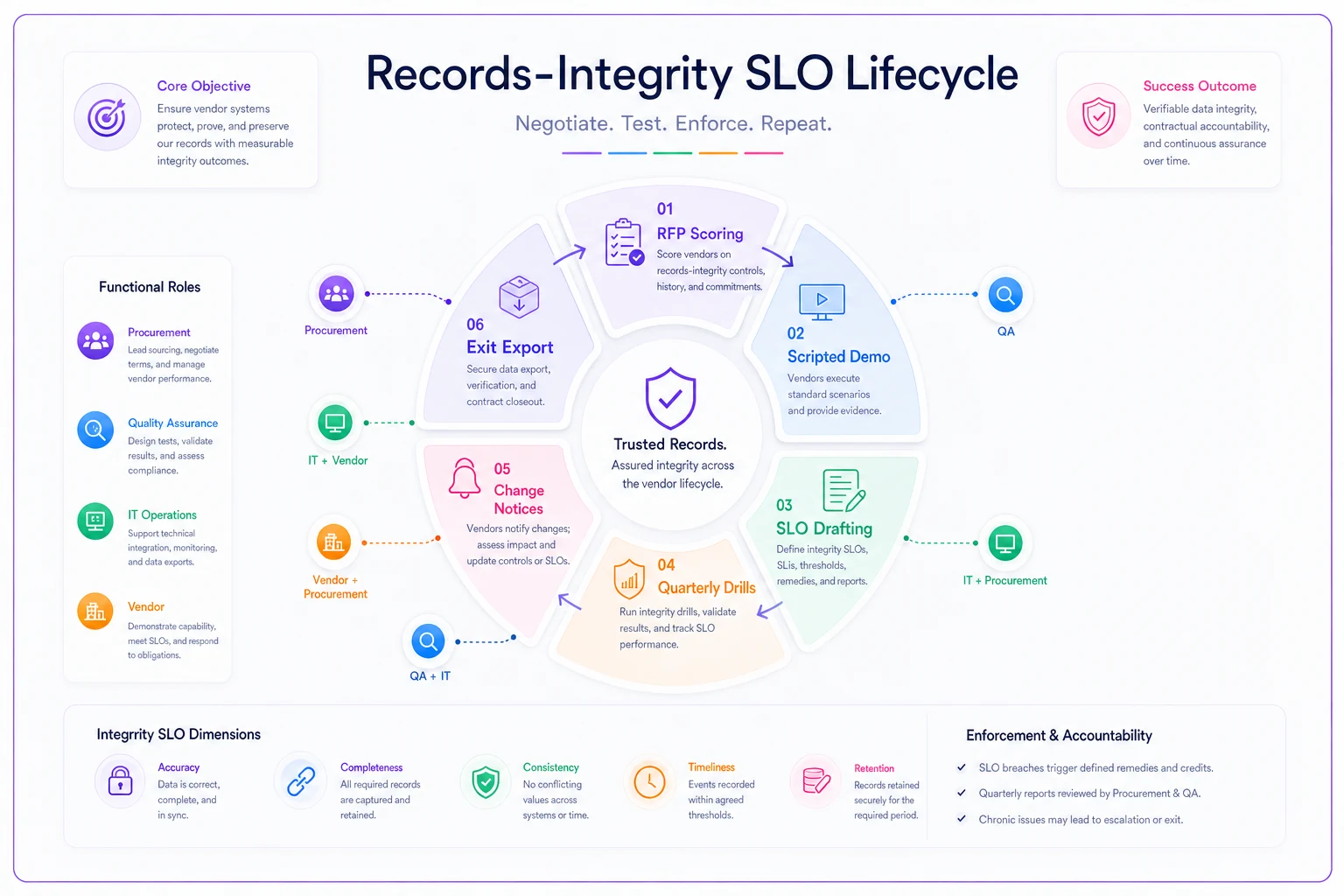
This is the core of the cloud EAM SLO contract checklist. Most vendor paper has an SLA schedule covering availability and support response times, and that's it. Regulated buyers need a second schedule, something like "Records Integrity and Portability Service Levels," held to the same measurability as uptime.
The rule for writing these is easy to state and annoying to do. Every commitment needs a defined scope, a measurement method, a target, a measurement period, and a consequence. Miss any one of the five and it isn't really an SLO.
| Clause area | Weak language you'll see | Prescriptive version | How it's measured |
|---|---|---|---|
| Evidence export | "Customer may export data at any time via standard tools" | "Standard Evidence Package (defined in Exhibit C) for up to 500 work orders generated self-service within 4 business hours; full-site package within 2 business days; 100% of manifest items present" | Quarterly buyer-run drill + vendor monthly job-completion report |
| Export format | "Commercially reasonable format" | "CSV or JSON with published schema, attachments in original format plus PDF/A renderings, SHA-256 hash manifest" | Format validation during drill |
| Retention | "Vendor retains data per its policies" | "Customer-configured retention by record class; no purge before configured period; purge executed within 30 days after expiry unless on hold; deletion certificate issued quarterly" | Quarterly sample audit of due-for-purge and retained records |
| Legal hold | Usually absent | "Record-level or query-scoped hold effective within 24 hours of instruction, across production; held records excluded from backup expiry-based deletion" | Test hold during annual drill |
| E-signature | "Supports electronic signatures" | "Signed records retain signer identity, date/time, and meaning; signature cryptographically or logically bound to record version; binding preserved in all exports" | Signature validation rate in drill sample (target: 100%) |
| Change notice | "Vendor may update the service" | "90 days' notice of changes affecting audit trail, signatures, retention or export; validation sandbox available 60 days pre-release" | Release notes log vs notice dates |
Here's a simple visual of that SLO lifecycle.
Evidence export: define the package, not just the export
"Export" without a package definition is meaningless. The contract needs an exhibit listing what a Standard Evidence Package contains: the work order with all field values, the full audit trail for that record (who changed what, when, old and new values), all attachments in original format, signature records, linked asset and calibration records, and a manifest with hashes so you can prove nothing was altered after export.
That exhibit should come from your own evidence-bundle standard, not the vendor's export feature list. Vendors define exports around what their system can do. You define the package around what an inspector will ask for. The contract is where the two lists get reconciled, and every gap becomes either a vendor commitment or a known risk you accept in writing.
Completeness is subtler. Vendors will often push for "substantially complete" or a 98% target. For regulated evidence, a package missing 2% of its items isn't 98% good. It's a package with a hole an inspector might find. Push for 100% manifest completeness, with a defined remediation timeline when it's missed.
Retention: the problem is usually early deletion, not over-retention
Most teams worry about the vendor keeping data too long. The more damaging failure is records disappearing before their retention period ends. A tenant-wide purge setting gets misconfigured, or a "data archiving" feature moves records into a tier that isn't included in exports, or attachments get compressed and lose their originals.
The contract should make retention configurable by record class, since calibration records and safety-critical work orders often need different periods than routine PM. It should also put the burden of proof on the vendor through periodic deletion certificates and an audit right.
Backups need their own sentence. Vendors generally can't surgically delete from backups, and they can't selectively keep held records in backups that rotate out. So the clause has to say how backup rotation interacts with retention and holds. Usually that means held records are guaranteed in production regardless of backup expiry, and deleted records are guaranteed gone from backups within a stated rotation window. If the vendor can't explain this clearly in negotiation, they probably haven't designed for it.
E-signature acceptance: define what "accepted" means
"E-signature acceptance" as an SLO sounds odd until you define it. A workable definition: a signed record is accepted if, after export, it still shows who signed, when, and what the signature meant, and that signature can be shown to belong to that specific version of the record, without anyone reconstructing it manually. For FDA-regulated buyers this lines up with Part 11's manifestation and record-linking expectations. EU buyers will be thinking Annex 11. Other sectors have their own flavor, but the operational test is the same.
Then measure it. In each quarterly drill, sample the signed records in the export and check each one against that definition. Target is 100%. Anything less triggers root-cause analysis from the vendor.
There's a second problem that catches people out. Contractor sign-offs often come in from outside tools, through a third-party e-signature platform or a contractor portal. The contract should say how externally signed documents are ingested, and whether the vendor preserves the external signature's validation data or just stores a flattened PDF. A flattened PDF with a signature image on it is not the same evidence as the original signed envelope with its certificate trail.
Consequences that actually change vendor behavior
Service credits are the default remedy, and for records-integrity SLOs they're close to worthless. A 5% credit on a monthly subscription does nothing for you when the real cost is a 483 observation or a failed inspection.
-
A root-cause report within 10 business days of any miss, with a corrective action plan
-
Executive escalation after a second miss in a rolling 12 months
-
A chronic failure definition (for example, missing the evidence-export SLO in 2 of any 4 consecutive quarters) that gives you a termination right without early-termination fees, plus transition assistance at no charge
-
Fee holdback on the next renewal if the chronic threshold is hit
Vendors fight harder over the chronic-failure clause than over credits. That tells you which one has teeth.
Months 9–14: the first evidence request, and what the workflow actually looks like
The first real audit request shows you whether any of this worked. Here's how it flows in a typical mid-sized regulated operation, and where it breaks.
An inspector or auditor asks QA for records, often broad at first: "all maintenance and calibration records for the filling line, last 18 months." QA turns that into a records scope and sends it to the maintenance systems owner, who is often a planner or reliability engineer with the EAM admin role on the side. That person runs the export. The output goes back to QA, who check completeness against what was asked, spot gaps, and loop back. Eventually a package goes to the auditor, sometimes through legal if there's any sensitivity.
With no evidence SLO in the contract, the middle of this loop gets messy. The export runs and times out on attachments. It gets split into date ranges and re-run. Signatures come out as a text column. The audit trail is a separate report that has to be matched by record ID in a spreadsheet, and QA spends two days reconciling. Three or four people lose most of a week. The response window is tight, so everyone's stressed and mistakes creep in, like a missed record or a mismatched attachment.
Run the evidence package as a saved, repeatable job, flagging missing attachments or unsigned steps before an auditor sees the package.
With a defined Standard Evidence Package and a tested export, the same loop is mostly mechanical. Someone enters the scope, the package generates, the manifest gets checked against the request, QA reviews content instead of reconstructing structure, and the package goes out.
The contract doesn't make the workflow good by itself. What it decides is whether the vendor is obligated to fix things when they break, or whether your team just absorbs the pain.
This is one place where AI-assisted operational platforms earn their keep, though not in a flashy way. Running the evidence package as a saved, repeatable job, flagging missing attachments or unsigned steps before the auditor sees the package, and auto-matching audit trail entries to records all cut out the reconciliation grind. Worth asking about in demos. The contract still has to say what happens when it doesn't work.
Year two: releases, sub-processors and quiet drift
This is the least visible failure point, because nothing dramatic happens. The vendor ships on its normal release cadence, maybe monthly, maybe quarterly. One release changes how the audit trail captures bulk edits. Another moves attachments to a new storage service with a new sub-processor in a different region. A third changes the export job's behavior on records over a certain size.
None of it is announced as "changes affecting your regulated records." It's buried in release notes, if it's mentioned at all.
Plenty of teams assume their initial validation covers them indefinitely. It doesn't. The system you validated at go-live isn't necessarily the one you're running 18 months later, and without a change-notice clause specific to records-integrity functions, you won't know which releases need revalidation.
The clause that helps: the vendor gives advance notice (90 days is reasonable for major changes, 30 for minor) of any change affecting audit trail, e-signature, retention, export or data location, with a validation sandbox available before production rollout. Pair it with a sub-processor change notice and an objection right, especially if data residency matters to you.
There's an internal side too, and in smaller organizations it's a real gap. Notices go to whoever was listed as the admin contact at signing, and that person may have changed roles twice since. Put a named role in the notice clause, not a named person, and route it to a shared mailbox QA can see.
Real scenario: contract manufacturer, three sites, one bad inspection prep
Business type: A contract manufacturer making components for medical device OEMs. Three sites, roughly 4,800 assets in the EAM, about 140 maintenance and metrology staff combined. Cloud EAM in place for a little over two years.
The problem: During an OEM customer audit (not even a regulator, which made it more uncomfortable in hindsight), they were asked for full maintenance and calibration history on two production cells across about 20 months. Their contract said data could be exported "in a commercially reasonable format." In practice that meant a tabular export, attachments downloaded separately in batches, and signatures exported as a text field with name and date but no meaning and no link to the record version.
Assembling the package took about 6 working days and three people (a planner, a metrology tech and a QA specialist). They found around a dozen records where the attachment in the export didn't match the latest version in the UI, because of how the export handled superseded files. The auditor noted the signature presentation as an observation. Not a major finding, but it went into the OEM's supplier file.
What they changed: The contract came up for renewal about seven months later. Instead of negotiating price first, they brought a records-integrity schedule to the vendor: a defined Standard Evidence Package exhibit, a 4-business-hour self-service target for up to 500 work orders, 100% manifest completeness, signatures exported with name, timestamp and meaning and bound to record version, quarterly drills run by the buyer, and a chronic-failure termination right. They traded a longer term (three years instead of two) for most of it. The vendor rejected the 4-hour target for full-site packages but accepted 2 business days.
-
Evidence package for a comparable scope
roughly 5–6 working days with three people before, around 3 hours with one person by the third quarterly drill
-
The first two drills each failed
one on attachment version handling, one on signature meaning missing for a specific approval type. Both went through the root-cause process and got fixed within the vendor's next two releases.
-
Next OEM audit about a year later
package produced the same day, no observations on records presentation
The early drill failures were the useful part. Without the contract language, those two defects would have surfaced in a real audit. With it, they surfaced in a drill and became the vendor's problem to fix on a timeline.
Renewal: your second cheap chance, usually wasted
Renewal is when your leverage is highest after initial selection, and most teams burn it entirely on price. The vendor's account team expects a pricing conversation. They're less ready for a records-integrity conversation, which is part of why it works.
Treat renewal as a re-scoring exercise. Pull out the RFP weights from selection (or build them now if you never did) and score the vendor's actual performance over the term: drill results, missed notices, support tickets on export, any audit observations tied to system behavior. That gives you a factual basis for asking for SLO additions, and it tells you honestly whether you should be renewing at all.
It also helps to pull renewal into whatever governance process controls your maintenance spending. A contract renewal is an investment decision and should be scored like one. If you run a portfolio process, the maintenance portfolio governance model is a reasonable place to slot renewals, so the records-integrity risk gets weighed next to the dollars instead of being something legal raises the week before the deadline.
Exit: the portability clause you hope you never use
The data portability clause gets the least attention in negotiation and causes some of the most expensive surprises. Take a mid-sized water utility moving off a cloud EAM after about eleven years of records. The contract promised export "upon request." The vendor's standard export turned out to be CSV tables without attachments. Getting the attachments (inspection photos, permit scans, contractor reports) packaged with mapping back to records was quoted as a professional services engagement at somewhere around $60k–$70k and 10–12 weeks. Signatures came out as text. Audit trail history was available, but only as a separate report the vendor would run "on a best-effort basis."
None of that was a breach. The contract just never said anything more specific.
-
Format and documentation. Open formats, a published schema, and a data dictionary, all available now and kept current, not produced at exit
-
Completeness. All records, all attachments in original format, full audit trail, signature records with their binding data, configuration (workflows, retention rules, roles) in a readable form
-
Integrity. A hash manifest across the full export
-
Timing. Full export available within a defined period after request (30 days is common for large tenants), with the platform kept accessible read-only during a transition period of at least 90 days after termination
-
Cost. Exit export included in subscription fees, or capped at a stated amount, with professional services rates fixed in advance
-
Test. A full-tenant export test before go-live and annually after that, at no extra charge
-
Deletion. Certificate of deletion after transition, with backup expiry timing stated
The annual test matters most. An exit clause that's never exercised is a guess. An annual export, even if all you do is verify it and archive it, turns the guess into something you've seen work. You also end up with an independent copy of your records, which helps with long-term archival and audit replay.
The cloud EAM SLO contract checklist
Use this as a working checklist during negotiation and renewal. It isn't exhaustive, and your counsel will add jurisdiction-specific items, but it covers the clauses most often missing.
-
Records-integrity SLO schedule exists as a separate exhibit from the availability SLA
-
Standard Evidence Package defined by content (record fields, audit trail, attachments, signatures, linked records, manifest), not by export feature
-
Export time targets set by scope tier (small scope self-service, full-site, full-tenant)
-
Completeness target of 100% manifest items, with a remediation timeline for misses
-
Export format committed
open formats, schema documentation, original attachments plus rendered copies, hash manifest
-
Retention configurable by record class, with no early purge, defined purge timing, and periodic deletion certificates
-
Legal hold at record or query scope, with stated effective time and backup interaction
-
E-signature requirements written out
signer identity, timestamp, meaning, binding to record version, preserved in all exports, plus handling of externally signed documents
-
Measurement method for each SLO
buyer-run drills, vendor reporting, and an audit right
-
Remedies beyond credits root-cause reports, escalation, chronic-failure termination right, transition assistance
-
Change notice for anything affecting audit trail, signatures, retention, export or data location, plus sandbox access before release
-
Sub-processor and location change notice with an objection right
-
Portability clause with format, completeness, timing, read-only transition period, capped cost, and annual export test
-
Notice routing to a role and shared mailbox, not an individual
-
Renewal re-scoring built into your governance calendar at least 6 months before term end
Don't expect to win every line. Vendors will trade on some of these and dig in on others, usually the chronic-failure termination right and the 100% completeness target. Decide before you sit down which items are non-negotiable for you and which you'd swap for a longer term or a cap on cost.
If you only get a handful, take the Standard Evidence Package definition, the annual export test, and the change-notice clause. Those three cover most of what goes wrong in practice, and they're also the ones that give you something to measure.
When this level of contract rigor makes sense, and when it doesn't
When this actually makes sense
If your maintenance records are themselves regulated evidence, it's worth the effort. That covers GMP manufacturing, med device, aviation maintenance, utilities under reliability standards, labs with accredited calibration, and food plants with documented sanitation and equipment controls. Same if you've had a records-related observation in the last few years, or if customers audit you as a supplier, since those audits are often stricter about presentation than regulators.
It also makes sense if you're planning growth through acquisition. Every site you bring in adds to the volume and variety of records the contract has to cover, and fixing language after the fact gets more expensive each time.
When this is a bad idea
If the vendor has a strict standard-paper-only policy and there's no realistic negotiating room, spending three months fighting for an SLO schedule may just delay go-live without changing much. Put the effort into RFP scoring and annual drills instead. You can't contract for remedies, but you can at least know where the weaknesses are and build internal workarounds before an audit exposes them.
It's also a poor use of time to push prescriptive SLOs for record classes that aren't regulated or audited. Not every work order needs evidence-package treatment, and over-scoping the schedule makes vendors resist the whole thing.
Who should NOT do this
Single-site operations with light or no regulatory exposure, where maintenance records are mostly for internal use, will get very little from a records-integrity schedule. A clear export clause and an annual export test cover most of the risk.
Teams without anyone who will actually run the quarterly drills should also hold off. An SLO you never measure is arguably worse than none, because it creates false confidence and leaves you without the drill history you'd need to invoke the chronic-failure clause. If nobody owns the drill, sort that out first.
Where to put your effort first
If you're mid-procurement, put your effort into the scripted demo and scoring weights. That's where you still have the most leverage, and everything later depends on it. If you're already under contract, the most useful move is running one evidence-export drill against a realistic scope this quarter, before an auditor asks. You'll learn more about your contract's real coverage in an afternoon than from rereading the agreement. If the drill goes badly, you have a renewal agenda. If it goes well, write down how you ran it so the next person can repeat it.
The contract should describe how your records will behave when someone outside the organization needs them, measured the same way you'd measure any other operational commitment. Most contracts don't do that yet, which means most regulated buyers are relying on the vendor's goodwill for the moments that matter most.
The contract should describe how your records will behave when someone outside the organization needs them, measured the same way you'd measure any other operational commitment. Most contracts don't do that yet, which means most regulated buyers are relying on the vendor's goodwill for the moments that matter most.
Ready to elevate your asset operations?
Join 1,500+ businesses using Ownitly to optimize asset utilization, reduce downtime, and ensure compliance.