


Most maintenance organizations don't have a funding problem. They have a translation problem. The reliability wins are real — a vibration program at one plant, a spares pooling experiment at another, a calibration overhaul that quietly extended instrument life — but by the time those wins reach the capital committee, they show up as disconnected slide decks with inconsistent math, no shared baseline, and numbers finance can't reconcile against the ERP.
So the money goes somewhere else. Not because the projects were bad, but because nobody could present them as a portfolio that behaves predictably.
That's what this article is about. Not a single decision rule or one clever KPI, but the actual pipeline — intake, decision gates, KPI health checks, and the artifacts that survive a CFO review — that moves local pilots into enterprise funding allocations without losing credibility somewhere along the way.
The real reason maintenance funding requests die
Walk into any capital planning cycle and you'll typically find three or four regions submitting maintenance investment cases in completely different formats. One site quantifies avoided downtime in production hours. Another uses dollars but skips the discount rate. A third bundles a genuine reliability project with a comfort upgrade nobody asked for. Finance can't compare them, so they default to the safest move: fund the projects with the loudest sponsor and defer the rest.
This isn't a communication failure. It's a governance failure. Without maintenance portfolio governance, every request is a one-off — and one-offs get evaluated on politics, not merit.
The pattern repeats across asset-heavy operations. Individual sites are perfectly capable of running strong pilots. What they can't do — because it was never their job — is normalize those pilots into a common language finance actually trusts. The portfolio layer is missing. So each request re-litigates first principles: what counts as a benefit, which costs go where, how confident are we in these numbers.
When you have to re-argue the basics every single cycle, you lose. Every time.
What a portfolio pipeline actually looks like
Think of it less as an approval process and more as a conveyor. Something enters as a rough idea from the field, and by the time it exits, it's a fundable artifact with consistent assumptions. Things that shouldn't advance get stopped early, cheaply, before anyone burns weeks building a business case.
Stop losing track of critical assets.
Ownitly helps you monitor, maintain, and manage every asset efficiently and reliably.
- Centralized asset tracking
- Automated maintenance alerts
- Compliance monitoring & reporting
No credit card required
Here's the shape of it, stage by stage:
-
Intake — Standardized capture of the opportunity. What asset, what problem, rough magnitude, sponsor, and a first-pass benefit hypothesis. Deliberately lightweight. The goal is to get things into the pipeline, not perfect them.
-
Screening gate — A quick filter that kills obvious non-starters and routes the rest. Does this align with risk appetite? Is there a plausible benefit? Is the data available to measure it?
-
Development — The surviving items get a real business case
TCO model, CAPEX/OPEX split, confidence rating, and a measurement plan.
-
Decision gate — The formal go/no-go with defined criteria. Not a vibe check. A scored decision against a matrix everyone agreed to beforehand.
-
KPI health checks — Post-funding verification that the pilot is delivering what the case promised. This is what makes next cycle's requests believable.
-
CFO-ready artifact assembly — Rolling funded and proposed items into a portfolio view finance can actually act on.
The value isn't in any single stage. It's that every item passes through the same stages with the same definitions. That consistency is what earns a portfolio the right to be trusted.
If your organization is still working out where its capabilities sit, it's worth grounding this pipeline against a maintenance maturity model that links capability gaps to concrete interventions. The pipeline only works if the underlying data and process maturity can support each gate — a Stage 2 organization trying to run Stage 4 decision gates will mostly just generate friction.
A simple visual helps teams see the stages and handoffs.
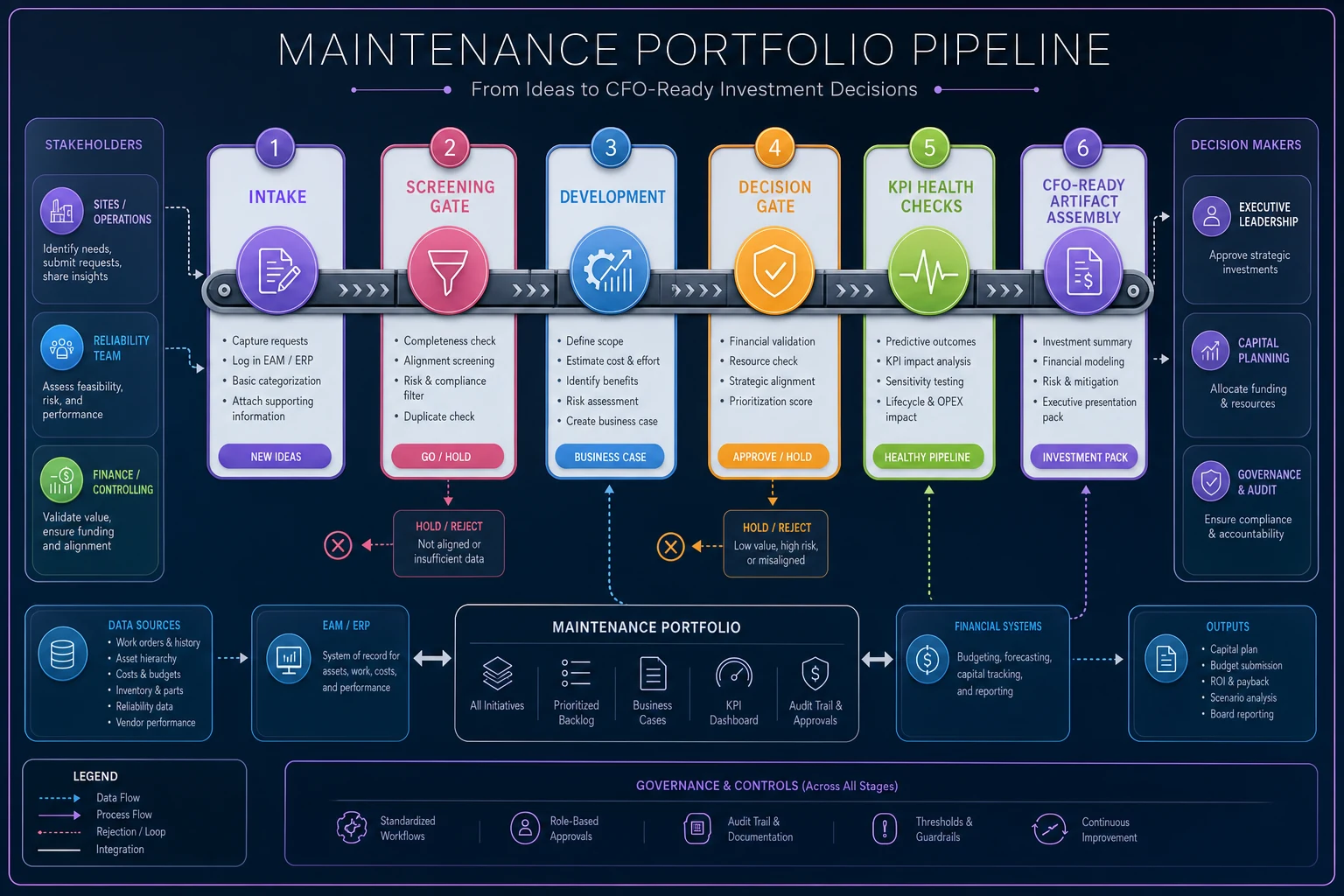
The pipeline only works if the underlying data and process maturity support each gate, and a visual makes misalignments obvious early.
Intake: designing the front door so it doesn't clog
The most common intake mistake is asking for too much upfront. If the intake form demands a full NPV model, field engineers won't fill it out, and you'll only ever hear from people who already know how to game the capital process. The good ideas from the shop floor never make it in.
Keep intake to what a reliability lead can answer in fifteen minutes:
-
Asset or asset class and its criticality tier
-
The failure mode or inefficiency being targeted
-
Rough order-of-magnitude cost (a band, not a precise number)
-
Expected benefit type — avoided downtime, extended life, reduced labor, compliance risk reduction
-
Who sponsors it and which budget it would touch
-
Whether the data needed to prove the benefit already exists
Keep intake to what a reliability lead can answer in fifteen minutes.
That last point matters more than people expect. A pilot with a great hypothesis but no way to measure the result is a pilot that will haunt you at the KPI health check. Better to flag the measurement gap at intake and either fix it or downgrade the request.
One pattern worth watching: sites that flood intake right before budget season. That's a sign your pipeline is being treated as a once-a-year event instead of a continuous flow. A healthy pipeline has intake trickling in year-round, which also gives you a natural backlog to draw from when funding opens up unexpectedly.
Decision-gate templates that hold up under scrutiny
A decision gate without written criteria is just a meeting where the senior person's opinion wins. That's fine until the CFO asks why Project A got funded over Project B, and the honest answer is "the plant manager pushed harder."
A gate template forces the criteria into the open. Here's a workable structure for a maintenance investment decision gate:
| Gate criterion | What you're checking | Pass threshold |
|---|---|---|
| Risk alignment | Does the target asset sit within stated risk appetite priorities? | Criticality tier 1–2, or documented exception |
| Benefit confidence | How solid is the benefit estimate? | Rated High/Med; Low requires a smaller pilot first |
| Measurability | Can we verify the outcome with existing or funded instrumentation? | Measurement plan attached |
| Cost integrity | Is the CAPEX/OPEX split defensible and ERP-reconcilable? | Split reviewed with finance |
| Dependency check | Does this rely on another unfunded project? | No blocking dependencies |
| Portfolio fit | Does it duplicate or conflict with an existing funded item? | No overlap |
The key discipline: a project either clears every gate or it goes back for rework. No partial passes waved through on urgency. Urgency is real, but it belongs in a separate expedited lane with its own criteria — not as an excuse to skip the math.
Once gates are written down, the quality of intake tends to improve on its own. When sponsors know exactly what they'll be scored against, they stop submitting half-baked cases. The gate does double duty as a filter and a teaching tool.
Prioritization: ranking when everything feels urgent
Passing the gate gets a project into the "fundable" pool. It doesn't tell you what order to fund things in when the budget can't cover everything — which it never can.
A simple two-axis matrix does most of the work: risk-reduction impact against implementation confidence. Plotting projects across these gives you four practical zones:
-
High impact, high confidence — Fund first. These are your anchor investments.
-
High impact, low confidence — Fund a scoped-down pilot to buy confidence before committing full capital.
-
Low impact, high confidence — Fill-in projects. Fund with leftover budget or bundle for efficiency.
-
Low impact, low confidence — Park them. Revisit only if the risk profile changes.
The mistake people make is over-engineering the scoring — weighting seven factors to two decimal places and pretending the false precision means something. A prioritization matrix is a conversation tool, not an oracle. Its job is to make trade-offs visible and force an honest discussion about which quadrant something actually belongs in. If two reasonable people plot a project in different quadrants, that disagreement is the valuable part.
For teams still building this discipline, tying prioritization directly to funding gates is what separates a wish list from a portfolio. The approach of turning reliability pilots into funded investments using lifecycle TCO models pairs naturally with the matrix — TCO gives you the impact axis with real numbers instead of gut feel.
CAPEX vs OPEX: the mapping rules that make or break credibility
Nothing torpedoes a portfolio faster than sloppy CAPEX/OPEX classification. If finance finds one misclassified item, they start doubting all of them, and suddenly your whole pipeline is under audit.
The distinction isn't always obvious in maintenance work, which is exactly why you need documented rules rather than case-by-case judgment. A few practical mapping principles:
-
Restoring an asset to its original condition is typically maintenance expense (OPEX). Replacing a failed motor with an equivalent motor doesn't extend the asset's life beyond its original expectation.
-
Extending useful life or increasing capacity/output usually qualifies as capital (CAPEX). Upgrading to a higher-spec component that materially extends service life often meets the threshold.
-
Bundled projects need splitting. A single work package that both restores and upgrades gets decomposed — the restoration portion to OPEX, the enhancement portion to CAPEX.
-
Sensors and monitoring hardware are often capitalizable, but the ongoing analytics and labor to run them are OPEX. Getting this split right at the case stage saves painful reversals later.
The single most valuable habit here is reconciling the classification with finance before the decision gate, not after funding. When the split has already been reviewed, the CFO artifact carries far more weight. This ties directly into broader asset capitalization and maintenance controls, including decision rules and EAM→ERP reconciliation — the portfolio pipeline should feed clean, pre-classified data straight into that reconciliation process rather than creating a second version of the truth that needs to be reconciled later.
A worked example: the spreadsheet that moves money
Abstract frameworks don't get funded. Numbers do. Here's a simplified version of the kind of roll-up that translates local pilots into an enterprise ask.
-
Site A — pump seal monitoring. CAPEX ~$85k (sensors + install), OPEX ~$18k/yr (analytics, labor). Estimated avoided downtime benefit: roughly $140k–$160k/yr, confidence rated High.
-
Site B — spares pooling reconfiguration. CAPEX minimal, mostly OPEX ~$12k/yr in logistics. Estimated carrying-cost reduction: around $95k/yr, confidence Medium.
-
Site C — calibration interval optimization. CAPEX ~$30k (test equipment), OPEX ~$9k/yr. Estimated benefit: about $60k/yr in avoided rework and compliance exposure, confidence Medium-High.
Rolled into a portfolio view, the enterprise ask is roughly $115k CAPEX and about $39k in incremental annual OPEX, against a blended estimated annual benefit somewhere in the $290k–$315k range. Even discounting Site B and Site C for their confidence ratings, the portfolio payback lands comfortably under two years.
Here's why the portfolio framing wins where the individual cases might not: Site B alone, with Medium confidence and no CAPEX, might get waved off as "just an operational tweak." Bundled with two stronger cases sharing the same measurement discipline and the same reconciled cost basis, it rides along as part of a coherent program. The CFO isn't evaluating three separate arguments — they're evaluating one portfolio with a transparent range and a stated confidence method.
That's the whole point. A single pilot is a bet. A governed portfolio is a plan.
KPI health checks: the part everyone skips (and pays for)
Getting funded is not the end of governance. It's the start of the next cycle's credibility. If you claimed $140k in avoided downtime at Site A and never verify it, your next request starts from zero trust.
Health checks should be scheduled at intake, not improvised after the fact. For each funded item, define:
-
The specific metric that proves the benefit (not a proxy — the actual thing)
-
The baseline it's measured against
-
The check cadence — quarterly is usually enough for reliability projects
-
A tolerance band and what happens when a project falls outside it
The uncomfortable but essential move is publishing the misses alongside the hits. A portfolio that reports "seven of nine pilots delivered within tolerance, two underperformed for these documented reasons" is more credible than one claiming a perfect record. Finance has seen enough business cases to know perfection is a red flag.
This is also where a lot of manual reporting collapses. Pulling KPI actuals from the EAM, reconciling them against the funded baseline, flagging drift, and assembling the quarterly view — done by hand across a dozen sites, it eats days and it's error-prone. This is where AI-assisted operational platforms earn their keep: automatically pulling actuals against baselines, surfacing pilots that are drifting out of tolerance, and drafting exception summaries so the reliability team spends its time investigating variances instead of compiling spreadsheets. The governance model is what matters; the automation just removes the drudgery that causes people to skip the health checks in the first place.
When this level of governance makes sense — and when it doesn't
A full portfolio pipeline is real overhead. It's not always the right call.
It makes sense when:
-
You run multiple sites competing for a shared capital pool
-
Maintenance investment cases regularly get deferred for lack of comparability
-
Finance has flagged classification or reconciliation concerns
-
You have enough project volume that a standardized flow saves more time than it costs
It's overkill when:
-
You're a single-site operation with one budget owner who sees everything anyway
-
Your annual maintenance capital is small enough that a shared spreadsheet handles it
-
You don't yet have reliable EAM data to feed the KPI checks — build that foundation first
Who should not attempt this yet: organizations without a trustworthy asset data layer. If your EAM has duplicate records, inconsistent criticality tiers, or unreconciled cost history, a governance pipeline will just industrialize bad data. Fix the foundation, then build the pipeline on top of it. Pouring structure over unreliable inputs produces confident-looking artifacts built on sand — which is worse than no artifacts at all, because people actually believe them.
A short real scenario
A mid-sized regional utility ran maintenance capital across five service areas, each submitting requests in its own format. In a typical cycle, roughly half the reliability projects got deferred — not rejected on merit, just deferred because finance couldn't compare them and defaulted to the easy-to-understand ones.
They introduced a standardized intake and a scored decision gate, plus a single portfolio roll-up with pre-reconciled CAPEX/OPEX splits. Nothing exotic. The first cycle under the new model, the maintenance portfolio shifted from a scattered set of individual pleas to one ranked program with a stated confidence range.
The result wasn't that everything got funded — plenty of projects still got parked. But the funded share of gate-cleared projects climbed noticeably, the reconciliation disputes with finance mostly dried up, and the following cycle's requests came in cleaner because sponsors knew the criteria in advance. The biggest shift was cultural: maintenance stopped being the department that "asks for money" and became the one that "manages a portfolio." That reputation, more than any single approval, is what compounds.
The organizations that consistently secure enterprise funding for maintenance aren't the ones with the best individual projects. They're the ones whose projects arrive in a common shape, pass through visible gates, carry reconciled numbers, and get honestly measured afterward. The pipeline is what converts local reliability wins — which happen everywhere — into capital decisions the CFO can actually defend.
Build the front door so good ideas can enter. Write the gates so decisions aren't about volume of argument. Fix the CAPEX/OPEX split before finance ever asks. And close the loop with health checks so this cycle's credibility funds next cycle's ambitions. Do that consistently, and maintenance portfolio governance stops being a compliance exercise and becomes the mechanism that gets your reliability work paid for.
Ready to elevate your asset operations?
Join 1,500+ businesses using Ownitly to optimize asset utilization, reduce downtime, and ensure compliance.