

Most fixed-asset evaluations go wrong in the same place: the demo. A vendor walks finance through a slick depreciation schedule, shows a clean disposal workflow, and everyone nods. Six months after go-live, the controller discovers the system can't handle a mid-year convention switch for a specific state, or that bonus depreciation elections don't carry cleanly across entities, or that the "audit trail" is really just a last-modified timestamp with no before/after values.
That gap — between what gets demoed and what finance actually has to defend during an audit or a tax filing — is what this guide is really about. Whether you're replacing a spreadsheet-based register, consolidating entities after an acquisition, or trying to figure out if your ERP's fixed-asset module is enough, the questions below are the ones that separate a good decision from an expensive one.
Start with the depreciation engine, not the UI
Everything else in a fixed-asset system is downstream of how it calculates and stores depreciation. If the engine is weak, no amount of dashboard polish saves you.
What people consistently underestimate is how many parallel depreciation "books" a real company needs to run simultaneously. A typical mid-sized manufacturer runs:
-
GAAP book (financial reporting)
-
Federal tax book (MACRS, bonus, Section 179)
-
State tax books — often several, because states decouple from federal bonus rules
-
AMT / ACE where still relevant
-
Management or internal book (sometimes a different useful-life assumption)
Each of those needs its own conventions, methods, and life tables, and they all have to tie to the same underlying asset. When a vendor says they support "multiple books," the real question is whether changing something on the asset — a cost adjustment, a partial disposal, a transfer between entities — propagates correctly across every book without someone re-keying it.
A pattern worth watching for: systems that handle the happy path (straight-line GAAP, standard MACRS) but fall apart on edge cases that actually cost money. Mid-quarter convention triggers. Short tax years. Like-kind exchange basis carryover. Bonus depreciation opt-outs by asset class and state. These are exactly the scenarios where a weak engine forces manual overrides, and manual overrides are where audit findings live.
What to actually test in a demo:
-
Load an asset acquired mid-year, then force a mid-quarter convention across the class and confirm it recalculates every affected book.
-
Do a partial disposal (sell 40% of a pooled asset) and verify the gain/loss splits correctly across GAAP and tax.
-
Change a useful life retroactively and see whether it handles the catch-up as a prospective change or forces a restatement.
-
Run a state that decouples from federal bonus and confirm the state book diverges correctly.
If a salesperson has to "get back to you" on any of those, you've learned something important.
Tax treatment depth is where ERP modules usually fall short
This is the fork in the road for most buyers. The core decision is whether your ERP's fixed-asset module is sufficient or whether you need a dedicated system.
Stop losing track of critical assets.
Ownitly helps you monitor, maintain, and manage every asset efficiently and reliably.
- Centralized asset tracking
- Automated maintenance alerts
- Compliance monitoring & reporting
No credit card required
ERP modules — the fixed-asset components inside your general ledger platform — are genuinely good at integration and generally weak at tax depth. They were built to feed the GL, not to defend a tax position. Dedicated fixed-asset platforms are the reverse: deep tax logic, strong compliance reporting, but you pay for the integration work to connect them.
| Scenario | Dedicated Fixed-Asset System | ERP Fixed-Asset Module | EAM Linkage |
|---|---|---|---|
| Single entity, <500 assets, simple tax | Overkill | Best fit | Not needed |
| Multi-state, bonus/179 complexity | Best fit | Risky — manual overrides pile up | N/A |
| Many entities post-acquisition | Best fit for consolidation/book management | Workable if same ERP everywhere | N/A |
| Heavy physical assets, field inspections | Pair with EAM | Pair with EAM | Source of truth for existence/condition |
| Need deep audit trail + tax provision | Best fit | Depends on vendor | Feeds capitalization events |
The EAM column trips people up, so it's worth being clear: your Enterprise Asset Management or CMMS system is not your accounting record. It knows where the pump is, its condition, and its maintenance history. Your fixed-asset system knows its cost basis, accumulated depreciation, and book value. The two have to reconcile, but they answer different questions. The mechanics of keeping those capitalization events reconciled between operational and financial systems is one of the most common places controls break down after an acquisition or a big CAPEX wave.
A real failure pattern: a company stands up a new EAM for maintenance, starts tagging assets there, and quietly ends up with two asset registers that disagree. Finance's register says 4,200 assets; the EAM says 5,600 because technicians created records for components finance treats as expense. Nobody owns the reconciliation. Two years later an auditor pulls a sample and half the items can't be traced between systems.
Multi-entity reporting: the feature that gets undersold
If you operate more than one legal entity, multi-entity handling moves from "nice to have" to "the whole reason you're buying." The problems here are subtle and expensive.
Inter-company asset transfers are the classic trap. When an asset moves from Entity A to Entity B, you need the system to retire it in A, establish it in B, carry over (or reset, depending on jurisdiction) the basis, and keep the historical trail intact so you can explain the whole lifecycle to an auditor. Systems that treat this as "dispose and re-add" lose the connective tissue, and you spend audit season manually stitching the story back together.
Consolidated reporting is the other piece. You want roll-up depreciation expense by entity, by cost center, and by asset class, with the ability to drill from a consolidated number down to the individual asset. The question to ask vendors isn't "can you consolidate" — it's "show me the drill-down from a consolidated depreciation line to a single asset's detail across three entities." If that takes more than a couple of clicks, your month-end close just got slower.
A smaller but recurring issue: currency. If entities report in different functional currencies, you need the system to hold cost in the asset's currency and translate for consolidation without corrupting the underlying basis. A lot of mid-market tools handle one currency gracefully and the second one badly.
Audit trails that actually hold up
"Audit trail" is one of those phrases every vendor claims and few deliver at the depth a controller actually needs. The distinction that matters: a change log records that something changed; a real audit trail records what the value was before, what it became, who changed it, when, and ideally why.
What a defensible audit trail needs to capture:
-
Before/after values on every financially relevant field (cost, life, method, convention, in-service date)
-
User identity tied to the actual person, not a shared service account
-
Timestamp in a consistent, immutable format
-
A reason code or note where the change is a judgment call
-
Immutability — the trail itself cannot be edited or purged within the retention window
That last point connects to a bigger architecture question most buyers skip: how long you keep the records and how you prove they weren't altered. Fixed-asset records can matter in a dispute or exam years after the asset is gone. If you're thinking seriously about defensibility, it's worth reviewing the long-term archival and audit-replay patterns that let you reconstruct the exact state of your records as of any past date. A system that can replay "what did this asset's schedule look like on the filing date three years ago" is worth far more during an exam than one that only shows current state.
Physical inventory and tagging — the part finance forgets
Depreciation math is clean. The physical world is not. The single biggest driver of a messy asset register is the gap between what's on the books and what's actually sitting in the plant.
Here's how the drift happens. Assets get moved between locations and nobody updates the register. Equipment gets scrapped but the disposal never gets recorded, so you keep depreciating a machine that's been gone for eighteen months — a "ghost asset." Or two facilities each tag the same shared asset, creating a duplicate. Over a few years, a register that started clean quietly develops a 10–15% error rate, and you don't find out until an insurance claim or a property-tax audit forces a physical count.
Tagging method matters more than people expect:
-
Barcode — cheap, reliable, but requires line-of-sight scanning. Fine for office and IT assets.
-
QR — holds more data, scannable by phone, good for field teams without dedicated scanners.
-
RFID — scan many assets fast without line of sight, great for high-volume warehouses, but tags and readers cost more and metal/liquid environments interfere with reads.
-
GPS/IoT — for high-value mobile assets (vehicles, portable gensets) where location is part of the control.
The practical mistake is picking one tagging technology for everything. A mix is usually right: RFID in the warehouse, QR for field equipment, barcode for office IT. What you need from the software is the ability to run a reconciliation workflow — scan, compare to the register, flag found/missing/moved, and generate an exception list for someone to clear. If your physical-inventory process is a once-a-year spreadsheet exercise, that error rate will keep climbing.
Run small tagging pilots in each environment to validate read rates and workflows before full deployment.
If your physical-inventory process is a once-a-year spreadsheet exercise, that error rate will keep climbing.
The integration map: ERP, EAM, and procurement
A fixed-asset system never lives alone. Three integration points determine whether it reduces work or just adds another silo.
ERP / General Ledger — This is non-negotiable. Depreciation journal entries, additions, disposals, and transfers all need to post to the GL without manual re-entry. The question is the direction and timing: does the fixed-asset system push summarized JEs on a schedule, or does it post real-time? For most controllers, a reviewable batch per period beats real-time, because you want eyes on the numbers before they hit the ledger.
EAM / CMMS — The link here is about capitalization triggers and existence. When a major maintenance event or a capital project completes in the EAM, that's often a capitalization event — a new asset or a basis addition. The EAM should feed those triggers to finance rather than relying on someone to notice. The handoff between operational and financial systems is a frequent breakdown point, especially during periods of heavy capital spending. If you're absorbing a wave of new asset investment, the practical moves for handling a capital-goods surge cover how to keep that capitalization pipeline from falling apart under volume.
Procurement / AP — The acquisition cost, in-service date, and vendor info should ideally flow from the purchase record so you're not keying asset details twice. This is where a lot of in-service-date errors originate: AP records the invoice date, but the asset wasn't actually placed in service for another six weeks, and that difference moves your depreciation start.
The workflow you want, described plainly:
-
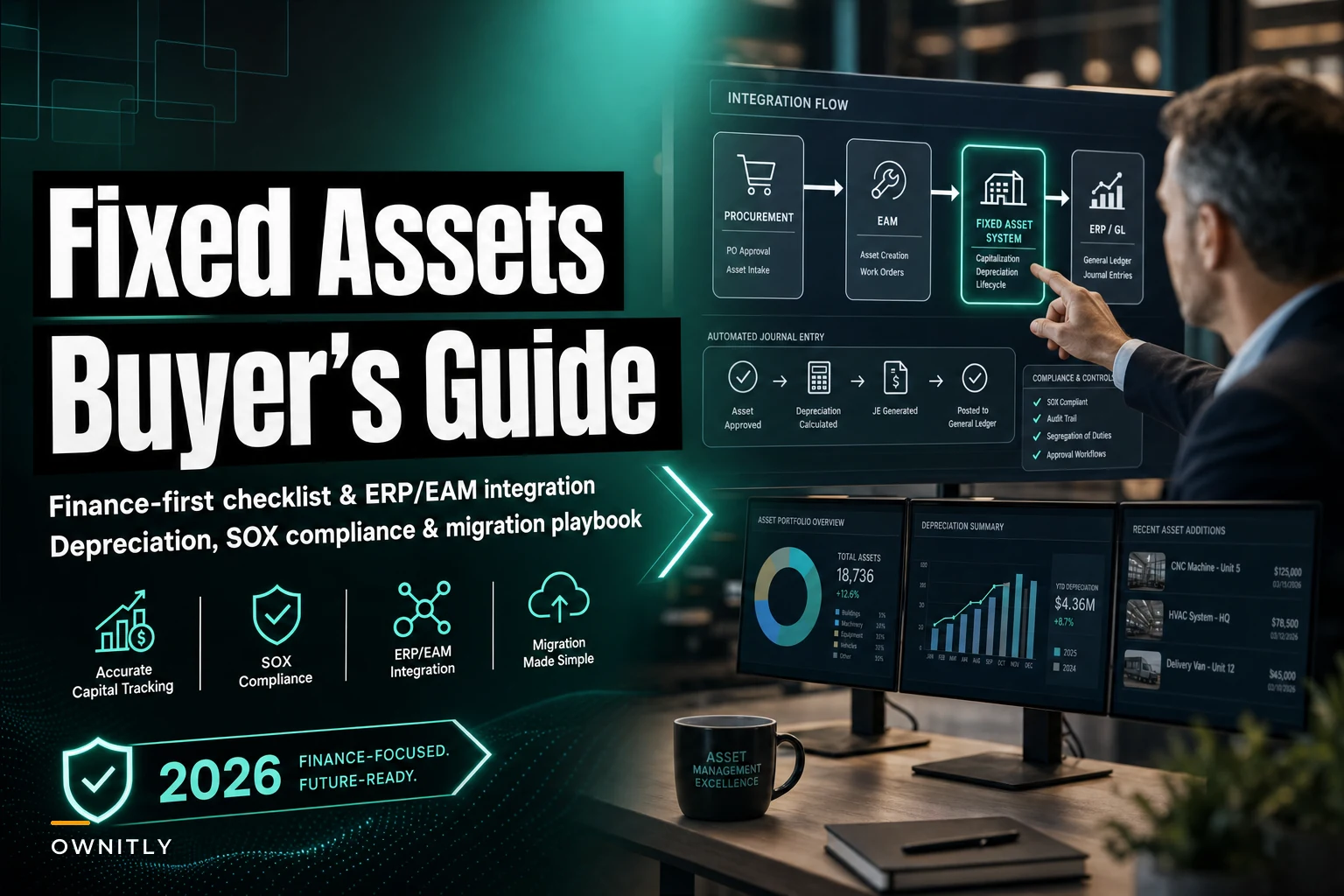
A capital PO gets approved in procurement.
-
The asset is received and cost flows to a construction-in-progress or clearing account.
-
When it's placed in service, finance — prompted by either procurement or the EAM — creates the fixed-asset record with the correct in-service date.
-
Depreciation begins.
-
Each period the JE posts to the GL.
-
Eventually, disposal or transfer closes the loop, with every step leaving an audit trail.
Visualized, the end-to-end handoffs look like this.
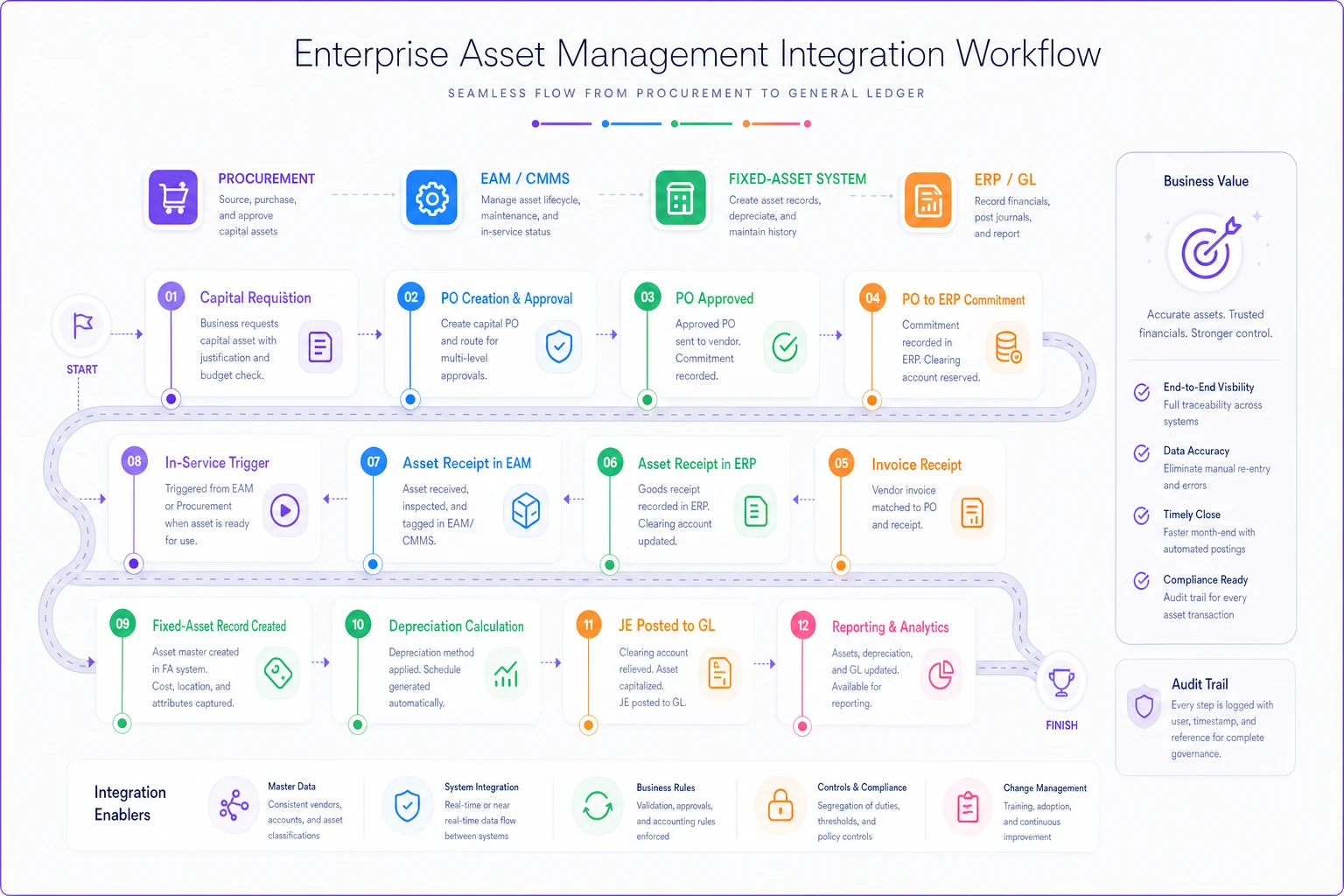
If any one of those handoffs depends on a person remembering to send an email, that's your weak link.
A vendor evaluation checklist you can actually use
Pull this into your RFP. These are the criteria that separate vendors who demo well from vendors who perform after go-live.
-
[ ] Supports unlimited (or at least 5+) parallel depreciation books tied to one asset
-
[ ] Handles all required state tax treatments, including bonus decoupling
-
[ ] Mid-quarter convention auto-triggers across an asset class
-
[ ] Partial disposals and partial transfers with correct gain/loss splits
-
[ ] Inter-company transfers preserve full history and handle basis correctly
-
[ ] Consolidated reporting with drill-down to individual assets across entities
-
[ ] Audit trail captures before/after values, user, timestamp, reason — and is immutable
-
[ ] Point-in-time reporting (reconstruct a schedule as of a past date)
-
[ ] Physical inventory reconciliation workflow with exception handling
-
[ ] Supports your tagging mix (barcode / QR / RFID)
-
[ ] ERP/GL integration with reviewable batch posting
-
[ ] Capitalization-trigger feed from EAM/CMMS
-
[ ] Procurement/AP feed for acquisition cost and in-service date
-
[ ] Data migration tooling and documented history import
-
[ ] Role-based access control and segregation of duties
-
[ ] Clear data export / exit path (you will leave someday)
That last item is one people skip and regret. Ask, in writing, how you get your full data out including history if you cancel. A vendor who can't answer cleanly is telling you something.
Data migration: where projects actually die
More fixed-asset implementations get wrecked by bad migration than by bad software. The reason is straightforward — you're not just moving current balances, you're carrying forward accumulated depreciation, original cost, in-service dates, and often years of history that has to tie out exactly.
The error that keeps coming up: teams migrate net book value instead of original cost plus accumulated depreciation separately. The current balance looks right, but now the system can't recalculate prior-period depreciation, run a correct gain/loss on disposal, or reconstruct the schedule for an audit. You've imported a number, not an asset.
A short migration playbook that reduces disruption:
-
Freeze and reconcile the source. Before you move anything, get the existing register to tie to the GL. Migrating a register that doesn't reconcile just moves the problem.
-
Separate cost and accumulated depreciation. Import original cost, in-service date, method, convention, and accumulated depreciation as distinct fields — never just net book value.
-
Run parallel for one full period. Calculate depreciation in both systems for a month (or a quarter) and reconcile to the penny before you cut over. Differences here are cheap to fix; differences after go-live are not.
-
Migrate history in waves. Current assets first, then disposed-but-within-retention assets, then older history if you need it for replay. Don't try to move everything at once.
-
Validate with a disposal test. Dispose a migrated asset in the new system and confirm the gain/loss matches what the old system would have produced. If it matches, your basis and depreciation carried correctly.
-
Keep the old system readable, not just archived. For at least one audit cycle, keep the ability to query the legacy register, because someone will ask.
The parallel-run step is the one teams want to skip under deadline pressure. It's also the single most effective safeguard you have — skipping it to hit a go-live date is how you create a problem that takes quarters to untangle.
A realistic ROI and total-cost-of-ownership picture
Buyers tend to compare license prices and ignore the costs that actually dominate the total. Here's where the money really goes over a few years.
Take a company with around 3,000 fixed assets across four entities, currently running the register in spreadsheets with one senior accountant spending roughly a week each quarter on depreciation and reconciliation. The visible pain is time. The hidden pain is risk — ghost assets still depreciating, missed Section 179 elections, property-tax overpayments on assets that were scrapped.
The costs you should model:
-
Software — subscription or license, plus per-entity or per-asset tiers
-
Implementation — usually the biggest first-year line; migration and configuration
-
Integration — connecting ERP, and optionally EAM and procurement
-
Training and change — the accountant who ran the spreadsheet needs to trust the new engine
-
Ongoing — support, version updates, periodic physical inventory
On the benefit side, the recoverable value usually isn't headcount — it's error elimination. Cleaning up ghost assets often trims property-tax and insurance exposure by a few percent of the asset base, which on a mid-sized register can be real money. Catching depreciation elections correctly affects cash taxes. And the time saved at close is steady rather than dramatic — maybe reclaiming a few days per quarter that were going to reconciliation.
The honest framing: a dedicated fixed-asset system rarely pays for itself on time savings alone at smaller asset counts. It pays for itself on risk reduction and tax accuracy — which is exactly why the depreciation-engine depth matters more than the dashboard.
When each option actually makes sense
A dedicated fixed-asset system makes sense when: you run multiple entities, deal with multi-state tax complexity, have meaningful bonus/179 activity, or need audit-grade point-in-time reporting. The tax depth justifies the integration cost.
The ERP module makes sense when: you're a single entity (or a few entities all on the same ERP), your tax situation is relatively straightforward, and you value having everything in one system over having the deepest tax engine. Don't over-buy.
Leaning on EAM/CMMS for the accounting register is almost always a bad idea. EAM is your source of truth for existence and condition, and it should feed capitalization events — but it is not built to defend a tax position or produce a consolidated depreciation roll-up. Keeping a clean boundary between the operational record and the financial record, with a disciplined reconciliation between them, saves you from the duplicate-register mess described earlier. The same discipline that keeps calibration and maintenance records trustworthy — knowing exactly which checks to keep and document — applies to keeping your two asset registers honest.
Who should wait: if your current register doesn't reconcile to the GL today, fix that before you buy anything. Migrating a broken register into a better tool gives you a more expensive broken register.
The one thing to get right
Test the depreciation engine against your ugliest real scenarios before you fall for the interface. The mid-year convention switch, the partial disposal, the state that decouples from federal bonus, the inter-company transfer that has to preserve history. Those edge cases are where systems either hold up for a decade or generate a steady stream of manual overrides and audit findings.
The interface you'll get used to in a week. The depreciation engine and the audit trail are what you'll be defending for years. Evaluate accordingly, insist on a parallel run before cutover, and keep the boundary clean between what your operational systems know and what your financial records must prove.
The interface you'll get used to in a week. The depreciation engine and the audit trail are what you'll be defending for years. Evaluate accordingly, insist on a parallel run before cutover, and keep the boundary clean between what your operational systems know and what your financial records must prove.
Ready to elevate your asset operations?
Join 1,500+ businesses using Ownitly to optimize asset utilization, reduce downtime, and ensure compliance.