


Most EAM programs don't fail because the software is bad. They fail somewhere between the pilot that everyone loved and the third site rollout where nobody's using mobile work orders, half the asset records are still wrong, and the sponsor who championed the whole thing quietly moved on to something else. The technology got installed. The behavior never changed.
That gap — between "we bought the platform" and "the organization actually runs on it" — is where an EAM change and adoption operating model earns its keep. Not a training plan. Not a comms deck. An operating model: a repeatable ladder that ties who's sponsoring what, how funding gets released in stages, which levers you pull at each site, and how you know whether adoption is real or theater.
This is the playbook version. It maps sponsorship, staged funding gates, site-level change levers, training, capability uplift, and adoption KPIs into an 18-month rollout — with the runbooks and role clarity that keep it from collapsing into a spreadsheet nobody updates.
Why enterprise EAM adoption breaks even when the pilot works
Here's the pattern. The pilot site gets extraordinary attention — a hand-picked reliability lead, vendor engineers on speed dial, a data set someone cleaned by hand, and a small crew of technicians who happen to be curious about new tools. Adoption looks fantastic. Everyone declares victory and funds the enterprise rollout.
Then site two gets a fraction of that attention. Site three gets a login and a PDF. By the time you reach site six, the "rollout" is really just software provisioning, and the behaviors that made the pilot work — clean data entry, disciplined work-order closeout, mobile-first inspections — never traveled with the platform.
-
Funding is committed up front instead of staged. Once the full budget is approved, there's no natural checkpoint to catch a site that's drifting. Money flows regardless of whether adoption is landing.
-
Sponsorship is nominal, not operational. An executive lends their name to the kickoff, then disappears until the program is in trouble.
-
Change levers get treated as one-time events. Training happens once. Data cleanup happens once. The org assumes it's done, and entropy takes over.
-
Adoption gets measured by license count, not behavior. "We have 400 users provisioned" tells you nothing about whether work orders are being closed properly.
The fix isn't more enthusiasm. It's sequencing. You need a ladder where each rung has a funding gate, a set of levers, and a measurable adoption bar that must clear before money and attention flow to the next rung.
The rollout ladder: five stages across 18 months
Think of the whole program as five stages. Each stage has an entry gate (what must be true to start), a funding release tied to it, and an exit gate (adoption KPIs that must clear before you advance). This is deliberately paced — trying to compress it into six months is how you end up with the site-six problem above.
Stop losing track of critical assets.
Ownitly helps you monitor, maintain, and manage every asset efficiently and reliably.
- Centralized asset tracking
- Automated maintenance alerts
- Compliance monitoring & reporting
No credit card required
| Stage | Months | Sites in scope | Funding gate releases | Exit adoption bar |
|---|---|---|---|---|
| 0 — Foundation | 0–3 | None (HQ) | ~10% (setup, governance, data baseline) | Governance signed, data quality baseline measured |
| 1 — Pilot | 3–6 | 1 lead site | ~15% | Activation + data-quality KPIs green for 6 weeks |
| 2 — Proof at variance | 6–10 | 2–3 dissimilar sites | ~20% | KPIs hold at sites unlike the pilot |
| 3 — Scale wave | 10–15 | 40–60% of sites | ~35% | Rolling site-level KPI clearance |
| 4 — Tail + sustain | 15–18 | Remaining sites | ~20% | Enterprise adoption steady, sustain model live |
A simple visual workflow of the rollout ladder:
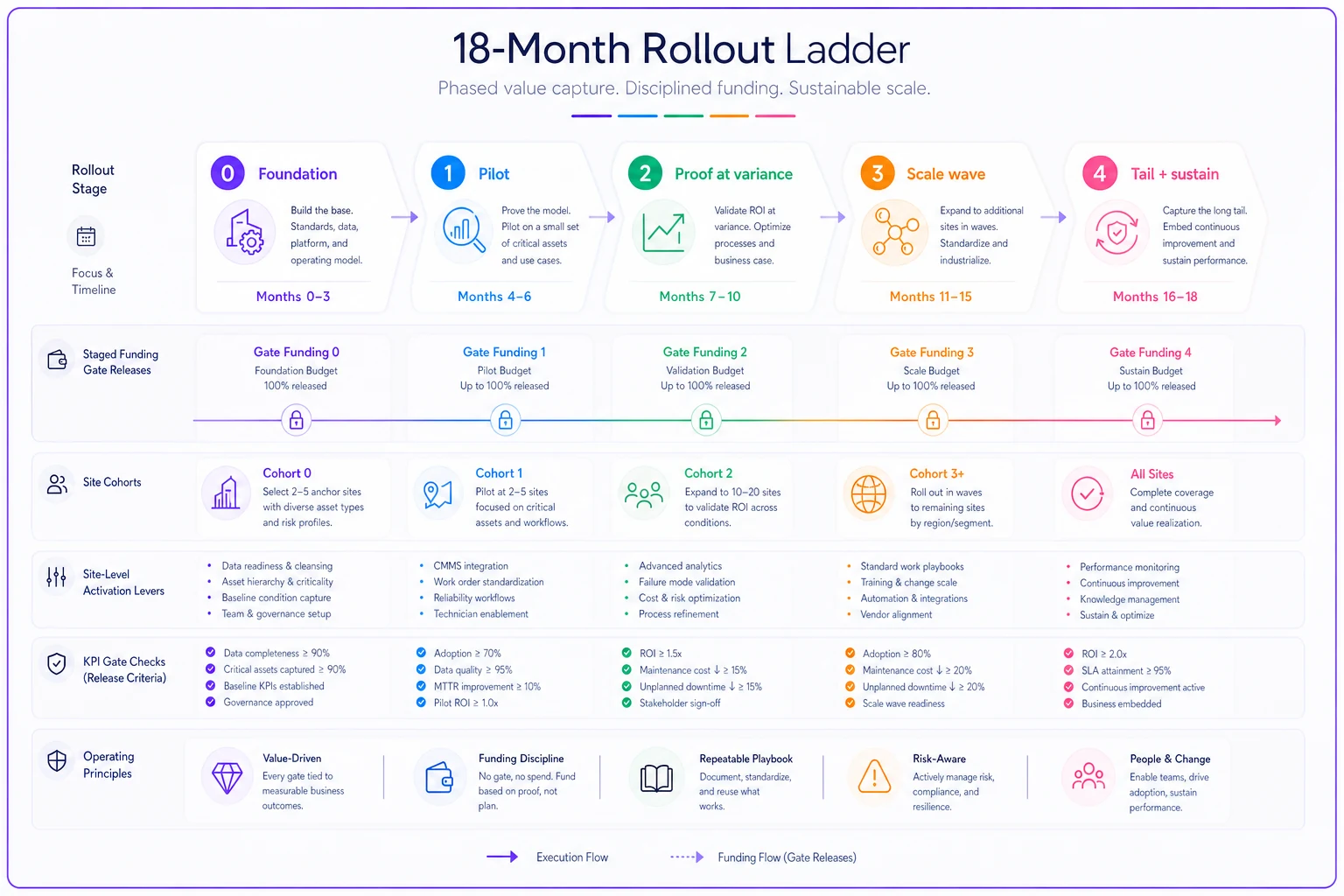
The percentages matter more than the exact numbers. The point is that roughly two-thirds of your funding is locked behind the moment when you've actually proven adoption travels across different kinds of sites — not just the friendly pilot. That's the checkpoint most programs skip.
Stage 2 is the one people consistently underestimate. If your pilot was a modern, well-staffed facility, prove the model at your worst-connected, most understaffed, most skeptical site before you commit scale funding. The variance stage is where you find out whether your runbooks are actually robust or whether they only worked because the pilot was easy.
Sponsorship that actually does something
Nominal sponsorship is the quiet killer. Someone senior agrees to be "executive sponsor," shows up at the kickoff, then disappears until things are on fire. That's not sponsorship — that's a photo op.
Operational sponsorship means someone with budget authority is on the hook for the funding gates and shows up when a site pushes back. In practice, three sponsor roles need to be distinct people:
-
Enterprise sponsor — owns the funding ladder, chairs the gate reviews, has the authority to pause the rollout when a gate isn't met. This person cares about the whole portfolio, and the maintenance portfolio governance model to secure enterprise funding is essentially the financial spine this role sits on top of.
-
Site sponsor — for each site, the plant or facility leader who commits their people's time and owns local adoption. Without this, technicians correctly read the rollout as "corporate's project" and wait it out.
-
Program owner — the day-to-day operator who runs the runbooks, tracks the KPIs, and escalates. The person who catches drift early.
A useful test: if your enterprise sponsor can't tell you, unprompted, which adoption KPI is closest to missing its gate this month, they're a figurehead. Real sponsors know the numbers because they're the ones who have to withhold funding if the numbers slip.
Site-level change levers
At each site you pull the same set of levers, but you tune the intensity based on where that site is starting from. Tying levers to a maturity assessment keeps you from over-investing in sites that are already capable and under-investing in the ones that need hand-holding. If you haven't already mapped your sites, the maintenance maturity model that links capability gaps to concrete interventions is the natural input here — it tells you which levers each site actually needs.
-
Data readiness. No site goes live until its asset register clears a quality bar. Duplicate records, missing criticality ratings, and orphaned parts records will poison adoption on day one because technicians stop trusting what they see on screen. If a site is migrating from an old system, the three-phase master data cleanup plan with rollback controls is the entry work, not a nice-to-have.
-
Role-based training. Not "everyone gets the same course." Planners, technicians, storeroom staff, and supervisors each get a workflow-specific path. A technician needs mobile closeout and photo evidence; a planner needs scheduling and backlog logic.
-
Local super-users. One or two respected technicians per site trained to a deeper level, positioned as the go-to instead of the help desk. Adoption moves through people the crew already trusts.
-
Workflow enforcement. Turning off the old path. If people can still email work requests or keep the paper log, they will. Adoption requires closing the escape hatches — deliberately, and with the site sponsor's cover.
-
Feedback loop. A weekly channel where field frustrations get triaged and fixed fast during the first six weeks. Nothing kills adoption faster than raising a legitimate problem and hearing nothing back.
Map levers to each site's maturity assessment so support goes to the sites that need it most.
The mistake is treating these as sequential checkboxes. They're continuous. Data readiness isn't "done" at go-live — it degrades weekly if entry discipline slips, which is exactly why the adoption KPIs below track data quality as an ongoing signal, not a one-time gate.
Adoption KPIs: measuring behavior, not licenses
Most scorecards go soft here. "Users provisioned" and "training completed" are activity metrics. They don't tell you whether the site runs on the platform. You need two families of KPIs, and both have to be green before a site clears its gate.
Activation KPIs — is the platform actually being used the way it's supposed to be?
-
Percentage of work orders created in-system vs. through legacy paths (target: 90%+ before gate clearance)
-
Mobile closeout rate — work orders closed in the field vs. batch-entered later
-
Planner adoption — schedules built in-platform vs. offline spreadsheets
Data-quality KPIs — is the data trustworthy enough to make decisions on?
-
Percentage of completed work orders with required fields populated (failure codes, labor hours, parts used)
-
Duplicate asset record rate, trending down
-
Work-order closeout accuracy sampled through spot audits
A single site scorecard might look like this:
-
Work orders created in-system
92% ✅
-
Mobile closeout rate
78% ⚠️ (target 85%)
-
Required-field completion
88% ✅
-
Duplicate asset rate
1.2%, down from 4% ✅
-
Planner in-platform scheduling
70% ⚠️ (target 80%)
Two ambers means this site does not clear its gate. That's the whole point — the KPI bar has teeth. A site that's mostly-there gets another few weeks of super-user support and enforcement, not a green light. Letting "mostly there" sites through is how the enterprise average slowly degrades until the whole program looks half-adopted.
Example runbook: the site pilot
A runbook is what makes a rollout repeatable instead of heroic. Here's a compressed version of a site pilot runbook — the sequence a program owner follows for each new site.
-
Week -4 to -2
Readiness assessment.
Score the site's data quality, connectivity, and staffing against the maturity model. Flag the gaps that need levers. -
Week -2
Data cleanup gate.
Asset register must clear the quality bar. If it doesn't, go-live slips. No exceptions — going live on dirty data is the single most common cause of adoption collapse. -
Week -1
Role-based training.
Deliver the workflow-specific paths. Certify super-users to the deeper standard. -
Week 0
Go-live with legacy paths closed.
The old request channels turn off. Super-users are on the floor, not in a back office. -
Weeks 1–6
Hypercare + daily KPI tracking.
Program owner reviews activation and data-quality KPIs daily for the first two weeks, then weekly. Field feedback triaged within 48 hours. -
Week 6
Gate review.
KPIs must be green and stable. Sponsor confirms. Only then does the site count as adopted and funding releases for the next wave.
The runbook matters most at step two. Skipping the data cleanup gate — even once, even for a site that's "almost ready" — sets a precedent that quietly unravels the whole program.
Example runbook: the scale wave
Scaling is a different beast than piloting, and reusing the pilot runbook unchanged is a classic mistake. At the pilot you had abundant attention per site. At scale you're running 8–12 sites in parallel, and you don't have the people to give each one hypercare. The scale runbook shifts the model:
-
Cohort-based launches. Group 4–6 similar sites into a cohort with a shared launch cadence, so training and support are delivered once per cohort, not once per site.
-
Traveling super-user pods. A small team of experienced super-users rotates through cohort sites during the first two weeks, then hands off to local super-users certified during launch.
-
Central KPI dashboard, exception-based. Instead of daily manual review per site, the program owner watches a rolling dashboard and intervenes only where a site's KPIs trend amber. Attention flows to where it's needed.
-
Standardized enforcement. Legacy-path shutoff is scheduled and non-negotiable across the cohort, so no single site gets to negotiate a special exception that becomes everyone's excuse.
Adoption support has to become exception-driven, not uniform. You physically cannot give every site pilot-level attention, so your KPIs have to be the thing that pulls attention to where it's actually needed. A central dashboard that surfaces two amber KPIs at site nine is worth more than a full-time analyst manually checking all twelve.
Role RACIs that prevent the finger-pointing
When a site's adoption stalls, the failure mode is everyone assuming someone else owned the fix. Clear RACIs kill that. A simplified version across the key activities:
| Activity | Enterprise Sponsor | Program Owner | Site Sponsor | Super-user |
|---|---|---|---|---|
| Funding gate decision | A | R | C | I |
| Data cleanup sign-off | I | A | R | C |
| Training delivery | I | A | C | R |
| Legacy path shutoff | C | R | A | C |
| KPI tracking & escalation | I | A/R | C | C |
The non-obvious one is legacy path shutoff, where the site sponsor is accountable. Only the local leader has the authority to tell their own crew "the paper log is gone as of Monday" and make it stick. If the program owner tries to enforce that from corporate, it reads as an outside imposition and quietly gets ignored.
When this operating model makes sense — and when it doesn't
This staged, gated approach is right for multi-site enterprises where you have real variance across facilities and enough sites that a botched rollout is expensive to unwind. If you're rolling out to 15 or more sites, the discipline pays for itself.
When it's overkill: a single-site operation or a two-site company. The gate machinery and cohort structure add overhead that a small footprint doesn't need. A lightweight version — one pilot, clear KPIs, then go — is plenty.
Who should NOT do this: any organization that can't or won't stage its funding. If your finance process forces you to commit the entire budget up front with no checkpoints, the funding gates become fiction, and half of this model's protective value evaporates. Fix the funding structure first, or accept that you're flying without the safety mechanism that catches drift early.
There's also a maturity floor. If your asset data is a mess enterprise-wide and you have no governance to keep it clean, no rollout ladder will save you — you'll just spread bad data faster. Sequence a data governance effort ahead of the adoption program, or at minimum fold it into Stage 0.
A realistic scenario
Consider a regional utility operator running maintenance across roughly 20 sites — a mix of large modern facilities and older, understaffed ones. Their first attempt at an EAM rollout committed the full budget up front and went big-bang across all sites in about seven months. Within a year, mobile closeout adoption sat around 40%, required-field completion was worse than the legacy system, and planners had quietly reverted to spreadsheets at more than half the sites. The platform was live; the operation wasn't running on it.
The reset used the staged ladder. Stage 0 rebuilt governance and baselined data quality — which was painful, because it surfaced how bad the asset register actually was. The pilot ran at one strong site and cleared its gate in roughly six weeks. The variance stage deliberately targeted their two worst sites, and one of them took nearly three months to clear because connectivity and staffing were real problems the pilot never exposed. That delay was the model working, not failing.
By the time the scale wave ran, cohort launches with traveling super-user pods held activation KPIs above 85% across most sites. Around 15 months in, enterprise required-field completion was north of 90% and planner in-platform scheduling had stabilized where it used to collapse. Not perfect — a couple of tail sites still needed babysitting — but the operation actually ran on the platform, which the first attempt never achieved.
Bringing it together
An EAM change and adoption operating model isn't about better training slides or a more inspiring kickoff. It's about sequencing — staging funding behind proven adoption, tuning site-level levers to each site's actual maturity, and measuring behavior instead of license counts so that drift gets caught early instead of discovered a year too late.
The programs that succeed treat sponsorship as an operational job, prove adoption at their hardest sites before committing scale money, and let the KPIs pull attention to where it's needed rather than spreading it uniformly and thin. If you're planning an enterprise rollout, the sequencing decisions you make in the first three months — before a single technician logs in — will determine whether you end up with a platform everyone uses or one everyone quietly works around. Pair this with a clear three-horizon reliability roadmap so the adoption program and the technical program are advancing on the same timeline instead of fighting each other for budget and attention.
Ready to elevate your asset operations?
Join 1,500+ businesses using Ownitly to optimize asset utilization, reduce downtime, and ensure compliance.